
Blog ·
How do you choose a high-security lock cylinder?
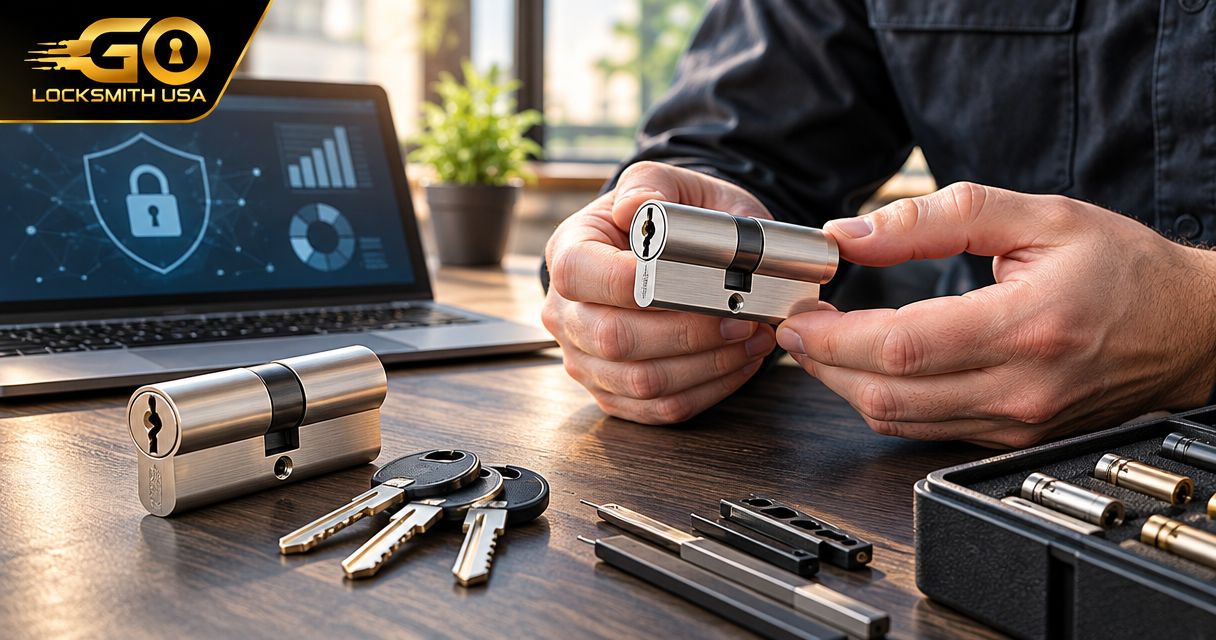
Choose a high-security lock cylinder by confirming it fits your existing hardware, checking documented security testing, and deciding how replacement keys will be controlled. The right cylinder must work with the whole door—not just resist manipulation at the keyhole. This guide explains what to verify before you approve a replacement.
TL;DR
- How to choose a high security cylinder: verify hardware fit, documented attack resistance, and replacement-key controls.
- UL 437 addresses key-lock security; verify the exact model and listing rather than relying on advertising.
- Restricted keys control duplication, but restrictions alone do not prove resistance to physical attack.
- GO Locksmith provides mechanical lock replacement and rekey services; confirm suitability for your specific hardware before booking.
Why this matters
A cylinder upgrade addresses only part of an entrance. A damaged frame, loose strike, worn lock body, or poorly closing door can remain a security problem after you change the keyed component.
Start by deciding whether you need stronger protection, better control over copied keys, or a repair. If the existing hardware is otherwise suitable, replacing just the lock cylinder is a question worth asking before replacing the complete lock.
Choose for the problem you actually have. Lost keys, unauthorized copies, a sticking mechanism, and damaged hardware call for different decisions.
How do you choose a high-security lock cylinder?
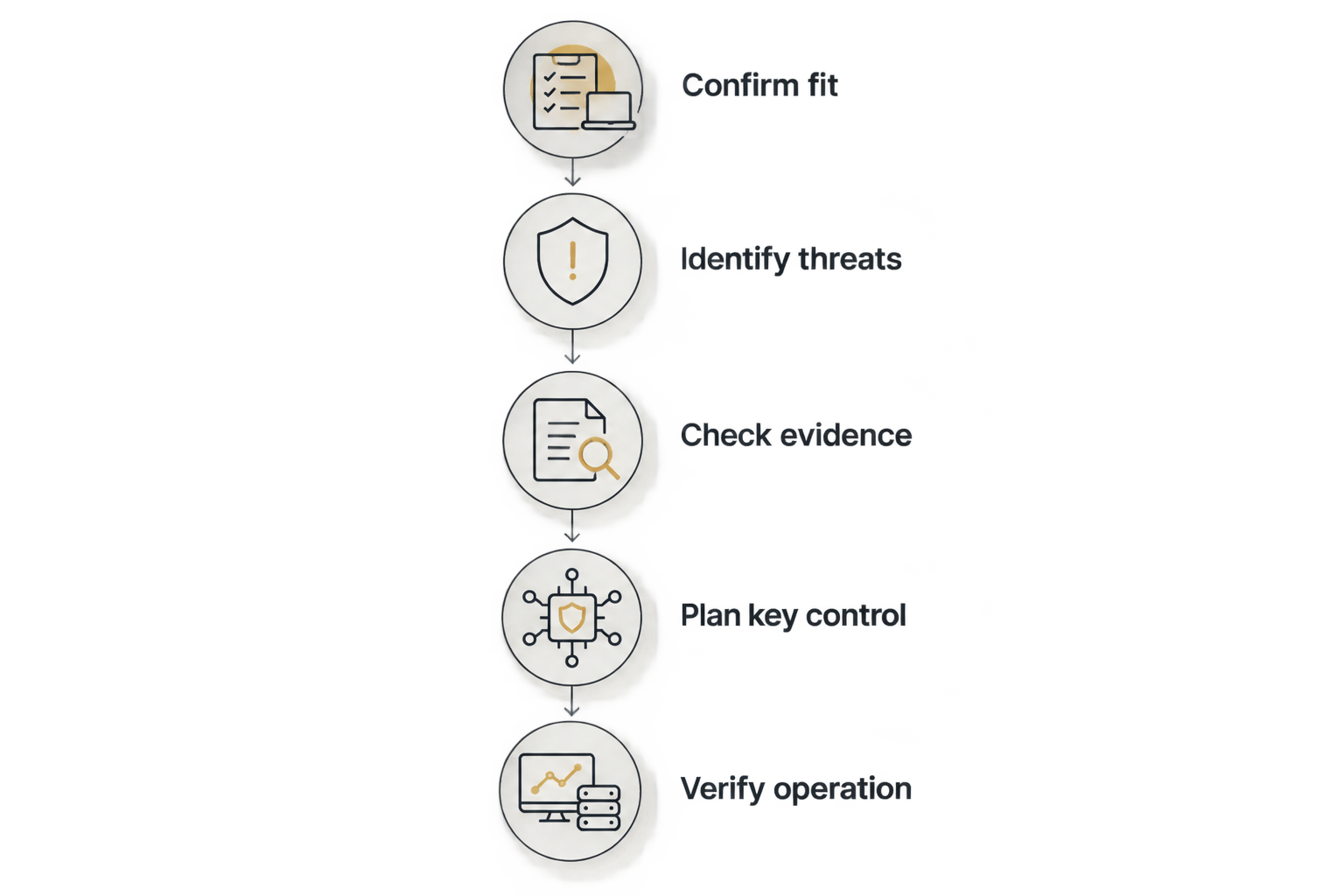
Use this sequence before selecting a particular model. Each step rules out a different kind of unsuitable purchase.
- Confirm fit. Identify the lock manufacturer, model, cylinder format, and connection to the locking mechanism. Similar-looking cylinders are not automatically interchangeable.
- Identify threats. Decide whether your priority is unauthorized key copying, manipulation resistance, physical attack resistance, or a combination. Do not assume a single feature addresses everything.
- Check evidence. Ask for documentation covering the exact cylinder model and configuration. A security claim for a product family does not establish that every version has the same protection.
- Plan key control. Establish who can authorize duplicates, where keys can be obtained, and what happens when an authorized person leaves.
- Verify operation. Confirm that the proposed change preserves proper locking, unlocking, and required exit operation. Include the surrounding door hardware in the decision.
Confirm compatibility before comparing security claims.
Ask for the proposed model in writing. That gives you something specific to compare with the manufacturer’s documentation instead of relying on a general description such as commercial grade or high security.
Compare cylinder formats before security features
Cylinder format describes how the component fits and operates within the lock. It is not a security ranking. The correct format depends on the existing hardware unless you plan to replace that hardware too.
| Cylinder format | Best for | Practical advantage | Limitation to check |
|---|---|---|---|
| Key-in-knob or key-in-lever cylinder | Compatible knob and lever hardware | Allows cylinder work within a compatible lockset | Body dimensions and operating connections vary |
| Mortise cylinder | Lock hardware designed for a threaded cylinder | Can permit cylinder replacement while retaining compatible hardware | Length, cam, and installation requirements must match |
| Rim cylinder | Compatible surface-mounted locking hardware | Operates the lock through a connecting tailpiece | Tailpiece and mounting arrangement must suit the lock |
| Interchangeable core | Compatible hardware where planned core changes are useful | Supports core changes using the system’s authorized control method | Core formats and control systems are not universally compatible |
| Profile cylinder | Hardware designed around the matching profile | Provides a replaceable keyed component in that hardware family | Profile, length, and operating configuration must match |
No cylinder format wins on security by itself. Compare documented protection only after you have established which format your door accepts.
What counts as evidence of high security?
Look for an identifiable standard, an exact model designation, and documentation explaining the certification or test claim. Words such as premium, hardened, and anti-pick are not substitutes for that evidence.
UL 437 is a published standard for key locks that addresses security performance. When a seller cites it, verify whether the exact product is listed and whether the proposed configuration matches the documentation. Do not treat the presence of a standard number in an advertisement as verification.
Keep these distinctions clear:
- Cylinder testing versus complete-lock testing: A result for a complete lock is not automatically a separate certification of every replacement cylinder.
- Attack resistance versus durability: Resistance to manipulation or destructive attack answers a different question from repeated-use performance.
- Tested configuration versus optional features: Protective components can be part of the configuration supporting a claim. Ask what the proposed installation includes.
- Certification versus description: A manufacturer’s feature description and an independently verified listing provide different kinds of evidence.
No lock is attack-proof. Testing gives you a defined basis for comparison, not a promise that a door cannot be defeated under any circumstances.
Restricted keys and attack resistance solve different problems
A restricted key system concerns control over access to key blanks and authorized duplication. Attack resistance concerns how the cylinder withstands attempts to manipulate or physically defeat it. A product can emphasize either feature, so ask about both separately.
A key stamped with a duplication warning does not, by itself, establish a controlled duplication system. Ask what actually prevents an unauthorized person from obtaining a working copy and who checks the authorization.
Before choosing a restricted system, clarify:
- Who is registered to authorize additional keys?
- What documentation is required for an order?
- Which authorized providers can supply replacement keys?
- How can authorization transfer when a property changes hands?
- What happens if the authorization record or credentials are lost?
The benefit is more deliberate key distribution. The trade-off is a more controlled replacement process, which you need to understand before an urgent need arises. Read more about duplicating a restricted high-security key before committing to that arrangement.
Keep a record of who receives each key. Even a carefully controlled key system needs a practical response when a key is lost or an authorized holder no longer needs access.
Why the right cylinder varies by door
The same cylinder is not the right choice for every entrance. These factors determine whether a proposed upgrade makes sense:
- Existing lock hardware: The cylinder must match the lock’s physical requirements and operating connection. Exterior appearance alone cannot establish compatibility.
- Door and frame condition: Misalignment, damage, and loose hardware need attention alongside the cylinder. A new keyed component does not repair the surrounding opening.
- Key distribution: A household and a workplace with changing keyholders have different authorization needs. Choose controls you can maintain consistently.
- Exposure: Check the manufacturer’s suitability guidance for the actual location, including outdoor or coastal exposure where relevant. A decorative finish does not establish corrosion resistance.
- Exit requirements: Changes must preserve the door’s required operation. Commercial exits, fire-rated openings, and other regulated doors need particular care.
- Future maintenance: Understand how rekeying, replacement keys, and compatible parts will be handled. A selection should remain manageable after installation.
For a Southwest Florida property, discuss the actual entrance rather than assuming every exterior door has the same exposure. A covered residential entry and a directly exposed business entrance present different conditions.
Should you rekey, replace the cylinder, or replace the lock?
Rekey when the problem is who has a working key; consider replacement when the problem is hardware condition or the protection you need. Rekeying normally changes which key operates a compatible lock without upgrading the underlying hardware’s attack resistance.
| Option | Best for | Main advantage | Main limitation |
|---|---|---|---|
| Rekey existing hardware | Changing access when suitable hardware remains in good condition | Retains the existing lock while changing the working key | Does not correct damaged hardware or create a different security design |
| Replace the cylinder | Changing the keyed component when the lock body remains suitable | Retains compatible surrounding hardware | Depends on compatibility and does not resolve other door defects |
| Replace the complete lock | Worn, damaged, unsuitable, or incompatible lock hardware | Allows the complete lock assembly to be reconsidered | Still requires attention to the door, frame, and installation |
Do not approve a cylinder upgrade solely because a key turns roughly. Describe the symptom and have the cause assessed. Wear, damage, alignment, and key condition are different issues; a replacement recommendation should explain which issue it addresses.
What should you ask before approving the work?
Request a clear description of the proposed work, not just a product label. A useful discussion covers the exact cylinder, compatible hardware, key arrangements, and anything outside the replacement scope.
Ask these questions:
- What exact cylinder model and configuration are proposed?
- What documentation supports its security claims?
- Will the existing lock body and trim remain?
- Are there door or strike issues that cylinder replacement will not fix?
- How will additional keys and future rekeying be handled?
- Does the proposed change preserve required exit operation?
For a job-specific estimate, describe the door, explain your concern, and provide any visible manufacturer or model information. Photographs can help communicate the hardware type, but they do not replace verification of fit.
GO Locksmith is a mobile locksmith service for homeowners and businesses needing mechanical lock repair, replacement, or rekeying. Its confirmed Southwest Florida service areas include Fort Myers, Cape Coral, Lehigh Acres, Estero, Bonita Springs, and Naples. Ask GO Locksmith to confirm the proposed cylinder and job scope rather than assuming a particular high-security system is supported.
Does a high-security cylinder make the whole door secure?
A high-security cylinder protects only part of the door assembly. It does not strengthen a damaged frame, correct a loose strike, or make an unsuitable lock body appropriate for the opening.
Check that the door closes and latches normally before treating a cylinder purchase as the complete solution. If you need to lift, pull, or force the door to operate the lock, describe that problem during the assessment.
Can a high-security cylinder work with your existing keys?
A high-security cylinder can use existing keys only when the proposed system and key are compatible. Keeping the same key should not be assumed, especially when changing to a different or restricted keyway.
If keeping several doors on one key matters, state that requirement before selecting the cylinder. Compatibility needs to be considered across all affected locks, not just the first entrance.
FAQ
What's the most important check when choosing a high-security cylinder?
Confirm compatibility with the existing lock before comparing security features. The cylinder format, dimensions, and operating connection must match the hardware.
Does a restricted key mean the cylinder is high security?
A restricted key system does not, by itself, establish the cylinder’s resistance to attack. Check duplication controls and documented security testing separately.
Is a high-security cylinder better than rekeying?
Cylinder replacement and rekeying address different needs. Rekeying changes which key works; a replacement can change the cylinder’s design or key system when compatible with the lock.
Can I keep my existing deadbolt when replacing its cylinder?
You can retain an existing deadbolt only if it accepts a suitable replacement cylinder and the remaining hardware is appropriate. Have the exact lock and proposed component checked before purchasing.
Will a high-security cylinder stop forced entry?
A high-security cylinder does not guarantee protection against forced entry. The complete lock, door, frame, strike, and installation also affect the entrance’s resistance.
How much does a high-security cylinder installation cost?
The estimate depends on the cylinder, existing hardware, and work required. Call GO Locksmith at (239) 412-1101 for a job-specific estimate and confirmation that the requested work is supported.
Should a commercial exit door need a key to open from inside?
Do not change an exit door’s inside operation without confirming the applicable requirements. The appropriate arrangement depends on the opening, occupancy, and governing code.
One last thing
Ask what happens when you lose a key—not just what happens during an attack. Knowing who can authorize a replacement and how access will be restored is part of choosing a usable security system.
For mechanical lock replacement or rekeying, call GO Locksmith at (239) 412-1101 to discuss your hardware and request an estimate. Hours are Sunday–Thursday, 7:00 AM–11:00 PM, and Friday, 7:00 AM–4:00 PM; Saturday is closed. Confirm current availability when you call.