
Blog ·
Can a locksmith duplicate a restricted high-security key?
Yes—a locksmith can duplicate a restricted high-security key when the locksmith has access to that key system and the required authorization. Possessing a working key does not automatically authorize another copy, and some systems direct requests through a designated dealer or the organization that controls the keys.
TL;DR
- Can a locksmith duplicate a restricted high-security key? Yes, subject to system access and authorization.
- A key marked Do Not Duplicate is not necessarily a restricted-key system.
- Ask the property’s key administrator which provider can supply an authorized copy.
- GO Locksmith offers residential and commercial lock services; confirm restricted-key capability before requesting service.
Why this matters
A restricted key involves more than finding a machine that can reproduce its cuts. The provider must identify the system, obtain the correct blank through the appropriate channel, and follow that system’s authorization requirements.
If you need help with a door rather than an extra key, describe that separately. GO Locksmith’s confirmed locksmith services include residential and commercial lock repair, replacement, and rekeying, but restricted-key duplication requires a separate capability check.
Can a locksmith duplicate a restricted high-security key?
Yes, but not every locksmith can duplicate every restricted key. The answer depends on the exact key system, the provider’s access to its blanks and equipment, and permission from whoever controls additional copies.
High-security construction and restricted duplication are related but different features. A lock can have security features intended to resist physical attack, while its key system separately controls who can obtain blanks or order copies. Do not assume the key’s appearance establishes either feature.
Your next step also depends on the problem you are trying to solve:
| Option | Best for | What it accomplishes | Main limitation |
|---|---|---|---|
| Authorized duplicate | Adding a permitted spare | Produces another working key without changing access | Requires access to the system and its approval process |
| Rekeying, where supported | Making an unreturned key stop working | Changes the lock’s keying while retaining suitable hardware | Depends on the cylinder, system, and authority to change it |
| Lock or cylinder replacement | Addressing unsuitable or unsupported hardware | Changes the relevant hardware and keying arrangement | Requires checking door compatibility and any shared-key arrangements |
An extra copy solves a shortage of keys. It does not solve the security problem created by a missing key that still opens the door.
How do you request an authorized duplicate?
Start with identification and permission, not a trip to a key-cutting counter. These steps help you establish whether duplication is possible before arranging service.
Identify the system
Look for the manufacturer’s name and any system designation on the key, lock, original paperwork, or key-control documents. Describe the markings to the provider rather than assuming that a thick key, unusual groove, or plastic head means it is restricted.
Avoid posting clear photographs of the key’s cuts or identifying codes publicly. If a provider requests photographs, ask what information is needed and how to send it directly.
Confirm authority
Find out who approves additional keys. Depending on the property and system, that could be the owner, property manager, employer, association, or another designated administrator.
A tenant or employee can legitimately possess a key without having permission to order copies. Ask the administrator what approval is required before submitting a request.
Confirm provider access
Ask whether the provider handles the exact system—not simply whether it cuts high-security keys. A locksmith’s general key-cutting capability does not establish access to a particular restricted blank.
Some requests must go through the original supplying dealer or a designated provider. If that applies, ask the administrator to identify the correct channel rather than contacting unrelated shops repeatedly.
Confirm requirements
Ask what you must supply before the order can proceed. Depending on the system, requirements can include identification, written permission, a security card, an account reference, or approval from a registered signatory.
Do not treat that list as a universal checklist. The provider should confirm which documents apply to your particular key.
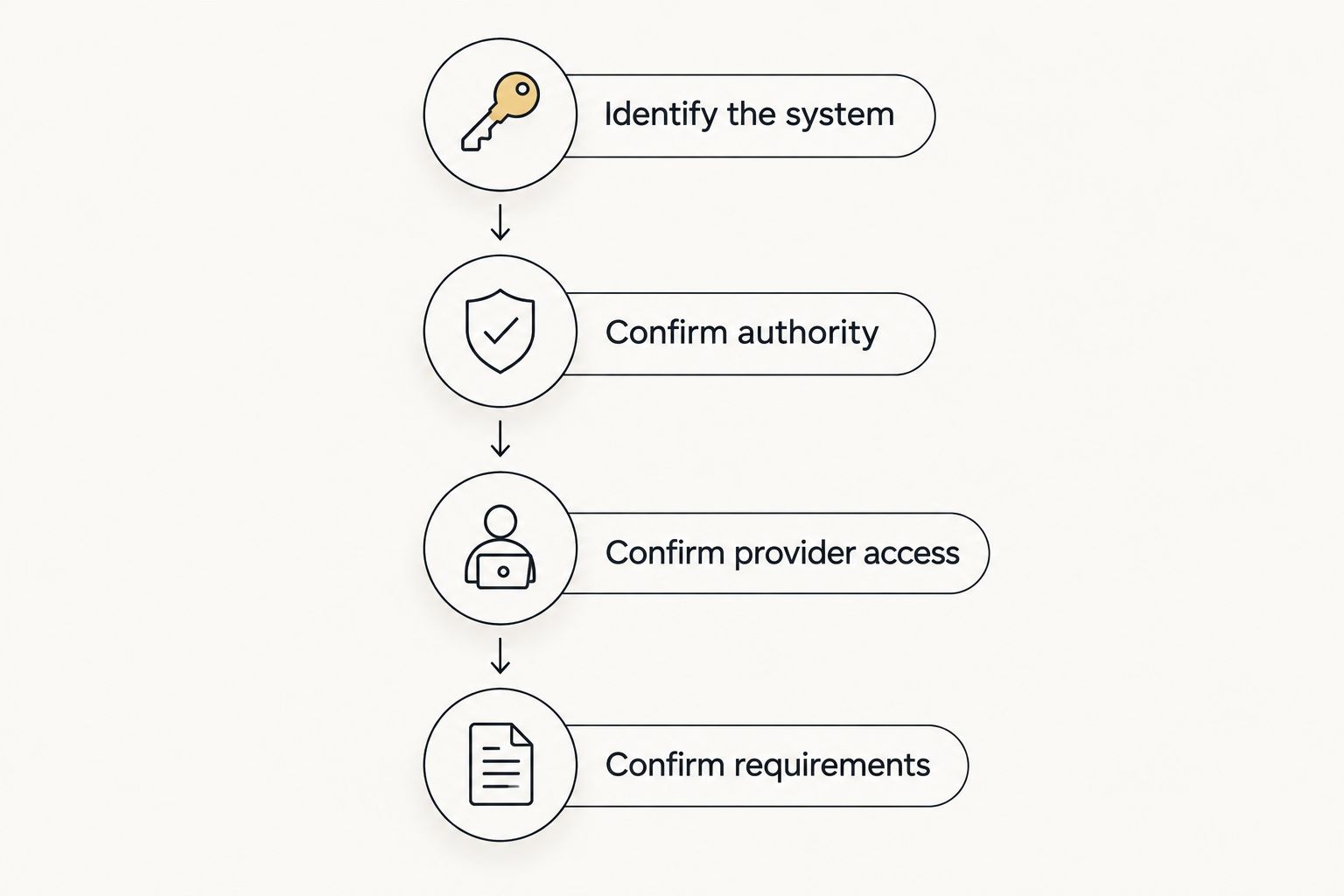
Identify the system and approval route before arranging key cutting.
Restricted keys: permission and supply both matter
A restricted key system limits access to compatible blanks or controls how additional keys are supplied. The exact restriction depends on the manufacturer, system, and distribution arrangement.
Authorization alone does not mean any shop can make the key. A willing property owner still needs a provider with the correct access and equipment. Equally, access to equipment does not remove the need to follow the system’s authorization rules.
For a managed building, start with the person responsible for its key records. That avoids ordering through a provider who cannot fulfill the request or requesting a key you are not authorized to receive.
High-security keys: identify the exact system
“High-security” does not describe a single key shape or universal copying process. Different systems use different key designs, cylinder mechanisms, and duplication controls.
Ask the provider to assess the actual system rather than promise compatibility from a general description. A key that looks similar to another key is not proof that the same blank or cutting process will work.
If the key operates several doors, explain that when requesting assistance. The provider needs to understand the intended access before considering a duplicate, rekey, or replacement.
Keys marked Do Not Duplicate: check what the marking means
A Do Not Duplicate stamp is not proof that a key belongs to a restricted system. The marking communicates a copying restriction, but it does not by itself identify the blank’s distribution controls or the lock’s security features.
Do not remove or conceal the marking to obtain a copy. Ask the owner or administrator whether another key is permitted and which provider should handle it.
Avoid assuming that every such stamp creates the same legal rule. The property’s authorization policy, the key system’s requirements, and applicable law are separate questions.
Why restricted-key duplication requirements vary
Several details determine the correct route. Give the provider the information you have rather than guessing at compatibility.
- Exact system: The manufacturer and key system determine which blanks and equipment are appropriate.
- Supply arrangement: The system can limit which providers obtain blanks or fulfill orders.
- Authorization records: The registered owner or administrator determines who can approve additional keys under the arrangement.
- Available documentation: Missing records or approval documents must be addressed through the relevant administrator or provider.
- Access scope: A key for a private door and a key that operates shared doors raise different permission questions.
- Reason for the request: An additional spare, a lost key, and a damaged lock call for different decisions.
These factors also affect the estimate. Ask for a job-specific explanation of what is required instead of assuming restricted duplication follows ordinary spare-key pricing.
What if you have lost the security card?
Contact the person or organization that administers the key system. Ask the designated provider what verification or replacement-document process applies; do not assume a photograph of the key replaces the missing card.
A security card is not required by every restricted system, and losing one does not establish that the lock must be replaced. The system’s actual rules determine the next step.
If you recently bought the property, check the handover paperwork and ask whether key-control records transferred to you. Possessing the building’s keys and being recorded as its authorized administrator are not necessarily the same thing.
What if the key opens shared building doors?
A key that opens your unit and a shared entrance can be part of a coordinated keying arrangement. Ask the property manager or association before ordering copies or changing a cylinder.
The same caution applies to workplace keys. An employee’s replacement request should follow the employer’s approval route, especially where the key opens more than the employee’s own workspace.
Physical custody and copying permission are separate controls. Questions about key cabinet compliance requirements concern how an organization manages stored keys; cabinet storage does not replace authorization to duplicate a restricted key. Requirements discussed for an Australian real-estate setting should not be treated as Florida law.
For your own records, distinguish who holds a key from who can authorize another one. Keeping those responsibilities clear makes replacement requests easier to assess without weakening the copying policy.
Should you duplicate, rekey, or replace after a key goes missing?
If an unaccounted-for key still opens the door, making a duplicate does not remove that access. Tell the owner or administrator that the key is missing before treating the problem as a request for a spare.
Rekeying changes which key operates a suitable lock. Replacement changes the relevant hardware. Neither should be selected without checking the existing system, door hardware, and any shared access that must remain functional.
A restricted-key system also does not prevent someone from using an original key they still possess. Copy control and withdrawal of existing access solve different problems.
If the lock is damaged as well, assess that issue separately. The decision about repairing or replacing an exterior door lock concerns hardware condition, not just permission to produce another key.
What should you ask before arranging service?
Have a short conversation before requesting a visit or authorizing an order. The useful questions are specific:
- Can you handle this exact manufacturer and restricted-key system?
- Does the request need to go through a designated dealer or administrator?
- What permission and identification are required?
- Does the estimate cover the complete requested job?
- If the key is missing, should the access arrangement be reviewed instead?
GO Locksmith is a mobile locksmith service for residential and commercial lock needs in its confirmed service areas. Those include Fort Myers, Cape Coral, Lehigh Acres, Estero, Bonita Springs, and Naples. Ask about your particular restricted system before assuming a duplicate can be supplied; mobile service does not establish access to every key system.
FAQ
Can any locksmith copy a restricted high-security key?
No. A locksmith needs access to the exact key system, suitable equipment, and the authorization required for that system. Some requests must go through a designated provider.
Can I get a restricted key copied if I already have the original?
Having the original does not automatically authorize a duplicate. Ask the system administrator which approval documents and provider are required.
Is a Do Not Duplicate key always a restricted key?
No. A Do Not Duplicate marking alone does not establish that compatible blanks are restricted or that the lock is high-security. Identify the actual system before requesting a copy.
Can a tenant order another restricted apartment key?
A tenant should ask the landlord or property manager for the approved process. Permission to use a key does not necessarily include permission to order additional copies.
Do I need a security card to copy a restricted key?
That depends on the key system. Some systems use security cards, while others use different authorization records; ask the designated provider what applies.
How much does restricted-key duplication cost?
Restricted-key duplication requires a job-specific estimate based on the system and the work required. Confirm authorization and provider access before requesting an estimate.
Will making a new key stop a lost key from working?
No. Making another copy does not invalidate the lost key. Ask the authorized administrator or provider whether rekeying or replacement is appropriate.
Does GO Locksmith duplicate every restricted key system?
Restricted-key compatibility must be confirmed before service is arranged. Call with the manufacturer and system details rather than assuming every restricted key can be duplicated.
One last thing
Before ordering a spare, ask yourself whether you need another working key or fewer working keys in circulation. Duplication addresses the first problem; reviewing the lock’s keying addresses the second.
For residential or commercial lock assistance, call GO Locksmith at (239) 412-1101 to discuss the job and check availability. Hours are Sunday–Thursday, 7:00 AM–11:00 PM, and Friday, 7:00 AM–5:00 PM; Saturday is closed. Confirm restricted-key capability and request an estimate before arranging service.