
Blog ·
Is it better to repair or replace an exterior door lock?
Repair an exterior door lock when the problem is limited and the remaining hardware is sound; replace it when damage or wear prevents dependable locking. If the lock works properly but you need to stop an old key from opening it, consider rekeying instead. Before choosing, check whether the problem is actually the lock or the way the door meets the frame.
TL;DR
- To repair or replace exterior door lock hardware, first separate lock damage from door-alignment problems.
- Repair suits a serviceable lock with an isolated fault; replacement suits damaged or unreliable hardware.
- Rekeying changes which key operates a compatible lock; it does not fix worn hardware.
- GO Locksmith offers mobile residential lock repair, replacement, and rekeying in confirmed Southwest Florida service areas.
Is it better to repair or replace an exterior door lock?
Repair makes sense when it restores reliable operation without leaving damaged components in service. Replacement makes sense when the existing hardware cannot provide that result. A difficult key turn alone does not establish which option you need.
GO Locksmith provides mobile exterior door lock repair, replacement, and rekeying for homeowners in Fort Myers and surrounding confirmed service areas.
| Option | Best for | Main advantage | Main limitation |
|---|---|---|---|
| Repair | An isolated fault in otherwise serviceable hardware | Keeps usable hardware in place | Does not resolve unrelated wear or damage |
| Replacement | A damaged mechanism or unsuitable existing lock | Removes the failed hardware | Requires a suitable fit for the door |
| Rekeying | Working hardware when old keys should stop working | Changes key access while retaining compatible hardware | Does not repair a mechanical fault |
The distinction matters because a lock has several jobs: accepting the correct key, moving its mechanism, and securing the door against the frame. A problem with one job does not automatically mean the entire lock needs replacing.
Why this matters before you buy another lock
A new lock is not a cure for every sticking door. If the bolt meets the edge of the strike opening instead of entering it, replacing the cylinder alone leaves the underlying alignment problem unresolved.
The reverse is also true. Adjusting a door does not restore a cracked lock body or a mechanism that no longer retracts reliably. Identify the failed part before deciding what to keep.
Think about access separately, too. Repairing a stiff lock does not automatically invalidate a missing key, and changing the key does not make damaged hardware sound.
When repairing the exterior door lock makes sense
Best for: a specific, correctable fault in hardware that remains suitable for the door. Repair is a reasonable choice when inspection identifies a limited problem rather than widespread deterioration.
Loose mounting hardware, a serviceable component that needs attention, or interference at the strike can produce symptoms that resemble complete lock failure. The appropriate correction depends on the lock's construction and the condition of the surrounding door.
Signs that support investigating repair include:
- The hardware is intact, without visible cracking or distortion.
- The problem has an identifiable cause rather than unexplained repeated failures.
- The lock operates normally when the door is open but binds when closed.
- The existing lock still meets your needs once the fault is corrected.
Repair has limits. A working key turn after an adjustment is not enough if the bolt still fails to engage the strike properly. Ask what caused the fault and how the proposed repair addresses it.
For a closer look at sticking mechanisms, read about fixing a jammed lock without replacing it. A jam is a symptom, not a diagnosis.
When replacing the exterior door lock makes sense
Best for: damaged, persistently unreliable, or unsuitable hardware. Replacement is the appropriate direction when retaining the existing mechanism would leave the door difficult to secure or operate.
Visible damage deserves particular attention. A bent bolt, cracked housing, or distorted mounting area needs assessment rather than repeated attempts to force the key. After attempted forced entry, inspect the door and frame as well as the lock.
Replacement also makes sense when the required repair parts cannot be obtained for the existing hardware. That does not mean every older lock needs replacement; the decision depends on its condition and serviceability.
Before choosing replacement hardware, confirm:
- It fits the door's thickness and existing preparation.
- Its latch or bolt is compatible with the door configuration.
- The strike and frame can support correct engagement.
- The operating function suits the entrance and its occupants.
A replacement lock must work as part of the whole doorway. On a commercial entrance or a labeled fire-rated door, hardware selection also requires attention to applicable opening and exit requirements. Do not substitute hardware based only on appearance.
When rekeying is the better answer
Best for: a mechanically sound, compatible lock when you want different keys to work. Rekeying changes the lock's keying rather than replacing the entire assembly.
This distinction is useful after moving into a home or losing track of who holds copies. If the mechanism works correctly and the hardware remains suitable, the access concern does not by itself establish a need for full replacement.
Rekeying is not a repair for a worn latch, damaged bolt, or misaligned door. A lock with both mechanical and key-access problems needs both concerns addressed.
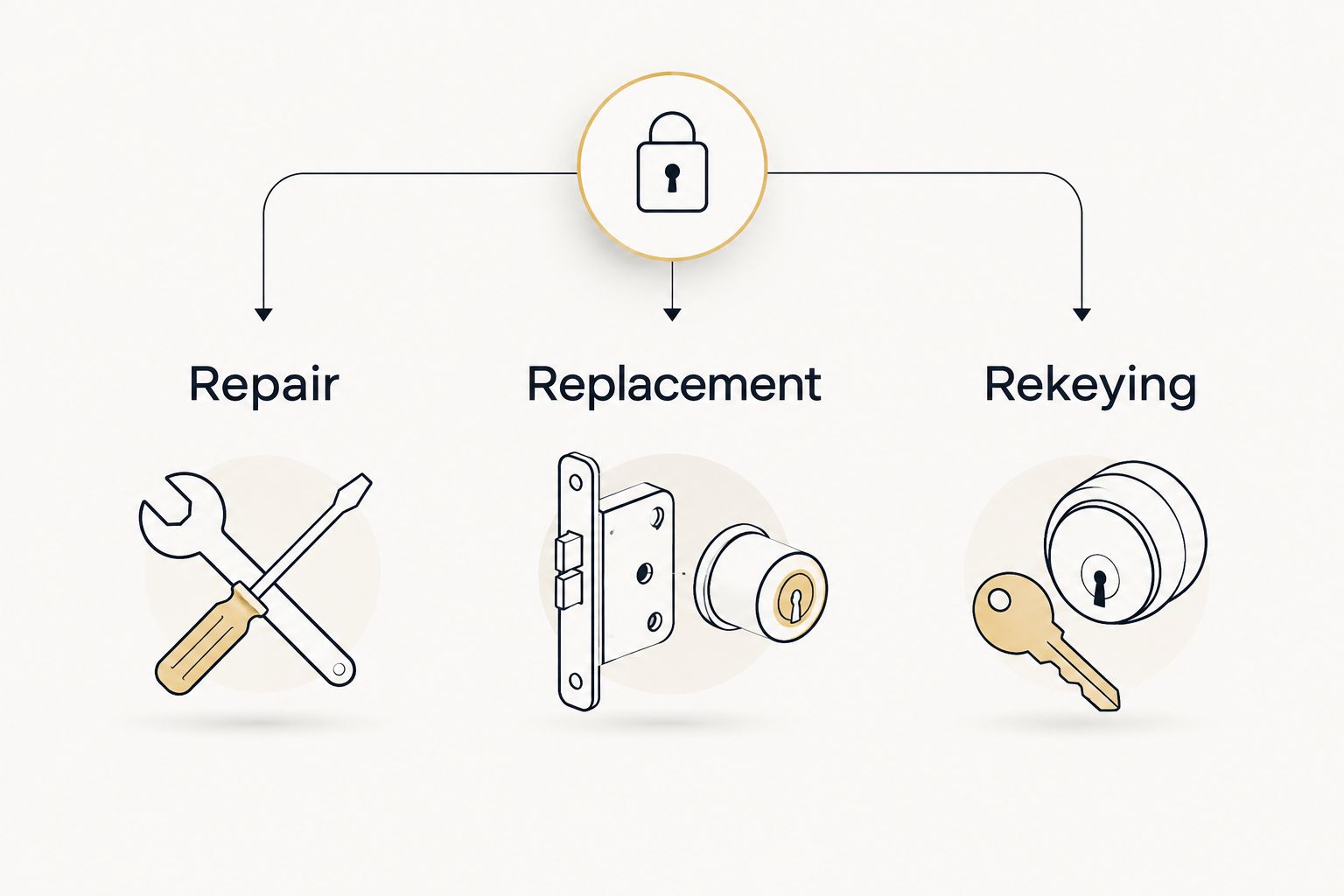
Choose according to hardware condition and key access, not the symptom alone.
What changes the repair-or-replacement decision?
The decision depends on the failed component, the condition of the remaining hardware, and whether the proposed work solves the actual problem.
- Mechanical condition: A sound assembly with a limited fault is different from hardware with multiple damaged components.
- Door alignment: Binding between the bolt and strike can make a working mechanism feel defective.
- Evidence of forced entry: Damage can extend beyond the visible lock into its mounting points or frame.
- Parts and compatibility: A repair requires suitable components; replacement requires hardware that fits the opening.
- Key control: Missing or unaccounted-for keys create an access concern even when the lock works smoothly.
- Exposure and corrosion: Exterior hardware needs inspection for deterioration that affects movement, attachment, or strength.
Age alone is not a diagnosis. Describe what the lock does, what changed, and whether the symptom occurs with the door open or closed. Those details are more useful than guessing how long the lock should last.
What can you check without taking the lock apart?
If you have authorized access and can safely keep the door open, a few observations help explain the problem. These are checks, not instructions to dismantle or bypass the lock.
- Look for damage. Check for an obviously bent key, loose hardware, cracking, or signs of force. Stop using a key that appears damaged.
- Observe open-door operation. With the door secured open, gently operate the lock normally. Do not force resistance or close the door with the bolt extended.
- Compare closed-door operation. If the lock works open but binds closed, describe that difference when requesting service. It points attention toward the door-and-strike relationship, without proving the exact cause.
- Describe key behavior. Note whether the key fails to enter, turns with resistance, or turns without moving the bolt. These are different symptoms.
- Explain recent changes. Mention a move, missing key, impact, attempted entry, or a problem that began after other door work.
Avoid filing hardware, drilling new holes, or applying an unspecified lubricant as a trial fix. Follow the lock manufacturer's maintenance instructions, and leave uncertain adjustments to someone familiar with the hardware.
If the door cannot be secured, explain that clearly when calling. If you are locked outside, do not attempt these checks through a closed door or force entry.
Should you replace a lock that only sticks when the door is closed?
A lock that sticks only when the door is closed needs an alignment assessment before replacement. The bolt or latch can meet resistance at the strike even though the mechanism moves normally with the door open.
That observation narrows the investigation; it does not prove that the lock is undamaged. Ask for the door, strike, and mechanism to be checked together rather than treating them as unrelated parts.
Do you need a new lock after losing a house key?
A lost house key creates a key-access problem, not automatic proof of hardware failure. Rekeying a suitable, working lock can prevent the old key from operating it without replacing the complete assembly.
Replacement becomes a separate consideration if the lock is damaged or no longer appropriate for the door. Tell the locksmith about both the missing key and any existing operating problems.
What should you ask before authorizing the work?
Ask for a job-specific estimate and a plain explanation of the proposed scope. A useful explanation connects the observed fault to the recommended repair, replacement, or rekeying.
Questions to ask include:
- Which component is causing the problem?
- Is the door or strike contributing to the resistance?
- What would remain in place after a repair?
- If replacement is recommended, why is repair unsuitable?
- Will the old key still work afterward?
- Does the estimate include all work being proposed for this door?
Do not compare descriptions that cover different work as though they are equivalent. Repairing the mechanism, replacing the hardware, and changing key access solve different problems.
GO Locksmith offers mobile residential lock repair, replacement, and rekeying in Fort Myers, Cape Coral, Lehigh Acres, Estero, Bonita Springs, and Naples. Call (239) 412-1101 for a job-specific estimate and to check current availability.
FAQ
How do I know whether to repair or replace my exterior door lock?
Repair suits an isolated, correctable fault in otherwise serviceable hardware; replacement suits damage or failure that prevents dependable operation. Have the door alignment and strike checked before assuming the lock itself has failed.
Can a sticking deadbolt be repaired?
A sticking deadbolt can be repairable, depending on the cause and condition of the hardware. Resistance caused by contact with the strike requires a different correction from a damaged internal mechanism.
Does rekeying fix a broken exterior door lock?
Rekeying does not fix a broken exterior door lock. It changes which key operates compatible hardware, so mechanical damage needs separate attention.
Should I replace my lock after someone tries to break in?
Have the lock, door, strike, and frame assessed after attempted forced entry. Damaged hardware needs repair or replacement according to its condition; a key that still turns does not establish that the doorway is sound.
Can I use any replacement deadbolt on my front door?
A replacement deadbolt must fit the door and suit the opening. Door thickness, existing preparation, strike alignment, and the required operating function affect the choice.
Should I keep forcing a key that is hard to turn?
Do not force a key that meets unusual resistance. Stop and have the cause checked, especially if the key is bent or the lock shows damage.
Does GO Locksmith provide exterior door lock repair at my home?
GO Locksmith is a mobile service offering residential lock repair, replacement, and rekeying in confirmed service areas. Call (239) 412-1101 to discuss your location, describe the lock problem, and check availability.
One last thing: check the result at the door
A smooth key turn is only part of a successful job. Before considering the work complete, confirm that the door closes normally, the bolt engages properly, and you can lock and unlock the entrance without unusual force.
Ask what changed and whether the old keys still work. That final question separates a mechanical repair from a change in access—and prevents an important misunderstanding.