
Blog ·
Does a commercial building need a push bar by fire code?
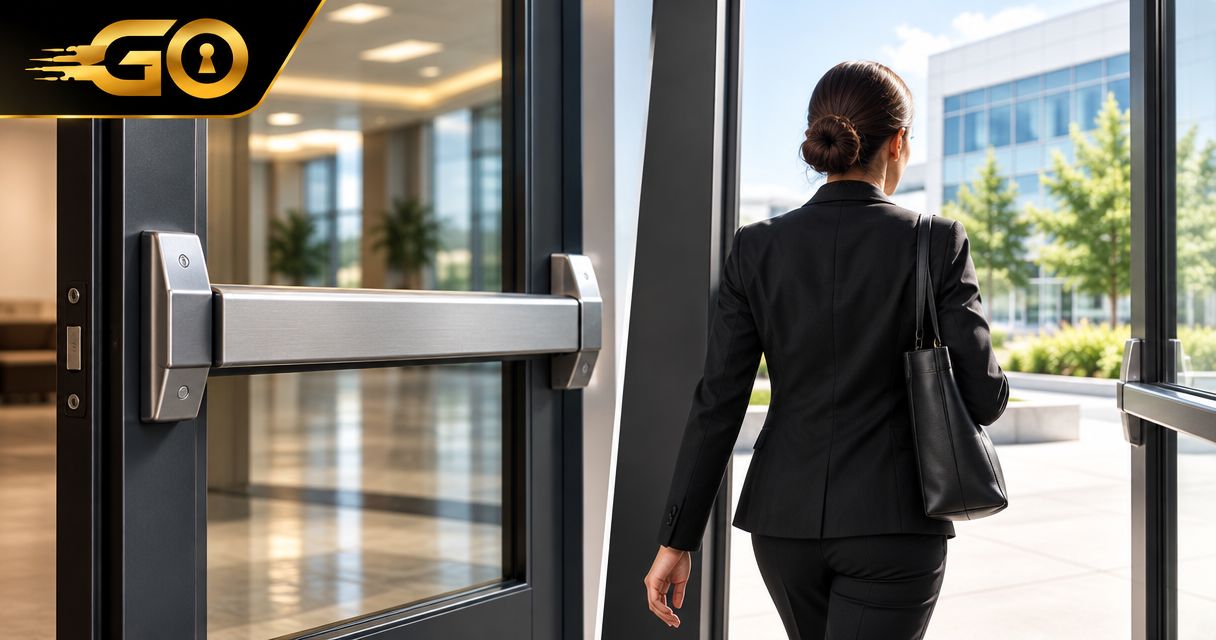
Not every commercial building needs a push bar by fire code. The requirement depends on the building’s occupancy classification, the occupant load served by the door, the door’s role in the exit route, and the applicable building and fire codes; a fire-rated opening also needs hardware suited to that rated assembly.
TL;DR
- Does a commercial building need a push bar by fire code? Not always; occupancy and occupant load determine requirements.
- International Building Code provisions generally require panic hardware for certain assembly and educational doors serving 50 or more occupants.
- Fire-rated doors requiring panic operation need listed fire exit hardware, not ordinary panic hardware.
- GO Locksmith provides mobile commercial locksmith services, including push bars and door closers, in Southwest Florida.
Does a commercial building need a push bar by fire code?
A commercial address alone does not trigger a push bar requirement. The code evaluates the use of the space and the people who must pass through the door, not simply whether a business occupies the building.
For mechanical lock and door-hardware service, GO Locksmith serves businesses as a mobile locksmith. The local building department or fire prevention authority determines which code requirements apply to your particular opening.
The following distinctions explain why a restaurant exit and a small office door can require different hardware:
| Door or space | General code direction | What you need to verify |
|---|---|---|
| Assembly or educational door serving 50 or more occupants | International Building Code provisions generally require panic or fire exit hardware where the door has a lock or latch, subject to applicable exceptions | Occupancy classification, served occupant load, and adopted provisions |
| High-hazard occupancy | Panic or fire exit hardware requirements apply under International Building Code provisions without the same assembly occupant-load threshold | Hazard classification and the particular door |
| Ordinary business office | Business occupancy alone does not automatically require panic hardware | Egress operation, door function, and any other applicable requirements |
| Fire-rated door requiring panic operation | Listed fire exit hardware is needed | Door and frame labels, hardware listing, and assembly compatibility |
| Door serving certain electrical equipment rooms | Separate electrical and building-code provisions can require panic hardware | Equipment characteristics, room arrangement, and applicable electrical rules |
These are screening rules, not approval for a particular door. Exceptions, existing-building provisions, and overlapping code requirements affect the final determination.
Why this matters before you replace a lock
A lock that keeps unauthorized people out must not create an unlawful barrier for people leaving. Installing a stronger lock does not resolve an exit-hardware problem, and adding a push bar does not establish that the whole doorway complies.
The door’s swing, clear opening, latch operation, closer, and surrounding exit route all matter. A correctly selected device on a damaged or improperly configured opening still leaves a problem to address.
Confirm the required exit function before choosing replacement hardware. That prevents you from treating a life-safety requirement as an ordinary lock upgrade.
Which occupant-load threshold applies in Florida?
Florida buildings are subject to both the Florida Building Code and the Florida Fire Prevention Code. The latter incorporates NFPA requirements, including NFPA 101, Life Safety Code, with Florida amendments. Building and fire requirements must be considered together.
International Building Code provisions generally use 50 occupants as the panic-hardware threshold for relevant assembly and educational doors. NFPA 101 assembly-occupancy provisions generally use 100 occupants for specified egress doors with latches or locks.
Those figures are not interchangeable permissions. A building-code requirement does not disappear because a separate fire-code provision has a higher threshold.
Count the occupants served by the door
The relevant number is not necessarily your staff count or the number of people present when you inspect the doorway. Code occupant load depends on the approved use and layout, and a door can serve people from more than one space.
Ask for the occupant load assigned to the space and the load served by the opening. A posted capacity sign helps identify approved information, but it does not explain every door’s required hardware.
Confirm the occupancy classification
A restaurant, classroom, retail space, and office do not automatically fall under identical rules. Some small gathering spaces are classified differently under applicable code provisions, so the everyday business description is not enough.
Ask the building department or fire prevention authority to confirm the classification. Do not select a threshold solely because customers gather in the room or because the lease calls it commercial space.
Panic hardware and fire exit hardware are different
A push bar is a common description of a device you press to release a door latch. For code purposes, the device’s listing and function matter more than its appearance.
| Hardware category | Best suited for | Main benefit | Important limitation |
|---|---|---|---|
| Listed panic hardware | Non-fire-rated openings where panic hardware is required or appropriately specified | Releases the latch through pressure on the actuating device | An ordinary panic device is not a substitute for fire exit hardware on a rated opening |
| Listed fire exit hardware | Fire-rated openings requiring panic operation | Provides panic release while meeting applicable fire-exit-hardware listing requirements | Must match the rated assembly; mechanical dogging that holds the latch retracted is not permitted |
| Conventional lever and latch hardware | Openings where panic hardware is not required and the arrangement otherwise complies | Provides ordinary passage and locking functions | Does not satisfy a panic-hardware requirement merely because the lever is easy to operate |
Panic hardware is evaluated under UL 305, the standard for panic hardware. Fire exit hardware also has applicable fire-test listing requirements. A product description that says commercial or heavy duty does not establish either listing.
Check the labels and documentation rather than identifying the device by shape. A bar-shaped handle is not proof of a listed panic device.
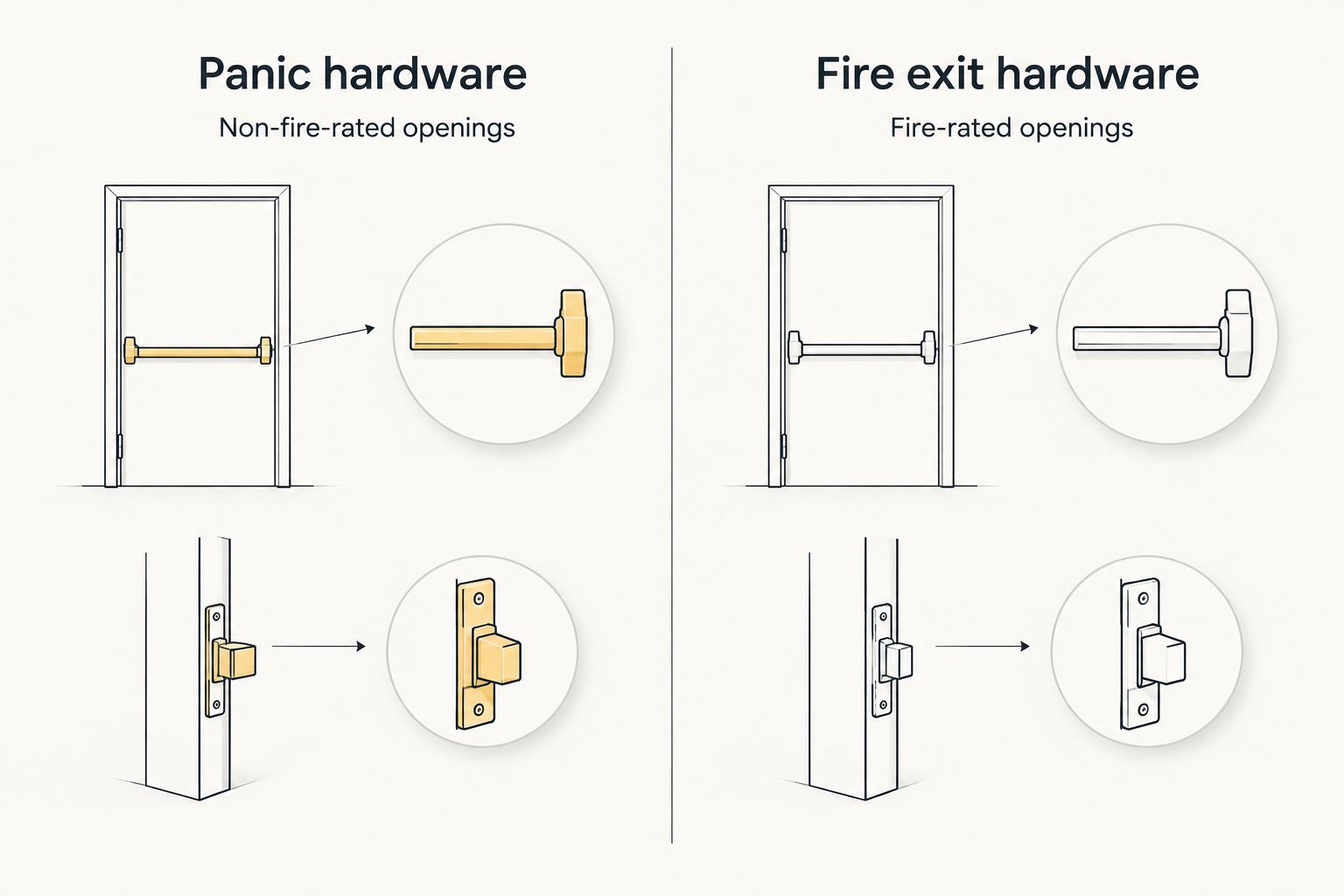
The opening’s fire rating affects which listed exit device belongs on the door.
Why push bar requirements vary between doors
The controlling factors concern the doorway and its approved use—not just the type of business on the sign.
- Occupancy classification: Assembly, educational, business, and high-hazard occupancies have different provisions.
- Occupant load: The number of occupants served by the door affects applicable thresholds.
- Exit function: A door along a required exit route must meet the requirements for its role in that route.
- Fire rating: A rated opening requires compatible listed components and appropriate latching.
- Special conditions: Certain electrical rooms and other regulated arrangements have additional requirements.
- Existing conditions and alterations: A change of use, renovation, or hardware replacement needs review under the applicable existing-building and alteration provisions.
For example, converting an office space into a gathering space can change the code analysis even when the door stays in place. Reusing the old lock is not evidence that the new use complies.
How do you confirm what your door needs?
Start with the approved building information, then connect that information to the actual opening. Do not buy hardware based only on a photograph of a similar business.
- Identify the use. Record what the space is approved for and how it is currently used. Note any recent tenant or layout changes.
- Confirm occupant load. Obtain the approved occupant-load information and ask which spaces discharge through the door.
- Document the opening. Photograph the door, frame, existing hardware, and any visible rating labels without removing components.
- Ask the authority. Contact the local building department or fire prevention authority for the applicable requirements, including any permit or inspection requirements.
- Match the hardware. Have the specified device checked against the door construction, rating, handing, frame, and existing preparation before work proceeds.
Ask for the required hardware function, not simply permission to install a push bar. That wording helps separate the code decision from the later product-selection decision.
Keep the response and relevant building records with your maintenance information. They help future managers understand why the opening has a particular arrangement.
What should you check on an existing push bar?
A push bar already on the door does not establish that it is the right device or that it works correctly. Look for visible damage, loose components, interference around the latch, and difficulty opening or closing the door during normal use.
Do not dismantle the device or alter a rated assembly to investigate. Report the symptoms and have the opening evaluated.
Look beyond the bar itself
A door closer that slams, a door dragging against the frame, or a misaligned strike can affect operation. Replacing the bar without addressing those conditions leaves the underlying problem unresolved.
GO Locksmith’s commercial locksmith services include push bars, door closers, and lock repair, replacement, and rekeying. These mechanical services are distinct from electronic access-control work, which GO Locksmith does not install or repair.
Do not add a second obstacle to exiting
An extra deadbolt, chain, padlock, or improvised restraint can undermine the door’s required exit function. Do not assume a device is acceptable because employees know how to release it.
If the door does not open normally, notify the responsible building manager and seek prompt professional guidance. A hardware problem should not be managed by creating another exit obstruction.
Can a small office use a lever instead of a push bar?
A small office does not automatically need a push bar, provided its occupancy, occupant load, door function, and applicable provisions allow another hardware arrangement. Conventional hardware must still meet the relevant egress and accessibility requirements.
Confirm the classification rather than relying on the word small. Shared exits or a changed use can alter the answer.
Does a fire-rated door always need a push bar?
A fire-rated door does not automatically require a push bar. The rating establishes requirements for the opening’s fire performance; occupancy and egress provisions determine whether panic operation is required.
When a rated opening does require panic operation, specify listed fire exit hardware. Ordinary panic hardware is not an equivalent replacement.
Can you lock the outside while keeping the exit usable?
Outside security and inside exit operation are separate hardware functions. An appropriate arrangement can restrict entry while preserving the required operation from the occupied side.
The correct arrangement depends on the opening and applicable code. Do not assume that locking an exterior handle authorizes additional interior locks, and have any proposed change reviewed before installation.
FAQ
Does every commercial exit door need a push bar?
No. Panic-hardware requirements depend on occupancy classification, occupant load, door function, and applicable code provisions. Every required exit must still meet its applicable egress requirements.
Is the push bar rule based on employees or everyone inside?
The relevant figure is the code occupant load served by the door, not just the employee count. Ask for the approved occupant-load calculation and the spaces that use the opening.
Does the 100-person rule mean a restaurant below that number needs no push bar?
No. NFPA 101 assembly provisions generally use a 100-occupant threshold, while International Building Code provisions generally use 50 occupants for relevant assembly doors. Applicable Florida building and fire requirements must be considered together.
Can I put ordinary panic hardware on a fire-rated door?
Ordinary panic hardware is not a substitute for listed fire exit hardware. A rated opening requiring panic operation needs hardware listed and compatible with that assembly.
Can I hold a fire exit latch open during business hours?
Mechanical dogging that holds a fire exit hardware latch retracted is not permitted. Any proposed hold-open or latch-release arrangement needs review for the particular rated assembly and applicable code.
Will rekeying a door fix a push bar code problem?
Rekeying changes which key operates a lock; it does not change the hardware’s listing or establish compliant exit operation. A code-related hardware problem needs a separate assessment.
Can GO Locksmith help with commercial push bars in Southwest Florida?
GO Locksmith offers mobile commercial locksmith services including push bars and door closers in Fort Myers, Cape Coral, Lehigh Acres, Estero, Bonita Springs, and Naples. Call (239) 412-1101 to discuss the opening and check availability; electronic access-control installation and repair are not offered.
One last thing: check the door, not just the device
A listed push bar is one component, not a certificate of compliance for the whole opening. Before authorizing work, confirm the occupancy requirement, the door’s rating, and the required exit function together.
Need help with a commercial push bar or door closer? Call GO Locksmith at (239) 412-1101 to discuss the job and check availability. Hours are Sunday–Thursday 7:00 AM–11:00 PM and Friday 7:00 AM–5:00 PM; Saturday is closed.