
Blog ·
Commercial locksmith services for warehouses: complete 2026 guide
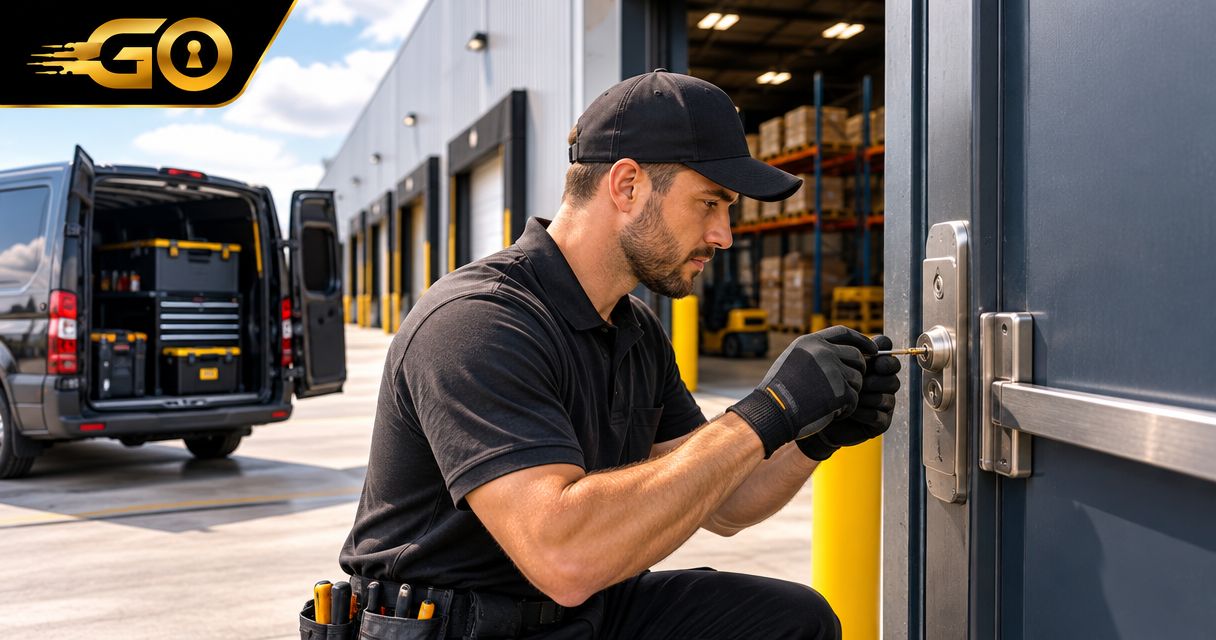
Warehouse commercial locksmith services are mechanical lock and door-hardware services that help warehouse managers control entry while preserving safe exit. This guide explains how to separate lost-key problems from damaged hardware, plan work around deliveries and shifts, and request the right service without overlooking exit doors.
TL;DR
- Commercial locksmith services for warehouses should address key control, lock condition, push bars, and door closers separately.
- GO Locksmith provides mobile commercial lock and door-hardware services, not electronic access-control installation or repair.
- Choose rekeying for suitable working locks when keys change hands; assess damaged hardware before choosing repair or replacement.
- Keep exit operation central to every hardware decision; confirm applicable requirements with the local authority.
Why commercial locksmith services matter for warehouses
A warehouse door can serve employees, delivery drivers, maintenance contractors, and supervisors at different times. Those uses create different questions: who needs a key, who authorizes entry, and whether the door closes and latches after use.
Treat key control and door operation as separate checks. Rekeying changes which key operates a compatible cylinder; it does not repair a dragging door, damaged latch, or faulty closer. Replacing hardware also does not solve an undocumented key-distribution process.
Start by matching the problem to the confirmed commercial locksmith services, rather than asking for every lock to be changed. Relevant services include business and interior-door lockouts, lock repair, replacement, rekeying, fresh installation, broken-key extraction, push bars, and door closers.
Warehouse managers also need to distinguish pedestrian-door hardware from loading equipment. A problem with a dock mechanism, powered overhead door, or electronic access-control system requires its own service assessment; do not assume a commercial locksmith request covers that equipment.
Plan warehouse lock service without losing track of doors
Map each door and its purpose
Begin with a paper checklist or shared spreadsheet. Walk the site with someone who knows daily operations, and record pedestrian entrances, staff doors, interior offices, and other keyed rooms separately. Identify which doors form part of an exit route without changing their hardware or operation.
Use location descriptions that a visiting technician can follow. “Staff entrance beside receiving” is more useful than “back door” when the building has several rear entrances. Photograph visible hardware and any readable manufacturer markings without dismantling anything.
Record the observed symptom, not an assumed diagnosis. A key that turns while the latch stays engaged describes a different problem from a key that will not enter the cylinder.
- Door location: Give each opening a clear, consistent name.
- Door purpose: Note employee, visitor, interior-room, or exit use.
- Hardware condition: Record sticking, looseness, damage, or failed latching.
- Work authorization: Identify the manager or landlord who approves changes.
Check who still holds working keys
Review your existing key log before arranging mechanical work. Ask supervisors to account for issued keys, including keys held by contractors and former staff. An unreturned key is an access-control concern even when the lock works normally.
Rekeying changes the internal configuration of a compatible lock cylinder so the previous key no longer operates that cylinder. It does not automatically affect other doors that the old key opens. List every affected opening instead of treating a missing key as an isolated door problem.
Do not assume that different locks can all accept the same key. Compatibility depends on the cylinders and key systems already installed. Ask for an assessment before making a building-wide keying request.
- Compare issued keys against your current staff and contractor lists.
- Identify every door operated by a missing or unreturned key.
- Separate lost-key concerns from damaged-lock complaints.
- Decide who approves and records newly issued keys.
Match the fault to the service
Write down what happens during normal use before requesting work. Does the key bind, does the handle move without retracting the latch, or does the door fail to settle into the frame? Avoid repeatedly forcing a key or operating visibly damaged hardware.
GO Locksmith is suited to warehouse managers seeking mobile commercial locksmith services for mechanical locks and door hardware. Its confirmed commercial work includes business lockouts, interior-door lockouts, lock repair, replacement, rekeying, fresh installation, push bars, door closers, and broken-key extraction. GO Locksmith does not install or repair electronic access-control systems.
Repair and replacement solve different problems. The guide to repairing versus replacing an exterior door lock explains that distinction further. For warehouse planning, keep the request focused on the affected opening and the observed fault; the appropriate work depends on the hardware and its condition.
- Request lockout assistance when authorized staff cannot enter.
- Request a rekey assessment when control of existing keys changes.
- Request repair or replacement assessment for damaged or unreliable locks.
- Mention a broken key before anyone attempts further operation.
Review push bars and door closers separately
Observe doors during ordinary use without taking hardware apart or altering adjustments. A closer controls closing movement; a latch holds a door closed. A working lock cylinder does not prove that either component is operating correctly.
Warehouse traffic makes this distinction practical. A staff door that remains ajar after deliveries presents a different issue from a cylinder that rejects a key. Record whether the door closes, whether it latches, and whether the exit hardware releases as intended.
Never add a locking device that obstructs required exit operation. Push-bar requirements depend on the building, occupancy, door, and applicable rules. Confirm requirements with the local building or fire authority rather than assuming every warehouse door needs identical hardware.
- Keep required exit routes clear of pallets and stored goods.
- Record doors that slam, stall, or fail to latch.
- Report loose, damaged, or unreliable push bars.
- Do not prop open fire doors or disable closing hardware.
Prepare the site and service request
Gather the door list, hardware photographs, and authorization details yourself before calling. This preparation gives the service discussion a clear scope. It also lets you distinguish a lockout requiring entry assistance from planned changes to several working locks.
GO Locksmith is a mobile service serving Fort Myers, Cape Coral, Lehigh Acres, Estero, Bonita Springs, and Naples. Call to check current availability for the warehouse location and describe the mechanical lock or door-hardware work involved. No arrival time is guaranteed here.
Explain site conditions that affect access, such as a staffed gate, visitor check-in, or a pedestrian entrance away from truck traffic. Ask what identification and proof of authorization are needed. Keep those documents with the person meeting the technician, not inside the locked area.
- Provide the exact service address and usable entrance.
- Describe affected doors and their visible hardware.
- Identify the on-site contact and work approver.
- Mention delivery activity or restricted work areas.
Verify operation and update your records
Before work begins, agree on which doors are included and what outcome is expected for each. Afterward, review those openings with the service provider. Check normal entry, closing, latching, and exit operation without improvising stress tests or altering hardware.
For rekeyed locks, confirm the intended new keys work and ask how the old keys were checked against the affected cylinders. If an old key still opens another door, address that remaining opening separately. A partial rekey should not be recorded as a whole-building key change.
Finish the administrative work while the details are fresh. Keep hardware descriptions and service records with the door list so the next manager does not have to reconstruct the building's lock history.
- Check each serviced door from the appropriate sides.
- Confirm any reported fault has been addressed or documented.
- Record which cylinders were rekeyed or replaced.
- Update the key log and identify unresolved door issues.
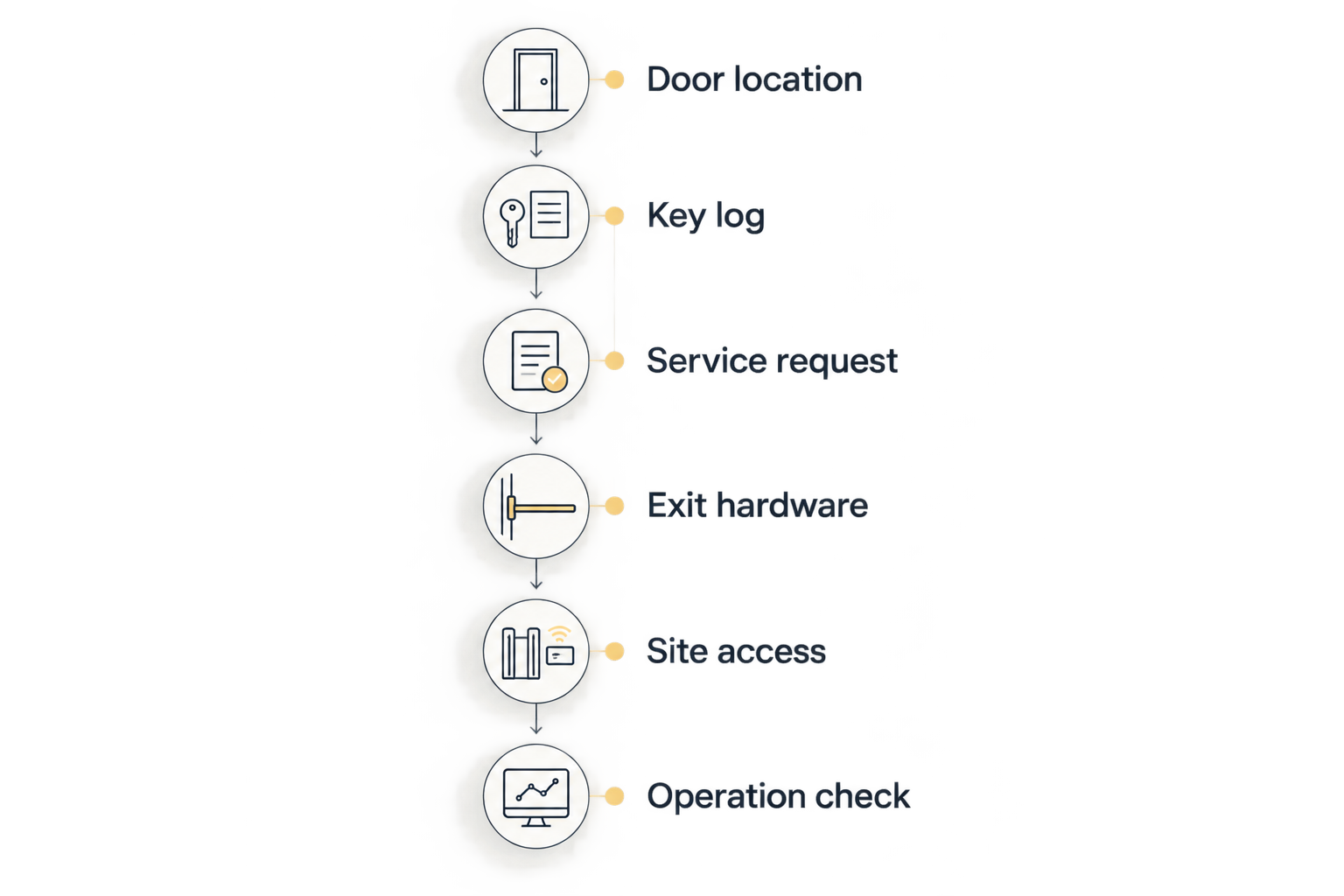
The sequence keeps diagnosis ahead of purchasing: identify the opening, account for keys, select the service, review exit hardware, arrange access, and verify the result.
Compare warehouse lock-service options
Choose work by the problem it solves, not by the assumption that new hardware is always necessary. The options below overlap in some jobs: a lockout can reveal damaged hardware, while a staff change can require rekeying otherwise functional locks.
| Option | Best for | Main benefit | Key limitation |
|---|---|---|---|
| Business or interior-door lockout service | Authorized staff unable to enter | Addresses the immediate entry problem | Does not by itself resolve lost-key control or worn hardware |
| Rekeying | Suitable working locks after keys change hands | Changes which key operates the affected cylinder | Does not repair mechanical damage; compatibility matters |
| Lock repair | A fault in otherwise serviceable hardware | Addresses the diagnosed mechanical problem | Suitability depends on condition and available repair options |
| Lock replacement | Hardware assessed as unsuitable for repair or continued use | Replaces the affected lock hardware | Must suit the door, its use, and applicable requirements |
| Fresh lock installation | A door needing an assessed new locking arrangement | Adds suitable locking hardware where appropriate | Door construction, authorization, and exit requirements constrain the work |
| Push-bar or door-closer service | Exit-release or closing-operation problems | Addresses hardware beyond the key cylinder | Does not automatically resolve door, frame, or electronic-system faults |
For a job-specific estimate, describe the doors, symptoms, and requested changes. Ask what work the estimate includes and how additional findings will be explained before authorization. Do not approve a whole-building replacement solely because the initial request involved several doors.
Common mistakes warehouse managers make
Rekeying only the most obvious entrance
A missing key can operate more than the front entrance. Check the key's full reach before deciding which cylinders need attention, including interior offices or staff entrances where applicable.
Treating a lock problem as a loading-equipment problem
A pedestrian-door lock, dock mechanism, and powered overhead door are different systems. Describe the exact equipment involved so the request reaches an appropriate provider rather than assuming all warehouse-door work falls under locksmith service.
Adding security without checking exit operation
An extra lock can change how occupants leave the building. Have the proposed arrangement assessed before installation, and confirm applicable requirements with the responsible authority.
Approving work without landlord involvement
Warehouse leases and management arrangements differ. Confirm who can authorize drilling, replacement hardware, or changes to shared entrances before scheduling alterations; possession of a working key does not establish permission to modify the door.
Leaving key records unchanged after service
New cylinders do not create accountability on their own. Record who receives each key, remove outdated entries, and name the person responsible for handling returns when staff or contractors leave.
FAQ
What do commercial locksmith services for warehouses include?
Warehouse commercial locksmith work can include business and interior-door lockouts, lock repair, replacement, rekeying, fresh installation, broken-key extraction, push bars, and door closers. Confirm the specific door and hardware before arranging service; loading equipment and electronic systems require separate assessment.
Should I rekey warehouse locks after an employee leaves?
Assess rekeying when a departing employee retains a key or you cannot account for working copies. Identify every door the key operates and confirm that the existing cylinders are suitable for rekeying.
Is replacing a warehouse lock better than rekeying it?
Replacement is not automatically better than rekeying. Rekeying addresses key control in suitable existing cylinders, while damaged or unsuitable hardware requires a repair-or-replacement assessment.
Does every warehouse exit need a push bar?
Push-bar requirements depend on the occupancy, door, and applicable building and fire rules. Confirm the requirement with the local authority before choosing or changing exit hardware.
Can a door closer fix a lock that will not latch?
A door closer is not a universal fix for a latching problem. The cause can involve closing movement, the latch, alignment, or other door components, so describe the symptom and request an assessment.
Does GO Locksmith install warehouse electronic access control?
GO Locksmith does not install or repair electronic access-control systems. Its confirmed commercial services focus on mechanical locks, lockouts, push bars, door closers, and related listed work.
Can I arrange warehouse locksmith service outside normal office hours?
Call to check current availability within the published service hours: Sunday–Thursday, 7:00 AM–11:00 PM, and Friday, 7:00 AM–5:00 PM; Saturday is closed. Do not assume that a warehouse's operating schedule establishes locksmith availability.
One last thing: report the door, not just the key
A key that turns successfully does not establish that the door closes and latches correctly. When reporting a warehouse problem, include what happens before entry, during closing, and when someone exits. That short description keeps the request focused on the whole opening rather than a cylinder alone.
For warehouse lockouts, rekeys, or mechanical door-hardware concerns, call GO Locksmith at (239) 412-1101 to check availability and request a job-specific estimate. Have the warehouse location, affected-door list, and authorization details ready.