
Blog ·
Can a locksmith adjust a door closer that closes too fast?
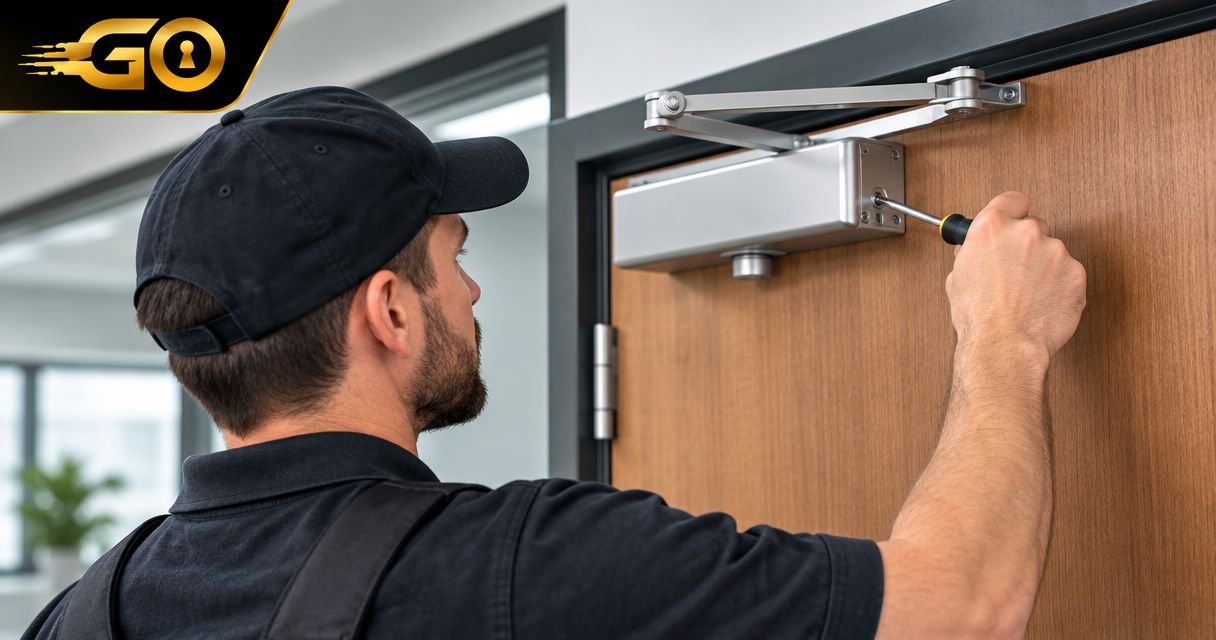
Yes. A locksmith who services commercial door hardware can adjust a door closer that closes too fast when the closer is adjustable and still in working condition. If the unit is leaking, its mounting is loose, or the door binds against the frame, changing the speed setting alone will not fix the underlying problem.
TL;DR
- Can a locksmith adjust a door closer that closes too fast? Yes, when the closer is adjustable and functional.
- GO Locksmith offers mobile commercial door-closer service in Fort Myers and Southwest Florida.
- A door that slams throughout its travel needs a different diagnosis from one that slams only near the latch.
- Do not remove adjustment valves or disconnect the closer arm; follow the specific manufacturer's instructions.
Can a locksmith adjust a door closer that closes too fast?
Adjustment is appropriate when the closer can still control the door and the door itself moves correctly. A locksmith needs to distinguish a speed-setting problem from damaged hardware, poor alignment, or a failing closer before making changes.
GO Locksmith provides mobile commercial locksmith services, including door-closer service. Describe what the door does when you call rather than asking only for a speed adjustment; the symptom helps explain what needs inspection.
| What you observe | What needs checking | Limitation of adjustment alone |
|---|---|---|
| Door moves too quickly through most of its closing travel | Main closing-speed control and closer condition | A damaged closer might not maintain controlled movement |
| Door moves normally, then slams near the frame | Latch-speed control, where fitted, and latch alignment | Slowing the final movement will not correct a misaligned latch |
| Door scrapes, catches, or needs pushing shut | Hinges, frame clearance, seals, and latch engagement | A speed setting does not remove physical interference |
| Oily residue appears around the closer body | Possible hydraulic leakage | Turning a valve does not repair a failed seal |
| Door behaves differently when nearby doors open | Wind and pressure conditions | A setting that works in one condition might not suit another |
These observations are clues, not a diagnosis. Avoid repeatedly letting an uncontrolled door slam while trying to identify the problem.
Why a quieter door is not the only goal
A closer must control the door without preventing it from closing and latching properly. Making the movement slower is not a successful repair if the door then stays slightly open.
For a business entrance, an unlatched door creates a different problem from a noisy one. For an exit or fire-rated opening, the hardware also has a safety function, so convenience cannot be the only measure of success.
The goal is controlled closing followed by reliable latching—not simply the slowest possible movement. Keep people clear of a door that closes unpredictably, and report it to the person responsible for building maintenance.
What a locksmith checks before changing the settings
A useful assessment follows the door's behavior, not a guess about which screw to turn. The exact inspection and adjustment depend on the closer model and the opening.
- Door movement. Check whether the door rubs, drags, or catches during normal use. Resistance can come from the opening rather than the closer.
- Closer condition. Look for leakage, visible damage, loose mounting, or a damaged arm. These signs change whether adjustment is an appropriate next step.
- Closing pattern. Identify whether the excessive speed occurs throughout the closing travel or only near the frame.
- Latch engagement. Confirm whether the latch engages without someone pushing or pulling the door into place.
- Operating conditions. Consider wind, nearby doors, and building pressure before judging the result.
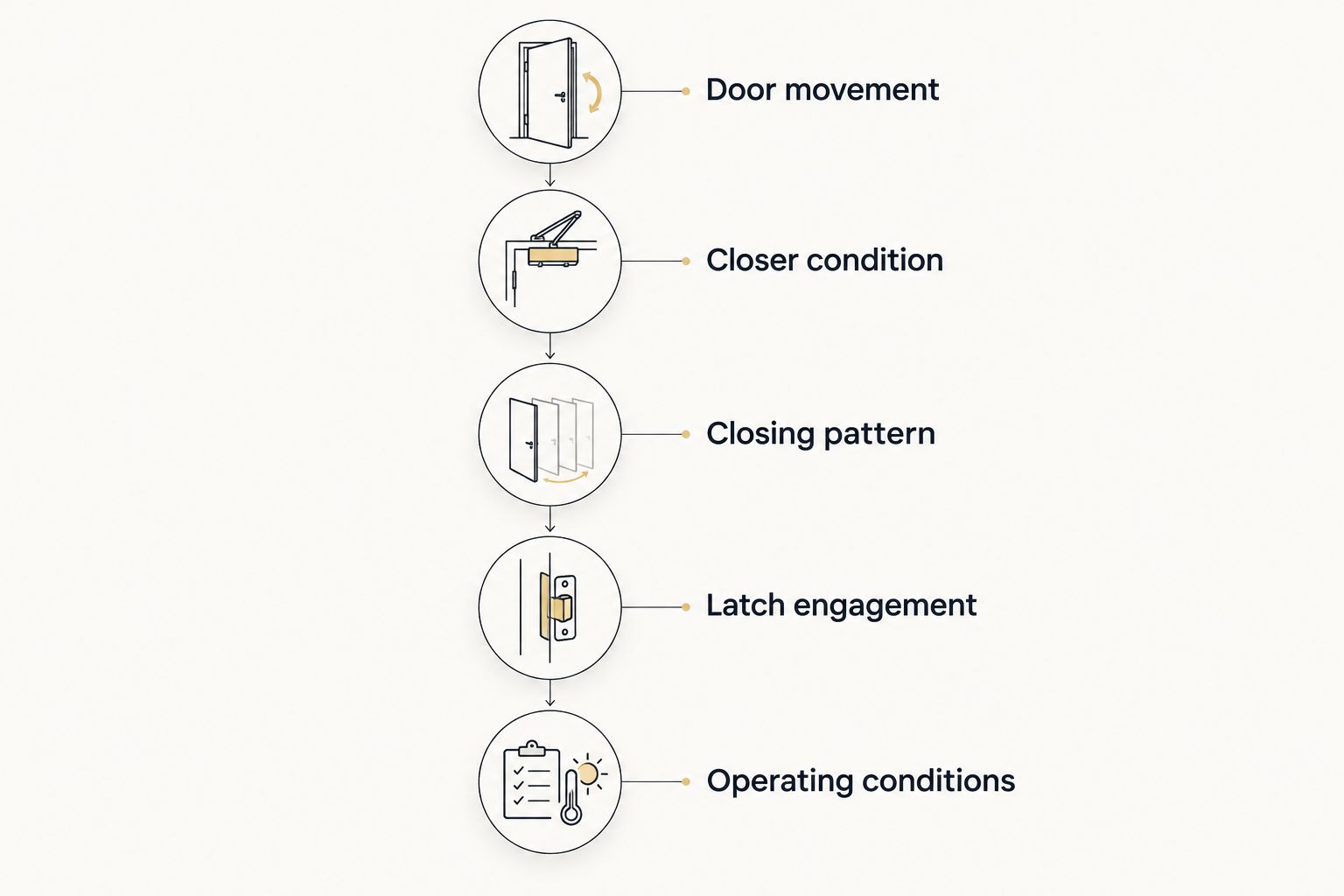
Check the whole opening before treating a fast-closing door as a speed-setting problem.
The manufacturer’s instructions matter because adjustment controls and permitted settings differ. A screw's position on one closer does not establish its function on another.
Main closing speed and latch speed are different
Many hydraulic door closers have separate controls for the main closing movement and the final movement into the latch. Not every closer has the same controls, so the model must be identified before adjustment.
Main closing speed
The main closing-speed control regulates movement through most of the closing travel. When a door swings toward the frame too quickly from an open position, this is one area to inspect.
Slowing that movement does not necessarily solve a hard final impact. The final closing stage and the condition of the latch still need attention.
Latch speed
The latch-speed control, where fitted, regulates the final portion of closing. A door that moves steadily and then bangs near the frame needs a different assessment from one that races shut throughout its travel.
The final movement must still allow the latch to engage. Setting it too slowly can leave the door resting against the latch instead of closing securely.
Backcheck is not a closing-speed control
Backcheck, where fitted, resists the door as it approaches the end of its opening movement. It is not the setting to change merely because the door closes too fast.
Do not treat every adjustment screw as interchangeable. Identify the closer and follow its instructions instead of copying settings from a different door.
Why door-closing behavior varies
Several conditions can make similar-looking doors behave differently. These are reasons to inspect the opening rather than apply a universal setting:
- Closer design and condition. Available controls differ, and worn or leaking components affect the unit's ability to regulate movement.
- Door weight and dimensions. The closer must be suitable for the door it controls; adjustment cannot make an unsuitable unit appropriate for every opening.
- Hinge and frame alignment. Sagging, rubbing, or binding introduces resistance that speed adjustment does not remove.
- Latch and strike alignment. A latch that meets the strike incorrectly can stop the door from securing even when closing speed looks reasonable.
- Seals and weatherstripping. Contact around the door can add resistance near the closed position.
- Wind and building pressure. Exterior conditions and air movement through the building affect how a door moves.
For an exterior business entrance, tell the locksmith whether the problem happens consistently or only under particular conditions. That distinction is more useful than describing the door as simply “too strong.”
When is adjustment enough, and when is replacement needed?
Adjustment is the first option to assess when the closer is intact, correctly mounted, suitable for the opening, and able to respond to its controls. Replacement becomes a consideration when damage or failure prevents reliable operation.
| Approach | Best suited to | Benefit | Limitation |
|---|---|---|---|
| Adjust the existing closer | A functional closer with incorrect settings | Retains usable hardware | Does not fix leakage, damage, or door misalignment |
| Address another hardware problem | Binding, loose mounting, or poor latch engagement | Targets the source of resistance or impact | The closer can still need a separate adjustment afterward |
| Replace the closer | A failed, damaged, or unsuitable unit | Addresses a closer that cannot perform correctly | Replacement selection must match the opening and its requirements |
Visible fluid around a hydraulic closer warrants inspection. Do not assume adding lubricant outside the unit will restore its internal speed control.
Likewise, replacing the closer without checking a dragging door risks leaving the original problem unresolved. Ask what failed and how the proposed work addresses it.
Who should handle a shared entrance or school door?
A shared entrance needs a clear maintenance owner. Tenants, employees, and visitors should report the fault rather than independently changing hardware that other people rely on.
For schools, distinguishing general maintenance from safety-sensitive door work matters. A maintenance plan covering handyman services for schools should identify which door faults require a qualified hardware specialist rather than treating every slamming door as a routine screw adjustment.
The same principle applies to offices and other shared buildings: record the affected opening, describe the behavior, and notify the responsible manager. If the door is part of a required exit or a fire-rated assembly, any work must preserve its required operation.
Do not wedge a fire door open to stop the noise. Do not disconnect a closer arm as a temporary way to make a busy entrance easier to use.
Can you adjust a fast-closing door yourself?
A model-specific instruction sheet is essential before considering any adjustment. Generic advice to turn an unidentified screw is not enough, especially on a commercial entrance or safety-related door.
Adjustment valves are not ordinary mounting screws. Backing a valve out too far can release hydraulic fluid and damage the closer; removing the arm can also create an uncontrolled door.
Leave the settings alone if you cannot identify the controls, see leakage, notice loose hardware, or find that the door binds. Report those observations when arranging service instead of trying to compensate with another setting.
You can still gather useful information without touching the hardware. Photograph the closer's label from a safe position, note where the movement becomes fast, and explain whether the latch catches normally.
What should you tell the locksmith when you call?
Give the locksmith a short description of the opening and the fault. “The door moves normally but slams just before latching” is more informative than “the closer is broken.”
Have these details ready:
- Whether the door is an exterior entrance, interior door, or shared building door.
- Whether the problem started suddenly or developed gradually.
- Whether the door slams throughout its travel or only at the end.
- Whether it rubs, fails to latch, or shows visible leakage.
- The closer's brand and model, if readable without removing parts.
- Your location and any building-management requirements for arranging access.
GO Locksmith offers mobile commercial door-closer service in Fort Myers, Cape Coral, Lehigh Acres, Estero, Bonita Springs, and Naples. Call to discuss the specific door and check current availability; an inspection determines whether adjustment alone is appropriate.
FAQ
Can a locksmith slow down a door that slams shut?
Yes, a locksmith who services door closers can adjust a functional, adjustable unit. Leakage, binding, loose mounting, or latch problems need assessment rather than a speed change alone.
Why does my door slam only during the last part of closing?
A problem during the final closing movement can involve the latch-speed setting, where fitted, or the door's latch alignment. The closer model and the door's condition determine the appropriate correction.
Will slowing the closer stop the door from latching?
Slowing the closer too much can prevent reliable latching. The finished adjustment must allow controlled movement and full latch engagement without someone pushing the door shut.
Does oil on a door closer mean it needs replacing?
Oil around a hydraulic closer can indicate leakage and needs inspection. Adjustment does not repair a failed seal, so the unit's condition determines the next step.
Should I turn the spring-power setting to make the door close slower?
Spring power and hydraulic closing speed are different controls. Do not use a spring-power adjustment as a substitute for identifying the correct speed control and checking the manufacturer's instructions.
Can I disconnect the closer until someone repairs it?
Do not disconnect a closer as a temporary fix for slamming. The door can become uncontrolled, and disconnecting hardware on a fire-rated or exit opening can compromise its required operation.
Does GO Locksmith provide door-closer service on Saturdays?
GO Locksmith is closed on Saturdays. Its hours are Sunday–Thursday, 7:00 AM–11:00 PM, and Friday, 7:00 AM–5:00 PM; call during those hours to check availability.
One last thing: check whether the latch actually catches
A quiet door is not necessarily a secured door. After any adjustment, the result needs to include reliable latch engagement—not just less noise.
For a commercial door that closes too fast, call GO Locksmith at (239) 412-1101 during business hours to describe the fault and request service. Mention any leakage, dragging, or failure to latch when you call.