Blog ·
Commercial locksmith services for law firms: complete 2026 guide
Law firm commercial locksmith services are mechanical lock and door-hardware services aimed at controlling office access, protecting confidential workspaces, and resolving lockouts. This guide explains how to plan access for attorneys, staff, contractors, and visitors without overlooking lease restrictions or safe exit routes.
TL;DR
- GO Locksmith provides commercial locksmith services for law firms needing mobile mechanical lock and door-hardware assistance.
- Rekeying changes which keys operate a compatible lock; replacement addresses hardware that needs changing.
- Separate public meeting spaces from private offices and records rooms when assigning keys.
- GO Locksmith does not install or repair electronic access-control systems.
Why commercial locksmith services matter for law firms
A law office needs more than a working front-door lock. Reception, consultation rooms, attorney offices, and records rooms serve different purposes; giving everyone the same access defeats those distinctions.
A returned key also does not establish that no copies exist. After a staff departure or lost key, you need to decide whether the affected locks should continue accepting that key—not simply whether the original was recovered.
GO Locksmith provides mobile commercial locksmith services, including business and interior door lockouts, lock repair, replacement, rekeying, fresh installation, push bars, door closers, and broken key extraction. Its Southwest Florida service areas include Fort Myers, Cape Coral, Lehigh Acres, Estero, Bonita Springs, and Naples; it also operates in Jacksonville.
GO Locksmith commercial locksmith services fit law firms needing mobile assistance with mechanical locks and door hardware. Electronic access-control installation and repair are outside its confirmed services.
Build a practical office access plan
Start with your own records and a walkthrough. You do not need new hardware to identify who holds keys, which doors cause problems, or who can authorize work. The following steps turn those observations into a specific service request.
Map access
Walk through the office with the person responsible for facilities or administration. Record each relevant door, the room it serves, and who currently needs access. Include interior doors rather than treating the suite entrance as the entire security boundary.
Distinguish public-facing spaces from private work areas. A visitor attending a consultation does not need the same access as an attorney retrieving archived files. Likewise, permission to enter the suite does not automatically mean permission to enter every room.
Keep the inventory simple: a door name, its purpose, current keyholders, and any observed fault. Avoid putting client names or matter details into a document that will be shared with a service provider.
If you lease your office, identify doors controlled by the landlord or building manager before requesting alterations. A shared corridor entrance and your internal records-room door can have different approval requirements.
- Name each door by room or function.
- Separate visitor areas from private workspaces.
- List current keyholders by role.
- Mark shared or landlord-controlled doors.
- Record sticking, loose, or unreliable hardware.
Assign key responsibility
Use your existing staff list to establish who holds each key and who approves new access. A spreadsheet or written register is a practical starting point; it works only if someone keeps it current.
For a law firm, distinguish permanent employees from temporary staff, visiting attorneys, cleaners, and other contractors. Assign access according to the rooms each role actually needs, rather than issuing the broadest available key by default.
Choose a responsible office contact for lost keys, departures, and lock problems. Without that owner, reception can assume the office manager handled a missing key while the office manager assumes reception collected it.
A key register documents custody, not every entry into a room. Mechanical keys do not provide an electronic entry history. If your firm needs that capability, treat it as a separate requirement rather than expecting a rekey to supply it.
- Record the holder and doors each key opens.
- Document key issue and return dates.
- Assign an approver for additional access.
- Set a reporting process for missing keys.
- Review contractor access when work ends.
Choose the remedy
First describe the problem without assuming a solution. Does the key fail to turn? Does the door fail to latch? Has a key gone missing? These observations help distinguish an access-control decision from a mechanical fault.
Choose rekeying when the objective is to stop an old key operating a suitable existing lock. Rekeying changes the lock's keying; it does not repair a damaged door, correct every hardware fault, or add electronic access records.
Replacement addresses hardware that needs changing. Repair addresses a fault when the existing hardware can be retained. Fresh installation involves adding lock hardware, subject to the door, intended use, and applicable requirements.
GO Locksmith offers these confirmed commercial services, but the appropriate choice depends on the actual lock and door. Ask for an assessment instead of requesting replacement of every lock solely because a key was lost.
Keep your service request specific enough to separate the problem from the proposed work:
- Describe the symptom or access concern.
- Identify which keys and doors are affected.
- Ask whether the existing lock suits rekeying.
- Separate damaged hardware from missing-key concerns.
- Obtain any required building approval.
Check door operation
Observe how the door behaves during ordinary use before arranging work. A lock that turns normally does not solve a door that fails to close or latch. Note whether the difficulty occurs with the door open, closed, or both, without dismantling the hardware.
Pay particular attention to records-room doors and staff-only entrances. A door that staff routinely leave unsecured because it is awkward to use undermines the access plan, even if the key register is accurate.
For exit doors, do not add hardware, improvise a locking arrangement, or disable a push bar to solve an access problem. Changes involving exit operation need review against the door's function and applicable requirements.
GO Locksmith's confirmed commercial services include push bars and door closers. Explain the observed problem when calling; naming a device alone does not establish what work is appropriate.
Interior-room selection also deserves attention. The guide to interior door locks for medical offices covers a related professional-office topic, but your law firm's rooms and existing doors need their own assessment.
- Note doors that fail to close or latch.
- Report loose handles and sticking key operation.
- Identify push bars and door closers already present.
- Preserve safe exit operation.
- Ask about suitability before changing hardware.
Prepare the service request
Gather the office address, suite details, affected door descriptions, and the contact authorized to approve work. For a lockout, explain whether you cannot enter the whole business or only an interior room. That distinction helps define the request.
Share relevant door and hardware photos if requested, while keeping client files, computer screens, and confidential material out of view. Have information about your authority to access the premises available and ask what verification is required.
For planned work, identify when the affected rooms are in use. A consultation room booked for a client meeting and a records room needed for active work require coordination, not an assumed completion window.
Call to check current availability and request a job-specific estimate. GO Locksmith operates Sunday–Thursday, 7:00 AM–11:00 PM, and Friday, 7:00 AM–5:00 PM; Saturday is closed. Those are business hours, not a promise of arrival at a particular time.
- Provide the address and suite information.
- Describe the affected door and problem.
- Identify the authorized office contact.
- Mention building-access or approval restrictions.
- Ask about availability and the proposed scope.
Verify the handover
After work, review the affected door with the service provider before updating your records. Confirm what was repaired, replaced, installed, or rekeyed; those are different outcomes and should not be recorded interchangeably.
For rekeying, check the intended new key on each affected lock and confirm that the previous key no longer operates it where that is the agreed objective. Check normal door closing, latching, locking, and unlocking without changing exit hardware arrangements.
Update the key register and issue keys only to approved holders. If you changed access after a departure, ensure the records-room and other affected interior doors are included—not just the entrance.
Keep the service documentation available to the office manager and any building representative who needs it. A clear handover prevents the next administrator from having to reconstruct which doors changed and why.
- Confirm the completed work by door.
- Check intended key operation.
- Check normal closing and latching.
- Update authorized keyholder records.
- Retain the work documentation.
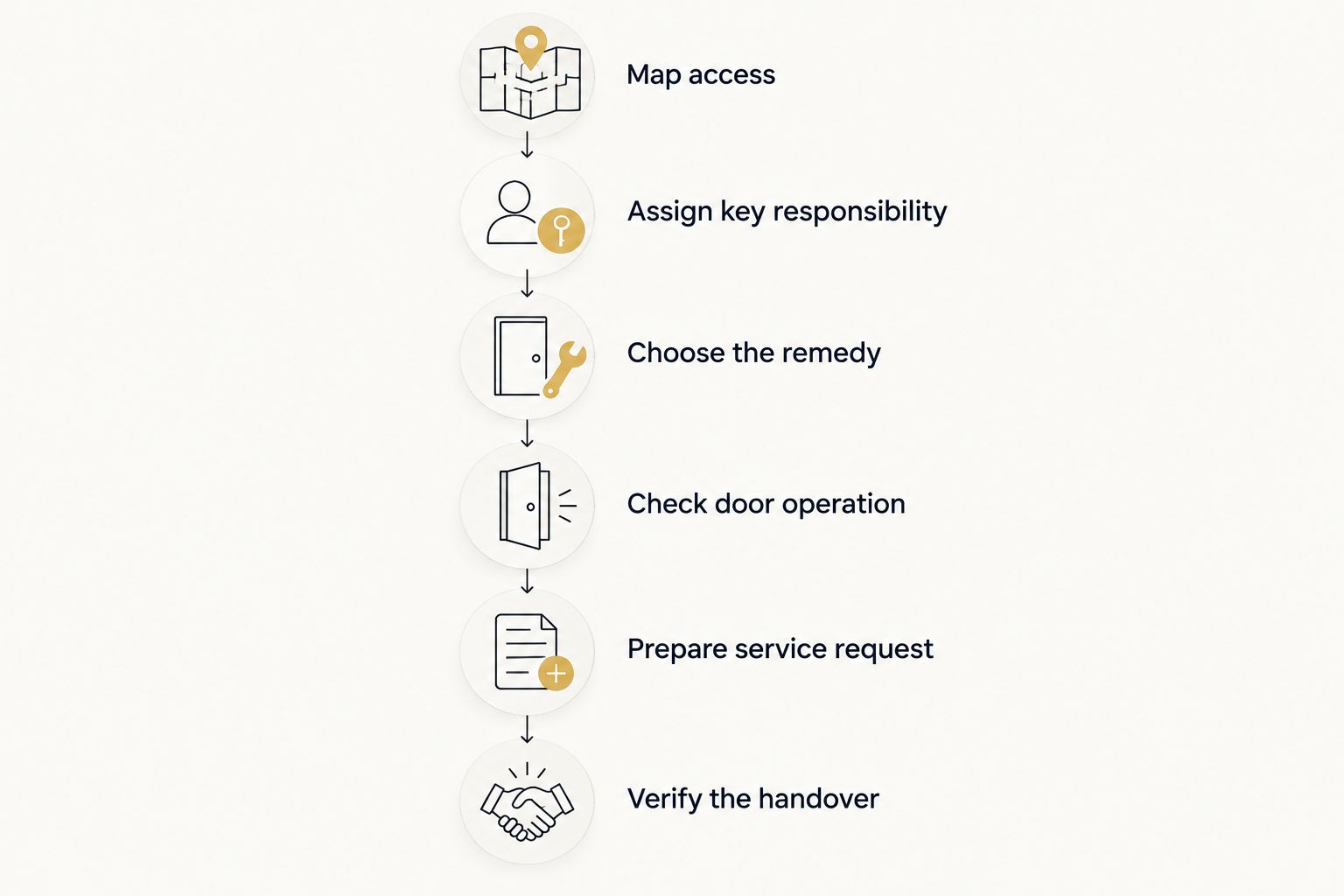
Define access needs before choosing hardware, then verify the completed work.
Compare the available approaches
Choose the option that addresses the actual problem. A law firm with a missing key has a different decision from a firm with a sticking lock or an unsecured records-room door.
| Option | Best for | Main advantage | Key limitation |
|---|---|---|---|
| Key register and access review | Firms that need clear responsibility for existing keys | Clarifies who holds access and who approves changes | Does not stop an existing key from operating a lock |
| Commercial rekeying | Firms changing authorized access while retaining suitable locks | Changes which keys operate the affected locks | Does not resolve unrelated door or hardware defects |
| Mechanical lock repair | Firms with a specific fault in existing lock hardware | Addresses the fault when the hardware can be retained | Suitability depends on the condition and cause |
| Lock replacement | Firms whose existing lock hardware needs changing | Replaces the affected hardware | Requires assessment of door fit and intended operation |
| Fresh lock installation | Firms needing a new mechanical locking point | Adds lock hardware where appropriate | Depends on the door and applicable requirements |
| Push bar or door closer service | Firms with problems involving those door devices | Addresses a defined door-hardware concern | Does not substitute for reviewing the complete door's operation |
Business lockout and interior door lockout services address an immediate access problem. They do not, by themselves, decide who should hold keys afterward. If the lockout followed a lost key, discuss the access concern separately from getting the door open.
Likewise, broken key extraction addresses a broken key lodged in a lock. Ask whether the underlying lock or door problem also needs attention rather than assuming removal alone resolves it.
Common mistakes law firms make
Treating key return as proof that access ended
Collecting a departing employee's key is useful, but it does not establish that no copy exists. Review which doors that key operated and decide whether those locks should continue accepting it. Document the decision rather than leaving it implicit.
Giving contractors unnecessary room access
A contractor's need to enter the office does not establish a need to enter attorney offices or records rooms. Define the work area, approved access, and return process before issuing keys. Avoid sharing client information to explain the access boundary.
Replacing locks before identifying the fault
A door that is difficult to secure needs assessment of the door and hardware, not an automatic shopping list. Record what happens during normal use. Match the service to the problem before approving replacement.
Ignoring building responsibilities
A leased suite can contain both tenant-controlled and building-controlled doors. Confirm approval responsibilities before requesting changes. Otherwise, the office risks arranging work that conflicts with the landlord's hardware or access requirements.
Expecting mechanical service to provide electronic records
A conventional keyed lock does not record who entered or when. Rekeying does not add that function. GO Locksmith does not install or repair electronic access-control systems; do not book mechanical work expecting it to provide electronic monitoring.
FAQ
What commercial locksmith services does a law firm need?
A law firm's needs depend on its doors, keyholders, and current problems. Common requests include business or interior door lockouts, rekeying, lock repair or replacement, fresh installation, broken key extraction, and work involving push bars or door closers.
Should we rekey the office after an employee leaves?
Review rekeying when a departing employee's key should no longer operate the affected locks. Recovering a key does not establish that no copies exist; identify the doors it opens and whether the existing locks are suitable for rekeying.
Is rekeying better than replacing every office lock?
Rekeying addresses a change in authorized keys when the existing lock is suitable for retention. Replacement addresses hardware that needs changing. The correct choice depends on the lock's condition, compatibility, and the office's requirements.
Can a locksmith help if we are locked out of a records room?
Interior door lockout is a confirmed GO Locksmith commercial service. Describe the door and lock when calling, and ask what authorization is required; assistance depends on the particular hardware and current availability.
Can GO Locksmith install electronic access control for our law firm?
No. GO Locksmith does not install or repair electronic access-control systems. Its confirmed commercial services focus on mechanical locks and door hardware.
How much will commercial locksmith work for our office cost?
Request a job-specific estimate based on the affected doors, hardware, and proposed work. Explain whether you need lockout assistance, repair, rekeying, replacement, or installation so the request reflects the actual job.
Can we request commercial locksmith service after office hours?
You can call to check availability during GO Locksmith's confirmed business hours: Sunday–Thursday, 7:00 AM–11:00 PM, and Friday, 7:00 AM–5:00 PM. Saturday is closed, and service is not advertised as available around the clock.
One last thing
A working entrance lock does not establish that your private rooms are properly secured. Before arranging work, follow the route a visitor takes from reception to a consultation room and identify where that route meets staff-only space. That walkthrough gives your office a concrete access question to resolve.
For help with a commercial lockout, rekey, lock fault, or confirmed door-hardware service, call (239) 412-1101 to check availability and discuss the affected doors. Have the office address, problem description, and authorized contact ready.