Blog ·
Best interior door locks for medical offices 2026
Best default for staff offices: a commercial keyed office-function lever. Best for exam-room privacy: a commercial privacy lever. Best for restricted storage: a storeroom-function lever. The best interior door locks for medical offices match each room’s purpose, exit requirements, and existing door—not one lock used throughout the practice.
TL;DR
- The best interior door locks for medical offices depend on room function, not appearance or one building-wide specification.
- Choose office-function levers for staff offices, privacy levers for exam rooms, and storeroom-function levers for restricted storage.
- GO Locksmith handles confirmed mechanical commercial lock services; electronic access-control installation and repair are not offered.
- Check accessible operation, exit requirements, door preparation, and key management before choosing hardware.
Why the room matters more than the lock brand
An exam room needs privacy while occupied. A records room needs controlled entry even when nobody is inside. Giving both rooms the same locking function creates an avoidable mismatch.
This guide ranks mechanical lock configurations rather than named products. A product recommendation requires the exact door preparation, intended function, and applicable building requirements; a familiar brand name does not settle those questions.
GO Locksmith is a mobile locksmith option for medical offices needing mechanical lock repair, replacement, or rekeying in confirmed service areas. You can contact GO Locksmith to discuss the door and request a job-specific estimate. Electronic access-control installation and repair are outside the confirmed services.
What makes a suitable medical-office interior lock?
Use these criteria before comparing finishes or ordering hardware:
- Room function: Decide whether the door needs temporary privacy, staff-controlled locking, continuously restricted entry, or no locking at all.
- Accessible operation: Select hardware that meets the applicable accessibility requirements. Lever shape alone does not establish compliance; operation and installation also matter.
- Exit requirements: People inside must be able to leave as required by the applicable code. Do not add a keyed exit-side lock without a qualified review.
- Door compatibility: Check the door thickness, preparation, frame, strike, and any fire-rating requirements. Existing holes do not prove that a replacement fits correctly.
- Key management: Decide who holds keys, who controls spare copies, and what happens when a key is lost or an employee leaves.
- Condition of the opening: A dragging door or misaligned strike needs attention. Changing the lock does not correct every door problem.
Ordinary outpatient offices and facilities with specialized patient-care requirements do not necessarily use the same hardware rules. Have the responsible facility professional confirm the requirements for your occupancy before treating this list as a purchasing specification.
Interior door lock options at a glance
| Rank and configuration | Best for | Standout feature | Key limitation |
|---|---|---|---|
| Commercial keyed office-function lever | Staff offices | Key-controlled entry with an interior locking control, depending on the selected function | Staff must understand when and how the outside lever locks |
| Commercial privacy lever | Standard exam-room privacy | Interior privacy control with an outside emergency-release feature | Not intended to secure restricted storage |
| Commercial storeroom-function lever | Records and supply rooms requiring restricted entry | Outside lever remains locked; authorized entry uses a key | Staff need reliable access to an authorized key |
| Commercial passage lever | Shared rooms without access restrictions | Door latches without a locking function | Provides no entry control |
| Compatible commercial mortise lock | Doors already prepared for mortise hardware | Replacement configuration suited to an existing mortise pocket | Case dimensions, function, and trim require careful matching |
Office, privacy, storeroom, and passage describe operating functions. Mortise describes a lock construction and door preparation. The final option belongs here because an existing mortise door presents a different replacement decision—not because mortise construction replaces the need to choose a function.
1. Office-function lever: best for private staff offices
A commercial keyed office-function lever suits a room where staff need to control entry but do not want the outside handle permanently locked. Common office functions combine an outside key cylinder with an interior locking control. Check the manufacturer's function description because the way a lock sets or releases varies by configuration.
For a manager's office or administrative workspace, that flexibility is useful. The room can remain accessible during normal use and be secured when unattended, provided the selected hardware supports that operation.
Office-function lever pros:
- Gives authorized staff keyed entry when the door is locked.
- Lets the occupant control privacy or security from inside, according to the selected function.
- Supports a mechanical approach without connected access-control equipment.
Office-function lever cons:
- An unlocked setting does not restrict entry.
- Staff can misunderstand locking behavior unless the function is explained.
- Lost or unaccounted-for keys require a key-control decision, not just another copy.
Best for: Private administrative and staff offices where locking needs change during the day.
Before choosing an office-function lever, write down what should happen after someone unlocks and opens the door. Should the next person need a key, or should the room remain accessible? The answer distinguishes an office function from a continuously locked storeroom function.
Verdict: Buy for staff offices when selectable locking matches the workflow.
2. Privacy lever: best for standard exam-room privacy
A commercial privacy lever lets an occupant engage privacy from inside. Typical privacy hardware includes an outside emergency-release feature rather than ordinary keyed access control. Confirm the exact release method and keep it available to authorized staff.
Privacy hardware is a room-use choice, not a records-security measure. It can serve an ordinary exam room where preventing accidental entry matters, but the practice must confirm that the function suits its patient-care procedures and applicable requirements.
Privacy lever pros:
- Gives an occupant a direct way to prevent routine entry during use.
- Includes an outside release feature for appropriate staff intervention.
- Separates temporary room privacy from employee key management.
Privacy lever cons:
- Does not provide the same access restriction as a keyed storage-room lock.
- Requires staff to know how to use the outside release.
- Is not a universal recommendation for specialized care environments.
Best for: Standard exam rooms and consultation rooms needing temporary occupant privacy.
Ask how staff should enter if a patient needs assistance. Establish that procedure before putting the room into service. Also consider whether a privacy lock belongs on that particular room at all; patient supervision requirements can change the answer.
Verdict: Buy for ordinary exam-room privacy after confirming the room's care requirements.
3. Storeroom-function lever: best for restricted storage rooms
A mechanical storeroom-function lever keeps the outside lever locked. Authorized users enter with a key, while the inside lever permits exit under the selected lock's operating design. This avoids relying on staff to remember to switch the outside lever back to a locked setting.
That makes the function a useful candidate for a records room or supply room requiring restricted entry. It does not establish that a door, frame, or storage arrangement satisfies every requirement for sensitive records or regulated materials.
Storeroom-function lever pros:
- Keeps outside entry key-controlled without a separate locking step.
- Gives a clear, consistent entry rule for staff.
- Separates restricted storage from patient-facing privacy functions.
Storeroom-function lever cons:
- Authorized staff need a key each time they enter.
- Propping the door open defeats the intended restriction.
- A conventional mechanical lock does not produce an electronic entry log.
Best for: Records and supply rooms where entry should remain restricted between visits.
A storeroom lock still depends on the door closing and latching properly. Check whether the latch engages without staff pulling or lifting the door. If the door repeatedly stays ajar, address the opening rather than assuming a different cylinder will solve the problem.
Verdict: Buy for continuously restricted rooms when mechanical key control meets your needs.
4. Passage lever: best for unrestricted shared rooms
A passage lever operates a latch but does not lock the door. It suits shared spaces where closing the door matters and restricting entry does not. Examples include a staff break room or shared meeting room, provided the practice does not need privacy locking there.
A passage function is not an inferior security product. It is the correct choice when the room does not need a lock.
Passage lever pros:
- Removes unnecessary keys from everyday staff circulation.
- Lets a door close and latch without creating a lockout.
- Makes the room's unrestricted entry function clear.
Passage lever cons:
- Does not prevent unauthorized entry.
- Does not provide occupant-controlled privacy.
- Is unsuitable for a room whose contents require restricted access.
Best for: Shared staff rooms and other interior spaces without privacy or security restrictions.
Review the room's actual use before choosing passage hardware. A meeting room used for confidential consultations has a different privacy need from a break room, even if both appear on the floor plan as shared spaces.
Verdict: Buy for unrestricted rooms; skip for exam-room privacy or restricted storage.
5. Compatible mortise lock: best for existing mortise doors
A mortise lock fits into a pocket in the edge of a door. If the office already has mortise hardware, replacement requires matching the existing preparation or planning a suitable modification. A cylindrical lever is not automatically a direct substitute.
Choose the operating function separately. A compatible mortise lock can still need an office, privacy, or storeroom function based on the room it serves.
Compatible mortise lock pros:
- Can retain an existing mortise preparation when correctly matched.
- Allows the room's operating function to guide the replacement specification.
- Avoids assuming that all commercial lever hardware fits the same opening.
Compatible mortise lock cons:
- Lock-case dimensions and trim compatibility need careful verification.
- An apparently similar replacement can have different operating behavior.
- Changing construction can require door work beyond a simple hardware exchange.
Best for: Existing commercial doors with mortise preparations that need a compatible replacement.
Do not order from a photograph of the outside lever alone. The lock body, edge preparation, strike, and function matter. Ask whether the existing assembly needs repair, rekeying, or replacement before committing to a different construction.
Verdict: Hold the purchase until the existing mortise preparation and required function are confirmed.
Check the opening before you order
Use this sequence to turn a room-level recommendation into a useful service request:
- Room purpose: Describe who uses the room and whether it needs privacy or restricted entry.
- Exit operation: Explain how the door currently opens from inside and flag any extra locking hardware.
- Door condition: Note sticking, sagging, failed latching, or a closer that does not shut the door properly.
- Hardware match: Identify the existing lock type and any fire-rating labels without removing or altering them.
- Key control: Explain who needs access and whether existing keys have been lost or left with former staff.
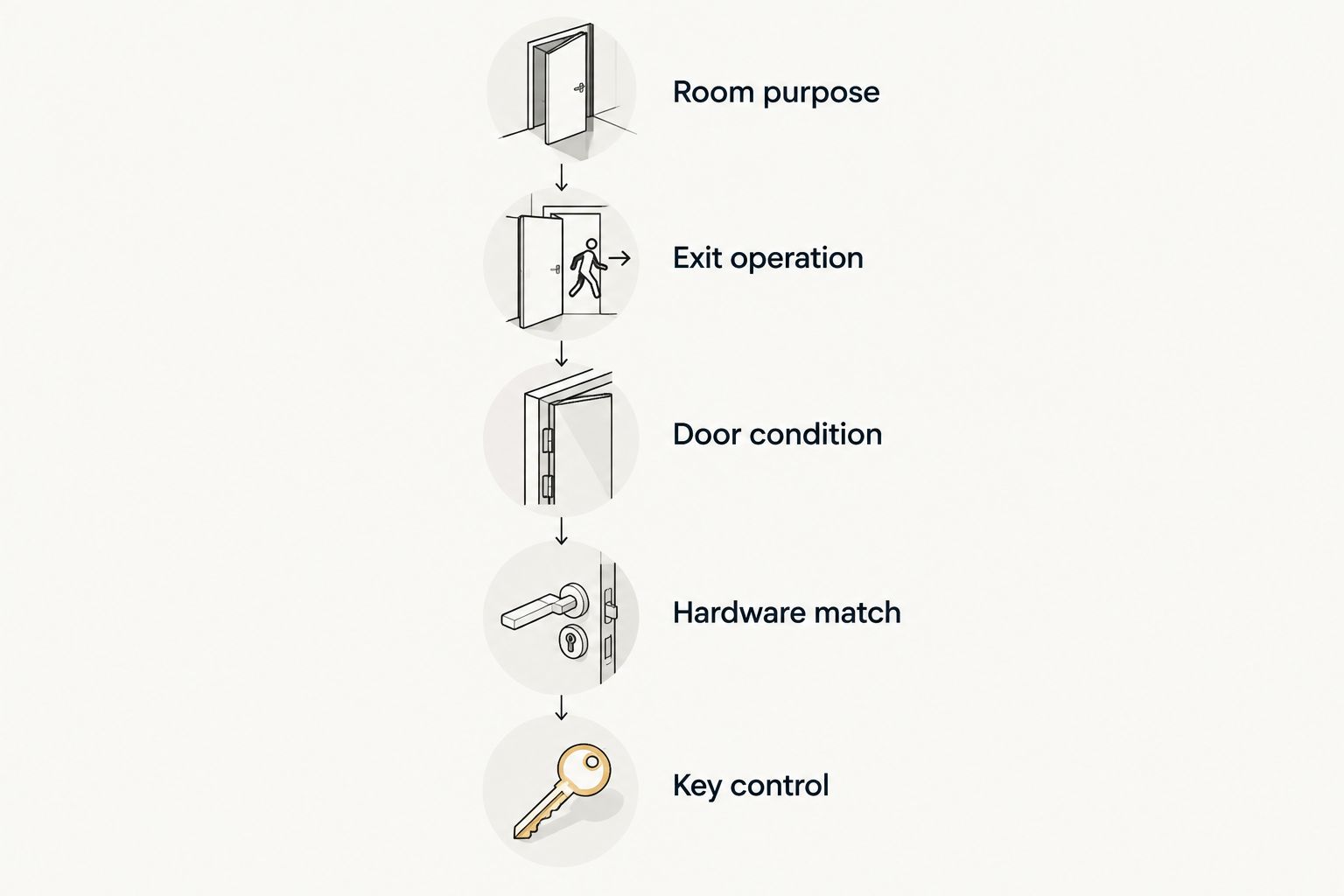
Choose the room function before specifying replacement hardware.
If the lock works and its function still suits the room, rekeying can change which keys operate it without changing that function. Rekeying does not correct a worn latch, damaged hardware, or an unsuitable locking arrangement.
If a door is already locked and staff cannot enter, address the immediate access problem separately from the replacement decision. The medical-office lockout guide covers that distinct situation.
How these configurations were ranked
The order follows room function, accessible operation, exit requirements, compatibility, and key management. Office-function hardware is the default for a typical staff-office question; the remaining options each solve a different problem.
This is not a product durability test or a ranking of manufacturers. Final selection requires the specific hardware documentation and the requirements that apply to the opening.
Which interior lock should you choose?
Choose the locking function first and the compatible hardware second. Use an office-function lever for selectable staff-office locking, a privacy lever for appropriate exam-room privacy, and a storeroom-function lever for continuously restricted entry.
Keep passage hardware on rooms that do not need locking. For an existing mortise door, confirm the preparation before ordering a replacement. Do not use a second lock to compensate for a door that fails to latch correctly.
GO Locksmith provides confirmed commercial services including lock repair, replacement, rekeying, fresh installation, interior door lockouts, push bars, and door closers. Its Southwest Florida service areas include Fort Myers, Cape Coral, Lehigh Acres, Estero, Bonita Springs, and Naples; it also operates in Jacksonville. No physical storefront is confirmed.
FAQ
What's the best interior door lock for a medical office?
The right lock depends on the room: an office-function lever suits selectable staff-office locking, a privacy lever suits appropriate exam-room privacy, and a storeroom-function lever suits continuously restricted entry. Confirm compatibility, accessibility, and exit requirements before choosing the exact hardware.
Should an exam-room door have a keyed lock?
An exam room does not automatically need keyed entry control. A commercial privacy function can suit ordinary occupant privacy, but the practice must confirm the function against its patient-care procedures and applicable requirements.
Is a privacy lock suitable for a medical records room?
A privacy lock is not the appropriate choice when the records room requires controlled keyed entry. Consider a suitable keyed function and review the security of the complete door, frame, and records-storage arrangement.
Can staff leave a storeroom-function door without a key?
A standard storeroom function provides keyed entry from outside and exit using the inside lever. Confirm the exact manufacturer's function and the applicable exit requirements rather than relying on the product name alone.
Does HIPAA require a particular interior door lock?
HIPAA does not identify one universal interior door-lock model for every medical office. Lock selection belongs within the practice's broader safeguards and risk assessment; buying a particular lock does not by itself establish compliance.
Should I rekey or replace an existing office lock?
Rekeying suits a functioning compatible lock when you need to change which keys operate it. Replacement is a separate decision when the hardware is damaged, the function is wrong, or the existing assembly no longer suits the opening.
Does GO Locksmith install electronic access-control systems?
GO Locksmith does not install or repair electronic access-control systems. Confirmed commercial services include mechanical lock repair, replacement, rekeying, fresh installation, lockouts, push bars, door closers, and broken key extraction.
One last thing: test the latch, not just the key
A key turning smoothly does not prove that the door secures the room. During your hardware check, close the door normally and confirm that the latch engages without lifting, pulling, or forcing the door. Keep the key test and the closing test separate.
For a medical-office lock repair, rekey, or replacement, call GO Locksmith at (239) 412-1101 to check current availability and request a job-specific estimate. Hours are Sunday–Thursday, 7:00 AM–11:00 PM; Friday, 7:00 AM–5:00 PM; Saturday closed.