Blog ·
Best fireproof safes ranked by fire rating 2026
Best for the longest paper-protection duration in this ranking: a UL Class 350 safe rated for 4 hours. Best starting point for household documents: a UL Class 350 safe rated for 1 hour. Best for heat-sensitive digital media: a safe with a suitable UL Class 125 rating. Compare the verified classification and duration, not the word fireproof on the packaging.
TL;DR
- The best fireproof safes ranked by fire rating separate paper protection from digital-media protection.
- UL Class 350 protects paper under specified test conditions; its duration determines the tested exposure period.
- UL Class 125 addresses lower internal temperatures and humidity limits for heat-sensitive media.
- GO Locksmith provides safe service, not a confirmed safe product range or product certification.
Why the fire rating matters more than the label
A fire-resistant safe has a defined performance limit. Fireproof sounds absolute, but no rating promises that your belongings will survive every fire, installation condition, or exposure.
For this 2026 guide, the reference is UL Solutions’ UL 72 standard, Tests for Fire Resistance of Record Protection Equipment. Its classifications distinguish the internal conditions permitted during testing and the duration of the exposure. This ranking compares those rating categories rather than assigning unsupported scores to individual safe models.
GO Locksmith is a mobile locksmith service with confirmed safe service. Safe servicing and choosing a fire-rated safe are different decisions: this guide helps you understand the latter without implying that the company sells or certifies safes.
What makes the best fire-resistant safe?
Check these criteria before comparing cabinet size, keypad features, or appearance:
- Verified classification: Look for the exact model’s certification label and supporting documentation. A general statement about a product family does not establish every model’s rating.
- Contents match: Paper records and digital media have different heat tolerances. Choose the protection class for what you will actually store.
- Tested duration: Compare minutes or hours only after confirming that the classifications and test standards match.
- Separate water protection: Fire resistance does not establish flood or water resistance. Read the separate claim and its conditions.
- Separate burglary protection: A fire classification does not establish resistance to forced entry. Check that protection independently.
- Usable storage and placement: Confirm that documents fit without interfering with closure, and follow the manufacturer’s placement and anchoring instructions.
A longer paper-protection rating is not a substitute for a media-protection rating. That distinction matters more than the order of a generic shopping list.
Fire ratings at a glance
The paper-safe rows run from longest to shortest tested duration. The media-safe row is a separate recommendation because its lower internal temperature limit answers a different storage need.
| Rating category | Best for | Standout feature | Key limitation |
|---|---|---|---|
| UL Class 350, 4 hours | Paper records when tested duration is the priority | Longest paper-protection duration in this comparison | Does not establish digital-media protection |
| UL Class 350, 2 hours | Extended-duration paper storage | Longer tested exposure than the 1-hour category | Still a paper-focused classification |
| UL Class 350, 1 hour | Household document storage | Clearly defined paper-protection classification and duration | Does not cover every possible fire exposure |
| UL Class 350, 30 minutes | Limited-duration paper protection | Defined fire performance rather than an unspecified claim | Shortest tested duration in this comparison |
| UL Class 125, 1 hour | Heat-sensitive digital media | Lower internal temperature limit with humidity requirements | Media suitability still needs verification |
The class numbers refer to internal temperature limits in degrees Fahrenheit under the standard’s specified conditions: Class 350 corresponds to 350°F, and Class 125 corresponds to 125°F. They are not the external fire temperature or a promise that every object inside remains usable.
1. UL Class 350, 4 hours: best for maximum paper-protection duration
A UL Class 350 safe with a 4-hour rating provides the longest tested paper-protection duration among the categories listed here. The classification concerns protection of paper records under defined fire-test conditions; it does not establish protection from theft, flooding, or every real-world fire.
Start here when your priority is extending the tested exposure period for important paper originals. Check the exact model’s documentation rather than accepting a seller’s shorthand description of a long-duration safe.
UL Class 350, 4-hour pros:
- Longest rated paper-protection duration in this comparison.
- A defined temperature class makes the claim interpretable.
- Suitable for comparing models certified to the same standard and duration.
UL Class 350, 4-hour cons:
- The paper classification does not establish suitability for digital media.
- The fire rating alone says nothing about water or burglary protection.
Best for: Buyers who put tested paper-protection duration ahead of other selection criteria.
Before committing, verify usable internal space, delivery requirements, and the manufacturer’s installation instructions. The rating is only one part of choosing a safe you can place and use correctly.
Verdict: Buy when the verified 4-hour paper rating matches your storage priorities; skip models with ambiguous documentation.
2. UL Class 350, 2 hours: best for extended-duration paper storage
A UL Class 350 safe rated for 2 hours offers a longer tested exposure period than a comparable 1-hour paper safe. The classification remains paper-focused. Doubling the stated duration does not mean doubling the probability that records survive an actual fire.
This category gives you a clear next step when a shorter paper rating does not meet your chosen requirements. Compare the exact labels before treating different manufacturers’ fire claims as equivalent.
UL Class 350, 2-hour pros:
- Longer tested duration than the 1-hour paper category.
- A defined classification for paper-record protection.
- Straightforward comparison when both models carry the same certification basis.
UL Class 350, 2-hour cons:
- A longer duration does not lower the Class 350 internal temperature limit.
- The classification does not establish performance for electronics or media.
Best for: Buyers seeking extended paper-record protection without choosing the longest duration listed here.
Check any requirements attached to your records, insurance arrangements, or business storage policy separately. A general buying guide cannot establish compliance with a specific requirement.
Verdict: Buy for a verified longer-duration paper requirement; hold if the certification or intended contents are unclear.
3. UL Class 350, 1 hour: best starting point for household documents
A UL Class 350 safe rated for 1 hour is a useful starting point for comparing protection for paper originals such as certificates and property records. It gives you a defined classification and exposure period instead of an unqualified fireproof claim.
This is a starting point, not a declaration that the rating is sufficient for every home. Your choice still depends on the contents, placement constraints, and any specific protection requirements.
UL Class 350, 1-hour pros:
- Clear paper-focused classification and tested duration.
- Easy to compare with longer-duration Class 350 options.
- Supports a document-first decision rather than a feature-first purchase.
UL Class 350, 1-hour cons:
- Shorter tested exposure than the 2-hour and 4-hour categories.
- Does not establish protection for heat-sensitive digital media.
Best for: Households beginning a paper-document safe comparison.
Make a list of what needs to fit before choosing an enclosure. Check the dimensions of folders and document sleeves, then confirm the manufacturer permits any additional containers you intend to use.
Verdict: Buy when the verified rating meets your paper-storage requirements; choose another class for media.
4. UL Class 350, 30 minutes: best for limited-duration paper protection
A UL Class 350 safe rated for 30 minutes has a shorter tested exposure period than the other paper categories in this guide. Its advantage over an unspecified fire-resistant claim is clarity: you can identify what was classified and for how long.
Do not describe this category as equivalent to a 1-hour paper safe. The duration is different, even if the internal temperature classification is the same.
UL Class 350, 30-minute pros:
- Defines a paper-protection class rather than relying on marketing language.
- Makes the shorter tested duration explicit.
- Can be assessed against a stated limited-duration requirement.
UL Class 350, 30-minute cons:
- Shortest paper-protection duration in this ranking.
- Does not establish protection for media, water exposure, or forced entry.
Best for: Buyers whose documented requirement specifically accepts this shorter paper rating.
Do not assume that a compact enclosure has this classification, or that a larger one has a longer rating. Size and certification answer different questions.
Verdict: Hold until you confirm that the shorter rating meets your needs; skip it when your requirement specifies longer protection.
5. UL Class 125, 1 hour: best for heat-sensitive digital media
UL Class 125 uses a lower internal temperature limit than Class 350 and includes humidity requirements. A Class 125 safe with a 1-hour rating therefore addresses a different protection problem from a 1-hour paper safe.
This is the category to investigate when your contents include heat-sensitive computer media. Confirm that the exact media type is covered by the safe manufacturer’s documentation; do not treat the class as a universal guarantee for phones, laptops, batteries, or every storage device.
UL Class 125, 1-hour pros:
- Lower permitted internal temperature than Class 350.
- Humidity requirements address an additional concern for sensitive media.
- Separates media protection from paper-document protection.
UL Class 125, 1-hour cons:
- The rating does not establish suitability for every electronic device.
- A local media copy remains exposed to the same building incident.
Best for: Buyers storing media specifically covered by the model’s stated protection scope.
Maintain a separate backup outside the safe’s location. The safe protects a physical copy under specified conditions; a backup addresses loss or failure of that copy.
Verdict: Buy only after verifying the exact media’s suitability; skip a paper-only safe as a substitute.
Read the label before making the shortlist
Use this sequence to turn a broad shopping search into a defensible comparison:
- Identify contents. Separate paper originals from media and other valuables.
- Verify classification. Find the exact model’s label and certification documentation.
- Compare duration. Compare exposure periods within the appropriate protection class.
- Check placement. Read installation instructions and assess the intended location.
- Confirm other protection. Review water and burglary claims independently.
The sequence prevents a common mismatch: choosing the longest fire duration first and only later discovering that the classification does not cover your contents.
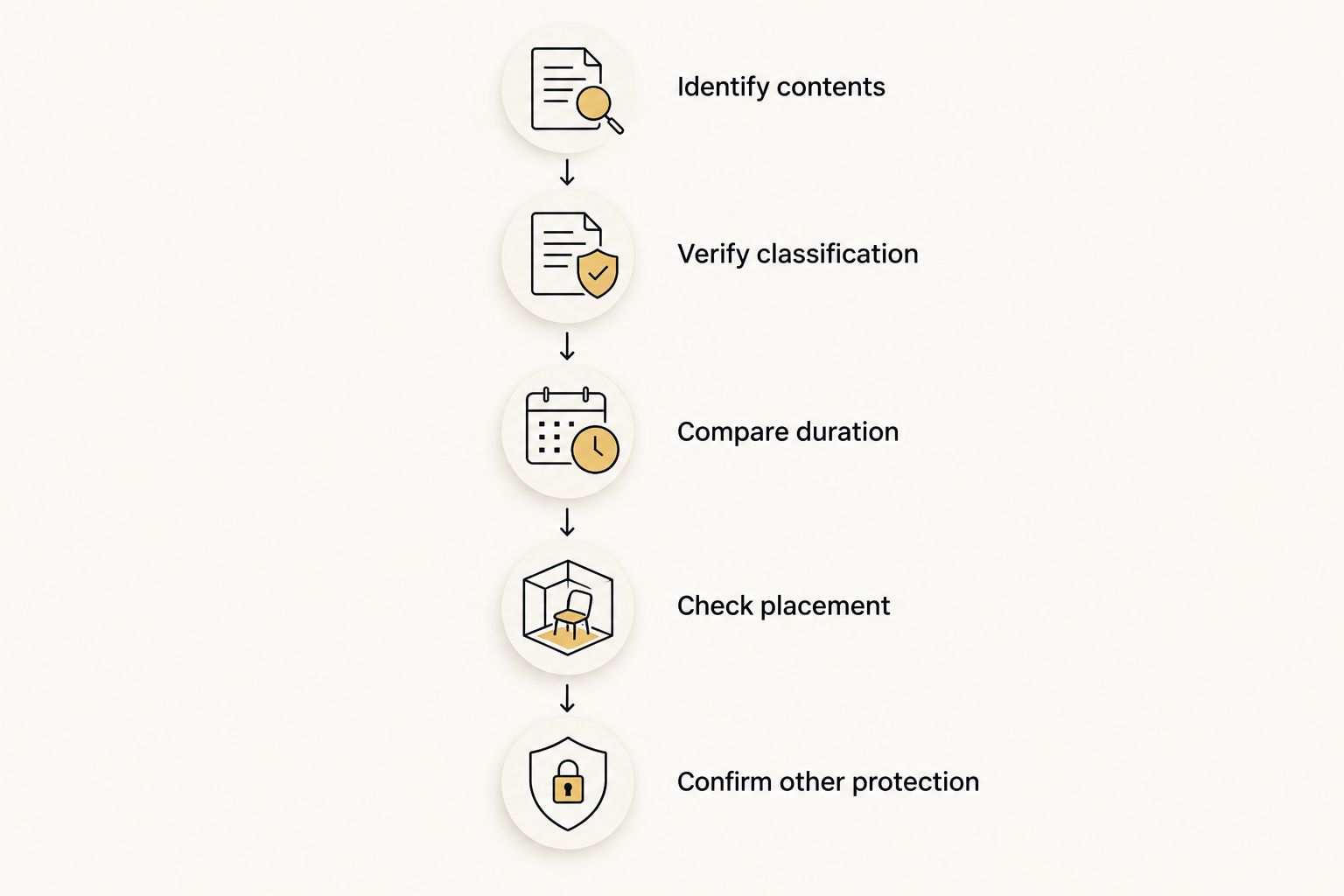
Choose the protection class before comparing the tested duration.
A separate impact, water, or burglary claim needs its own documentation. Do not infer those protections from a fire label, and do not modify a safe’s enclosure or installation beyond the manufacturer’s instructions.
How the categories were ranked
The paper categories are ordered by their stated UL 72 exposure duration, longest first. Class 125 appears separately because contents compatibility comes before duration when comparing paper and media protection.
This is a rating-category comparison, not a model-level product test. It does not assign reliability scores, recommend a particular manufacturer, or establish that an individual safe carries the classification printed in a retailer’s description.
Which fire-resistant safe should you choose?
For paper documents, begin with a verified UL Class 350 rating and choose the duration that meets your requirements. For heat-sensitive media, investigate the appropriate Class 125 protection before comparing duration.
Choose the longer paper rating when tested exposure time is your priority. Do not let a keypad, fingerprint reader, or spacious interior replace the classification check.
If you already own a safe and need help with a service issue, GO Locksmith provides safe service. Describe the safe, the problem, and your location when requesting assistance; the confirmed service listing does not establish support for every model or situation.
FAQ
What's the best fireproof safe rating for paper documents?
UL Class 350 is the paper-record protection category discussed in this guide. Choose a verified duration that meets your requirements; the 4-hour category has the longest tested paper-protection duration in this comparison.
Is a 2-hour fire safe better than a 1-hour safe?
A 2-hour rating provides a longer tested exposure period when both safes have the same classification and certification basis. It does not establish better protection for different contents or guarantee survival in every actual fire.
What does UL Class 350 mean on a safe?
UL Class 350 identifies a paper-record fire-protection classification with a 350°F internal temperature limit under specified test conditions. Read the duration alongside the class; the class number alone does not state how long the safe is rated.
Can I keep digital backups in a paper fire safe?
A paper-safe fire rating does not establish protection for digital backups. Investigate suitable media protection, such as an applicable Class 125 classification, and verify the exact media type against the model's documentation.
Does a fire rating mean a safe is waterproof?
No, a fire rating does not establish water protection. Check the safe's separate water-resistance documentation, including the conditions and exclusions attached to that claim.
Does a fire-resistant safe also protect against burglary?
Not necessarily; fire resistance and burglary resistance are different properties. Review a separate burglary rating or documented security specification rather than treating the fire classification as proof of theft protection.
Can GO Locksmith help with an existing safe?
GO Locksmith provides safe service. Call (239) 412-1101 with the safe details, the issue, and your location to discuss the job and check availability; support for a particular model or procedure requires confirmation.
One last thing: protect the information separately
A safe protects the physical record, while a separate copy protects your ability to recover the information. Keep appropriate copies or backups outside the same building, and secure sensitive information wherever you store it.
Need help with an existing safe? Call GO Locksmith at (239) 412-1101 to discuss safe service and check availability. Hours are Sunday–Thursday 7:00 AM–11:00 PM and Friday 7:00 AM–5:00 PM; Saturday is closed.