
Blog ·
Commercial locksmith services for salons and spas: complete 2026 guide
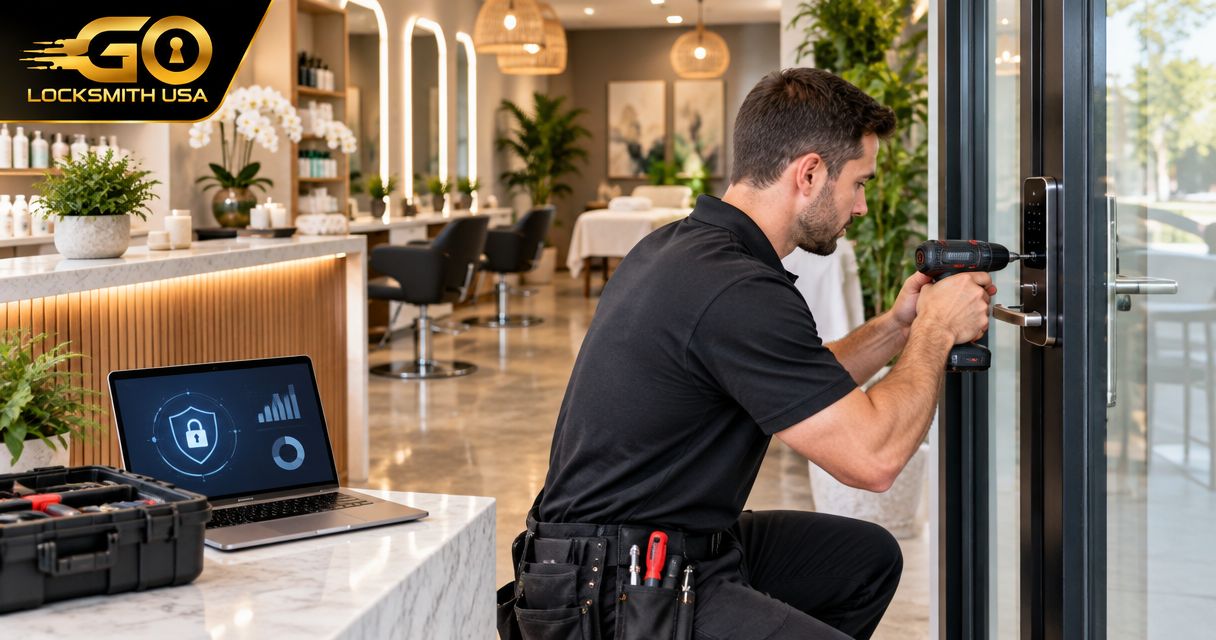
Salon and spa commercial locksmith service is mechanical lock and door-hardware work aimed at keeping authorized staff working, private rooms secure, and exits usable. Your plan should distinguish the public entrance from treatment rooms, employee areas, and storage rather than give every door the same lock or every worker the same key.
TL;DR
- Commercial locksmith services for salons and spas should address staff keys, room privacy, mechanical lock failures, and exit hardware.
- GO Locksmith provides mobile commercial lock and door-hardware services, not electronic access-control installation or repair.
- Rekeying changes which key operates a compatible lock; it does not repair worn hardware.
- Check lease responsibilities and exit requirements before approving changes to commercial doors.
Why commercial locksmith services matter for salons and spas
A salon entrance serves a different purpose from a treatment-room door. Customers need straightforward entry during appointments, practitioners need appropriate room privacy, and managers need control over who can enter before opening or after closing.
GO Locksmith provides mobile commercial locksmith services for salon and spa owners who need mechanical lock and door-hardware service. Its confirmed locksmith services include business and interior-door lockouts, lock repair, replacement, rekeying, fresh installation, push bars, door closers, and broken key extraction.
The useful starting point is not a shopping list of locks. It is a record of which doors you control, who holds keys, and what problem each door actually has.
Build a door-by-door service plan
Map each door's purpose
Start with a paper floor plan or a simple spreadsheet. Mark the entrance, rear door, treatment rooms, staff room, and any separately locked storage that exists in your premises.
Distinguish privacy from access restriction. A treatment room needs a different discussion from a staff-only stockroom, and neither should be treated automatically like the exterior entrance. Describe the room's use before choosing replacement hardware.
- Public entrance: Record opening arrangements and who unlocks it.
- Treatment rooms: Note privacy needs and the current inside-release function.
- Staff areas: Identify which workers need entry.
- Storage: Record the door hardware and who controls the key.
- Rear exit: Note the existing exit hardware and any operating problems.
Record who holds working keys
Create a key register before deciding whether to change locks. List employees, booth renters, independent practitioners, cleaners, and property-management contacts who actually hold keys to your business.
A returned key does not establish that no copies exist. When a working key is missing or its distribution is uncertain, discuss whether rekeying the affected locks is appropriate. Changing staff schedules alone does not change what a physical key opens.
Keep the register private. It should help you make access decisions, not become a directory left at the reception desk.
- Record each keyholder's name and authorized doors.
- Separate entrance keys from treatment-room and storage keys.
- Document key issue and return dates.
- Flag missing keys and unexplained copies.
- Assign responsibility for approving future key distribution.
Match the service to the fault
Observe the problem without dismantling the lock or forcing the door. Note whether the key sticks, the latch misses its opening, the handle feels loose, or the door fails to close fully.
Rekeying addresses key control; repair addresses a fault. Replacement becomes a separate question when the existing hardware is unsuitable or cannot reasonably be repaired. The repair-or-replace guide for exterior door locks explains that distinction further.
GO Locksmith offers commercial lock repair, replacement, and rekeying. Describe the symptoms when requesting service rather than assuming a new lock is necessary. A technician must assess the actual hardware before confirming the appropriate work.
- Report whether the door is open, closed, or locked shut.
- Describe what happens when the key turns.
- Note whether the problem changes when the door is open.
- Identify any broken key remaining in the cylinder.
- Explain recent damage without attempting to straighten components yourself.
Check privacy without compromising exit
Review treatment-room doors from both sides while the rooms are empty. Staff should understand the existing lock function and the approved response if an occupied room cannot be opened normally.
Do not solve a privacy complaint by adding an improvised bolt. Commercial door changes need to account for the room's use, accessibility, and applicable exit requirements. Ask the landlord and the appropriate building or fire official about requirements that are unclear.
Privacy hardware also does not replace staff procedures. Agree on knocking, room-use indicators, and permission to enter without assuming a lock alone prevents interruptions.
- Describe whether the room is customer-facing or staff-only.
- Check that users understand the inside-release function.
- Report sticking handles or unreliable latching.
- Establish an authorized response to an interior-door lockout.
- Confirm approval before adding or changing locking hardware.
Review closers and exit hardware separately
Observe each relevant door during ordinary use. A door that slams, stops short of closing, or fails to latch needs an assessment of the door assembly, not an automatic cylinder replacement.
Push-bar requirements depend on the building's use and applicable rules. A salon or spa label alone does not establish whether a particular door needs panic hardware. Confirm requirements before changing the door's function.
Keep exit routes usable while arranging service. Do not chain an exit shut or add a keyed barrier as a temporary fix for unreliable hardware.
- Report whether the door slams or closes incompletely.
- Note whether the latch engages without extra pushing.
- Identify loose or visibly damaged exit hardware.
- Keep merchandise and treatment equipment clear of exit paths.
- Refer damaged frames or structural issues to the responsible property professional.
Prepare the service request around appointments
Gather the information yourself first: business address, affected doors, symptoms, and authorization to approve work. Then coordinate a service visit with the person responsible for the premises.
Tell the dispatcher whether a treatment room is occupied or whether access requires passing through an active service area. Explain the constraint without assuming a particular arrival or completion time. Ask what access and authorization documentation the technician will need.
For a lockout, avoid repeated force or improvised entry attempts. If someone is in immediate danger, contact emergency services rather than treating the situation as a routine service appointment.
- Provide the full address and suite number.
- Identify the door and whether anyone is inside.
- Describe the lock or hardware using photos if requested.
- Confirm landlord approval where required.
- Ask for a job-specific estimate and explain scheduling constraints.
- Arrange for an authorized decision-maker to be present.
Compare the mechanical service options
Choose the service that matches the problem, not the service name that sounds most secure. A new lock does not correct every door problem, and rekeying does not strengthen damaged hardware.
| Option | Best for | Main benefit | Key limitation |
|---|---|---|---|
| Rekeying | Changed staff access or an unaccounted-for key | Changes the operating key while retaining compatible hardware | Does not repair wear, damage, or door alignment |
| Lock repair | A fault in hardware that remains suitable for the door | Addresses the cause without automatically replacing the assembly | Suitability depends on the condition and fault |
| Lock replacement | Damaged, unsuitable, or unrepairable locking hardware | Allows installation of appropriate replacement hardware | Requires checking door preparation, function, and applicable requirements |
| Door-closer service | Slamming or incomplete controlled closing | Addresses closer-related operation | Does not resolve every frame, hinge, or latch problem |
| Push-bar service | A problem with existing commercial exit hardware | Addresses the exit device rather than just the key cylinder | Requirements and compatibility need confirmation for the specific opening |
| Business or interior-door lockout service | An authorized person unable to enter a locked space | Addresses the immediate access problem | Does not resolve missing-key control or prevent another lockout |
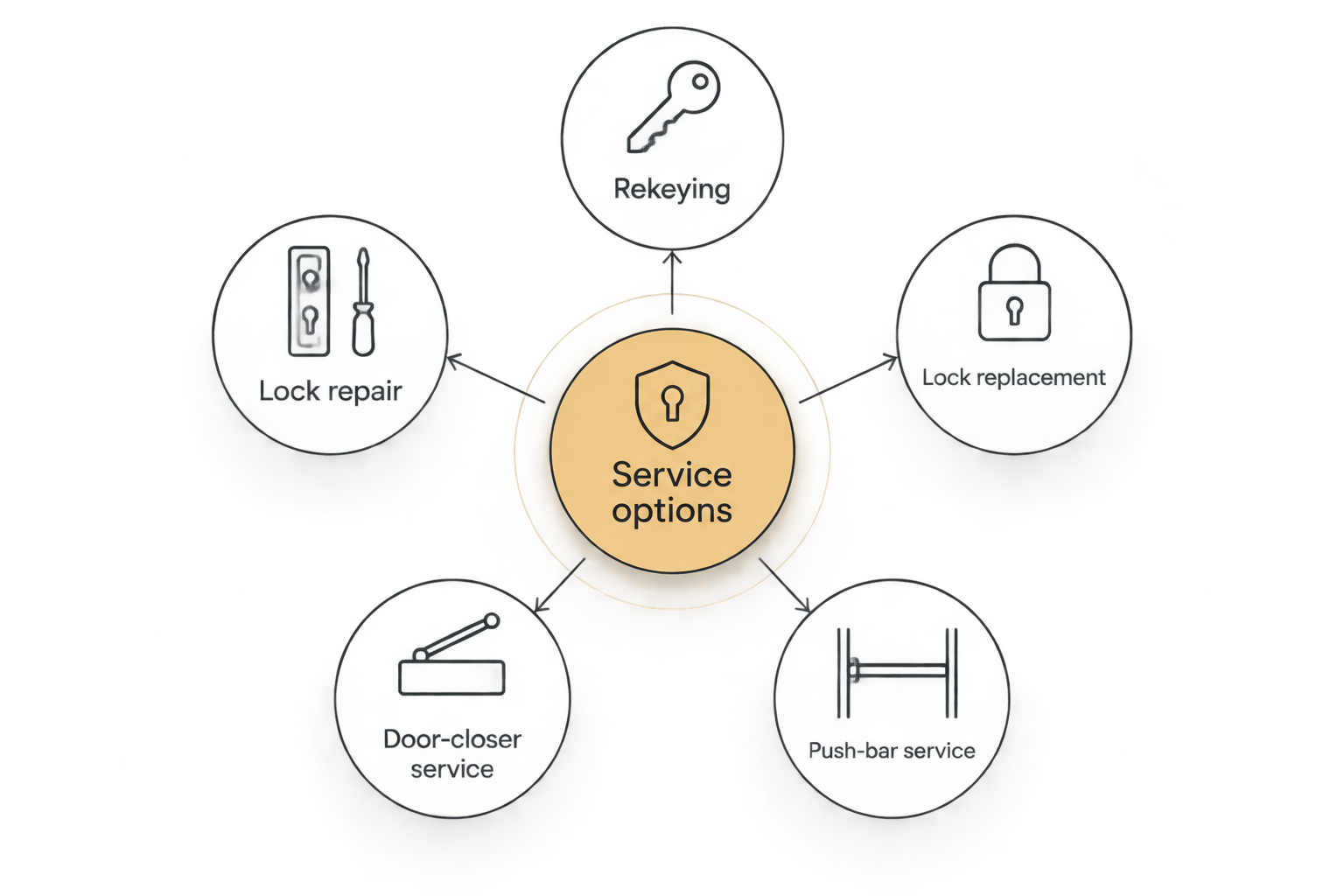
Match the service to the affected component and the problem you need to solve.
The estimate should distinguish the affected openings and proposed work. Ask whether the recommendation concerns the cylinder, lock assembly, closer, or exit device; these are not interchangeable parts of a service request.
Common mistakes salon and spa owners make
Treating a departing renter's key return as the whole plan
Collecting a key is useful, but it does not establish who else has a copy. Review which doors that key operates and decide whether the remaining uncertainty warrants rekeying. Keep that decision separate from any rental or employment dispute.
Giving every practitioner unrestricted access
A person who needs to open the business does not automatically need every private office or stockroom key. Assign access by actual duties and agreements. Document exceptions rather than distributing keys informally at shift changes.
Buying a residential privacy lock for a commercial room
A lock's appearance does not establish that it suits a treatment room. Check the required function, door preparation, accessibility, and applicable rules before purchasing hardware. Do not assume a familiar bathroom-style lock is appropriate for every commercial interior door.
Adding locks before checking the lease
Your lease or property manager may control changes to exterior doors, shared entrances, or specified hardware. Confirm responsibilities before authorizing work. A lockout and permission to alter a door are separate issues.
Replacing the cylinder when the door will not latch
If a door closes poorly, the cylinder is not automatically the cause. Explain whether the latch misses, the closer stalls, or the door rubs. Accurate symptoms help keep the assessment focused on the faulty component.
FAQ
Should I rekey my salon when an employee or booth renter leaves?
Review rekeying when a departing employee or renter held a working key and you cannot account for all copies. First identify which doors the key opens, then confirm authorization and whether the existing locks are suitable for rekeying.
Can a locksmith help if my spa's treatment-room door is locked?
Interior-door lockout assistance is a confirmed GO Locksmith commercial service. Describe the door, whether someone is inside, and who can authorize entry; contact emergency services if anyone is in immediate danger.
Do all salons and spas need push bars on their exit doors?
The business category alone does not determine whether a door requires a push bar. Confirm the requirements for the particular building and opening with the appropriate building or fire official before changing exit hardware.
Does rekeying fix a salon lock that sticks?
Rekeying changes which key operates a compatible lock; it is not a repair for sticking hardware. A sticking key, damaged cylinder, or poorly latching door needs assessment to identify the actual fault.
Can GO Locksmith install electronic access control for my spa?
GO Locksmith does not install or repair electronic access-control systems. Its confirmed commercial work covers mechanical locks, business and interior-door lockouts, fresh lock installation, push bars, door closers, and broken key extraction.
How do I get an estimate for several salon doors?
Request a job-specific estimate with a separate description of each affected door. Provide the address, suite number, symptoms, authorization details, and any appointment-related access constraints.
Can I schedule mobile locksmith service in Southwest Florida?
The confirmed Southwest Florida service areas are Fort Myers, Cape Coral, Lehigh Acres, Estero, Bonita Springs, and Naples. Call to check current availability and explain the commercial door or lock problem; no arrival time is guaranteed.
One last thing: test the handoff, not just the key
Before accepting completed work, ask the technician to explain the affected door's operation. Have the authorized opener and closer understand it too, especially when treatment-room privacy or exit hardware is involved. Store the updated key register somewhere other than the public reception area.
For mechanical lock or door-hardware service, call GO Locksmith at (239) 412-1101 to discuss the job and check availability. Hours are Sunday–Thursday 7:00 AM–11:00 PM and Friday 7:00 AM–4:00 PM; Saturday is closed.