
Blog ·
Commercial locksmith services for retail stores: complete 2026 guide
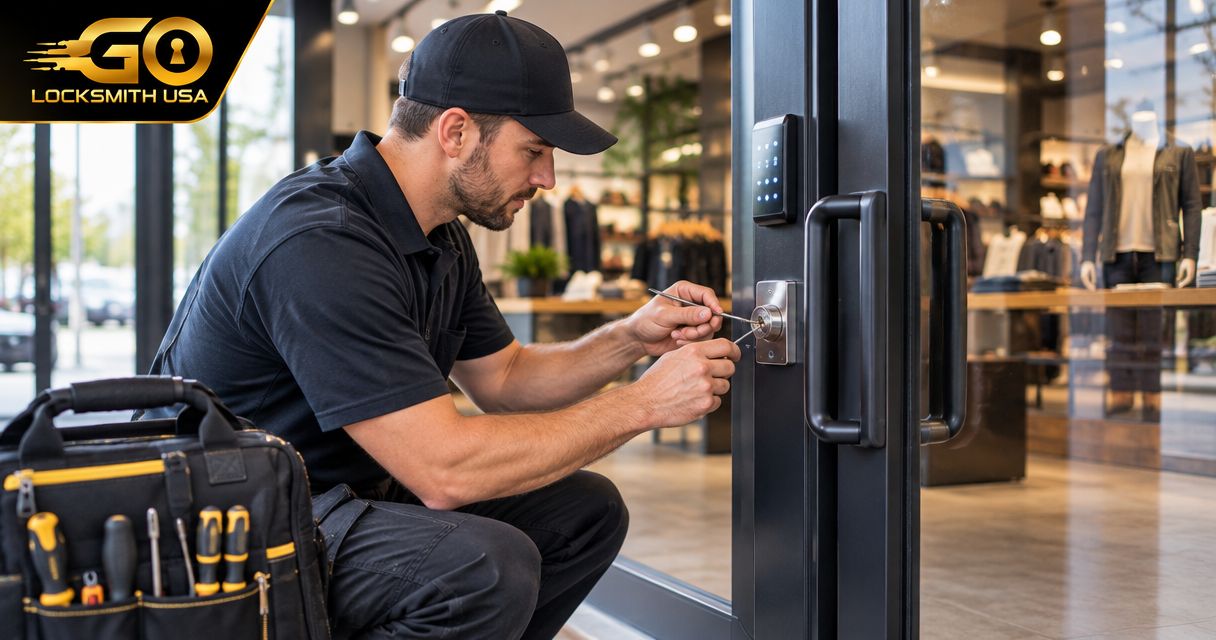
Retail store locksmith service is the repair, rekeying, installation, and opening of commercial locks and door hardware to help retailers control entry and keep doors working properly. Commercial locksmith services for retail stores must account for customer entrances, employee-only rooms, deliveries, and exit hardware—not just the front-door key.
TL;DR
- GO Locksmith provides commercial locksmith services for retail stores needing mobile help with mechanical locks and door hardware.
- Choose rekeying for changed key access; request inspection when a lock or door stops working properly.
- Assess storefront entrances, stockrooms, delivery doors, push bars, and door closers separately.
- GO Locksmith does not install or repair electronic access-control systems.
Why commercial locksmith service matters for retail stores
A retail door serves different people throughout the day. Customers need an accessible entrance, employees need appropriate access, and closing managers need to know that the premises are secured.
A missing key and a door that will not latch are different problems. Rekeying addresses which key operates a compatible lock; it does not correct a damaged frame or a door that drags.
GO Locksmith is a fit for Southwest Florida retailers needing mobile commercial locksmith services for mechanical locks and door hardware. Its confirmed locksmith services include business and interior-door lockouts, lock repair, replacement, rekeying, fresh installation, push bars, door closers, and broken key extraction.
The service is mobile, with Fort Myers as its primary market. Confirmed Southwest Florida service areas also include Cape Coral, Lehigh Acres, Estero, Bonita Springs, and Naples; no storefront visit is implied.
Plan the work around how your store operates
Map each door and its purpose
Start with a walk-through and a simple written list. Record what each door separates, who uses it, and whether the problem involves entry, locking, closing, or latching.
Distinguish a stockroom door from a delivery entrance even if both use similar-looking hardware. Their roles differ, and the same change is not automatically appropriate for both.
Include leased-space boundaries. Your lease or property manager determines who can authorize changes to shared entrances or landlord-controlled hardware; do not assume that responsibility belongs to the shop tenant.
- Customer entrance: Note sticking, loose handles, or difficulty locking at closing.
- Delivery door: Record who holds keys and whether the door closes and latches.
- Staff-only doors: List stockrooms, offices, and interior rooms with restricted access.
- Exit hardware: Record visible damage or difficulty operating a push bar.
- Shared doors: Identify the property manager responsible for authorizing work.
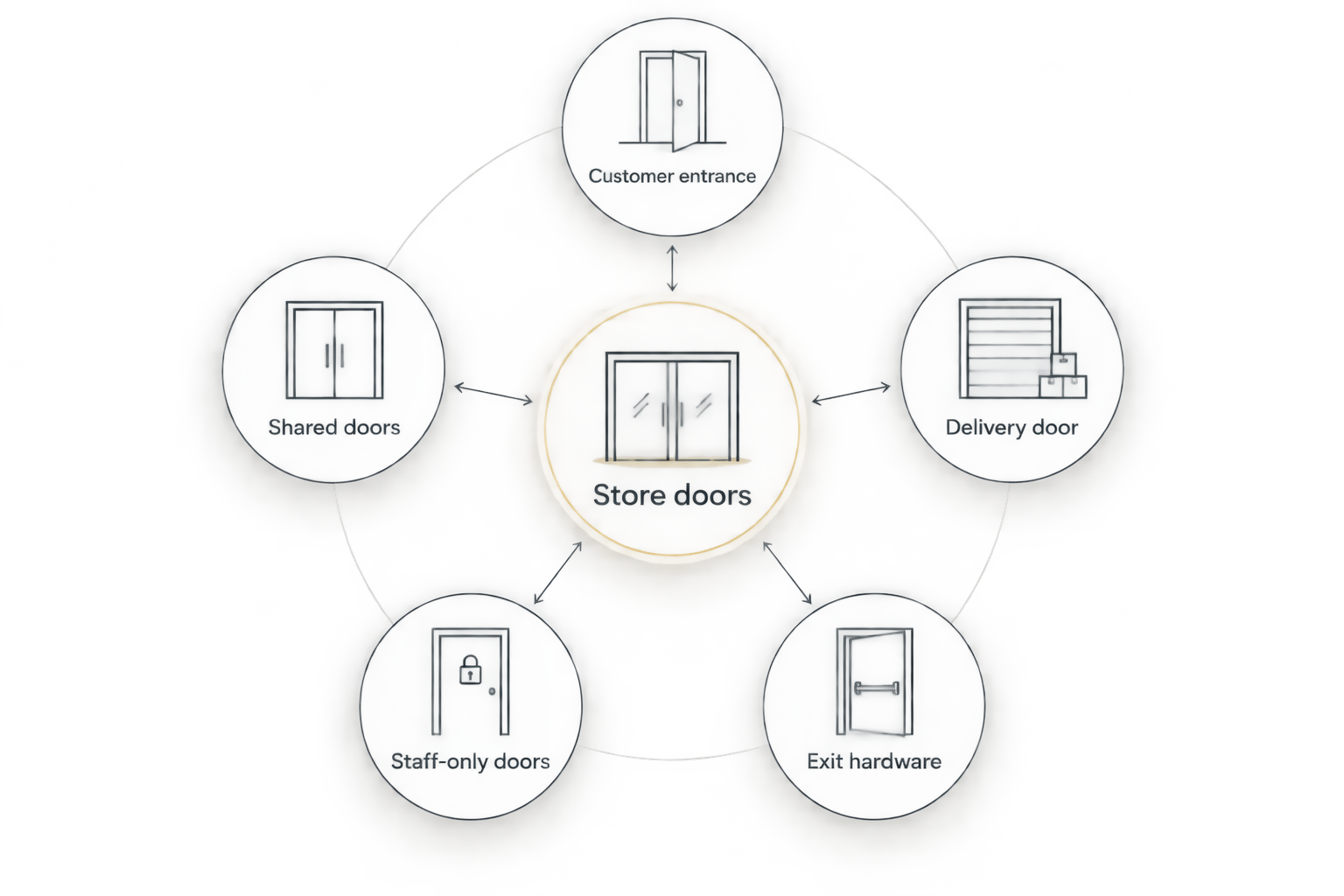
Identify each door's purpose before deciding what work to request.
Separate key-control problems from hardware faults
Write down the symptom before deciding on a service. A former employee retaining a key creates an access concern; a key that turns only when someone pulls the door suggests a problem that needs inspection.
Rekeying changes the working key while retaining compatible existing lock hardware. Replacement changes the hardware itself. Neither decision should rest on appearance alone.
For a sticking storefront lock, describe whether the difficulty occurs with the door open, closed, or both—without forcing the mechanism. That observation helps explain the complaint, but it is not a diagnosis.
- List missing, unreturned, or unaccounted-for keys separately from damaged hardware.
- Note whether the key enters, turns, and comes out normally.
- Record whether the door rubs, sags visibly, or fails to latch.
- Photograph the lock and door edge without exposing key-cut details.
- Stop forcing a key that bends or meets unusual resistance.
Match the service request to the actual problem
Use your door list and symptoms to describe the job when calling. You do not need to identify the lock model correctly before asking for help, but clear photographs and a plain description make the request more specific.
GO Locksmith offers the confirmed mechanical commercial services listed above, including business lockouts and broken key extraction. Whether a particular lock can be repaired, rekeyed, or replaced depends on the hardware and its condition.
Ask for assessment before authorizing replacement of a functioning lock solely because a key is missing. Conversely, do not treat rekeying as a repair for worn or damaged parts.
- Request business lockout help when authorized staff cannot enter the premises.
- Ask about rekeying when you need to change which keys operate existing locks.
- Describe sticking, looseness, or failure to secure when requesting lock repair.
- Identify push-bar or door-closer concerns separately from cylinder problems.
- Confirm the job scope rather than assuming all doors need identical work.
Protect customer movement and exit operation
Inspect door behavior without dismantling hardware or changing adjustments. Note whether the entrance slams, remains partly open, or requires someone to pull it shut.
A door closer controls closing movement; the latch holds the door shut. Replacing a lock cylinder does not address every closing or latching problem, so explain the whole sequence rather than reporting only that the door is “broken.”
Do not add a locking device to an exit door simply because it appears more secure. Exit and accessibility requirements depend on the building, occupancy, door, and applicable rules; confirm proposed changes with the appropriate building or fire authority when required.
- Keep merchandise and delivery cartons clear of door operation and exit paths.
- Report a push bar that binds, feels loose, or does not release normally.
- Note slamming or incomplete closing without attempting closer adjustments yourself.
- Flag fire-rated or labeled doors before anyone proposes hardware changes.
- Avoid improvised chains, bolts, or wedges as substitutes for proper repair.
Arrange authorization and a clear work scope
Before booking, identify who can approve work and who will meet the technician. For a leased retail unit, coordinate with the property manager if the affected hardware falls under landlord control.
Ask what proof of authorization is required for the requested service. Have the business name, service address, affected entrance, and responsible contact ready; do not send sensitive documents through an unverified channel.
For a job-specific estimate, explain the symptoms, number of affected doors, and whether parts appear damaged. Ask what work the estimate covers and how any additional work will be approved.
- Name the person authorized to approve the job.
- Confirm tenant or landlord responsibility before altering hardware.
- Provide the exact store location and appropriate meeting entrance.
- Describe the affected doors and requested services separately.
- Ask for an explanation of scope changes before approving them.
Test the result and update your key records
After the work, ask for a demonstration of the affected lock and door. Test normal operation from the appropriate sides while someone authorized remains present; avoid locking everyone outside during the check.
A completed rekey also needs an updated key record. Otherwise, the store starts another cycle of undocumented copies and uncertainty about who can enter.
Keep hardware concerns separate in the final notes. If a lock now works but a frame or door problem remains outside the agreed scope, record that unresolved issue and assign responsibility for addressing it.
- Check that the intended keys operate the serviced lock.
- Observe the door closing and latching through normal use.
- Ask how the serviced push bar or closer should operate.
- Record who receives each newly issued key.
- Keep the work description and any remaining concerns with store records.
Compare the service options
Choose the service by the problem, not by the assumption that every lock issue requires new hardware. These options address different needs; none replaces inspection of the actual door and lock.
| Option | Best for | Main benefit | Key limitation |
|---|---|---|---|
| Rekeying | Changing key access when existing hardware is suitable | Retains the existing compatible lock while changing its working key | Does not repair worn components or door alignment |
| Lock repair | A malfunctioning lock with repairable components | Addresses the identified fault without automatically replacing everything | Depends on condition, construction, and the fault |
| Lock replacement | Hardware that is unsuitable or cannot be satisfactorily repaired | Replaces the affected lock hardware | Must suit the door and its operational requirements |
| Business lockout service | Authorized staff unable to enter | Addresses the immediate access problem | Does not automatically resolve missing-key control afterward |
| Push-bar or door-closer service | Problems operating exit hardware or controlling door closing | Focuses on hardware beyond the key cylinder | Is not a substitute for evaluating the complete door assembly |
For the repair-versus-replacement decision, compare repairing or replacing an exterior door lock against the symptoms you recorded. A replacement decision should address the fault, not simply produce a newer-looking lock.
Common mistakes retail stores make
Treating a returned key as proof that access is controlled
A returned key does not establish whether other copies exist. When access must change after an employee departure, missing key, or tenant turnover, review the affected doors and discuss rekeying where appropriate.
Do not rekey only the front entrance without checking whether the same concern applies to the delivery entrance or stockroom. Base the scope on actual key access.
Replacing the lock before assessing break-in damage
Following forced entry, a damaged frame or door can remain a problem even after the cylinder is replaced. If there is immediate danger or suspected criminal activity, contact emergency services or law enforcement before arranging routine repair.
The scope behind door repair costs after a break-in is separate from lock work: damage to the door or frame needs its own assessment. Ask who is responsible for each part of the repair rather than assuming a locksmith estimate covers rebuilding the opening.
Propping open a troublesome delivery door
A door that repeatedly sticks or fails to close needs attention, not a permanent workaround. Leaving it propped open also defeats the store's intended control over that entrance.
Record the symptoms and escalate the issue to the responsible manager. Keep delivery procedures separate from hardware repairs, especially when the door also serves an exit function.
Requesting electronic access-control work as ordinary lock repair
Card readers, electronic access permissions, and connected access-control systems are not the same scope as mechanical lock service. Describe electronic components at the outset so the request reaches an appropriate provider.
GO Locksmith does not install or repair electronic access-control systems. Its commercial scope focuses on the confirmed mechanical lock and door-hardware services, not software integrations or remote employee-access management.
FAQ
Should a retail store rekey or replace locks after an employee leaves?
Rekeying is an option when you need to change key access and the existing lock is compatible and in suitable condition. Replacement addresses hardware that is unsuitable or cannot be satisfactorily repaired; an employee departure alone does not establish that replacement is necessary.
Can a locksmith help if our store key breaks in the lock?
Broken key extraction is a confirmed commercial locksmith service. Explain whether the door is locked and whether the lock was already difficult to operate; the hardware needs assessment before its condition can be determined.
Does every retail store exit need a push bar?
A retail store's push-bar requirements depend on the applicable building and fire rules and the specific occupancy and door. Confirm the requirement with the appropriate authority rather than choosing exit hardware solely by appearance.
Can changing the lock fix a storefront door that slams?
Changing a lock does not directly address a door's closing speed. A slamming door needs assessment of the closer and related door conditions, while any separate locking problem should be described as its own symptom.
How do I get an estimate for commercial locksmith work?
Call with the service address, affected doors, symptoms, and requested work to ask for a job-specific estimate. Clarify what the estimate covers and how additional work will be approved.
Does GO Locksmith offer overnight or Saturday retail lockout service?
GO Locksmith's stated hours are Sunday–Thursday, 7:00 AM–11:00 PM, and Friday, 7:00 AM–4:00 PM; Saturday is closed. Do not assume overnight service outside those hours; call during business hours to check current availability.
One last thing: check the delivery door too
Your closing checklist should cover every relevant entrance, not just the door customers use. Confirm that the delivery entrance and restricted interior doors operate as intended, and record faults before they become another shift's unexplained problem.
Need help with a retail lockout, rekey, or mechanical door-hardware issue? Call GO Locksmith at (239) 412-1101 during business hours to discuss the job, request an estimate, and check current availability.