
Blog ·
Commercial locksmith services for pharmacies: complete 2026 guide
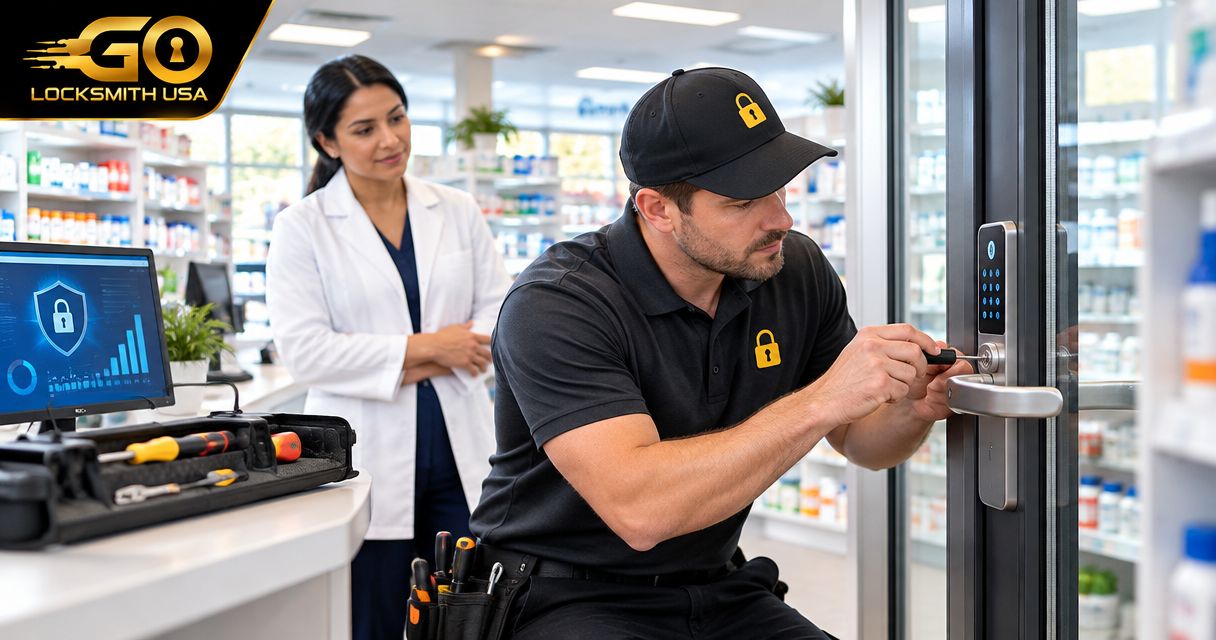
Commercial locksmith services for pharmacies are lock and door-hardware services that help pharmacy managers control entry, resolve lockouts, and keep doors working properly. A pharmacy needs to distinguish public entrances, staff-only doors, medication-storage areas, and exit routes rather than treat every lock as the same job.
TL;DR
- Commercial locksmith services for pharmacies should address key custody, mechanical faults, and exit hardware as separate issues.
- GO Locksmith provides mobile commercial lock, rekey, push bar, and door closer services—not electronic access-control installation or repair.
- Rekeying changes which key operates a compatible lock; it does not repair worn or damaged hardware.
- Confirm pharmacy security requirements and door-hardware restrictions before approving changes to restricted areas or exits.
Why commercial locksmith services matter for pharmacies
A working lock and controlled access are different problems. A lock can operate normally while an unreturned key remains in circulation. Conversely, collecting every issued key does not fix a door that fails to latch.
For a pharmacy manager, the first decision is whether the problem concerns entry permission, failed hardware, or both. Start with the confirmed commercial locksmith services, then describe the affected door and the operational problem rather than request a particular replacement immediately.
Keep the scope clear: mechanical locksmith work is not a pharmacy security assessment or a determination of regulatory compliance. Your pharmacist-in-charge, property manager, applicable authorities, and relevant security providers should resolve requirements that extend beyond the mechanical work.
Plan the work around pharmacy operations
Map your doors
Start with a paper floor plan or a simple spreadsheet. List the public entrance, delivery entrance, staff doors, interior restricted-area doors, and any other door involved in the request. Keep this record private; it describes how people enter your business.
For each door, record its purpose and who controls it. A door inside a shared medical building can involve a different approval process from a pharmacy's own entrance. Confirm that distinction before authorizing changes.
Do not assume a lock used elsewhere in the building suits a medication-storage area. Establish the applicable requirements first, then have the existing door and hardware assessed for the proposed work.
- Label each affected door consistently in your notes.
- Record whether the door is pharmacy-controlled or landlord-controlled.
- Identify public, staff-only, and restricted-area uses.
- Note any exit signs, closers, or push bars already present.
- Keep photographs free of patient information and visible key details.
Review key custody
Use your existing staff records to establish who holds each relevant key. Start with active employees, former employees, managers, contractors, and anyone else authorized to hold a copy. Record uncertainty instead of marking an unconfirmed key as returned.
Rekeying addresses key access; replacement addresses the hardware when replacement is necessary. On a compatible rekeyable lock, rekeying changes the internal configuration so a different key operates it. It does not make a damaged latch, loose handle, or failing closer work properly.
If a key operates several doors, identify the full affected group before requesting work. Do not assume every cylinder can be rekeyed together or that a proposed change preserves an existing key arrangement.
- List issued keys against named authorized holders.
- Mark missing and unreturned keys separately.
- Identify other doors operated by the same key.
- Confirm who can approve a change in key access.
- Plan how authorized staff will receive replacement keys.
Describe the fault
Before calling, write down what staff actually experience. Useful descriptions include a key that will not turn, a broken key in the cylinder, a door that closes without latching, or a push bar that does not operate normally. Avoid forcing the hardware to reproduce a fault.
GO Locksmith provides mobile commercial locksmith services for pharmacies needing mechanical lock and door-hardware work. Its confirmed commercial services include business and interior door lockouts, lock repair, replacement and rekeying, fresh installation, push bars, door closers, and broken key extraction. It does not install or repair electronic access-control systems.
A symptom is not a diagnosis. A door that needs pulling or lifting before the key turns warrants an assessment of the door and hardware, not an automatic request for a new cylinder. The guide to repairing or replacing an exterior door lock explains that decision in more detail.
- State whether the door is locked, unlocked, or intermittently working.
- Describe the key, handle, latch, closer, or push bar symptom.
- Mention visible damage without attempting disassembly.
- Explain whether the fault affects opening, closing, or both.
- Separate mechanical symptoms from electronic-system alerts.
Confirm hardware requirements
Gather the information you already have: lease restrictions, door documentation, existing hardware details, and the pharmacy's security procedures. Ask the responsible decision-maker to identify requirements for the particular opening before selecting new hardware.
Exit hardware needs separate attention. Do not add another lock, alter a push bar, or change door-closing behavior simply to make entry more restrictive. Have proposed changes checked against the applicable fire, building, accessibility, and pharmacy requirements by the responsible parties.
A locksmith's mechanical service scope does not establish whether the pharmacy needs a particular security configuration. When an opening includes electronic components, clarify who handles those components and whether the proposed mechanical work affects them.
- Confirm landlord approval where the lease requires it.
- Identify any documented door or hardware restrictions.
- Ask the responsible authority about unresolved exit requirements.
- Confirm whether electronic components are involved.
- Record the approved scope before work begins.
Plan service access
Prepare a short service brief instead of relying on a verbal description passed between shifts. Include the location, affected door, symptoms, authorized contact, and the requested assessment. Keep sensitive pharmacy information out of routine messages and photographs.
GO Locksmith serves Fort Myers, Cape Coral, Lehigh Acres, Estero, Bonita Springs, and Naples. It is a mobile service; arrange service at the affected property rather than planning a storefront visit. Call to check current availability and discuss the specific job.
Choose a work period with the pharmacy manager and responsible staff. Plan how deliveries, customer entry, and restricted-area access will be managed while the door is being assessed or serviced. Do not assume a lockout or replacement has a fixed completion time.
- Give the exact property location and affected entrance.
- Arrange an authorized person to meet the service provider.
- Ask what authorization or property documentation is needed.
- Explain operational restrictions before work is scheduled.
- Request a job-specific estimate and clarify its scope.
Check the handover
Before treating the job as complete, have the authorized manager review what changed. Distinguish a repaired fault from a change in key access, and ask which components were retained or replaced.
Check normal operation with the service provider using the agreed scope. For a rekey, confirm that authorized keys operate the serviced lock and ask how to verify that superseded keys no longer do. For a closer or push bar issue, have the provider explain the work performed and any remaining concerns.
Update your internal records after the work—not at the end of an unrelated maintenance cycle. An accurate key register and door history help the next manager understand the current arrangement without guessing.
- Confirm which doors and components received service.
- Review normal locking, latching, and opening operation.
- Update key assignments and collect superseded keys.
- Record unresolved faults or work outside the agreed scope.
- Retain the service documentation with restricted access.
The process should leave a clear record from the original door problem through the final handover. Keep responsibility assigned at every stage, particularly when the landlord and pharmacy approve different parts of the work.
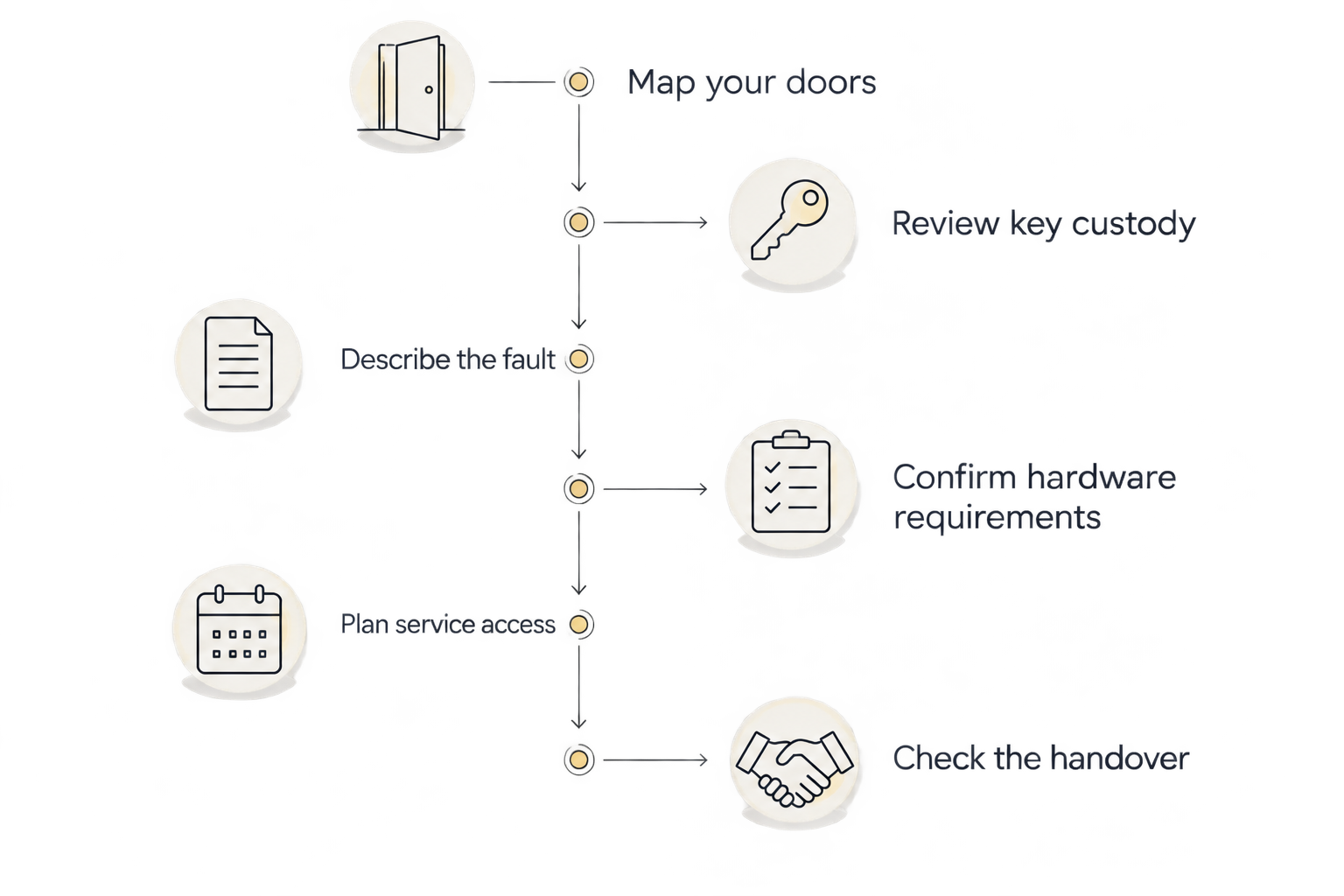
Document the door problem before choosing the work, then update the records after handover.
Compare the mechanical service options
Choose the service that addresses the diagnosed problem, not the most extensive change. These options solve different issues, and a single door can need more than one type of work. Final suitability depends on the existing hardware and the requirements for that opening.
| Option | Best for | Main benefit | Key limitation |
|---|---|---|---|
| Lock rekeying | Changing key access on compatible, serviceable hardware | Retains suitable hardware while changing the operating key | Does not fix damaged hardware or create an access log |
| Lock repair | A mechanical fault that can be corrected | Addresses the fault without automatically replacing the entire lock | Suitability depends on the fault, condition, and parts |
| Lock replacement | Hardware assessed as unsuitable or beyond repair | Allows an appropriate replacement to be selected | Requires checking door compatibility and applicable restrictions |
| Door closer service | Problems with controlled door closing | Addresses the closer's role in door movement | Does not resolve every latch, alignment, or lock problem |
| Push bar service | Faults involving existing exit hardware | Addresses mechanical operation of the exit device | Does not by itself establish that the opening meets every applicable requirement |
Ask for the reason behind the recommendation. If replacement is proposed, ask what makes repair unsuitable. If rekeying is proposed, ask whether the existing lock is mechanically sound and whether other doors are affected by the same key.
Common mistakes pharmacy managers make
Treating a lost key as only a lockout
Opening a door restores entry, but it does not address the missing key. Determine which doors that key operates and have the authorized manager decide whether a change in access is necessary.
Rekeying a door that still fails to latch
A new operating key does not correct every mechanical fault. Report both the access concern and the closing problem so the service request does not stop at the cylinder.
Changing restricted-area hardware without approval
A convenient replacement is not automatically appropriate for a medication-storage area. Confirm the pharmacy's requirements and approval process before authorizing a hardware change.
Assuming stronger entry restrictions improve every door
An entrance and an exit route have different functions. Do not add locking hardware or disable existing exit hardware as an improvised security measure; obtain the necessary assessment first.
Sending sensitive details with a service request
A photograph can show the door problem without exposing prescription labels, patient records, key-cut details, or security codes. Review attachments before sending them and share only what the service provider needs.
FAQ
What commercial locksmith services can a pharmacy request?
A pharmacy can request assessment of mechanical lockouts, lock faults, rekeying needs, replacement locks, push bars, and door closers. The appropriate work depends on the door, existing hardware, authorization, and applicable requirements.
Should a pharmacy rekey its locks when an employee leaves?
Review the departing employee's key access and whether all issued keys have been returned. If access needs to change, ask whether the affected locks are compatible with rekeying and identify every door operated by the same key.
Is rekeying better than replacing a pharmacy door lock?
Rekeying fits a key-access change when the existing lock is compatible and serviceable; replacement fits hardware that needs replacing. Neither choice should be made without considering the lock's condition and the requirements for the opening.
Can GO Locksmith install electronic access control at a pharmacy?
No. GO Locksmith does not install or repair electronic access-control systems. Its confirmed commercial scope covers mechanical locks and specified door hardware, including push bars and door closers.
Does every pharmacy exit door need a push bar?
Do not assume every pharmacy exit has the same hardware requirement. Ask the responsible fire or building authority to confirm the requirements for the particular opening before approving changes.
Can a locksmith guarantee that a pharmacy meets security regulations?
Mechanical locksmith service alone does not establish pharmacy regulatory compliance. Have the pharmacist-in-charge and the relevant authorities or qualified advisers resolve the pharmacy's specific obligations.
What should I prepare before calling about a pharmacy lockout?
Prepare the property location, affected door, your authorization to request entry, and a clear description of the problem. Ask what documentation is needed and whether the job involves mechanical hardware, electronic components, or both.
One last thing
An unreturned key and a failing door need separate decisions—even when they affect the same entrance. Put both on the service brief so restored entry does not get mistaken for resolved key access or repaired hardware.
For pharmacy lock, rekey, push bar, or door closer work, call GO Locksmith at (239) 412-1101 to discuss the problem and check availability. Hours are Sunday–Thursday 7:00 AM–11:00 PM and Friday 7:00 AM–4:00 PM; Saturday is closed.