
Blog ·
Commercial locksmith services for government offices: complete 2026 guide
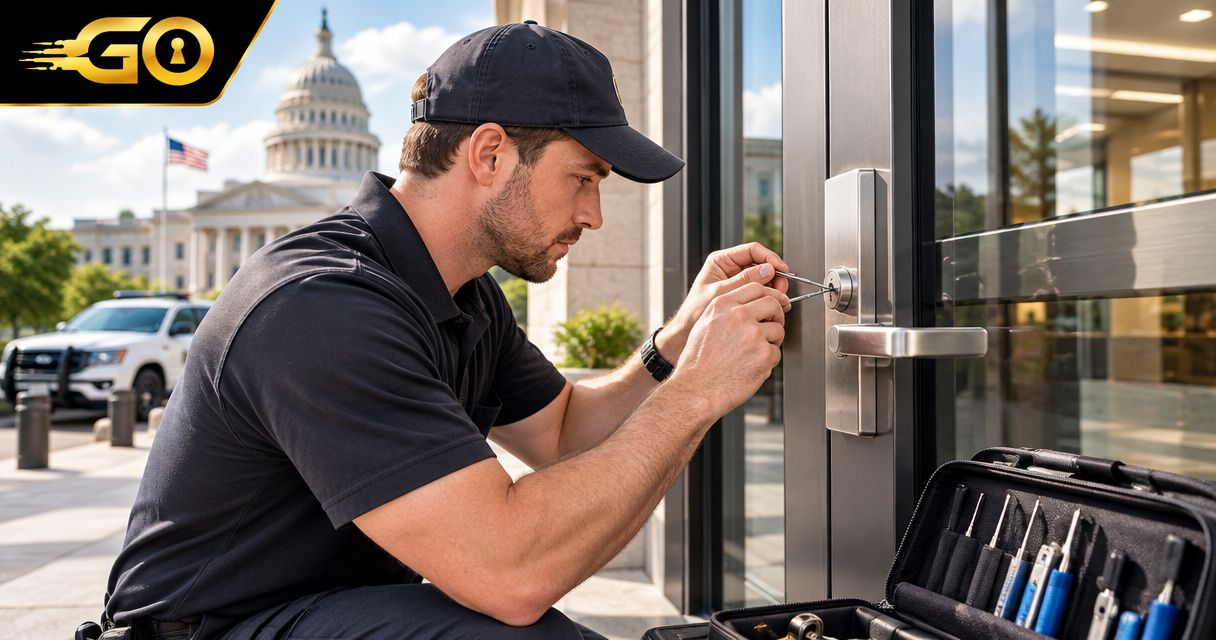
Government office commercial locksmith service is work on mechanical locks and door hardware aimed at maintaining authorized access while keeping public services operating. Unlike a private office, a government facility needs clear work authorization, documented key control, and attention to public access and exit requirements—not just a working key.
TL;DR
- Commercial locksmith services for government offices should separate lockouts, rekeying, lock repairs, and exit-hardware concerns.
- GO Locksmith provides mobile commercial locksmith services for offices needing mechanical lock and door-hardware work.
- Rekeying changes which keys operate a compatible lock; replacement addresses hardware that needs changing.
- Confirm agency authorization, purchasing requirements, and door-specific restrictions before approving work.
- GO Locksmith does not install or repair electronic access-control systems.
Why commercial locksmith services matter for government offices
A government office door serves more than one purpose. A public entrance, staff corridor, records room, and shared building entrance each have different access needs; treating them as interchangeable creates an incomplete work order.
Order work around the door’s function and the actual problem—not a blanket instruction to change every lock. A missing key requires a key-control decision. A door that fails to latch requires investigation of the door and hardware, not an assumption that rekeying will fix it.
GO Locksmith’s confirmed commercial services include business and interior door lockouts, lock repair, replacement, rekeying, fresh installation, push bars, door closers, and broken key extraction. Specific hardware and job suitability need confirmation before service is arranged.
This guide addresses routine office facilities decisions. Do not treat it as a specification for detention areas, classified spaces, or other specialized government facilities; route those requirements through the agency’s designated security and facilities personnel.
Plan the work before requesting service
Identify each affected door and its purpose
Start with a building walk-through and a simple door list. A spreadsheet or paper checklist is enough to distinguish a public-facing entrance from a staff-only room and record what is actually wrong.
Describe symptoms without diagnosing the mechanism. For example, record that a key turns but the latch does not retract, rather than labeling the cylinder defective. Note whether the problem happens consistently or only when the door is closed.
Avoid circulating photographs that expose restricted room names, key details, or sensitive floor plans. Use the agency’s approved method for sharing job information with an outside provider.
Keep the work order tied to individual openings. A request covering “the administration building” leaves too much room for disagreement about which doors need attention.
- Assign a clear door identifier.
- Record whether the door serves public or staff access.
- Describe the observed symptom.
- Note visible hardware markings without dismantling anything.
- Identify any building-management contact responsible for that opening.
Confirm who can authorize access and changes
Check your agency’s facilities and purchasing procedures before arranging entry or changing a lock. Occupying an office does not, by itself, establish authority to alter a shared entrance or building-owned hardware.
Separate permission to enter from permission to modify. An employee reporting a lockout, a facilities manager approving repairs, and a purchasing officer authorizing expenditure can be different people. Establish the approval path before an urgent situation tests it.
For leased premises, review who controls the affected door under the lease and building procedures. Do not assume that an agency’s internal approval replaces any required owner authorization.
Prepare the documentation your agency and the service provider require without sending sensitive identification through an unapproved channel. Confirm requirements directly rather than assuming a standard document will be sufficient.
- Name the person requesting service.
- Identify the person authorized to approve changes.
- Confirm ownership or management responsibility.
- Check purchasing and vendor-onboarding requirements.
- Arrange an authorized on-site contact or escort.
Match the service to the actual problem
Use the door list to distinguish an access incident from a hardware failure. Rekeying addresses which keys work; it does not repair a damaged lock or correct a door that will not close properly.
A business lockout requires an entry-service discussion. A broken key requires an extraction assessment. A damaged or unreliable mechanism calls for evaluation before deciding between repair and replacement.
GO Locksmith provides mobile commercial locksmith services for offices needing mechanical lock and door-hardware work. The service list is not confirmation of compatibility with every government building’s hardware, restricted key system, or procurement specification; describe those requirements when calling.
Keep electronic problems separate. A failed badge reader or an access-permission issue is not automatically a mechanical lock fault, and electronic access-control installation and repair are outside this provider’s confirmed services.
- Describe missing keys as a key-control concern.
- Report lockouts separately from hardware faults.
- Identify broken keys without attempting extraction yourself.
- Flag locks that bind, spin, or fail to latch.
- Route badge-reader and electronic system faults to the responsible provider.
Check exit and accessibility constraints before changing hardware
Review the door’s role with facilities staff before approving a different lock, push bar, or closer. Hardware selection must account for the opening, its use, and applicable requirements—not simply what fits the existing holes.
Do not assume every government office entrance needs the same exit device. Occupancy, door location, and applicable code provisions affect the answer; confirm requirements with the appropriate building or fire authority when needed.
A closer also affects how the door behaves during everyday use. Report slamming, failure to latch, or difficulty opening without making unverified adjustments or adding hardware to compensate.
The guide to whether a commercial building needs a push bar provides related context. Building-specific decisions still belong with the responsible facilities personnel and authority having jurisdiction.
- Identify designated exit doors.
- Flag fire-rated openings for appropriate review.
- Report opening, closing, and latching problems separately.
- Avoid adding secondary locks without approval.
- Confirm who reviews accessibility and exit requirements.
Schedule work around public service and secure areas
Build the appointment around how the office operates. A public counter entrance and a staff records-room door create different coordination needs, even when the mechanical repair is similar.
Ask the service provider to discuss the proposed scope and scheduling before committing to a work window. Do not promise staff a completion time until the actual job has been assessed and arrangements confirmed.
GO Locksmith is mobile and serves Fort Myers, Cape Coral, Lehigh Acres, Estero, Bonita Springs, and Naples. Call to check current availability and whether the specific job can be handled.
Published hours are Sunday–Thursday, 7:00 AM–11:00 PM, and Friday, 7:00 AM–5:00 PM; Saturday is closed. Match the service request to those hours rather than treating mobile service as round-the-clock coverage.
- Explain public-facing operating constraints.
- Arrange escort access where agency procedures require it.
- Identify who can approve a revised scope.
- Plan how the affected area will remain secured.
- Confirm scheduling directly with the provider.
Verify operation and close the key-control record
Agree on acceptance checks before work begins. Afterward, have the authorized representative review the completed scope and observe operation from both sides of the affected door where appropriate.
Do not close a rekey work order solely because the new key turns. Confirm authorized entry, intended locking operation, and normal closing and latching, with any exit or accessibility concerns referred for appropriate review.
Update the agency’s key records through its existing process. Keep sensitive key information separate from broadly distributed invoices or maintenance summaries, and record unresolved issues rather than treating them as completed work.
A useful closeout record explains what changed and what remains outstanding. It should let another facilities employee understand the job without relying on the memory of the person who met the technician.
- Record the doors included in the completed work.
- Verify intended key operation.
- Observe closing and latching.
- Update authorized key-holder records.
- Document outstanding defects and follow-up responsibility.
Compare mechanical service options
Start with the symptom, then confirm the appropriate service after assessment. Replacing a lock is not automatically an improvement over repairing or rekeying it; the right choice depends on hardware condition and the access problem.
| Option | Best for | Main benefit | Key limitation |
|---|---|---|---|
| Business or interior door lockout service | Authorized occupants unable to enter | Addresses the immediate access problem | Does not by itself resolve missing-key exposure or an underlying defect |
| Rekeying | Changing authorized keys on compatible, serviceable locks | Changes key operation while retaining suitable hardware | Does not repair worn components or suit every lock system |
| Lock repair | A repairable mechanical fault | Retains hardware that remains suitable for the opening | Assessment can reveal that replacement is necessary |
| Lock replacement | Damaged, unsuitable, or unserviceable locks | Changes the affected hardware | Requires compatibility and door-function checks |
| Fresh lock installation | An approved opening needing a new lock installation | Adds the specified locking hardware | Door preparation and applicable restrictions need review |
| Push bar or door closer service | Problems involving exit hardware or controlled closing | Addresses hardware beyond the keyed lock | Does not replace building-specific code or accessibility review |
For estimates, provide the door list, symptoms, hardware information, and agency requirements. Ask what the proposed work includes, what remains subject to inspection, and how additional work would be authorized.
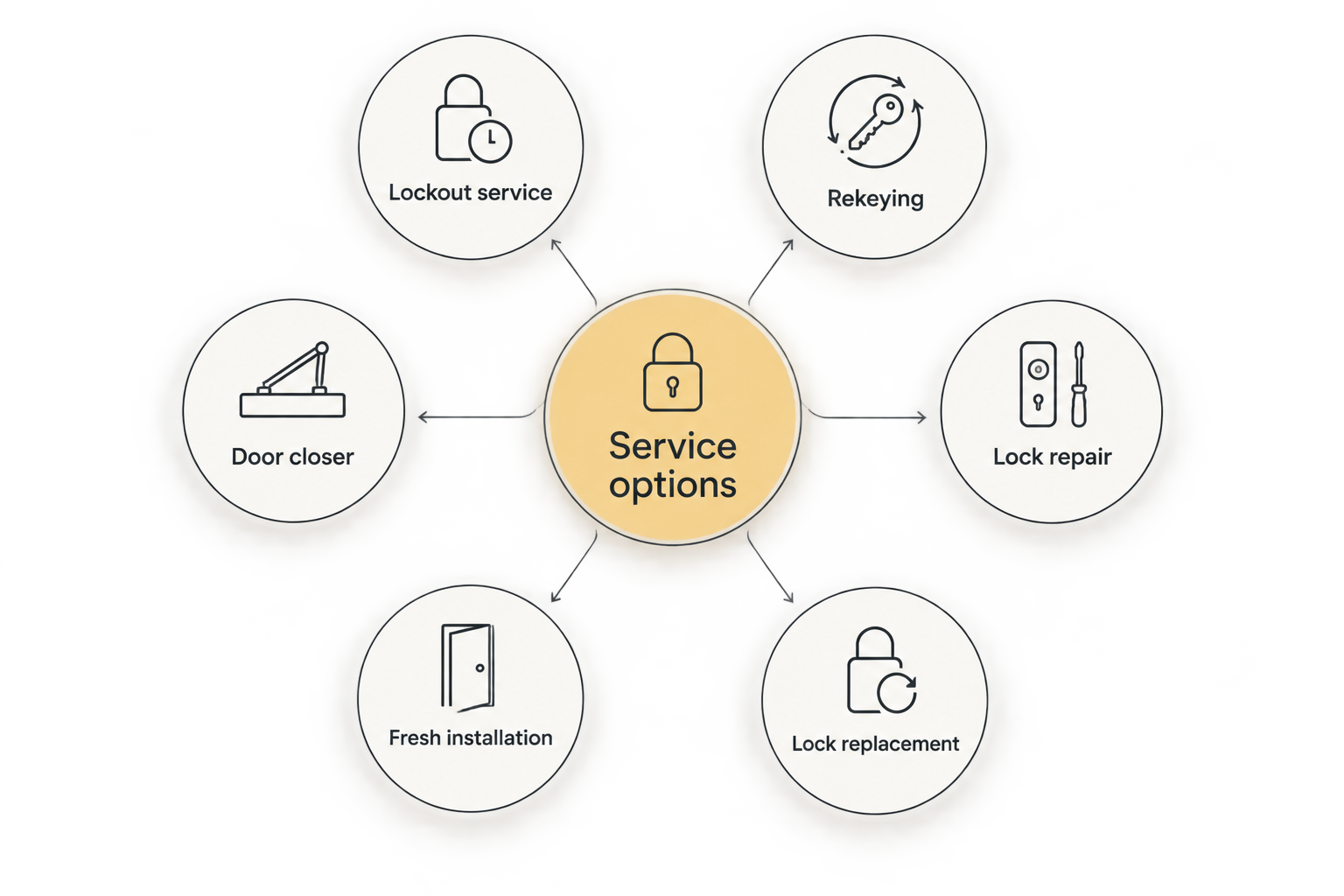
Choose the service after identifying the access problem and hardware condition.
Common mistakes government offices make
Treating an employee’s missing key as only a replacement-key request
A missing key raises a question about continuing access. Follow the agency’s incident and key-control procedures, identify the affected doors, and let the authorized decision-maker determine whether rekeying is needed.
Combining mechanical and electronic work in one vague request
“Fix the access system” does not tell a provider whether the problem is a cylinder, latch, closer, badge reader, or software permission. Separate these issues so each reaches a provider with the relevant confirmed scope.
Changing hardware without checking the building’s requirements
An office manager’s preferred lock is not a substitute for reviewing an exit door, fire-rated opening, or accessibility concern. Obtain the required review before authorizing changes, rather than asking the technician to work around conflicting instructions.
Approving work without planning key distribution
A completed rekey can still leave staff unable to enter if nobody has arranged authorized key handover. Decide who receives keys and who updates the records before closing the job.
Assuming public-sector vendor eligibility
A published commercial service list does not establish agency-approved vendor status or satisfaction of a particular contract’s conditions. Check required documentation, purchasing procedures, and any facility-specific restrictions before placing the order.
FAQ
What do commercial locksmith services for government offices include?
Mechanical services include lockout assistance, rekeying, lock repair or replacement, fresh installation, broken key extraction, and work involving push bars or door closers. Confirm the provider’s scope and the agency’s requirements for each affected door.
Should a government office rekey or replace locks after an employee leaves?
Base the decision on key-control procedures and hardware condition. Rekeying changes which keys operate a compatible lock; replacement addresses hardware that is damaged, unsuitable, or otherwise needs changing.
Can GO Locksmith repair our office badge-reader system?
No. GO Locksmith does not install or repair electronic access-control systems. Route badge-reader, electronic permissions, and related system problems to the agency’s responsible provider.
Does every government office door need a push bar?
No blanket rule applies to every government office door. The requirement depends on the opening, occupancy, and applicable code provisions; confirm building-specific requirements with the responsible authority.
What should I prepare before calling a commercial locksmith?
Prepare the location, affected door identifiers, observed symptoms, hardware information, and an authorized contact. Check purchasing requirements and use approved channels when sharing sensitive facility information.
How much does government office locksmith work cost?
Pricing depends on the specific job, hardware, and approved scope. Call for a job-specific estimate and ask how any additional work discovered during assessment would be authorized.
Can I arrange government office locksmith work outside public hours?
Discuss the requested work window directly with the provider. GO Locksmith’s published hours are Sunday–Thursday, 7:00 AM–11:00 PM, and Friday, 7:00 AM–5:00 PM; Saturday is closed.
One last thing
An unaccounted-for key does not stop working because an employee’s name leaves the staff list. Connect personnel changes to the agency’s key-control process, then decide whether mechanical changes are required.
For an office lockout, rekey, or mechanical door-hardware problem in a confirmed service area, call GO Locksmith at (239) 412-1101. Describe the affected opening and agency requirements to check job suitability, request an estimate, and discuss scheduling.