
Blog ·
Commercial locksmith services for banks and credit unions: complete 2026 guide
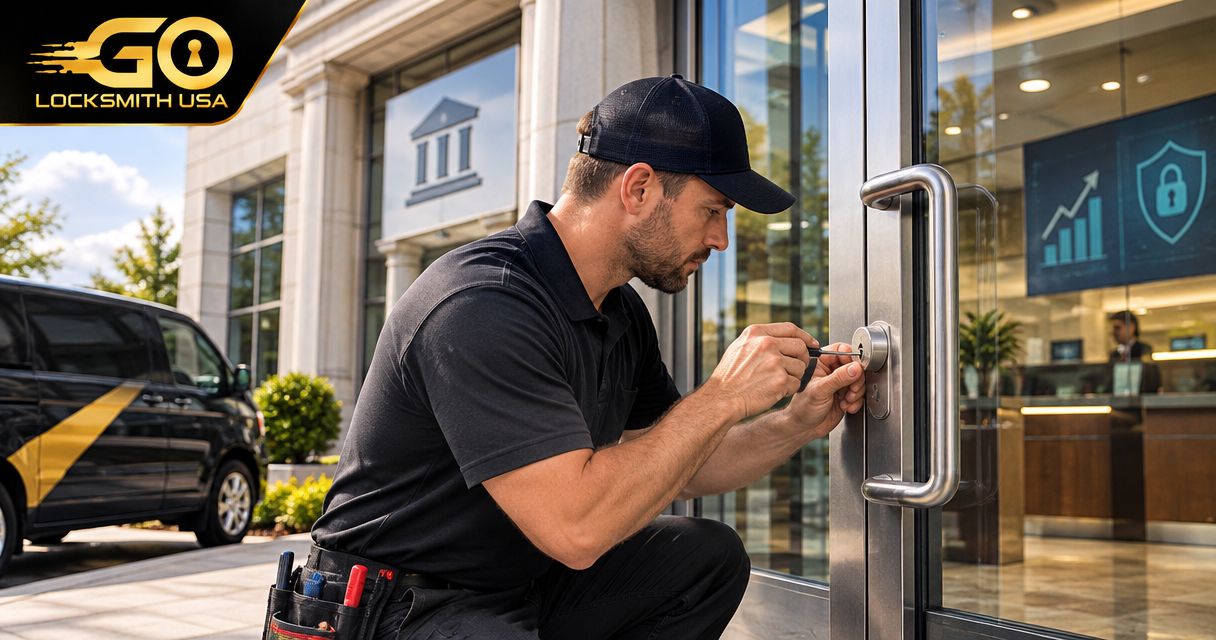
Banks and credit unions’ commercial locksmith services cover mechanical locks and door hardware to maintain authorized branch access. The work needs a clearly approved scope that separates ordinary branch doors from electronic access control, alarms, and specialized vault equipment.
TL;DR
- GO Locksmith offers commercial locksmith services for banks and credit unions needing mechanical lock and door-hardware work.
- Rekeying changes which keys operate a compatible lock; it does not repair worn hardware or revoke electronic credentials.
- Separate branch-door repairs from vault, alarm, and electronic access-control work before requesting service.
- Confirm authorization, hardware compatibility, and exit requirements before approving changes.
Why commercial locksmith services matter for banks and credit unions
A branch-door problem needs a defined repair scope, not an assumed security-system overhaul. A missing mechanical key, a sticking staff entrance, and a door that fails to latch require different decisions. Treating them as the same problem risks leaving the original fault unresolved.
Banks and credit unions also need to distinguish who uses a door from who can authorize changes to it. A branch manager, facilities team, landlord, and security department can have different responsibilities; establish the approval route before scheduling work.
GO Locksmith’s confirmed commercial locksmith services include business and interior-door lockouts, lock repair, replacement and rekeying, fresh lock installation, push bars, door closers, and broken key extraction. Confirm the specific branch hardware and requested work by phone rather than assuming every commercial device is supported.
This guide concerns mechanical branch doors. It does not establish that any particular repair satisfies your institution’s security program, insurer requirements, lease obligations, or applicable building and fire requirements.
Plan branch lock work in six steps
Start with an internal walkthrough and a written service request. Your branch team can collect the facts without taking hardware apart or sharing sensitive access information publicly.
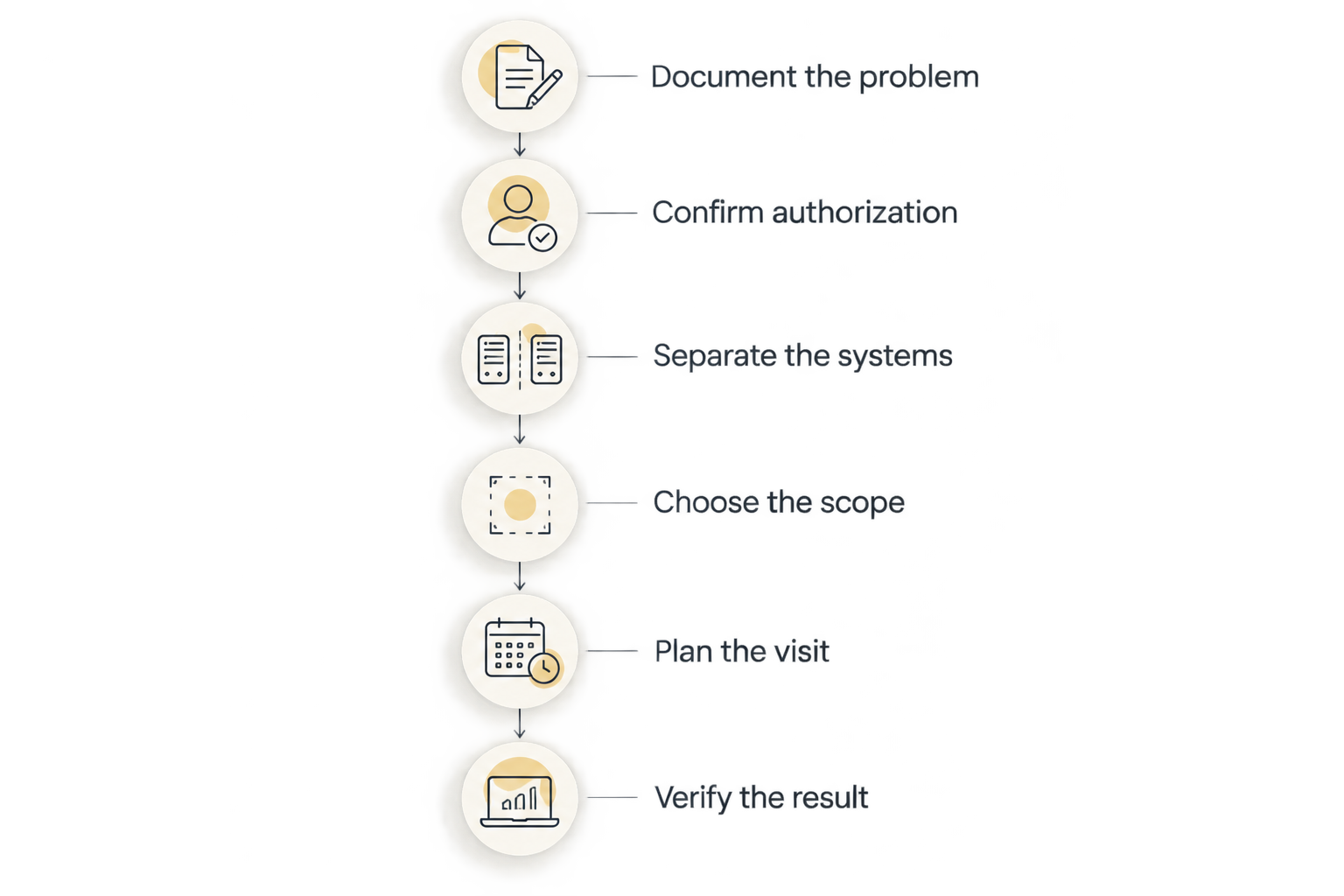
Document the problem
Describe what the door does, not just what you think needs replacing. A key that turns while the latch stays engaged presents a different symptom from a door that closes but does not latch.
Use ordinary observation first. Do not force a key, disassemble exit hardware, or repeatedly operate a visibly damaged lock to reproduce a fault. If the door cannot provide safe access or exit, follow your institution’s safety procedures while arranging appropriate help.
Record enough detail to distinguish a lock fault from a closing or alignment problem. Photographs should show hardware, not customer information, key-cut patterns, alarm details, or security-sensitive room contents.
- Identify the door using an internal location reference.
- Describe whether the problem affects entry, exit, closing, or latching.
- Note whether the symptom is constant or intermittent.
- Record visible hardware names or model markings when accessible.
- Keep sensitive photographs within approved communication channels.
Confirm authorization
Name the person who can approve the work before requesting a visit. Someone with permission to enter a branch does not automatically have permission to alter its locks.
Check your internal process for contractor access, landlord approval, purchase authorization, and changes to key possession. If a key is missing, report the loss through the institution’s security process rather than treating it solely as a maintenance ticket.
Keep the authorization narrow enough to prevent accidental changes to doors outside the request. A repair to an office door should not become an unapproved change to a shared entrance or restricted room.
- Name the branch contact and the work approver.
- Confirm any landlord or facilities approval needed.
- Identify which doors are included and excluded.
- Ask what authorization documents the service provider requires.
- Establish who can approve a revised scope during the visit.
Separate the systems
Distinguish a mechanical lock problem from an electronic access-control problem. A card reader denying entry is not the same fault as a physical key that will not turn, even when both affect the same doorway.
GO Locksmith provides confirmed mechanical commercial lock and door-hardware services; it does not install or repair electronic access-control systems. Route reader, controller, credential, and integration problems to the appropriate system provider. Where mechanical and electronic components share a door, coordinate the work rather than assuming one provider covers both.
Do not extend general safe service into a claim of bank-vault capability. Vault doors, safe-deposit equipment, time locks, and other specialized banking hardware require explicit confirmation from an appropriate provider.
- Mechanical doors: identify the cylinder, lock, latch, and closing symptoms.
- Electronic access: refer credential and reader faults to the system provider.
- Alarm interfaces: identify the responsible alarm contractor.
- Vault equipment: confirm specialized capability separately.
- Shared doors: establish which provider owns each part of the repair.
Choose the scope
Choose rekeying for a key-authorization change, repair for a serviceable fault, and replacement when the existing hardware is unsuitable or cannot be repaired appropriately. Rekeying changes the lock’s keying; it does not correct every mechanical defect or improve the underlying hardware’s performance rating.
A closer or alignment issue also needs a different assessment from a cylinder problem. If a door does not close and latch, replacing the key cylinder alone does not address that symptom.
Use the distinction between repairing and replacing an exterior door lock to frame the request, then confirm the decision against the actual hardware. Do not order replacement equipment solely because it looks similar to the existing device.
- Rekey compatible, serviceable locks when authorized key access must change.
- Request repair assessment for sticking, loose, or malfunctioning hardware.
- Consider replacement when repair is inappropriate or requirements have changed.
- Request door-closer assessment when closing behavior is the issue.
- Check compatibility and exit requirements before approving new hardware.
Plan the visit
Prepare the branch internally before asking a mobile locksmith to attend. Choose a work window, identify the person meeting the technician, and decide how staff and customers will use the area while the affected door is being serviced.
GO Locksmith is a mobile service covering Fort Myers, Cape Coral, Lehigh Acres, Estero, Bonita Springs, and Naples. Call to confirm the branch location, hardware scope, and current availability. A listed service area is not a promised arrival time.
Share sensitive branch-access details through your approved process. The initial request needs a useful description of the problem, not a complete map of the institution’s security arrangements.
- Provide the branch address and an appropriate on-site contact.
- Describe the door, symptoms, and requested service.
- Identify escort or contractor check-in requirements.
- Agree on the estimate and approval process before work begins.
- Plan how to maintain safe access while the doorway is being serviced.
Verify the result
Check the completed work against the original complaint before closing the service request. A door that opens successfully still needs to close and latch correctly; a rekeyed lock also needs its key distribution recorded.
Have the responsible branch representative observe the relevant functions with the service provider. Where another contractor owns an electronic or alarm interface, arrange the appropriate handoff rather than assuming a mechanical repair verifies that system.
Keep completion records specific. Record what changed, what was tested, and what remains unresolved without placing key details or sensitive access information in broadly shared maintenance notes.
- Confirm the authorized key operates the serviced lock.
- Check closing, latching, and normal exit operation as applicable.
- Verify the intended key change after rekeying.
- Record issued keys using the institution’s internal process.
- Document exclusions, unresolved faults, and any required specialist follow-up.
Compare the mechanical service options
Start with the observed problem. These options solve different issues, and none substitutes for an institution-wide security review.
| Option | Best for | Main benefit | Key limitation |
|---|---|---|---|
| Rekeying | Changing authorized mechanical-key access on compatible locks | Retains serviceable hardware while changing the operating key | Does not fix wear, door alignment, or electronic credentials |
| Lock repair | A repairable mechanical fault | Addresses the fault without automatically replacing the entire lock | Suitability depends on condition, parts, and hardware requirements |
| Lock replacement | Hardware that is unsuitable or not appropriately repairable | Replaces the affected lock with compatible equipment | Requires assessment of the door, function, and applicable requirements |
| Door-closer service | A door that closes improperly | Addresses controlled closing behavior | Does not resolve every latch, frame, or access-control fault |
| Push-bar service | An existing exit-device fault or an approved installation need | Addresses the doorway’s exit hardware | Device selection and installation depend on the opening and applicable requirements |
| Business or interior-door lockout service | Authorized access to a locked branch door or room | Addresses the immediate access problem | Does not automatically resolve missing-key risk or damaged hardware |
For mechanical branch-door work, GO Locksmith is an option within its confirmed service areas. Its confirmed scope does not include electronic access-control installation or repair, and specialized bank-equipment capability must not be assumed.
Common mistakes banks and credit unions make
Treating every lost credential as a rekeying job
A missing mechanical key and a missing electronic credential need different responses. Identify what was lost, which openings it affects, and who controls the response before approving work. Rekeying a cylinder does not deactivate a card or mobile credential.
Extending an ordinary lock request to vault equipment
A provider’s commercial-lock service listing does not establish capability with a vault door, safe-deposit lock, or time-lock system. Name specialized equipment explicitly and obtain confirmation before scheduling work. Do not approve an ordinary branch-door work order as authorization to alter it.
Replacing a lock without checking door behavior
A replacement cylinder will not correct a door that misses its strike because the opening is misaligned. Describe the complete symptom, including whether the door closes and latches. Ask the provider to explain which component the proposed work addresses.
Adding hardware without checking exit requirements
Do not add a lock, change an exit function, or disable a push bar merely to restrict entry. Have the responsible facilities professional and relevant authority address applicable requirements before modifications. Entry control and safe exit need to be considered together.
Closing the ticket without updating key records
A technically successful rekey leaves an administrative gap if nobody records who received the new keys. Assign responsibility for distribution and returned keys before the work begins. Store those records under the institution’s security procedures.
FAQ
What commercial locksmith services can a bank branch request?
A bank branch can request mechanical lockout assistance, lock repair, replacement, rekeying, and appropriate door-hardware work. Confirm the specific opening, authorization, hardware, and provider capability before scheduling service.
Should a credit union rekey or replace locks after a key is lost?
Rekeying is an option when the affected locks are compatible and serviceable; replacement addresses hardware that is unsuitable or cannot be repaired appropriately. The institution should also assess which doors the missing key operates and follow its security procedures.
Can GO Locksmith repair our branch card-reader system?
GO Locksmith does not install or repair electronic access-control systems. Contact the responsible system provider for card-reader, controller, credential, or integration faults.
Does commercial locksmith service include bank vaults?
General commercial locksmith service does not establish bank-vault capability. Confirm specialized support for vault doors, safe-deposit equipment, and time locks separately before authorizing work.
How much does commercial locksmith work at a bank cost?
The estimate depends on the specific job, affected hardware, and approved scope. Call with the door symptoms and requested work to request a job-specific estimate rather than relying on an unrelated lock-service figure.
Can we schedule branch lock work outside customer hours?
Ask whether your preferred work window falls within the provider’s hours and current availability. GO Locksmith’s hours are Sunday–Thursday, 7:00 AM–11:00 PM, and Friday, 7:00 AM–4:00 PM; Saturday is closed.
What should a branch prepare before a locksmith visit?
Prepare an authorized contact, a clear description of the affected door, and the approval process for the work. Confirm contractor check-in requirements and how the branch will maintain safe access during service.
One last thing: separate opening the door from securing it
Restoring access and resolving the underlying security issue are separate tasks. Opening a locked office does not account for a missing key, and replacing a lock does not verify an electronic credential system.
Before closing the job, ask two questions: does the door now work as intended, and has the reason for requesting service been addressed? Keep any remaining security action assigned to a named internal owner.
For a branch mechanical-lock or door-hardware request, call (239) 412-1101 during the stated hours to confirm the scope, check current availability, and request an estimate.