
Blog ·
Commercial locksmith services for assisted living facilities: complete 2026 guide
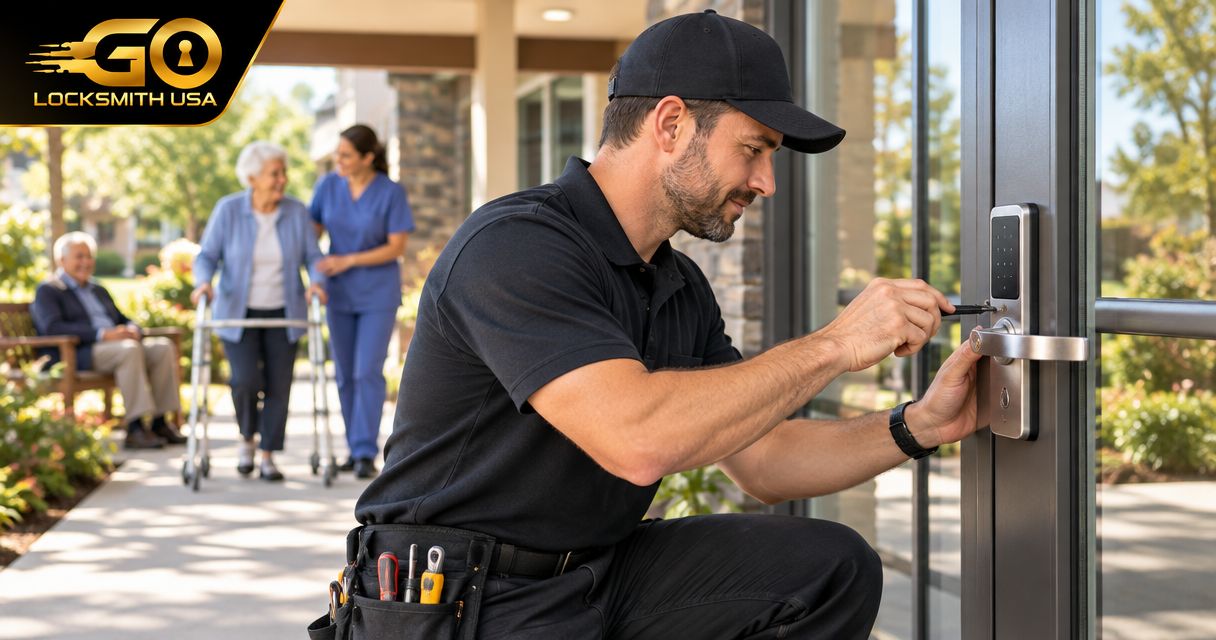
Assisted living facility locksmith service is mechanical lock and door-hardware work aimed at protecting resident access, staff access, and safe exit routes. Commercial locksmith services for assisted living facilities must account for resident privacy, care routines, emergency procedures, and each door’s approved function—not just whether a key turns.
TL;DR
- Commercial locksmith services for assisted living facilities should separate key-control problems from faulty locks and door hardware.
- GO Locksmith handles confirmed mechanical commercial locksmith services, not electronic access-control installation or repair.
- Rekeying changes key access; it does not repair damaged hardware or resolve an unsuitable door arrangement.
- Confirm resident-care needs and exit requirements before changing locks, push bars, or door closers.
Why locksmith work matters for assisted living facilities
A lost staff key and a resident-room lockout need different responses. One concerns who retains access; the other concerns restoring authorized entry without disrupting care or compromising privacy.
Assisted living facilities also contain doors with different purposes: resident rooms, staff offices, storage rooms, shared spaces, and exterior exits. Treating every opening as an ordinary office door overlooks those differences. Start with the door’s purpose, then identify the fault.
GO Locksmith’s commercial locksmith services fit facility teams seeking mechanical lock and door-hardware help, rather than electronic access-control work. The confirmed locksmith services include business and interior-door lockouts, lock repair, replacement and rekeying, fresh installation, push bars, door closers, and broken key extraction.
A service appointment does not replace a facility’s life-safety review. Changes affecting resident movement, fire-rated doors, or exit operation need review through the facility’s responsible personnel and the applicable authority having jurisdiction.
Plan the work around residents and door function
Identify the problem before requesting a hardware change
Begin with a written observation, not a proposed product. Record whether the key fails to turn, the latch fails to engage, the door closes too forcefully, or an authorized person cannot enter. These symptoms do not establish the same repair.
If a resident faces immediate danger, follow the facility’s emergency procedures and contact emergency services as appropriate. Do not wait for an ordinary service appointment to address a care emergency.
Give each affected door a clear identifier. “East corridor staff office” tells a technician and your care team more than “the broken lock,” especially when several doors need attention.
- Record the door location and the room’s purpose.
- Describe what happens without forcing the key or hardware.
- Note whether the problem affects entry, exit, closing, or latching.
- Identify any immediate resident-care impact.
- Name the manager authorized to approve the work.
Map access needs before collecting quotes
Use a spreadsheet or paper register to list who should enter each area. Separate resident access, care-team access, maintenance access, and outside-contractor access according to your facility’s policies. Do not put resident medical information into a locksmith work order.
Reconcile issued keys with returned keys before deciding which locks need attention. A missing key that opens several rooms creates a different scope from a damaged key used at a single staff office.
Do not assume compatible-looking locks can share a key. Ask a locksmith to assess the existing hardware before planning a facility-wide change, and confirm the requested work is within the provider’s scope.
- List each affected door and its authorized users.
- Record missing, returned, and unaccounted-for keys.
- Identify whether a missing key opens other areas.
- Keep sensitive key records in an authorized location.
- Separate mechanical-key requests from electronic credential issues.
Match the service to the actual fault
A rekey changes which keys operate a compatible lock while retaining the existing lock hardware. A repair addresses a fault; replacement changes the affected hardware. None is automatically the right answer for every problem.
GO Locksmith offers commercial lock repair, replacement, and rekeying, along with the other confirmed mechanical services listed above. Ask whether the proposed work addresses lost-key access, failed operation, or both. Confirm suitability for the specific hardware before authorizing it.
Do not approve replacement solely because a lockout occurred. Equally, do not use rekeying as a substitute for fixing worn or damaged hardware. The guide to repairing versus replacing an exterior door lock explains that decision separately.
- Request rekey assessment when key access needs to change.
- Request repair assessment when operation becomes unreliable.
- Discuss replacement when existing hardware is unsuitable or damaged.
- Identify broken keys without pushing fragments deeper.
- Ask what the proposed service will leave unchanged.
Review exit and resident-use requirements before alterations
Check the facility’s door schedule, maintenance records, and approved procedures before requesting a different lock function. Where records do not settle the question, involve the appropriate facility specialist or authority before altering the opening.
A memory-care exit is not a routine office-security decision. Neither a stronger lock nor an added locking device establishes a suitable resident-safety arrangement. Do not disable alarms, defeat exit hardware, or add improvised restraints while waiting for service.
Electronic access-control installation and repair are outside this provider’s confirmed scope. If the problem involves a reader, controller, alarm interface, or electronically controlled release, identify the responsible system provider instead of treating it as a mechanical rekey request.
- Confirm whether the opening serves an exit route.
- Flag fire-rating labels and existing special hardware.
- Describe resident-use and mobility considerations.
- Obtain the required review before changing door function.
- Keep electronic-system faults separate from mechanical work.
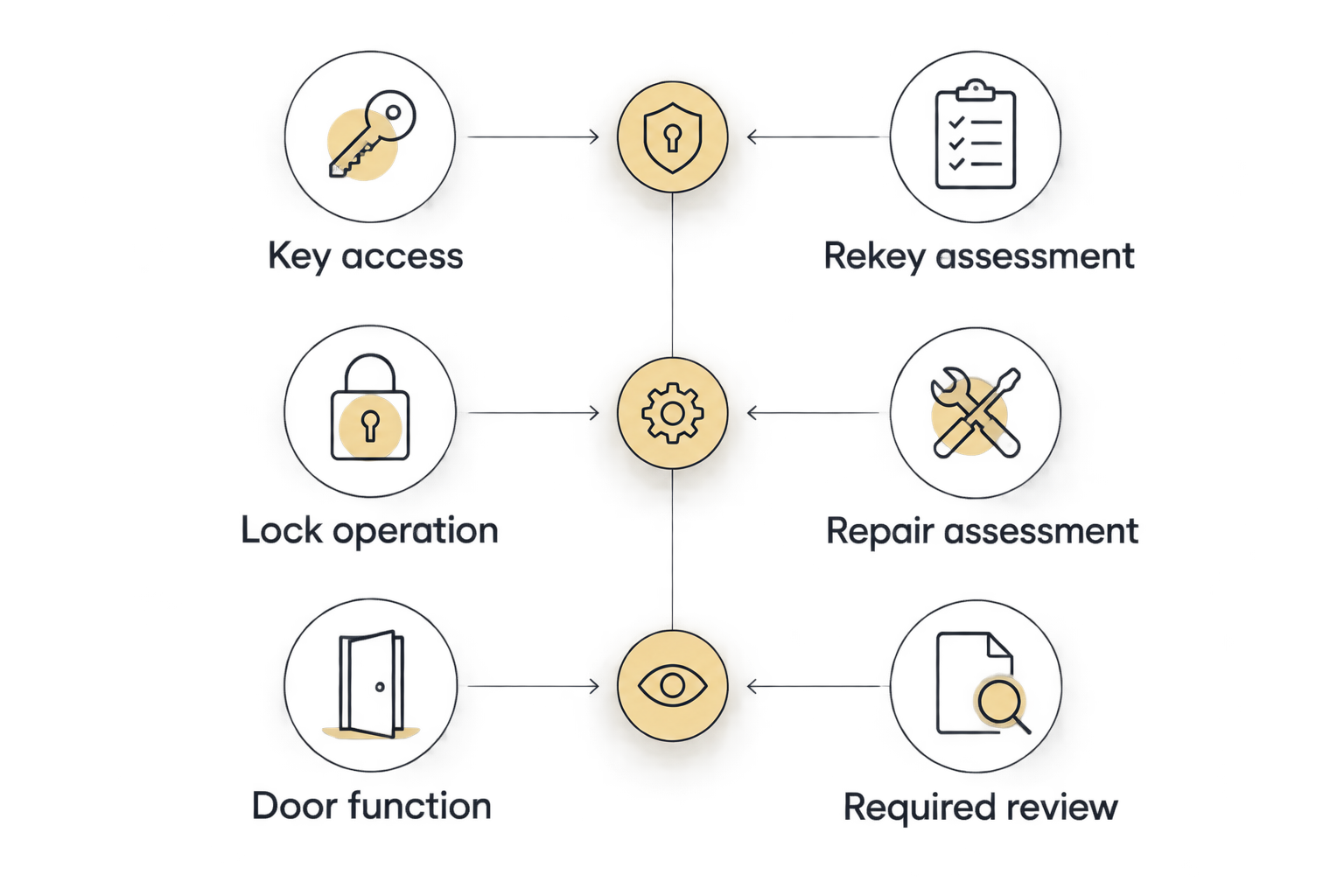
Match the request to the problem before approving a change.
Coordinate the visit with care staff
Plan access to resident areas through the facility’s own consent, privacy, and authorization procedures. Tell staff which doors are affected and who will accompany the service provider. Avoid including unnecessary resident details in appointment messages or photographs.
For facilities in Fort Myers, Cape Coral, Lehigh Acres, Estero, Bonita Springs, and Naples, GO Locksmith provides mobile service. Call to check current availability and discuss the specific mechanical work; do not treat the service-area listing as an arrival-time commitment.
Ask for a job-specific estimate after describing the hardware, symptoms, affected doors, and access constraints. Confirm how additional findings will be explained and approved before work expands beyond the original request.
- Choose a facility contact who can authorize work.
- Arrange approved access to each affected space.
- Explain care routines that the appointment must respect.
- Provide clear directions to the designated meeting point.
- Confirm the scope and approval process before work begins.
Check the result and update key records
Before closing the work order, have authorized staff review the affected doors with the service provider. Check the intended operation from both sides where appropriate, following facility procedures. Confirm that the work performed matches the authorized scope.
After a rekey, confirm which issued keys should work and which affected keys should no longer work. Record the result rather than assuming a key-control problem is resolved because new keys were handed over.
Keep functional checks separate from regulatory approval. A door operating during a handover does not, by itself, establish that the entire opening satisfies every applicable requirement.
- Record the service completed at each door.
- Confirm authorized entry and intended exit operation.
- Review closing and latching where hardware was serviced.
- Update the key register and collect superseded keys.
- Document unresolved issues and their responsible owner.
Compare mechanical service options
Choose the service by its purpose, not by a blanket instruction to “change all the locks.” Each option has a useful role and a clear limit. Hardware condition, compatibility, door function, and the facility’s approvals determine the appropriate scope.
| Option | Best for | Useful result | Key limitation |
|---|---|---|---|
| Commercial lockout service | Restoring authorized entry to a locked business or interior space | Addresses the immediate access problem | Does not by itself resolve missing-key exposure or faulty hardware |
| Rekeying | Changing key access where existing locks are suitable | Retains the existing lock while changing its keying | Does not repair physical damage or change the lock’s underlying function |
| Lock repair | Addressing a serviceable mechanical fault | Targets the affected component or operating problem | Suitability depends on the fault and hardware condition |
| Lock replacement | Addressing hardware that needs replacement | Changes the affected lock hardware | Requires compatibility and door-function checks |
| Push-bar service | Addressing mechanical exit-device concerns | Focuses attention on the affected exit hardware | Does not establish approval for a different exit arrangement |
| Door-closer service | Addressing mechanical closing concerns | Focuses on how the door closes | Does not resolve every alignment, latch, or accessibility issue |
For mixed problems, request a door-by-door scope. An office with a lost key, a resident-room latch fault, and an exterior closer problem should not receive an identical recommendation simply because the requests arrived together.
Common mistakes assisted living facilities make
Treating restricted resident movement as an ordinary lock upgrade
Adding a lock to prevent a resident from leaving changes more than access security. Refer that request through the facility’s resident-care and life-safety process before ordering hardware. Do not ask a service provider to improvise a containment solution.
Rekeying without tracing the missing key’s reach
Rekeying the nearest office does not address other doors opened by the same missing key. Identify the affected openings first, then approve the scope. Keep the key’s reach documented without circulating sensitive access information unnecessarily.
Overlooking closing and latching after lock work
A turning key is only part of door operation. Staff should also report a door that slams, stays ajar, or needs unusual force to latch. Describe each symptom separately rather than assuming the lock cylinder caused all of them.
Leaving care staff out of the appointment
Unannounced work at a resident-room door disrupts privacy and routines. Assign a facility contact, arrange authorized access, and explain what staff need to know before the visit. Keep resident information limited to what the task requires.
Assuming mobile service means around-the-clock coverage
An overnight staffing plan needs an accurate escalation route. Record provider hours and the facility’s separate emergency procedures; do not build the plan around an assumed response time or an unconfirmed service capability.
FAQ
What commercial locksmith services can an assisted living facility request?
An assisted living facility can request assessment of mechanical lockouts, lock repair, replacement, rekeying, broken key extraction, push bars, and door closers. The appropriate work depends on the affected door, hardware, authorization, and applicable requirements.
Should an assisted living facility rekey after a staff key goes missing?
A missing staff key calls for an access review and assessment of the affected locks. Identify every door the key opens before deciding the rekey scope, and follow the facility’s incident procedures.
Can a locksmith change locks on memory-care exit doors?
Changes to memory-care exit doors require review of the approved resident-safety and exit arrangement before work is authorized. Do not treat a new lock as a substitute for that review or assume a mechanical locksmith handles electronic release systems.
Does GO Locksmith install electronic access-control systems?
GO Locksmith does not install or repair electronic access-control systems. Its confirmed commercial services focus on mechanical locks and door hardware, including push bars and door closers.
How much does locksmith work for an assisted living facility cost?
The estimate depends on the specific job, affected doors, hardware, and required work. Call with the door locations and symptoms to request a job-specific estimate rather than relying on a general facility-wide figure.
Can we keep the existing locks when changing staff key access?
Rekeying can retain existing locks when the hardware is suitable for the requested change. It does not repair damage, and compatibility must be assessed before assuming every affected lock can be rekeyed.
When can our facility contact GO Locksmith for service?
GO Locksmith’s hours are Sunday–Thursday, 7:00 AM–11:00 PM, and Friday, 7:00 AM–4:00 PM; Saturday is closed. Call (239) 412-1101 to check current availability and discuss the facility’s mechanical locksmith needs.
One last thing
A successful lockout opening does not finish a lost-key incident. Restoring entry and deciding who still has access are separate tasks. Before closing the incident, assign responsibility for the key review, any approved rekeying, and the updated access record.
For mechanical lock or door-hardware help at your assisted living facility, call (239) 412-1101 during the listed hours. Have the door location, symptoms, and approving contact ready so the conversation starts with the actual problem.