
Blog ·
Can a locksmith restrict who can copy a business's keys?
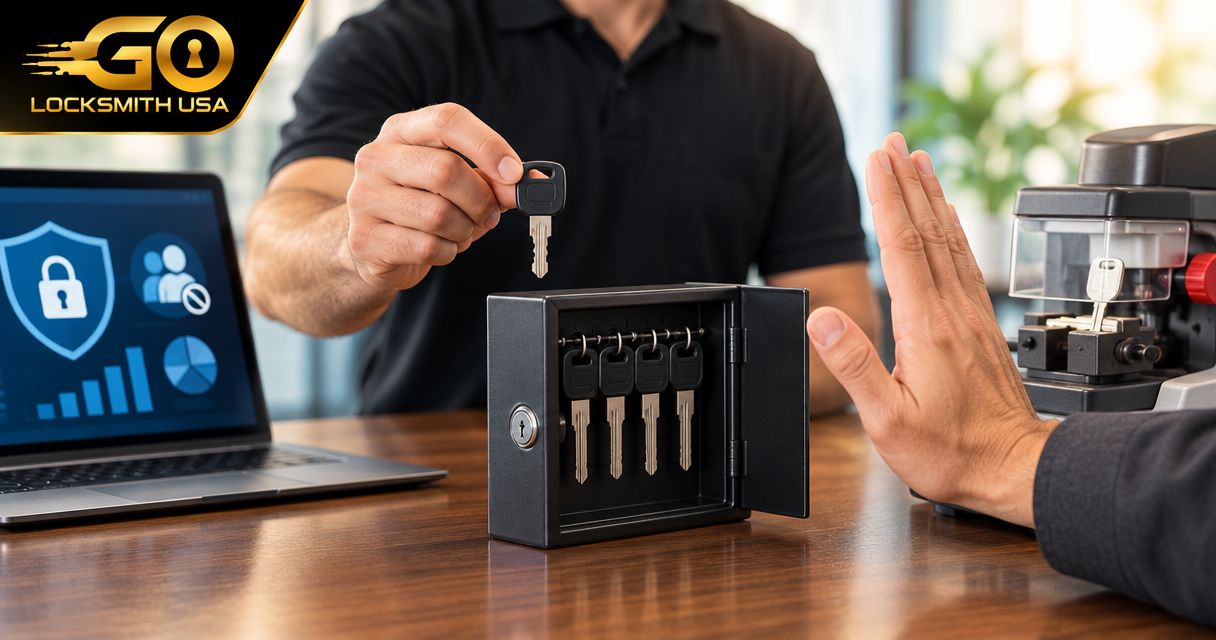
Yes—a locksmith can help restrict who is authorized to order copies of your business keys by using a restricted key system with controlled blanks and an authorization process. A standard key stamped Do Not Duplicate does not provide the same control. Restrictions depend on the specific system, and they do not stop someone from using a working key that is already in circulation.
TL;DR
- Can a locksmith restrict who can copy business keys? Yes, with a restricted key system and documented authorization.
- A Do Not Duplicate stamp is not the same as controlled access to key blanks.
- Restricted keys control duplication; rekeying addresses working keys that are lost or unaccounted for.
- GO Locksmith provides commercial lock repair, replacement, and rekeying; ask separately about restricted-system support.
Can a locksmith restrict who can copy a business's keys?
Yes, but the restriction must come from the key system and its authorization rules—not just the wording on the key. A locksmith's decision not to copy an ordinary key does not prevent another provider from copying it.
For the related question of obtaining an authorized replacement, see whether a locksmith can duplicate a restricted high-security key. For a business owner setting policy, the main differences are these:
| Key arrangement | Best for | Main benefit | Main limitation |
|---|---|---|---|
| Ordinary keys with an employee key log | Businesses documenting who holds existing keys | Makes issued keys easier to track | The log does not control duplication elsewhere |
| Ordinary keys stamped Do Not Duplicate | Businesses communicating a no-copy policy | Gives keyholders and copying providers a visible instruction | The stamp does not make the blank restricted |
| Restricted keys with documented authorization | Businesses seeking tighter control over additional copies | Controls access to blanks and authorized ordering under the system's rules | Requires compatible hardware and ongoing administration; existing keys still work |
Before choosing a system, ask the provider to explain exactly what makes it restricted. The answer should cover the key blanks, who can supply copies, and how the business approves an order.
Why this matters: permission to enter is not permission to copy
An employee might need a key to open the business without needing authority to order more keys. Treat those as separate permissions. Otherwise, giving someone access can unintentionally give them control over how many working keys exist.
A written workplace rule helps communicate expectations, but it does not change an ordinary key's physical design. Similarly, collecting an employee's original key does not establish that no copies were made.
Decide separately who can hold a key, who can approve a copy, and what happens when a key is missing. Those decisions give a locksmith a clearer brief than a general request to make the building more secure.
What a restricted key system actually controls
A restricted key system limits access to the blanks used to make its keys through the applicable supplier or manufacturer arrangements. Depending on the system, ordering also involves registered authorization, an account record, a security credential, or another verification process.
The details matter. Do not assume every restricted system uses a card, that every locksmith can service it, or that possession of an original key is enough to obtain a copy.
Ask the provider:
- Who is permitted to supply additional keys for this system?
- What evidence establishes that someone can approve an order?
- Can an employee holding a working key order another without management approval?
- How does the business remove an outdated approver?
- What happens if an authorization credential is lost?
- What documentation does the business receive when keys are supplied?
The benefit is control over legitimate duplication channels. The limitation is that no mechanical key arrangement establishes who actually used a shared key or prevents an authorized holder from lending it to someone else.
Does Do Not Duplicate legally prevent copying?
Do Not Duplicate is not, by itself, a technical restriction on copying. A provider might decline to copy a marked key or require authorization, but that policy is different from restricted access to the correct blank.
Do not treat the stamp as a universal legal prohibition either. Legal obligations depend on the circumstances and applicable law; the practical purchasing question is whether the key belongs to a genuinely controlled system.
If you are unsure what you have, ask a qualified provider to identify the key system. A label on the key is not enough to establish its duplication controls.
How to set up business key-copy authorization
Start with ownership and responsibility, not the replacement hardware. A technically suitable system still needs clear instructions about who can request keys and what approval means.
Establish authority
Identify who controls the locks: the business, the property owner, or a property manager. If you lease the premises, review the lease and obtain any required permission before changing cylinders or key arrangements.
Also establish who will hold the system's authorization records. Keep control with the business rather than relying entirely on an individual employee's personal records.
Identify hardware
Have the existing cylinders and door hardware assessed before assuming restricted keys can be added. Changing the keys alone does not convert an ordinary cylinder into a restricted system.
Compatibility determines whether a suitable cylinder change is possible or whether other hardware work is needed. If you are weighing a limited change, read about replacing just the lock cylinder rather than the whole lock.
Name approvers
Give the provider clear instructions about who can authorize additional keys and how approval must be verified. Distinguish an approver from someone merely collecting an approved order.
Ask how changes to that list are recorded. An authorization process loses value if a former manager remains able to approve new copies.
Record issued keys
Maintain a key register showing the key identifier, recipient, relevant doors, issue date, and return status. Record who approved each issue as well.
A register supports accountability; it is not proof that an ordinary key has never been copied. Keep that limitation visible when reviewing missing or returned keys.
Plan recovery
Write down what happens after a lost key, employee departure, ownership change, or missing authorization credential. Identify who can approve remedial work and who needs notification.
The plan should distinguish a missing working key from a missing ordering credential. They create different problems and do not necessarily need the same response.
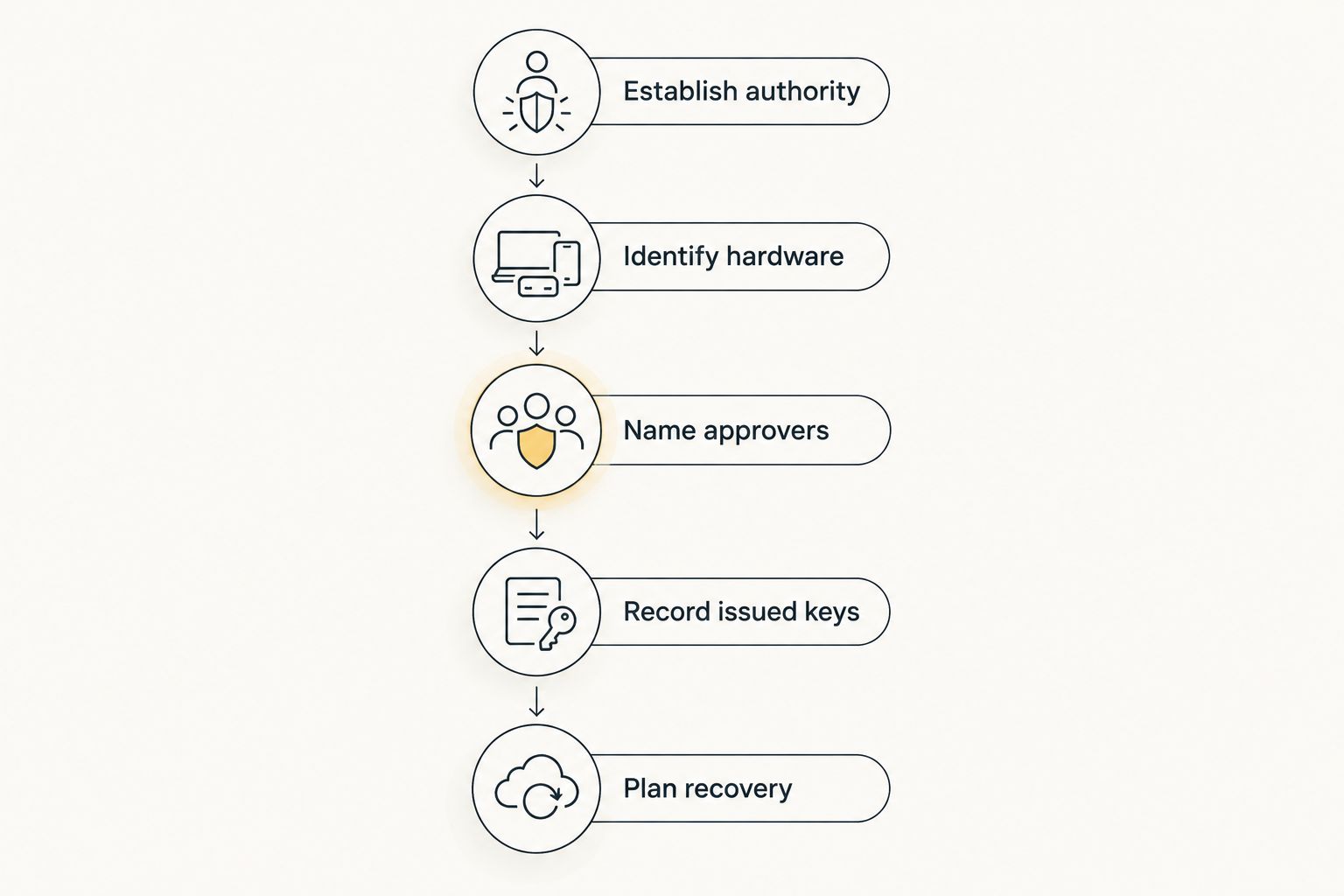
Agree on authorization and missing-key procedures before issuing new business keys.
Why key-copy restrictions vary between businesses
The right arrangement depends on how your business uses its doors and manages its staff. These factors determine whether a proposed restriction addresses your actual concern:
- Existing hardware: The cylinder must support the proposed key system; an authorization policy cannot change compatibility.
- Property control: A tenant's authority to change locks can differ from an owner's authority, so establish permission first.
- Supplier rules: Providers and manufacturers set different conditions for obtaining blanks and approving copies.
- Staff responsibilities: Someone who opens a single room does not necessarily need a key that opens every business door.
- Key history: Unknown copies remain a concern even after you introduce stricter rules for future orders.
- Management changes: Your business needs a way to update approvers without losing control of authorization records.
Ask for the proposed arrangement in writing. It should explain both what the restriction accomplishes and what responsibility remains with your business.
Does rekeying stop employees from copying business keys?
Rekeying changes which key operates a compatible lock; it does not automatically restrict future duplication. Rekeying an ordinary cylinder to another ordinary key addresses the old key, not the copying permissions attached to the new one.
If a former employee has an unreturned key, controlling future copy orders alone does not remove that person's existing access. Discuss rekeying or replacement for the affected locks and confirm the scope of the work.
If your concern is that current employees can obtain extra copies, ask about the key system and authorization process. These are separate problems, though a business can need to address both during the same project.
Does a master key system restrict who can order copies?
A master key system determines which keys operate which locks; it does not inherently restrict duplication. Master keying and restricted key control serve different purposes, even when they are combined in a suitable system.
A master key creates broader access, so its loss can affect more doors than the loss of a limited-access key. Keep ordering authority, key custody, and missing-key procedures clear rather than assuming the master key arrangement supplies those controls automatically.
What should you ask a commercial locksmith before requesting work?
Describe the problem in plain terms: an unreturned key, uncontrolled copying, unclear authorization, or hardware that needs attention. Then ask whether the proposed work addresses that specific problem.
Useful questions include:
- Will this work invalidate the keys I am concerned about?
- Is the replacement key restricted, or simply a different ordinary key?
- Who can obtain additional copies afterward?
- What approvals are required from the owner or property manager?
- What existing hardware will remain in place?
- What records and key-control instructions will I receive?
GO Locksmith provides mobile commercial locksmith service for businesses needing mechanical lock repair, replacement, or rekeying. Restricted-system installation or duplication support must be confirmed separately; do not assume it from the availability of general commercial locksmith services.
GO Locksmith serves Fort Myers, Cape Coral, Lehigh Acres, Estero, Bonita Springs, and Naples. Describe your location, existing hardware, and key-control concern when requesting a job-specific estimate.
FAQ
Can an employee copy a business key marked Do Not Duplicate?
A Do Not Duplicate stamp does not physically prevent an ordinary key from being copied. A copying provider might require authorization or decline the request, but that is not the same as restricted access to key blanks.
Can I let employees hold keys without letting them order copies?
Yes, a restricted key system can separate possession of a working key from authority to approve additional copies. Confirm the specific system's ordering rules and keep the authorized-approver list current.
Will a restricted key stop a former employee from entering?
No, a restricted key does not invalidate an existing working key. If a former employee retains a key, discuss rekeying or replacement of the affected locks rather than relying only on future copying restrictions.
Do I have to replace every lock to restrict key copying?
Not necessarily; the required changes depend on the existing cylinders, hardware, and proposed key system. Have compatibility assessed before assuming that either a cylinder change or complete lock replacement is required.
Is a master key the same as a restricted key?
No, a master key concerns which locks a key opens, while a restricted key system concerns control over duplication. A suitable arrangement can combine these functions, but neither term automatically establishes the other.
Can a tenant change a business's key system?
A tenant should establish permission under the lease and any applicable property-management requirements before changing the key system. Confirm who controls the locks and who must retain access before authorizing work.
Does GO Locksmith install restricted business key systems?
Restricted-system installation support must be confirmed directly with GO Locksmith. Confirmed commercial services include mechanical lock repair, replacement, and rekeying; those services alone do not establish support for a particular restricted key system.
One last thing: a returned key does not close the record
Mark a returned key as returned—not as proof that every possible copy is accounted for. That distinction helps you make a sensible decision when staff leave, keys disappear, or management changes hands.
Need help with a business lock or an unreturned key? Call GO Locksmith at (239) 412-1101 to discuss the job and check availability. Hours are Sunday–Thursday 7:00 AM–11:00 PM and Friday 7:00 AM–5:00 PM; Saturday is closed.