
Blog ·
Can a locksmith fix a door that won't latch or lock fully?
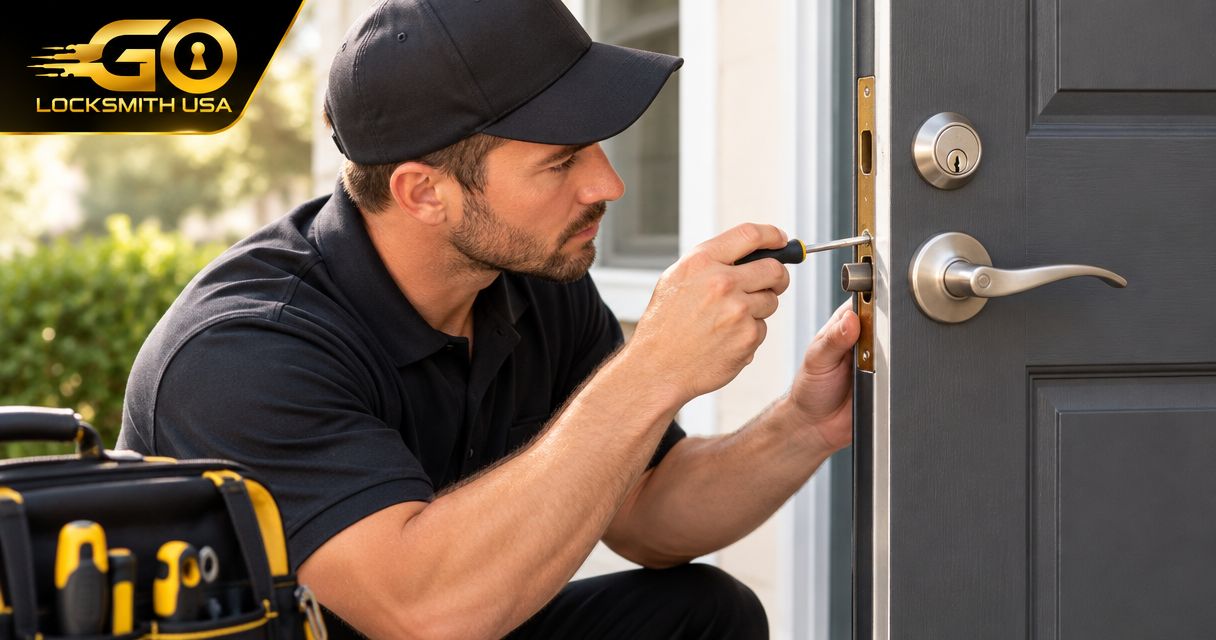
Yes, a locksmith can fix a door that won't latch or lock fully when the problem involves the latch, lock mechanism, strike plate, or related door hardware. The important distinction is whether the lock itself is failing or the door is no longer lining up with the frame. A damaged door or frame can require a door-repair professional rather than lock work alone.
TL;DR
- Can a locksmith fix a door that won't latch or lock fully? Yes, when the fault involves locks or related hardware.
- A lock that works with the door open but binds when closed points toward alignment or clearance problems.
- Replacing a lock does not correct a damaged frame or a sagging door.
- GO Locksmith provides residential and commercial lock repair; describe the symptoms before requesting service.
Can a locksmith fix a door that won't latch or lock fully?
Yes—but the repair should address the cause, not just replace the lock. A latch that misses its opening needs a different assessment from a deadbolt that will not move even with the door open.
GO Locksmith offers mobile residential and commercial lock repair and replacement in Fort Myers and its confirmed Southwest Florida service areas. Its locksmith services also include commercial push bars and door closers; structural door or frame repair is not a confirmed service.
Use these symptoms to describe the problem when you call. They are clues, not a diagnosis.
| What you notice | What needs checking | Useful next step | Limitation |
|---|---|---|---|
| Door closes, but the latch does not catch | Latch movement and alignment with the strike opening | Best for this symptom: assess the latch and strike relationship | A working latch cannot compensate for substantial door or frame damage |
| Deadbolt turns with the door open but binds when closed | Bolt alignment and clearance in the frame | Best for this symptom: check alignment before replacing hardware | Open-door operation does not prove every lock component is sound |
| Handle or key binds with the door open | Lock mechanism, installation, and hardware condition | Best for this symptom: request a lock assessment | The exact repair depends on the hardware |
| Door rubs, sags, or has a visibly damaged frame | Door support, hinges, and frame condition | Best for this symptom: establish whether door repair is needed | Lock replacement alone does not correct structural damage |
Why this matters: closed does not mean secured
A door can look closed while its latch rests against the strike plate instead of entering the opening. Likewise, turning a thumbturn partway is not the same as fully extending the deadbolt.
Do not rely on appearance or a clicking sound alone. The door needs to latch, lock, and reopen normally without lifting, slamming, or forcing it. If an exterior door will not secure, arrange an assessment rather than treating a temporary workaround as a repair.
There is also an exit-safety concern. Do not improvise a fix that traps occupants or obstructs a required exit, particularly on a commercial door.
Check the symptoms without taking the lock apart
You can collect useful information without drilling, filing, or removing hardware. Stop if a part feels stuck, the door feels unstable, or testing would risk locking you out.
- Check door movement. Open and close the door gently. Notice rubbing, resistance, an uneven gap, or a need to lift the handle to get the door into position.
- Check open-door operation. With the door safely open, gently operate the handle and lock. Retract the deadbolt completely before closing the door; never close it against an extended bolt.
- Check closed-door operation. If the door closes normally, try the lock without forcing it. Notice whether light pressure on the door changes the resistance, but do not use that pressure as a permanent solution.
- Report the difference. Tell the locksmith whether the problem occurs with the door open, closed, or both. Mention anything that changed immediately before the trouble started.
The useful observation is the contrast: a mechanism that moves freely in open air but catches against the frame directs attention toward alignment or clearance. A mechanism that binds in both positions needs a closer look at the lock itself.
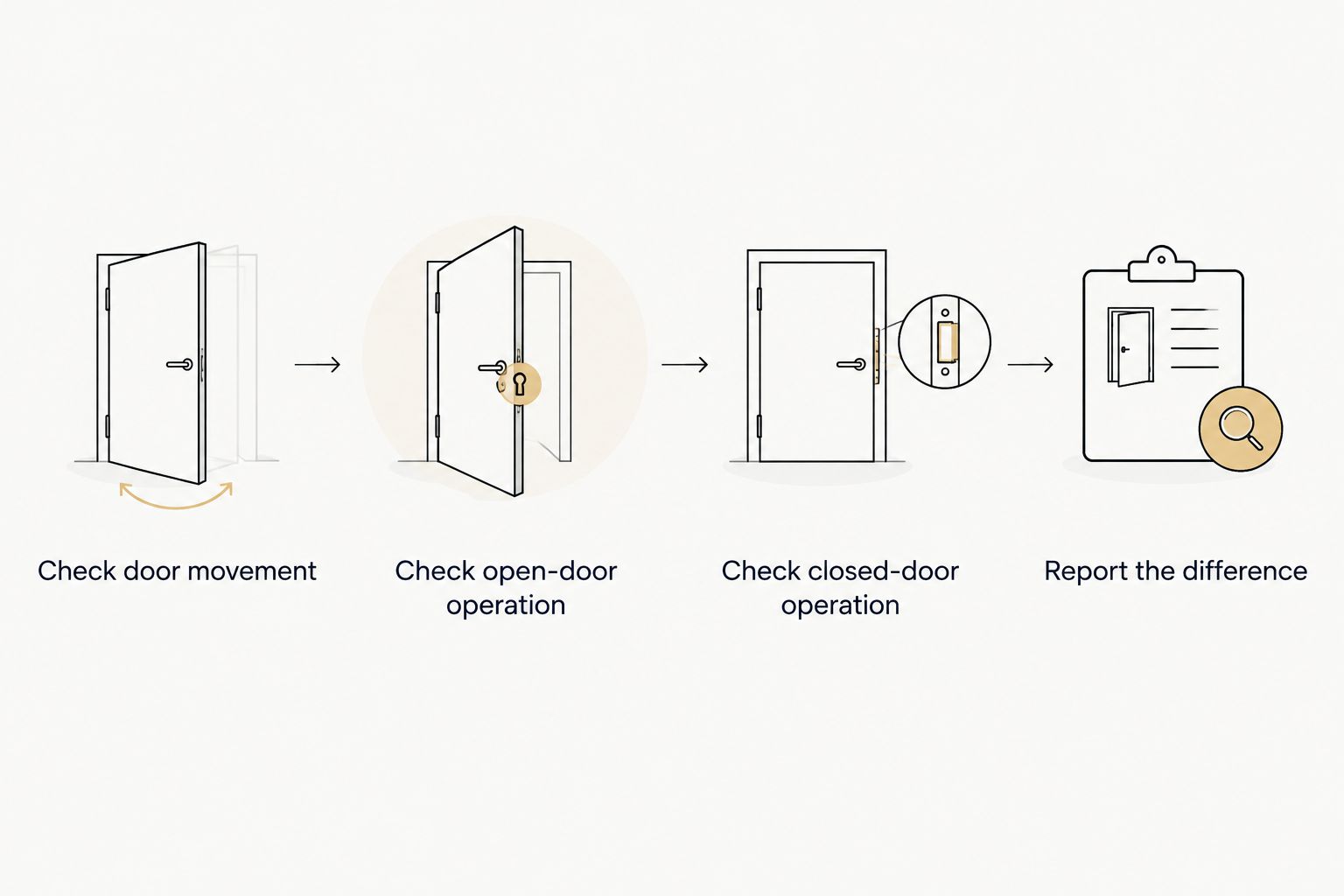
Compare open-door and closed-door operation before assuming the lock needs replacement.
When the latch will not catch
A spring latch must enter the strike opening to hold the door closed. If it hits the surrounding metal instead, the door can bounce back or stay shut only while you hold it.
Notice whether the latch retracts when you operate the handle and extends again when you release it. Keep your fingers clear of closing edges, and do not push tools into the mechanism. A latch that remains retracted presents a different problem from a latch that extends normally but misses the strike.
Visible rubbing around the strike can help explain where contact occurs. It does not establish why the alignment changed. Loose hardware, door movement, and installation issues require different corrections.
Do not start by enlarging the strike opening. Removing material before identifying the cause can leave the original problem unresolved and affect how securely the hardware is supported.
When the deadbolt will not extend fully
A deadbolt needs an unobstructed path into its receiving opening. If the bolt contacts the strike or the inside of that opening, the key or thumbturn can stop before the bolt reaches its intended locked position.
Compare operation with the door open and closed, without forcing either test. Tell the locksmith if you have to pull the door toward you, push it inward, or lift it before the bolt moves.
Do not use extra force on the key to overcome resistance. A key is not a handle, and a hard-to-turn lock deserves an assessment before a key breaks or the mechanism becomes stuck.
Replacing the cylinder is not automatically the answer. The cylinder operates the lock; it does not change where the door sits relative to the frame.
Why the cause varies from door to door
The same complaint—“it won't lock”—can describe several mechanical problems. These factors help determine what needs repair:
- Latch and strike alignment. The latch needs to meet its receiving opening rather than the surrounding plate.
- Door position. Sagging, rubbing, or shifting changes how lock hardware meets the frame.
- Hardware condition. A sticking latch, damaged mechanism, or loose component needs attention at the hardware itself.
- Recent work. A problem that began after lock replacement, painting, or weatherstripping work gives the technician useful context.
- Door and frame condition. Splitting, distortion, or forced-entry damage can put the problem beyond the lock alone.
- Closing hardware. On commercial doors, closer operation and resistance during closing can affect whether the door reaches the latching position.
Describe what you observe rather than choosing a repair in advance. “The bolt works with the door open” is more useful than “I need a new deadbolt.”
Should you repair the lock, replace it, or repair the door?
Choose the work that corrects the fault. Replacing functional hardware does not solve misalignment, while adjusting a strike does not restore a broken internal mechanism.
| Approach | Best for | Advantage | Limitation |
|---|---|---|---|
| Lock or hardware repair | A repairable fault in otherwise suitable hardware | Keeps usable hardware in service | Depends on condition and the available repair |
| Lock replacement | A failed or unsuitable lock | Replaces the affected mechanism | Does not straighten a door or repair a damaged frame |
| Door or frame repair | A damaged or poorly supported door assembly | Addresses the underlying physical problem | Can require a professional outside the locksmith's service scope |
Ask what the proposed work will correct and how normal operation will be checked afterward. For a closer look at that decision, read whether to repair or replace an exterior door lock.
Rekeying serves a different purpose: it changes which key operates a compatible lock. It is not a repair for a door that misses its strike or a broken latch.
What changes on a commercial door?
A business entrance can involve a lock, latch, push bar, and door closer working together. The door must reach the correct position before the latching hardware can engage; a fault in one part can resemble a fault elsewhere.
Tell the service provider whether the door stops short, slams, catches only when pulled shut, or fails to latch after someone uses the push bar. Also identify any fire-rating label or known exit-door requirements without removing or altering labels or hardware.
Do not disconnect a closer, disable a latch, or block an exit to make the symptom disappear. Fire-rated openings and required exits need hardware and repairs appropriate to that opening; the applicable requirements depend on the building and door.
GO Locksmith's confirmed commercial locksmith services include mechanical lock repair and replacement, push bars, and door closers. Electronic access-control installation and repair are not offered.
What should you tell the locksmith before a visit?
Describe the door, the symptoms, and whether you can currently secure it. That helps keep the request focused on the actual problem rather than an assumed replacement.
Have these details ready:
- Whether it is a home entrance, interior door, or business door.
- Whether the latch fails to catch, the deadbolt binds, or both happen.
- Whether the lock operates differently with the door open.
- Whether the door rubs, needs lifting, or has visible damage.
- Whether the issue followed new hardware, other work, or attempted forced entry.
- Your location and any property-management authorization needed for repairs.
Pricing depends on the specific job. Ask for an estimate based on the symptoms and clarify what needs inspection before the repair scope can be confirmed.
If you rent, notify the landlord or property manager before authorizing alterations. Avoid turning a minor alignment issue into an unauthorized change to the door or frame.
How do you know the repair actually worked?
Check the complete door operation before considering the problem resolved. A key turning smoothly with the door open is only part of that check.
The door should close normally, the latch should catch, and the lock should reach its intended locked position without lifting or pushing the door into place. You should also be able to unlock and open it normally from the appropriate side.
For commercial doors, ask how the closer and exit hardware should operate after the work. If a limitation remains, get a clear explanation of what still needs attention and who should handle it.
FAQ
Can a locksmith fix a door that won't latch or lock fully?
Yes, a locksmith can address faults involving the latch, lock, strike, or related hardware. A damaged door or frame can require a door-repair professional instead of, or alongside, lock work.
Why does my deadbolt work when the door is open but not closed?
A deadbolt that works open but binds closed points toward alignment or clearance problems. The bolt can be contacting the strike or receiving opening, so inspection should precede replacement.
Will a new lock fix a door that will not latch?
A new lock fixes the problem only if the existing lock is the cause. Replacement does not correct a sagging door, damaged frame, or misaligned receiving opening.
Can rekeying fix a sticky door lock?
Rekeying changes which key operates a compatible lock; it does not correct door alignment or repair a broken latch. Ask for an assessment of the sticking problem rather than requesting rekeying as the solution.
Should I file the strike plate if the latch misses it?
Do not file the strike plate before the cause is identified. Removing material can leave the underlying alignment problem unresolved and affect hardware support.
Can a locksmith help with a business door that will not close and latch?
A locksmith can assess mechanical locks and related door hardware within the provider's service scope. Commercial doors can also involve closer operation, push bars, and opening-specific safety requirements.
How much does fixing a door that will not lock cost?
The estimate depends on the fault, hardware condition, and work required. Call GO Locksmith at (239) 412-1101 for a job-specific estimate rather than assuming the door needs a replacement lock.
One last thing
If lifting the door makes the lock work, report the lifting—not just the stuck lock. That detail helps distinguish a door-position problem from a mechanism that binds on its own.
For residential or commercial locksmith help in Fort Myers, Cape Coral, Lehigh Acres, Estero, Bonita Springs, or Naples, call GO Locksmith at (239) 412-1101 to discuss the symptoms and check availability. Hours are Sunday–Thursday, 7:00 AM–11:00 PM; Friday, 7:00 AM–5:00 PM; Saturday closed.