
Blog ·
Best safes for small business cash handling 2026
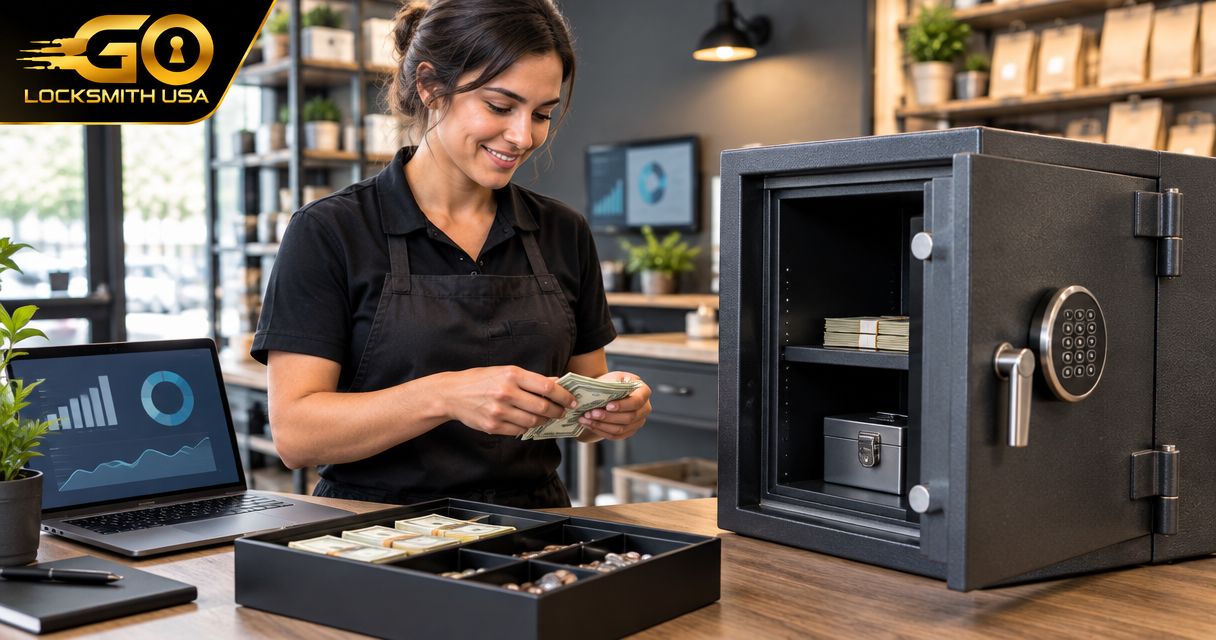
Best overall for routine cash drops: a depository safe. Best for separating deposits from change: a dual-compartment depository safe. Best for manager-controlled cash reserves: a burglary-rated chest safe. The best safes for small business cash handling match who deposits money, who retrieves it, and what stays on the premises overnight—not just the available floor space.
TL;DR
- The best safes for small business cash handling separate employee deposits from manager-only cash access.
- Choose a depository safe for routine drops; choose separate compartments when employees also need change.
- A burglary-rated chest safe suits controlled storage, but depositing money requires opening the main door.
- GO Locksmith provides safe service; confirm the specific safe and requested work before booking.
Why cash handling changes the safe you need
A safe used throughout a trading day has a different job from a container opened only at closing. Employees need somewhere to put excess cash without repeatedly exposing everything already inside.
Start with the cash movement, not the keypad. A deposit opening, a separate change compartment, and a documented burglary rating address different problems. None replaces a clear rule about who controls the main compartment.
GO Locksmith is a mobile locksmith business with confirmed safe service among its available services. For a specific safe problem, describe the unit and requested work before arranging service; do not assume every model or procedure is supported.
What makes the best safe for business cash handling?
Use these criteria before comparing individual models:
- Deposit separation: Staff should be able to deposit excess cash without gaining access to accumulated deposits when that is your operating requirement.
- Verified protection: Check the exact model’s documented burglary and fire protection separately. A keypad or heavy door does not establish either rating.
- Access control: Decide who needs deposit access, change access, and authority to open the main compartment. Check the lock’s actual features rather than assuming it supports individual users.
- Installation requirements: Confirm the manufacturer’s anchoring instructions, suitable mounting surface, door clearance, and usable location before purchase.
- Usable capacity: Check whether your actual envelopes, bags, coin rolls, and change trays fit—not just whether the advertised interior volume sounds large.
- Cash accountability: Choose a design that works with labeled deposits, reconciliation, and controlled retrieval. The safe does not verify your cash records by itself.
Business cash safes at a glance
These are safe types, not interchangeable protection levels. A depository safe can also carry a burglary rating, and a chest safe can have separate fire protection; verify each feature on the exact model.
| Safe type | Best for | Standout feature to verify | Key limitation |
|---|---|---|---|
| Depository safe | Routine employee cash drops | Deposit access separate from the main door | Does not dispense change or verify deposit amounts |
| Dual-compartment depository safe | Keeping deposits separate from change | Independently secured compartments | Separation fails if employees share unrestricted access |
| Burglary-rated chest safe | Manager-controlled reserve cash | Documented burglary resistance | Main door must open for deposits and withdrawals |
| Fire-rated document safe | Protecting paper business records | Documented fire protection for the contents | Fire protection alone does not establish burglary resistance |
1. Depository safe: best for routine employee cash drops
A depository safe accepts deposits through an opening separate from the main storage door. Employees can put away excess notes or deposit envelopes without being given access to the contents of the main compartment.
That makes the design a useful default for a business where staff collect cash but a manager retrieves deposits. Check the deposit mechanism, its resistance to retrieval through the opening, and the exact items it accepts.
Depository safe pros
- Separates depositing cash from opening the main storage compartment.
- Supports a routine for removing excess cash from the register.
- Accepts deposits without sharing the main-door credential, subject to the design.
Depository safe cons
- Does not count, authenticate, or reconcile the money placed inside unless the specific model explicitly provides those functions.
- Does not solve change distribution; staff still need a separate, controlled way to access their float.
- Deposit openings and accepted package sizes vary by model.
Best for: Retail counters, service desks, and other businesses where employees deposit cash and managers retrieve it.
Before buying, try your normal deposit envelope or bag against the published opening dimensions. An opening that accepts loose notes is not automatically suitable for a filled deposit bag, and forcing an oversized package creates an avoidable problem.
Verdict: Buy a depository safe when your main requirement is depositing cash without opening the main compartment.
2. Dual-compartment depository safe: best for separating deposits and change
A dual-compartment depository safe combines a deposit area with a separately secured compartment. Depending on the design, you can assign one compartment to deposits and the other to change reserves or working cash.
The useful feature is independent access—not simply having shelves inside one locked space. Confirm which door or credential opens each compartment and whether the deposit path reaches the intended storage area.
Dual-compartment depository safe pros
- Separates deposited takings from money reserved for making change.
- Supports different access permissions when compartments have independent locks.
- Keeps distinct cash functions in one cabinet when the layout suits your premises.
Dual-compartment depository safe cons
- Each compartment has less usable space than the cabinet’s total interior suggests.
- Shared credentials can defeat the separation the design is meant to provide.
- More compartments mean more access rules and credentials to manage.
Best for: Businesses where employees need authorized access to change but should not retrieve completed deposits.
Write the access rule before choosing the safe: who opens the change compartment, who retrieves deposits, and who reconciles the records? If everyone will receive every credential, the second compartment adds organization but does not create meaningful access separation.
Verdict: Buy a dual-compartment design when deposits and change need genuinely different access permissions.
3. Burglary-rated chest safe: best for manager-controlled reserve cash
A chest safe stores contents behind a main door rather than accepting deposits through a separate opening. Choose an exact model with documented burglary resistance when protection against forced entry is the purchasing priority.
This type suits reserve cash that authorized managers handle deliberately. It is less convenient for frequent employee drops because each deposit requires access to the main compartment.
Burglary-rated chest safe pros
- Makes documented burglary resistance a clear selection criterion.
- Provides main-compartment storage without requiring items to pass through a deposit opening.
- Fits a workflow where a limited group controls both deposits and withdrawals.
Burglary-rated chest safe cons
- Opening the door exposes access to the stored contents.
- Staff cannot make independent drops without receiving main-compartment access.
- A burglary rating does not automatically establish fire or water protection.
Best for: Manager-only cash reserves and businesses that do not need employee-operated deposit access.
Read the certification details for the exact safe, not just the product family. Also ask your insurer whether it has requirements for cash storage, installation, or declared holdings; do not assume a particular rating guarantees coverage.
Verdict: Buy a burglary-rated chest safe for controlled reserve storage; skip it as the only safe when employees need independent cash drops.
4. Fire-rated document safe: best for paper records, not routine cash drops
A fire-rated document safe addresses exposure of its specified contents to fire under its stated test conditions. It belongs in this comparison because businesses often need to protect records alongside cash—and can mistake one protection claim for another.
Fire protection and burglary resistance are separate considerations. A document safe without a deposit mechanism also requires the main door to open whenever someone adds money.
Fire-rated document safe pros
- Provides documented fire protection when the exact model carries the relevant rating.
- Gives paper records a designated storage location.
- Can complement a separate cash-deposit workflow.
Fire-rated document safe cons
- Fire protection alone does not establish resistance to forced entry.
- Main-door access is unsuitable for separating employee deposits from manager retrieval.
- Protection for paper does not automatically establish protection for electronic media or water exposure.
Best for: Paper records that need documented fire protection, with cash-handling needs assessed separately.
If one safe must hold both records and money, verify that the exact model meets both requirements. Do not let a fire claim stand in for burglary documentation or a suitable deposit process.
Verdict: Buy for the documented records-protection need; skip a fire-only choice as your default business cash-handling safe.
Match the safe to your daily cash routine
A useful buying decision follows the money from the register to its final retrieval. Work through the process before choosing dimensions, lock style, or cabinet finish.
- Define deposits: List what staff put away, including envelopes, bags, and coin rolls. Check the opening and usable compartment dimensions against those items.
- Assign access: Separate permission to deposit cash, obtain change, and retrieve stored money. Avoid giving broader access simply because it is easier to explain.
- Plan retrieval: Decide who removes deposits, checks the records, and handles discrepancies. The safe should support that responsibility rather than blur it.
- Confirm placement: Check the mounting surface, manufacturer’s instructions, door movement, and staff working space before ordering.
- Document handover: Keep the safe’s model information, instructions, authorized-user record, and service contact details somewhere accessible without opening the safe.
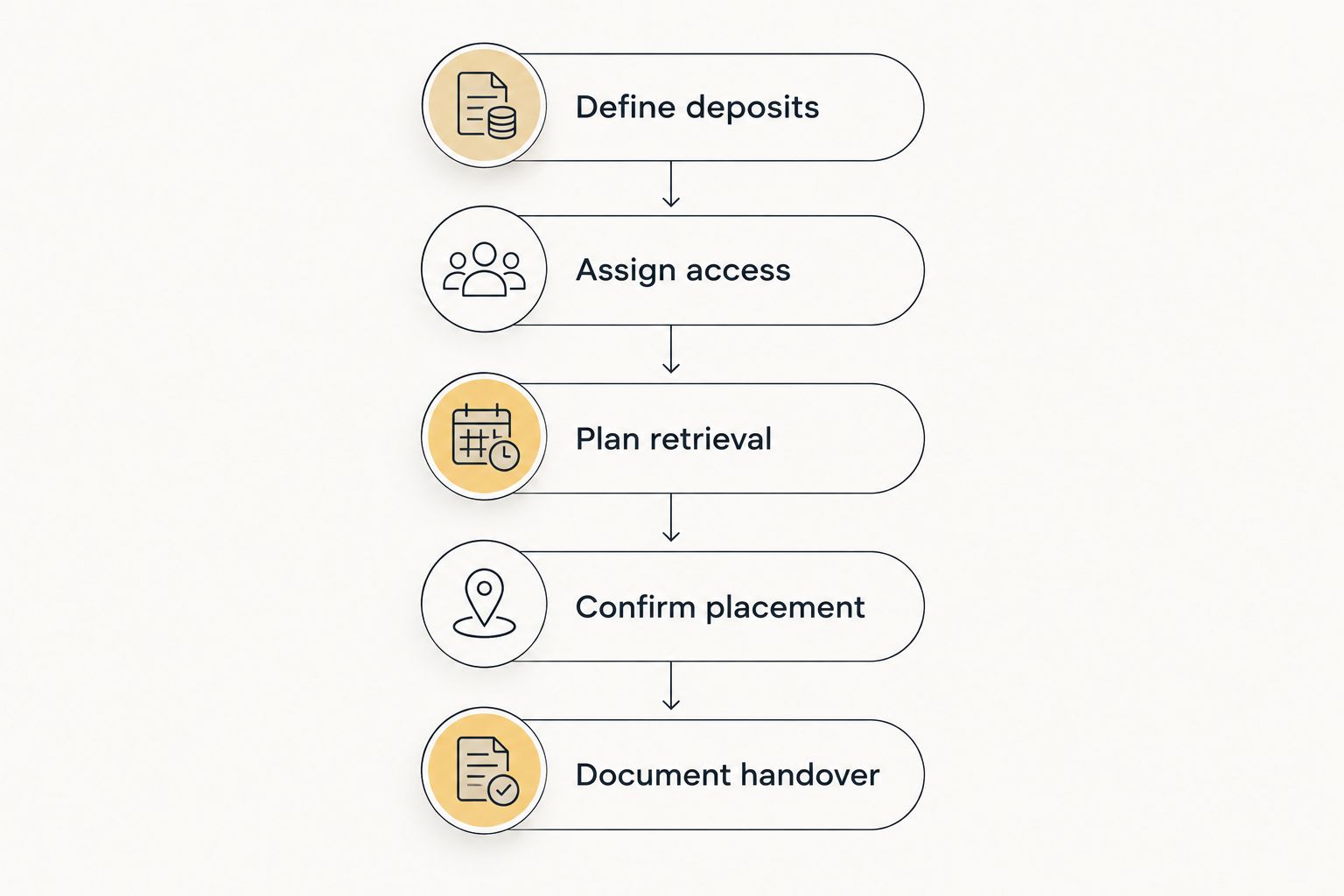
Choose the safe around the cash routine before choosing its lock style.
Do not treat a deposit as a reconciled transaction. Recording who deposited an envelope and checking its contents are separate tasks. A deposit opening restricts access; it does not prove that the stated amount is inside.
Likewise, do not assume a keypad records individual activity. If individual credentials, event records, or dual-user opening matter to your process, verify those features in the specific lock documentation before buying.
How these safe types are ranked
The order prioritizes everyday small-business cash movement: independent deposits first, separate change access second, and controlled reserve storage third. Fire-rated document storage serves a different primary purpose, so it is not the default cash-handling recommendation.
This is a selection guide, not a model-by-model performance test. Compare exact models using the criteria above, then confirm installation requirements and any insurance conditions before committing.
Which business cash safe should you choose?
Choose a depository safe by default when employees need to put money away without retrieving earlier deposits. Move to independently secured compartments when the same premises also needs controlled change access. Choose a burglary-rated chest safe when managers alone handle the stored reserve.
A cash safe also sits within a wider security arrangement. Review damaged exterior locks rather than treating the safe as a substitute for securing the building; this guide explains the repair-or-replace decision for exterior door locks.
FAQ
What's the best safe for a small business that takes cash?
A depository safe is the default choice when employees need to deposit cash without opening the main storage compartment. Choose the exact model by its deposit mechanism, documented protection, usable dimensions, and installation requirements.
Is a drop safe better than a regular safe for cash handling?
A drop safe is better suited to independent employee deposits. A regular chest safe suits manager-controlled storage, but its main door must open whenever money is added or removed.
Do I need separate compartments for deposits and change?
Choose separate compartments when different people need access to deposits and change. Confirm that the compartments are independently secured; shelves behind a shared door do not provide the same access separation.
Is a fireproof safe enough for business cash?
Fire protection alone is not enough to establish suitability for business cash storage. Check documented burglary resistance, deposit access, installation requirements, and any conditions set by your insurer.
Does a safe keypad track which employee opened it?
A keypad does not automatically provide individual-user tracking. Verify whether the exact lock supports distinct credentials and event records, and check how those records are accessed.
Should a business cash safe be bolted down?
Follow the exact safe manufacturer's anchoring instructions and confirm that the proposed surface is suitable. Check those requirements before purchase rather than assuming the cabinet's weight replaces anchoring.
Can GO Locksmith help with a business safe?
GO Locksmith lists safe service among its confirmed services. Call (239) 412-1101 with the safe's make, model if known, and the issue so the requested work and current availability can be confirmed.
One last thing: check access before loading cash
Before putting business money into a new safe, follow the manufacturer’s setup and lock-check instructions. Confirm that authorized users understand normal operation and that recovery information is not stored exclusively inside the locked compartment.
For safe service in Fort Myers, Cape Coral, Lehigh Acres, Estero, Bonita Springs, or Naples, call GO Locksmith at (239) 412-1101 to discuss the specific unit and requested work. Hours are Sunday–Thursday, 7:00 AM–11:00 PM, and Friday, 7:00 AM–5:00 PM; Saturday is closed.