
Blog ·
Can a locksmith change the combination on a safe?
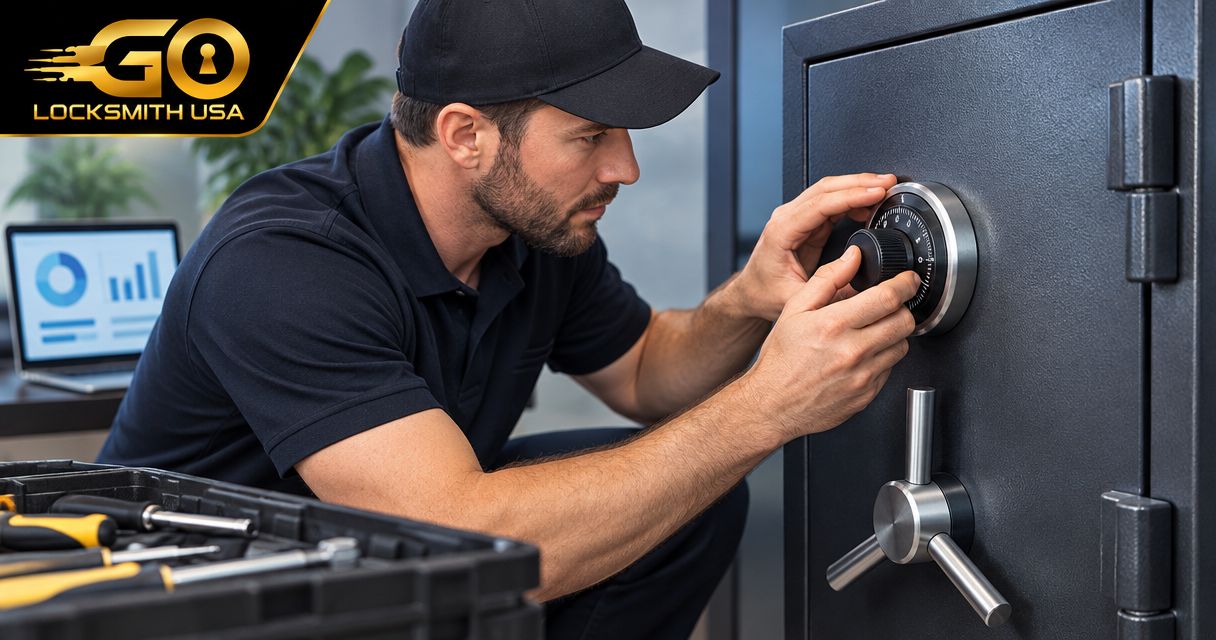
Yes—a locksmith who works on safes can change the combination when the safe’s lock supports it and the necessary access or authorization is available. A working combination change is different from opening a locked safe with a forgotten code, so the lock type, door position, and current access determine what comes first.
TL;DR
- Can a locksmith change the combination on a safe? Yes, when the lock supports a change.
- Mechanical dial locks and electronic safe locks require different, model-specific procedures.
- A forgotten combination creates an opening problem before a combination-change job.
- GO Locksmith offers safe service; confirm support for your specific safe before booking.
Can a locksmith change the combination on a safe?
Yes, but not every safe has an owner-changeable combination, and not every locksmith services every safe lock. Identify the safe and its lock before arranging work. A familiar-looking dial or keypad does not establish which procedure applies.
GO Locksmith is a mobile locksmith service offering safe service in Fort Myers and Southwest Florida. When you call, explain whether the safe opens and ask whether your particular combination-change job is supported.
| Safe or access situation | What the job involves | Best suited to | Important limitation |
|---|---|---|---|
| Working mechanical dial lock | Changing the combination using the lock’s specified procedure | Owners keeping a functioning dial lock | Not every dial lock is changeable in the same way |
| Working electronic safe lock | Changing an authorized code through the specified programming procedure | Owners updating access on a compatible keypad lock | User codes and administrative credentials can have different permissions |
| Locked safe with an unknown combination | Establishing authorized access before evaluating a change | Owners who cannot currently open the safe | A combination change alone does not solve the lockout |
| Faulty or non-changeable lock | Evaluating repair or compatible replacement | Owners whose existing lock cannot meet the need | A new combination does not correct a mechanical or electronic fault |
The advantage of changing a working combination is that you can update access without automatically replacing the lock. The limitation is equally important: a code change is not a repair, an opening service, or a guarantee that every other access method has been removed.
Why the distinction matters
“Reset my safe” can describe several different requests. You might know the combination and want a new one, have forgotten it entirely, or have a keypad that no longer responds.
Those situations need different assessments. Tell the locksmith what the safe actually does rather than asking only for a reset. “The door is open and the current code works” gives a much clearer starting point than “the safe needs reprogramming.”
Do not close an open safe just to demonstrate the problem. Keeping access available lets you discuss the next step without turning a maintenance question into a lockout.
Mechanical dial safes: the lock determines the method
Many changeable mechanical safe locks require access to the lock from inside the open door and a procedure specific to that lock. Some use a dedicated change tool; others use a different arrangement. The presence of a numbered dial alone does not tell you which system you have.
The benefit of retaining a working mechanical lock is straightforward: a supported combination change updates the credential while keeping the existing lock. The drawback is that a mechanical change is not necessarily an owner-level task, especially when the lock’s identity or instructions are uncertain.
Do not remove the lock cover or improvise with a tool because an online demonstration looks similar. Incorrect work can leave a lock unable to accept the intended combination.
Before arranging service, note the safe manufacturer and any accessible model information. The lock manufacturer can differ from the safe manufacturer, so an exterior badge does not always identify the mechanism that needs attention.
Electronic safe locks: changing a code is model-specific
Many electronic safe locks allow an authorized user to change a code, but the required credentials and steps differ. Some distinguish between a user code and a manager or master credential. Knowing a code that opens the safe does not automatically establish permission to manage every setting.
The benefit of a supported user-code change is convenience: the manufacturer’s instructions might provide an owner-performed process. The limitation is that instructions for another keypad or lock can be wrong for yours, even when the hardware looks alike.
Use instructions for the exact lock, not a generic keypad-reset sequence. Avoid repeated guesses if the instructions do not match what you see or the keypad behaves unexpectedly.
Replacing a battery is also different from changing a combination. Treat a power problem and an access-code problem as separate questions; do not assume removing the battery will erase a forgotten code.
If you do not know the current combination
A locksmith needs to distinguish a forgotten combination from a lock fault. A safe that does not open might have an incorrect code, an operating issue, or a problem with its lock or boltwork. Those possibilities are not interchangeable.
Explain whether the combination previously worked, whether anything changed, and whether the door is open or closed. Describe observable behavior without trying to diagnose the mechanism yourself.
Expect to establish ownership or authority to request access. Ask what documentation is appropriate before the visit, particularly for an inherited safe, a business-owned safe, or equipment acquired with a property.
Do not assume a code change includes opening the safe. Confirm the scope of both tasks before authorizing work.
Why the work varies from safe to safe
The main factors are practical, not simply whether the safe is large or small:
- Lock design: Mechanical and electronic locks use different change procedures, and some locks do not support the requested change.
- Door position: An open door provides access that a closed, locked safe does not.
- Current credentials: A working combination or authorized administrative credential can change the starting point.
- Lock condition: A sticking dial, unresponsive keypad, or intermittent operation needs assessment rather than an assumed reset.
- Access requirements: Changing a shared code is different from managing separate authorized users on a lock that supports them.
- Identification: Clear safe and lock information helps establish which instructions and service requirements apply.
These factors also explain why a photograph alone cannot guarantee that a particular job is possible. It helps identify the equipment, but it does not establish the condition of the mechanism inside.
What should you prepare before calling?
You do not need to dismantle the safe to make a useful service request. Gather information you can obtain safely, without exposing the combination or disturbing the lock.
- Identify the safe. Note the manufacturer, model, and accessible identifying information. Photograph the exterior and keypad or dial if requested.
- Describe access. State whether the door is open, whether the current combination is known, and whether it still works.
- Explain the change. Say whether you want to replace a shared combination, remove someone’s access, or address an operating problem.
- Confirm authority. Ask what ownership or authorization documents the service provider needs.
- Confirm scope. Ask whether the job includes only the combination change or also diagnosis, opening, repair, or replacement.
Keep the actual combination out of an initial general inquiry. Ask how sensitive access information should be handled if the technician needs it during authorized service.
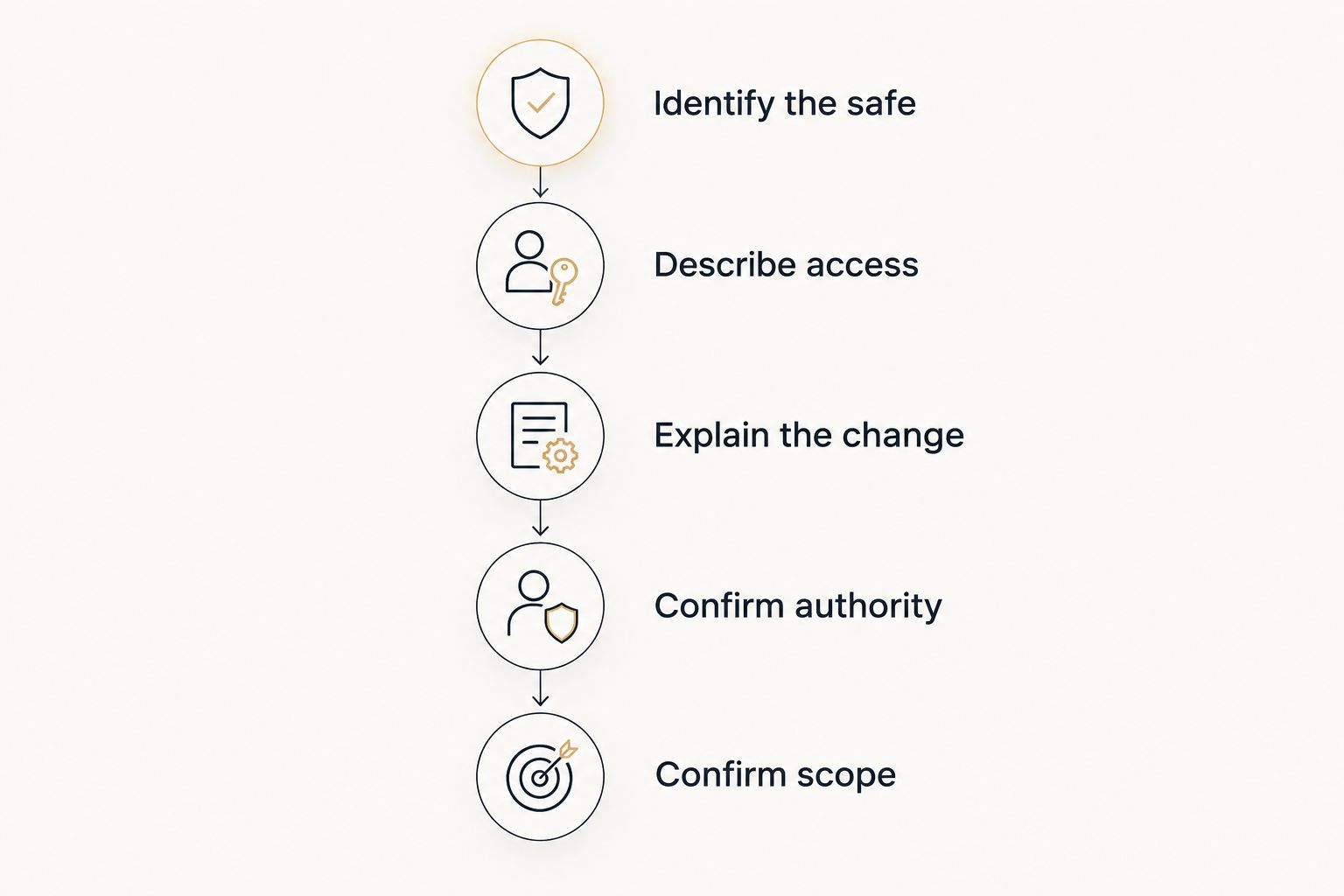
Identify the equipment and current access before deciding what service is needed.
A clear request also helps prevent misunderstandings about the appointment. “I can open the safe and want the existing combination changed” describes a different job from “I bought a locked safe and have no code.”
Should you change the combination on a secondhand safe?
Treat the existing combination as shared information unless you can establish who knows it. Receiving a working code from a seller gives you access, but it does not establish exclusive access.
When buying a secondhand safe, the combination is only part of the access question: you also need to identify the lock, establish whether its credentials can be changed, and understand any other access methods it has. A safe that opens during the handover can still have credentials known to previous users.
Ask the seller for the manufacturer’s documentation and available ownership records. Do not rely on a promise that a universal reset procedure will work after you take possession.
If an electronic lock supports multiple users, changing one code does not necessarily remove the others. Ask how existing user permissions are reviewed for that exact lock. If the safe has a separate key-operated access method, discuss that separately rather than assuming a combination change affects it.
The same reasoning applies when a safe comes with a home or business purchase. Establish control of access before placing valuables inside, not after discovering that the previous arrangement is unclear.
How do you check that the new combination works?
Complete the manufacturer’s specified testing with the safe door open before closing it. The purpose is to verify the new credential without risking an immediate lockout.
Ask the technician to explain the correct operating sequence and any model-specific precautions. For a mechanical lock, accurate dialing matters; for an electronic lock, confirm which credential was changed and what permission it carries.
Confirm that the intended new combination works and that the credential being retired no longer grants access as intended. Where a lock supports additional users, address those credentials separately rather than treating one successful test as proof that all access has changed.
Keep the new combination in a secure location separate from the safe. Avoid leaving the only record inside it, and do not place the combination on an exterior label.
If operation is inconsistent during testing, stop and raise the issue before closing the door. A successful opening followed by repeated failures is not a satisfactory handover.
Does changing the combination mean replacing the lock?
No. A functioning lock that supports a combination change can often remain in place. Replacement becomes a separate discussion when the lock is faulty, non-changeable, or unsuitable for the owner’s access requirements.
Changing a credential addresses who knows the credential. Replacing hardware addresses a different problem. Neither action should be prescribed automatically without identifying the lock and the reason for the work.
Ask what each proposed task solves. If replacement is suggested, request an explanation of why the existing lock cannot provide the intended result.
How do you get an estimate for a safe combination change?
Request an estimate for the specific safe and access situation. Explain whether it opens, which lock it has, and whether the request includes troubleshooting or opening a locked door.
Ask what work the estimate covers and how additional work would be authorized. A quote for changing a known combination should not be confused with a quote for recovering access to a locked safe.
GO Locksmith offers mobile safe service; call to confirm whether your safe’s combination-change request is supported and request a job-specific estimate. Do not assume compatibility from the service category alone.
FAQ
Can a locksmith change a safe combination without the old combination?
Sometimes, but access to the safe and the lock’s design determine what is possible. A closed safe with an unknown combination presents an opening problem before a combination change can be assessed.
Can I change my safe combination myself?
You can change it yourself only when the manufacturer provides an owner-change procedure for your exact lock and you have the required access credentials. Do not substitute instructions for a similar-looking lock.
Does replacing the battery reset an electronic safe code?
Battery replacement is not a combination-change procedure. Follow the exact lock’s instructions for power replacement and code management rather than assuming battery removal erases the code.
Should I change the combination after buying a used safe?
Yes, establish control of the safe’s credentials because previous users can still know the existing combination. Confirm whether the lock has additional users or separate access methods that also need attention.
Will changing one safe code delete every other code?
Not necessarily; a lock that supports multiple users can retain other authorized credentials. Confirm the exact lock’s user-management procedure rather than assuming one code change removes everyone else.
Should the safe door stay open while testing the new combination?
Yes, follow the manufacturer’s testing procedure with the door open before closing it. Confirm reliable operation and address any inconsistency while access remains available.
Can every locksmith change every safe combination?
No; safe-lock experience and support for the particular mechanism matter. Identify the safe and lock when calling, and confirm that the requested work is within the provider’s scope.
One last thing
The most useful detail in your first call is often whether the safe is already open. That fact separates a credential-change request from a possible lockout and helps frame the work accurately.
For safe service in Fort Myers, Cape Coral, Lehigh Acres, Estero, Bonita Springs, or Naples, call GO Locksmith at (239) 412-1101. Describe the safe and its current access, then ask about support for your lock, current availability, and an estimate.