
Blog ·
How long does it take to open a locked safe?
There is no reliable fixed time for opening a locked safe: the estimate depends on the safe, its lock, and why it will not open. A forgotten combination, an unresponsive keypad, and a jammed mechanism require different assessments. Ask for an estimate that separates the wait for service, the opening work, and any repairs needed afterward.
TL;DR
- How long does it take to open a locked safe? The safe and fault determine the estimate.
- GO Locksmith provides safe service; call to confirm whether your specific safe can be assessed.
- Describe the lock, symptoms, and previous attempts before requesting an opening-time estimate.
- Opening the safe and restoring secure operation are separate parts of the job.
How long does it take to open a locked safe?
A useful opening-time estimate starts with identifying the safe and the problem—not a generic promise of quick entry. The person assessing the job needs to distinguish a problem with the credential, power supply, lock, or door mechanism.
GO Locksmith offers safe service as a mobile locksmith business. Call with your safe's details to confirm the scope of service before making plans around an appointment.
The following situations explain why the same opening-time promise does not fit every safe. These are assessment clues, not diagnoses or instructions for bypassing a lock.
| What you notice | What needs checking | What it means for the estimate |
|---|---|---|
| You no longer know the combination | Safe identification and the available authorized recovery route | The missing combination alone does not establish an opening time |
| The keypad does not respond | Model-specific power requirements and possible keypad or lock faults | An unresponsive keypad does not prove the mechanism has failed |
| The safe signals acceptance, but the door stays shut | The meaning of the signal and the condition of the locking mechanism | Credential acceptance does not establish that the door can release |
| The dial or handle behaves differently | Lock condition, door operation, and any recent damage | An assessment is needed before estimating the work |
| The safe has already been forced or drilled | Existing damage and the remaining options | Previous attempts can change the scope of the job |
Tell the service provider what you observe rather than declaring that the lock is broken. A description such as “the keypad lights up, but the handle does not move” is more useful than “the safe is dead.” Do not send the combination as part of an initial inquiry.
Which part of the appointment does the estimate cover?
The time until you regain access includes more than the opening work. Ask what starts and stops the estimate. Otherwise, you and the service provider can be talking about different parts of the visit.
Waiting for service
Scheduling and travel are separate from the work on the safe. Give your actual location and ask about current availability rather than treating an opening estimate as an arrival promise.
GO Locksmith serves Fort Myers, Cape Coral, Lehigh Acres, Estero, Bonita Springs, and Naples. Confirm availability for your address and the particular safe service you need; a service-area listing is not an appointment confirmation.
Assessment and opening
The assessment establishes what safe is present, what symptoms it has, and which work is appropriate. Clear photos and model information help explain the request, but they do not replace an examination when the fault cannot be established remotely.
Ask whether the estimate includes assessment as well as opening. Also ask what would require the estimate to change and when you would be told.
Repair and return to use
Getting the door open does not necessarily resolve the original fault. A safe with a damaged lock or unreliable mechanism needs a separate decision about its condition before you rely on it again.
Ask whether the proposed work ends with access or includes restoring normal operation. Do not assume that an opening appointment includes replacement parts or follow-up work.
Why safe-opening time varies
The useful question is not simply whether a locksmith can open safes. It is whether the person handling the request can assess this safe, explain the likely work, and identify the limits of the estimate.
These factors shape that assessment:
- Safe identification. The manufacturer and model help establish which documentation and lock arrangements apply. “A small home safe” is not a model identification.
- Lock type. A mechanical dial, keyed lock, and electronic keypad have different operating requirements. Appearance alone does not establish the exact mechanism inside.
- Reason for the lockout. A missing credential is different from a credential that worked previously but no longer releases the door.
- Physical condition. A damaged handle, distorted door, corrosion, or previous forced-entry attempt needs to be disclosed before work is planned.
- Working access. A safe inside tight cabinetry presents different access conditions from one with clear space around its door. Describe the surroundings without moving the safe yourself.
- Required outcome. Access to the contents and continued use of the safe are separate goals. Make clear whether preserving the safe for reuse matters to you.
None of these factors establishes a duration by itself. They explain why a responsible estimate includes assumptions and why the scope sometimes needs to change after inspection.
What should you do before calling?
Collect identifying information and stop experimenting with the lock. The goal is to give an accurate account of the problem without adding damage or triggering further restrictions.
- Identify the safe. Note the manufacturer and model if visible on the outside or available in your records. Do not dismantle anything to find a label.
- Describe the symptoms. Record what the keypad, dial, handle, and door actually do. Mention any displayed message without sharing a working combination.
- Record previous attempts. Explain whether anyone changed batteries, tried alternate credentials, forced the handle, or worked on the lock.
- Confirm authorization. Be ready to explain your right to access the safe and ask which identification or ownership documents are required.
- Request the scope. Ask about current availability, the assessment process, the estimate, and what happens if the original plan changes.
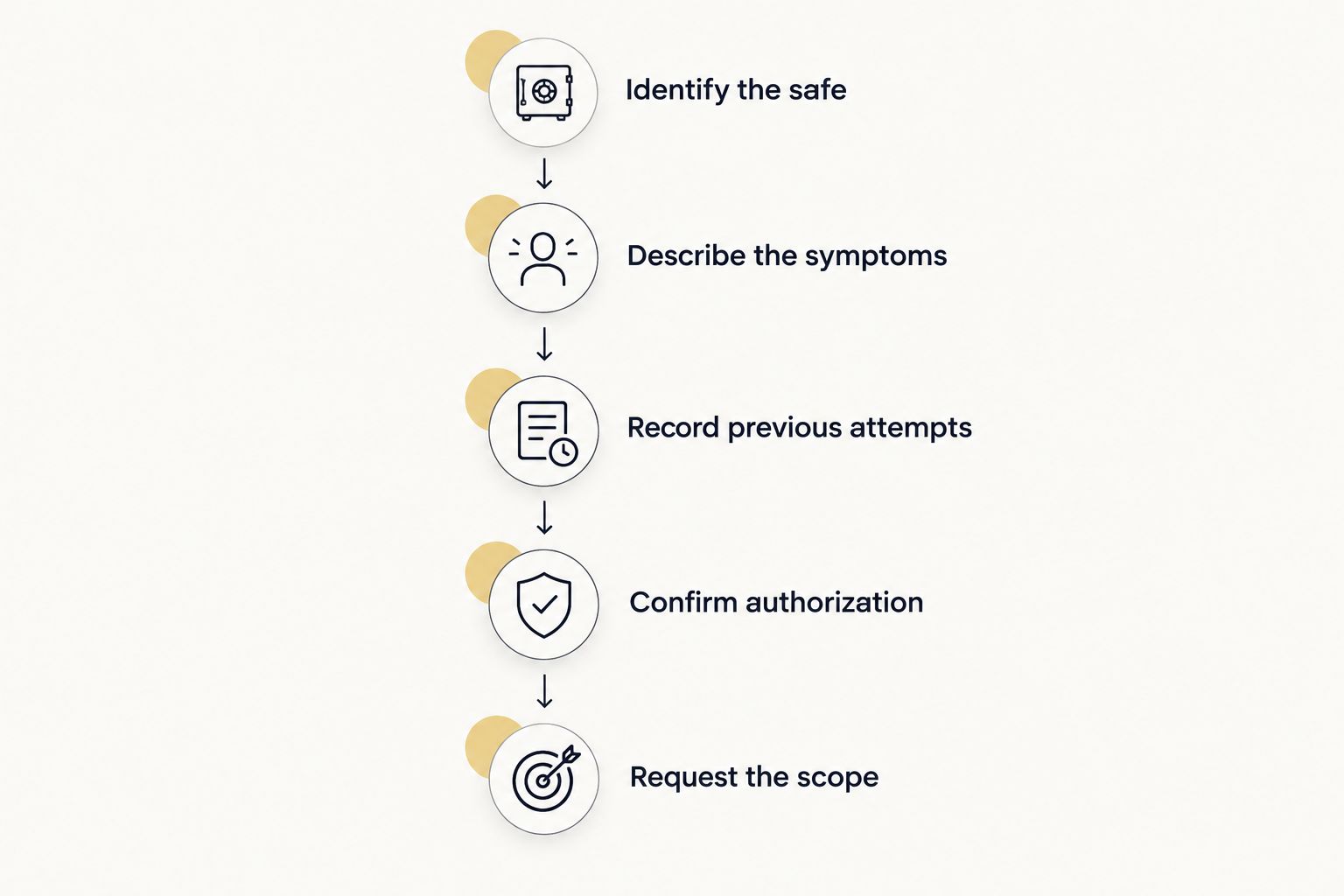
Clear identification and an accurate symptom history support a more useful assessment.
Take exterior photos only if you can do so safely. Include the full door, the lock controls, and any accessible identification label, but keep private documents and valuables out of the image.
If ownership is complicated—for example, the safe belongs to a business or an estate—raise that before arranging service. Ask what authorization is needed rather than assuming possession of the building is sufficient.
Should you keep trying the code while you wait?
Stop repeated guessing and follow the instructions for your exact safe. Some electronic safe locks impose a temporary lockout after incorrect entries, but the triggering conditions and recovery instructions depend on the model.
Do not borrow a waiting period or reset sequence from instructions for a different safe. A familiar-looking keypad does not establish that the same procedure applies.
If you believe the batteries are the issue, consult the manufacturer's instructions before doing anything. Battery location, replacement requirements, and any external power arrangement are model-specific; do not improvise a power connection or assume a battery change will clear the fault.
Avoid pulling harder on the handle, striking the door, or attempting to drill the safe. These actions do not establish the cause and can damage components that the service provider needs to assess.
Write down the last normal operation you remember. Whether the safe stopped working after a battery change, a move, or an attempted opening is useful context, but it is not proof that the event caused the problem.
What if you need something inside urgently?
Explain what you need to access and any real deadline when requesting service. Distinguish an inconvenient delay from an immediate health or safety emergency; contact emergency services when someone is in immediate danger rather than waiting for a locksmith appointment.
For emergency safe opening, urgency explains the access deadline, but the safe's lock and condition still determine the work. Ask whether the provider can assess your specific safe and what uncertainty remains before you commit to the visit.
If you need a document, consider whether the issuing organization can provide a replacement or another acceptable form of verification. That does not solve the lockout, but it separates your immediate deadline from the safe-opening appointment.
Tell the service provider about any known hazard associated with the safe or its contents. Do not move a heavy safe, remove its anchors, or put yourself at risk to make the appointment easier.
What should you agree on before work starts?
An estimate is useful only when you understand what it covers. Ask for a clear explanation before authorizing work, especially if the proposed approach changes after inspection.
You do not need instructions for defeating the lock. You do need to understand the expected effect on your property and the limits of the proposed service.
Confirm these points:
- What problem has been identified, and what remains uncertain?
- Does the estimate cover assessment, opening, or additional work?
- Is damage to the lock or safe expected under the proposed approach?
- Will the provider seek authorization before changing the scope?
- What must happen before the safe can be secured and used again?
GO Locksmith is a mobile locksmith service for Southwest Florida customers seeking safe service. Call to confirm whether the specific request is within scope. Safe service does not establish compatibility with every model, an opening method, or a guaranteed completion time.
For an estimate, describe the job rather than asking for a universal safe-opening charge. Request clarification if the assessment changes what is required.
FAQ
Can a locksmith tell me exactly how long opening my safe will take over the phone?
An exact opening time cannot be established from a general description alone. Manufacturer information, symptoms, and photos help with the initial assessment, but inspection can reveal conditions that change the estimate.
Will my safe open faster if I still know the combination?
Knowing the combination helps distinguish a lost-credential problem from an operating fault, but it does not guarantee a faster opening. A correct combination does not resolve a damaged lock or jammed mechanism.
Does a dead safe keypad mean the safe needs to be drilled?
An unresponsive keypad does not establish that drilling is necessary. The model-specific power requirements and possible faults need to be assessed before choosing an approach.
Does the opening estimate include the locksmith's arrival time?
Arrival time and safe-opening time are separate unless the provider explicitly combines them. Ask about current availability and clarify which part of the appointment each estimate covers.
Can I use the safe again immediately after it is opened?
Opening the safe does not establish that it is ready for secure reuse. Ask whether the original fault has been resolved and whether further work is needed before closing it again.
What information should I give GO Locksmith about my locked safe?
Give GO Locksmith the visible manufacturer and model, your location, the symptoms, and a history of previous attempts. Ask what authorization documents are needed and whether the specific safe service is within scope.
When can I call about safe service?
GO Locksmith's hours are Sunday–Thursday 7:00 AM–11:00 PM and Friday 7:00 AM–5:00 PM; Saturday is closed. Call (239) 412-1101 during those hours to check current availability and request a job-specific estimate.
One last thing
Before the door is closed again, ask whether the safe is ready for normal use. Regaining access and correcting the original problem are not always the same result. Clarify that distinction while the safe is open, not after the contents are locked away again.
Need help arranging safe service? Call (239) 412-1101 during the hours listed above with the model information and symptoms to check availability and request an estimate.