
Blog ·
Best door closers for ADA-compliant commercial entrances 2026
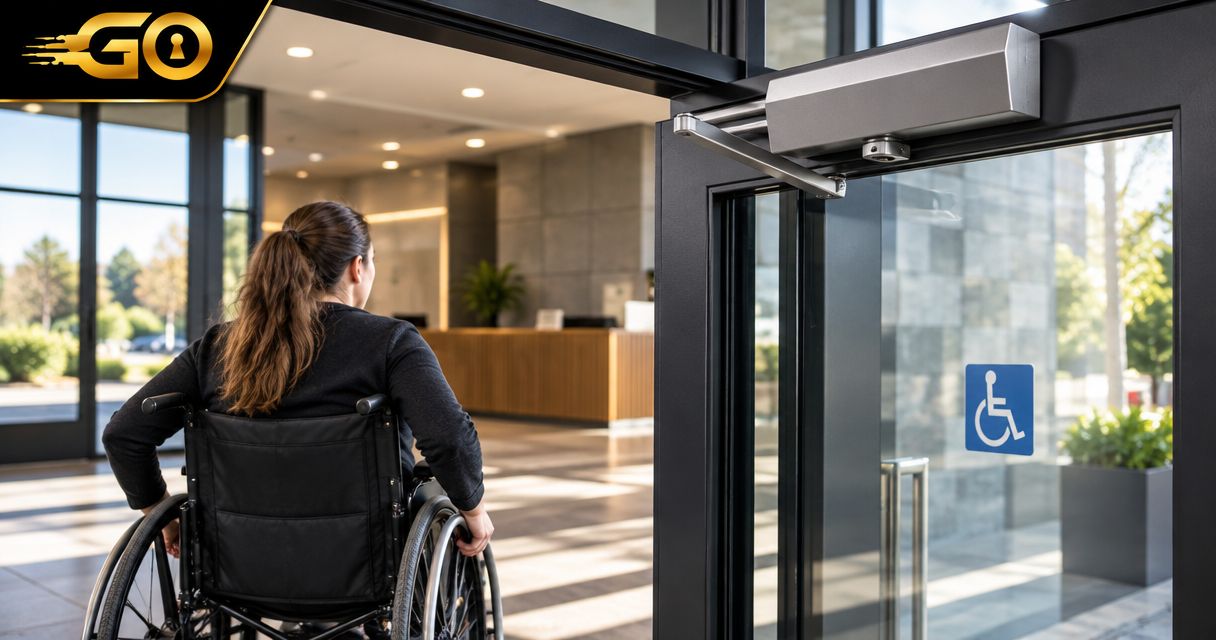
The best door closers for ADA-compliant commercial entrances are closers matched to the door, adjusted for accessible operation, and checked after installation. An adjustable surface-mounted closer is a practical starting point; a cam-action closer deserves consideration when opening effort is the main concern, while a concealed closer suits entrances designed around hidden hardware.
TL;DR
- The best door closers for ADA-compliant commercial entrances require correct selection, installation, and measured performance—not just an accessibility label.
- Adjustable surface-mounted closers are a practical default for serviceable commercial entrances.
- Cam-action closers deserve consideration when reducing opening resistance is the priority.
- GO Locksmith provides mobile commercial door closer service; electronic access-control installation and repair are not offered.
Why the closer label is not enough
A door closer controls how a swinging door returns toward its frame. It does not, by itself, make the entrance ADA compliant: opening force, closing speed, clear width, maneuvering space, thresholds, and operating hardware also matter.
GO Locksmith provides mobile commercial door closer service in Fort Myers and confirmed Southwest Florida service areas. GO Locksmith is a service option for businesses needing mechanical commercial door closer work, not electronic access-control installation.
This guide compares closer types rather than naming a universal winning model. The correct model depends on the door construction, mounting conditions, exposure, required closing force, and any fire-door requirements.
What makes a good closer for an accessible entrance?
Use these criteria before comparing models or accepting a replacement recommendation:
- Opening effort: The installed door must meet the applicable force requirement. A closer's adjustable spring does not prove that the complete entrance passes.
- Controlled closing: The closer must allow the required closing time while still bringing the door into its intended closed position.
- Door and frame fit: Door width, weight, handing, frame geometry, mounting position, and reinforcement affect selection.
- Latching and fire safety: Accessibility adjustments must not defeat required self-closing or positive-latching functions.
- Serviceability: Accessible adjustment points and identifiable replacement parts help keep the door operating correctly after installation.
- Exposure: Wind, pressure differences, moisture, and the manufacturer's environmental limitations matter at exterior entrances.
Ask for the proposed model, mounting arrangement, and reasons for choosing them. A useful recommendation explains the door's requirements rather than relying on the words ADA compliant printed in a listing.
Door closer types at a glance
These categories describe selection priorities, not completely separate technologies. Cam-action closers, for example, can also be surface mounted; the distinction below is between a conventional exposed-arm arrangement, a cam-action slide-track arrangement, and concealed installation.
| Closer option | Best for | Standout characteristic | Key limitation |
|---|---|---|---|
| Adjustable surface-mounted rack-and-pinion closer | Straightforward commercial replacement and maintenance | Exposed hardware with accessible adjustment points | Arm geometry and spring settings affect opening effort |
| Cam-action slide-track closer | Entrances where opening resistance needs particular attention | Cam mechanism shapes opening and closing forces | Correct model and installation remain essential |
| Concealed overhead closer | Entrances designed around hidden closer hardware | Closer body sits within the door or frame assembly | Access and replacement depend heavily on existing preparation |
No row is an automatic compliance approval. Each option must be suitable for the actual door and checked as part of the completed entrance.
1. Adjustable surface-mounted closers: best for routine replacement
An adjustable surface-mounted rack-and-pinion closer is a practical first option for many existing commercial doors. Its body and arm attach visibly to the door and frame, with the mounting arrangement determined by the opening and manufacturer instructions.
The main advantage is service access. A technician can identify the closer, inspect its mounting, and reach its adjustment controls without opening a concealed pocket in the frame.
Surface-mounted closer pros:
- Visible mounting makes loose fasteners and damaged arms easier to spot.
- Adjustment controls are generally accessible for servicing.
- Different mounting arrangements accommodate different door and frame conditions.
Surface-mounted closer cons:
- Visible hardware does not suit every entrance design.
- Incorrect spring selection or arm installation can increase opening resistance.
- Existing mounting holes do not establish that a replacement is compatible.
Best for: Businesses replacing an exposed closer on a conventional commercial entrance, subject to fit and performance checks.
Ask whether the proposed unit matches the door's dimensions and mounting preparation. Reusing holes is convenient only when the manufacturer permits the arrangement and the supporting material remains sound.
Verdict: Buy when the closer fits the opening and the installed door meets the applicable requirements.
2. Cam-action closers: best for opening-effort concerns
Cam-action closers use a shaped cam mechanism to control the relationship between opening effort and closing force. They deserve consideration when an entrance is difficult to pull open but still needs dependable controlled closing.
The mechanism is not a substitute for measurement. Door alignment, seals, hinges, pressure differences, and mounting geometry still affect what a customer experiences at the handle.
Cam-action closer pros:
- The mechanism can provide a favorable opening-force profile.
- Slide-track arrangements avoid a projecting articulated arm.
- Suitable models provide controlled closing without treating maximum spring force as the default solution.
Cam-action closer cons:
- A slide track alone does not identify a cam-action mechanism.
- Door and frame geometry constrain which configurations fit.
- The closer cannot correct dragging hinges, binding hardware, or an unsuitable threshold.
Best for: An entrance where excessive opening effort remains a concern after basic door defects are addressed.
Ask the installer to explain how the selected model addresses the measured problem. If the door is hard to open because it rubs against the frame, changing closer technology leaves the underlying defect unresolved.
Verdict: Buy when the selected configuration addresses a documented opening-effort problem and still closes the door correctly.
3. Concealed overhead closers: best for purpose-designed entrances
A concealed overhead closer places the closer body within the door or frame assembly rather than leaving it exposed on the surface. This arrangement suits entrances designed to accommodate the necessary preparation and supporting hardware.
It is not an automatic upgrade for an existing surface-mounted closer. The door construction, header space, pivots or hinges, and manufacturer requirements determine whether concealed installation is appropriate.
Concealed overhead closer pros:
- Keeps the closer body out of direct view.
- Preserves the appearance of an entrance designed for concealed hardware.
- Provides controlled closing when correctly specified and installed.
Concealed overhead closer cons:
- Inspection and replacement access can be more involved.
- Existing door and header preparation restrict replacement choices.
- Hidden hardware still needs maintenance and performance checks.
Best for: Maintaining or specifying an entrance already designed around a compatible concealed closer system.
Do not choose concealed hardware solely because it looks less intrusive. A serviceable surface-mounted closer is preferable to a concealed arrangement that does not fit the opening or cannot deliver the required operation.
Verdict: Hold until the door construction and exact replacement requirements are confirmed.
The ADA checks that change the buying decision
The U.S. Access Board's ADA Standards provide the relevant federal accessibility criteria. For this guide, the key provisions are Sections 404.2.3, 404.2.8.1, and 404.2.9, covering clear width, closer timing, and opening force respectively.
Closing speed: at least 5 seconds
For a door equipped with a closer, Section 404.2.8.1 requires at least 5 seconds to move from 90 degrees open to 12 degrees from the latch. That is not a requirement to time the entire movement from fully open until the latch clicks.
A door that takes several seconds overall can still move too quickly through the specified portion. Timing must follow the stated angles.
Opening force: distinguish interior from exterior doors
Section 404.2.9 sets a maximum opening force of 5 pounds for interior hinged doors, excluding fire doors. The provision does not establish a numerical opening-force maximum for exterior hinged doors; fire-door force is governed by the appropriate administrative authority.
Do not apply the interior limit to every storefront entrance without checking the applicable requirements. Exterior entrances still have accessibility obligations, and other governing codes can affect the assessment.
Clear width: hardware is only part of the opening
Section 404.2.3 generally requires at least 32 inches of clear opening, measured between the face of the door and the stop with the door open 90 degrees. Specific exceptions and conditions must be checked against the standard.
A closer adjustment does not fix inadequate clear width or missing maneuvering space. Treat the entrance as a complete assembly, not a closer attached to an otherwise unquestioned door.
Check the entrance before replacing hardware
Use this sequence to organize a service request. It separates symptoms from purchasing decisions and helps you describe the problem clearly.
- Observe movement. Note slamming, hesitation, rubbing, leaking fluid, loose mounting, or failure to latch. Do not force a damaged door through its travel.
- Identify hardware. Photograph the closer label, arm, mounting position, hinges, latch, and any fire-door labels without removing components.
- Check operation. Have opening force, closing time, alignment, and latching assessed using the applicable requirements.
- Choose the remedy. Decide whether adjustment, mechanical repair, or closer replacement addresses the actual fault.
- Verify performance. Recheck the complete door after work, including normal opening, controlled closing, and required latching.
A door that suddenly slams does not automatically need a different closer type. The cause determines the remedy; the guide to a door closer that closes too fast explains that service question in more detail.
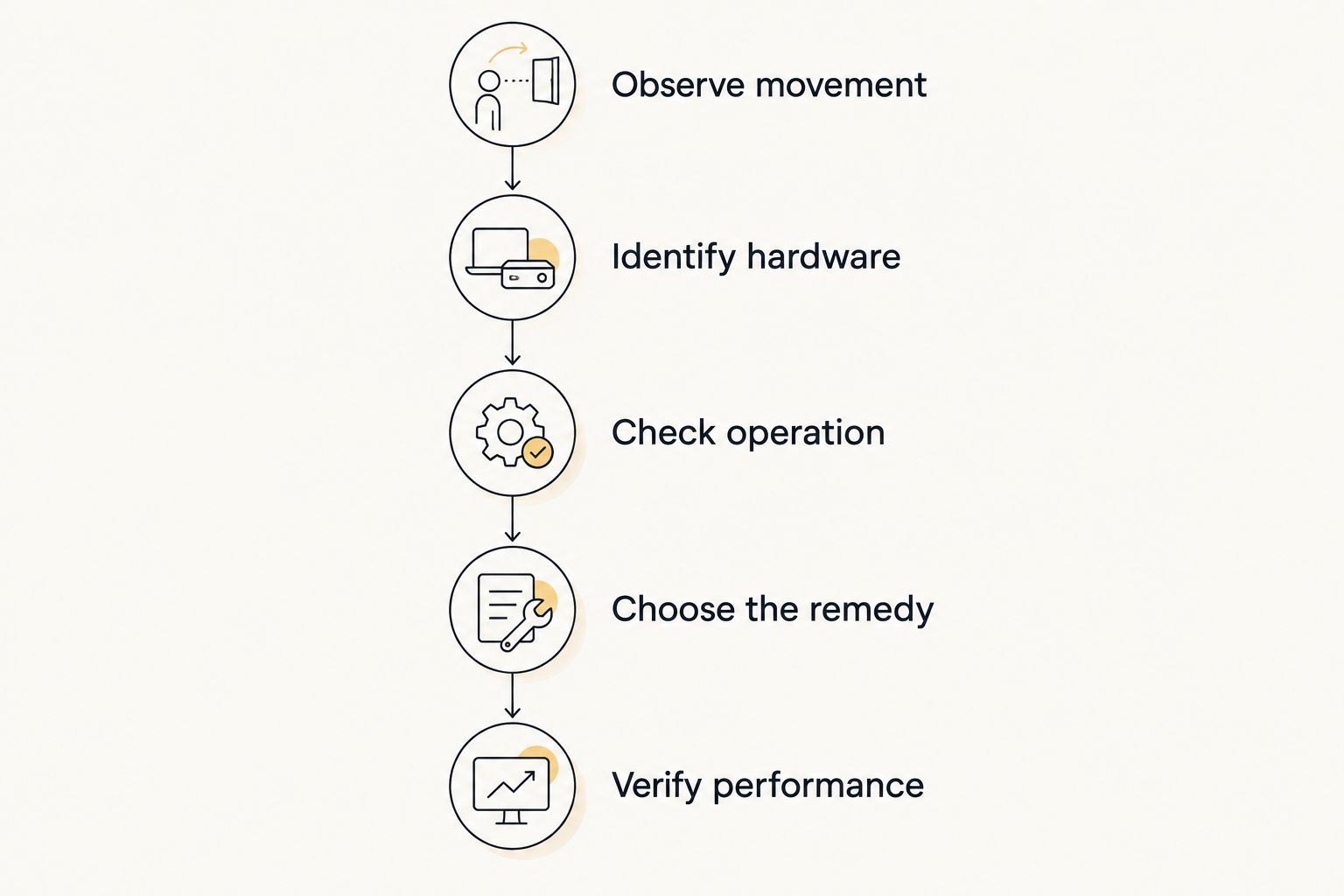
Choose the remedy after identifying the fault, then check the complete door again.
Avoid adjustments that solve the wrong problem
Do not increase spring force simply because the latch misses the strike. Misalignment, hinge wear, seal resistance, or pressure differences need assessment before stronger closing force becomes the answer.
Likewise, slowing the door excessively is not a complete accessibility strategy. The entrance still needs to close and latch as required, especially where a fire-rated assembly is involved.
Backcheck also deserves a clear distinction: it cushions opening near the end of the opening swing; it is not a substitute for a door stop. Follow the closer manufacturer's instructions rather than experimenting with adjustment valves or removing screws.
For Southwest Florida businesses, describe whether the trouble occurs continuously or changes with wind and building operation. Those observations help distinguish a persistent mechanical fault from conditions that alter how the entrance moves.
How these options are ranked
The default recommendation favors accessible adjustment, practical maintenance, and suitability for common replacement work. Cam-action hardware receives a separate recommendation for opening-effort concerns; concealed hardware serves entrances whose construction supports it.
This is a selection guide, not a product test or compliance certification. No closer earns approval solely through its category, appearance, or advertised accessibility features.
FAQ
What's the best door closer for an ADA-compliant commercial entrance?
The best choice is a closer that fits the door and allows the installed entrance to meet applicable accessibility and closing requirements. An adjustable surface-mounted closer is a practical starting point, while cam-action hardware deserves consideration when opening effort is the concern.
Does an ADA label mean my entrance is compliant?
No. A closer's accessibility claim does not establish compliance of the complete entrance, which also depends on installation, adjustment, opening dimensions, maneuvering space, thresholds, and operating hardware.
How slowly does an accessible door closer have to close?
The ADA Standards require at least 5 seconds for a closer-equipped door to move from 90 degrees open to 12 degrees from the latch. Timing the entire swing until the door latches is not the same measurement.
Does the ADA require every exterior door to open with 5 pounds of force?
No. The federal ADA Standards specify that limit for interior hinged doors, excluding fire doors, and do not set a numerical opening-force maximum for exterior hinged doors. Check the requirements that apply to the particular entrance and jurisdiction.
Is a cam-action closer better than a conventional closer?
A cam-action closer deserves consideration when its opening-force characteristics address the entrance's needs. It is not automatically better for every opening, and it cannot correct binding hinges, poor alignment, or other door defects.
Can GO Locksmith help with a commercial door closer?
Yes. GO Locksmith lists commercial door closer service among its confirmed services. Call (239) 412-1101 to discuss the door, request a job-specific estimate, and check current availability during business hours.
Can I reduce spring tension on a fire door to make it easier to open?
Do not reduce closer force without confirming that the fire door will still self-close and latch as required. Fire-door requirements, the manufacturer's instructions, and the appropriate authority must guide the adjustment.
One last thing: describe the symptom, not just the closer
Before calling, write down whether the door is hard to open, closes too fast, fails to latch, or behaves differently in windy conditions. That description is more useful than requesting an ADA closer without explaining what the entrance does wrong.
For commercial door closer service in Fort Myers, Cape Coral, Lehigh Acres, Estero, Bonita Springs, or Naples, call GO Locksmith at (239) 412-1101 for a job-specific estimate and current availability. Hours are Sunday–Thursday, 7:00 AM–11:00 PM, and Friday, 7:00 AM–5:00 PM; Saturday is closed.