
Blog ·
How much does it cost to install a commercial door closer?
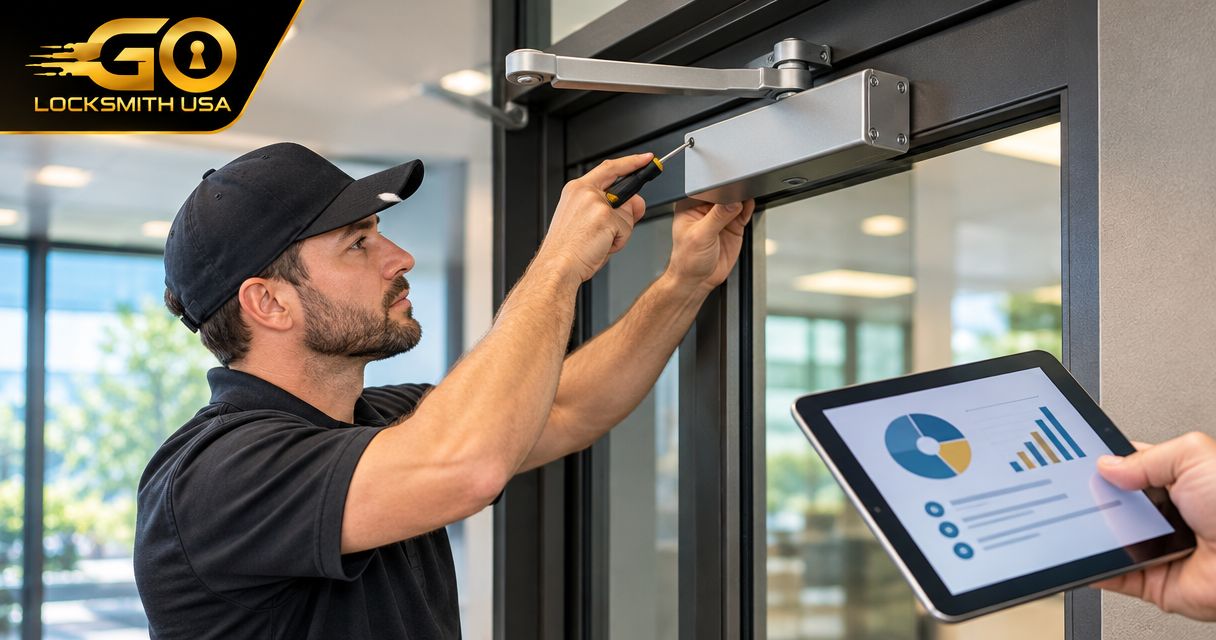
The cost to install a commercial door closer depends on the closer, the mounting requirements, and the condition of your door and frame; request a job-specific estimate rather than relying on a universal installed price. Ask whether that estimate includes the hardware, installation, adjustment, and any additional work identified during assessment. Replacing an existing closer and fitting one to a door that has never had one are different jobs.
TL;DR
- The cost to install a commercial door closer depends on hardware, mounting requirements, and door condition.
- Compare estimates for the complete installation, not just the closer itself.
- A slamming or sticking door needs assessment before you choose adjustment or replacement.
- GO Locksmith provides mobile commercial door-closer service in Fort Myers and confirmed Southwest Florida service areas.
Why the installation scope matters
A useful estimate tells you what will make the door close and latch properly—not just what it takes to attach a closer. If the door rubs against the frame or the latch does not line up, replacing the closer alone does not resolve that separate problem.
GO Locksmith provides mobile commercial door-closer service for businesses in Fort Myers and Southwest Florida. When you request an estimate, describe both the hardware you have and what the door does during normal use.
Keep the discussion focused on the mechanical door hardware. A door closer controls the closing movement; it does not replace the lock, latch, or exit device.
How much does it cost to install a commercial door closer?
There is no single installed price that accurately covers every commercial door. Request a written estimate that separates the closer from the installation work and identifies anything outside the agreed scope. That gives you a usable basis for comparing proposals.
The following breakdown shows what to ask about. These are estimate categories, not a statement that every job needs every item or that a particular provider charges them separately.
| Estimate category | What to clarify | Why it matters |
|---|---|---|
| Closer hardware | Which closer, arm, and mounting components are included? | The equipment must suit the door and installation arrangement. |
| Installation labor | Is this a replacement or a fresh installation? | Existing preparation and mounting points affect the work involved. |
| Door and frame preparation | Are additional mounting preparations or supports needed? | The closer needs a sound attachment to the door and frame. |
| Adjustment and testing | Does the scope include checking closing movement and latching? | Attaching the hardware is not the same as confirming operation. |
| Related hardware work | Are latch, hinge, or other door issues included or excluded? | A separate fault can remain after the closer is installed. |
An estimate that lists only a closer model leaves important questions unanswered. Ask the installer to describe the intended result and explain what happens if assessment reveals a separate door problem.
What should a complete estimate say?
A clear proposal identifies the door being serviced, the work being authorized, and the hardware being supplied. It should also distinguish confirmed work from anything that requires further assessment.
If you supply the closer yourself, disclose that before agreeing to the job. Ask whether the installer can use that exact unit and whether all required components are present; do not assume that matching the appearance or screw-hole pattern establishes compatibility.
Replacing an existing commercial door closer
Best for: a door with an existing closer that has been assessed as needing replacement. A replacement uses the existing installation as the starting point, but the new closer still needs to match the door and mounting requirements.
Photograph the existing closer body, arm, mounting points, and any readable identification. Those details help explain the job without requiring you to diagnose the mechanism yourself.
The advantage of a suitable replacement is that existing preparation can sometimes remain useful. The limitation is that worn mounting points, damaged hardware, or a different mounting arrangement can change the work required.
Do not buy a replacement solely because it looks similar. Ask the installer to confirm suitability before purchasing hardware that could be wrong for the opening.
Installing a closer where none exists
Best for: a commercial door that needs a closer and does not already have a suitable installation. A fresh installation requires a mounting plan rather than a straight exchange of hardware.
The door, frame, opening direction, and available mounting space all matter. A suitable closer also needs appropriate attachment points; the visible surface alone does not establish whether the proposed mounting is suitable.
The benefit is that the installation can be planned around the actual opening. The limitation is that preparation and mounting requirements need assessment before the scope is settled.
If you lease the premises, check who can authorize changes to the door and frame. Obtain the necessary property approval before allowing new drilling or other alterations.
Adjustment, replacement, or fresh installation?
A door that closes badly does not automatically need a new closer. Describe the symptom first, then ask which course of action addresses its cause.
| Option | Best for | Main benefit | Main limitation |
|---|---|---|---|
| Assessment and adjustment | An existing closer that remains suitable and serviceable | Addresses settings without automatically replacing hardware | Cannot correct every mechanical failure or separate door fault |
| Closer replacement | An existing installation with a closer that needs replacing | Replaces the affected closing mechanism | Requires compatibility and mounting checks |
| Fresh installation | A door without a suitable existing closer | Adds a planned closing mechanism | Requires assessment of mounting space and preparation |
Choose the work that corrects the problem, not the option with the shortest description. Adjustment is not a substitute for replacing failed hardware, and replacement is not a substitute for addressing a rubbing or misaligned door.
Avoid turning adjustment screws experimentally. Closer instructions are model-specific, and incorrect adjustment can create unsafe operation or damage the closer.
Why commercial door-closer installation costs vary
The job changes with the opening and the hardware. These are the main factors to discuss when requesting an estimate:
- Existing installation: Replacing a closer and preparing an unmodified door involve different tasks. Explain whether a closer is already fitted.
- Door and frame condition: Loose attachment points, rubbing, or visible damage need attention during assessment. Do not assume the closer causes every closing problem.
- Mounting arrangement: Available space, opening direction, and the relationship between the door and frame determine suitable mounting options.
- Closer requirements: Door characteristics and intended use guide hardware selection. Appearance alone is not a reliable selection method.
- Related mechanical hardware: Hinges, latches, locks, and exit devices affect how the opening works. Clarify whether any related work is part of the estimate.
- Opening requirements: A fire-rated opening or an accessible route introduces requirements that must be considered alongside the closer manufacturer's instructions.
Tell the installer if the door serves a public entrance, staff room, shared corridor, or exit. That context helps frame the assessment without asking you to select technical settings or hardware yourself.
What to prepare before requesting an estimate
You do not need to dismantle the closer to explain the job. Gather information from normal observation, keeping clear of moving hardware and avoiding any test that feels unsafe.
- Door overview: Photograph the whole opening from both sides, including the top of the door and frame. This gives context that a close-up alone misses.
- Hardware details: Photograph the closer, arm, attachment points, and readable labels. Leave covers and components in place unless a qualified person advises otherwise.
- Closing symptoms: Describe whether the door slams, stops short, rubs, or fails to latch. Mention whether the behavior is constant or occurs under particular conditions.
- Installation scope: State whether you want assessment of existing equipment, replacement, or a first installation. Identify any known property-approval requirements.
These details support a more focused conversation. They do not replace assessment of the door or establish that a particular closer will fit.
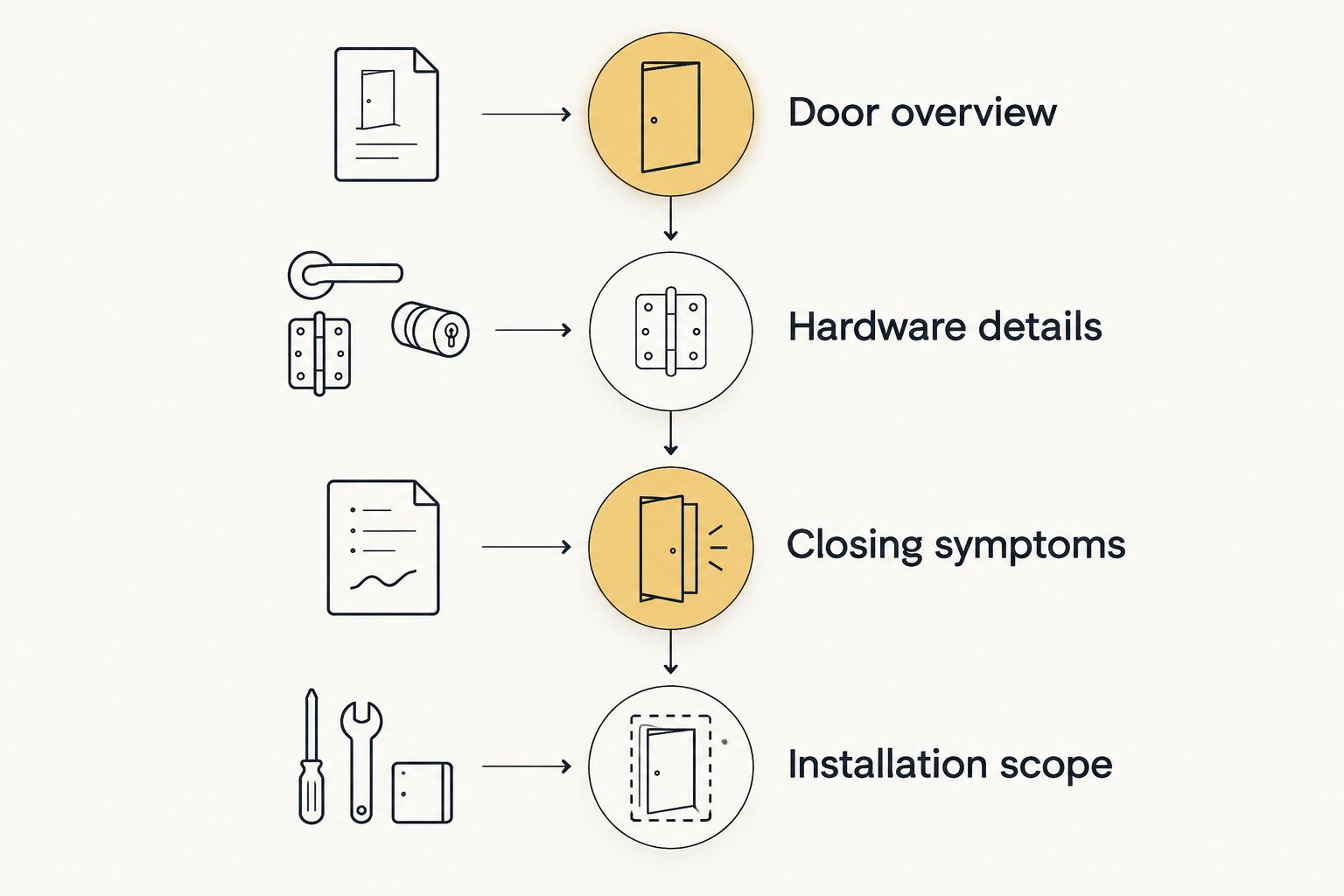
Describe the opening and its symptoms before choosing replacement hardware.
How to compare installation estimates fairly
Compare proposals for the same opening and the same intended work. A hardware-only figure and a complete installation estimate do not describe equivalent jobs.
Ask each provider to clarify:
- Whether the closer and required mounting components are included.
- Whether the proposal covers replacement or fresh installation.
- Whether adjustment and an operational check are included.
- Which existing door or hardware problems fall outside the scope.
- How additional work will be explained and authorized.
Do not assume that a vague phrase such as complete installation covers every defect in an existing door. Get exclusions explained before authorizing work, particularly if the door already binds or will not latch.
For a fire-rated opening, ask how the proposed hardware and installation suit that opening. For accessibility concerns, ask for assessment against the applicable requirements rather than simply requesting a stronger or weaker closer.
Does a slamming commercial door always need a new closer?
No. Slamming is a symptom, not proof that replacement is necessary. An assessment needs to distinguish unsuitable settings from failed hardware or another condition affecting the door.
Record what you observe without repeatedly cycling a door that appears unsafe. Visible leakage, loose components, or damaged attachment points are useful details to report, but they do not establish the full repair scope by themselves.
Can you reuse the existing mounting holes?
Existing mounting holes are reusable only when they suit the proposed hardware and remain sound. Matching the old closer's footprint does not establish that every part of the installation is suitable.
Ask whether the estimate assumes reuse of existing preparation. If that assumption changes after assessment, request an explanation of the revised work before proceeding.
Is a door closer the same as a push bar?
No. A door closer controls closing movement, while a push bar is exit hardware used to release the door from the inside. The components perform different jobs, even when they are fitted to the same opening.
If your concern involves both closing and exit operation, describe both symptoms. Treat the closer and exit device as separate parts of the assessment rather than assuming replacement of either one fixes the other.
FAQ
How do I get an accurate cost to install a commercial door closer?
Request a job-specific estimate that identifies the hardware, installation work, adjustment, and exclusions. Provide photos of the door and existing closer, plus a description of any closing or latching problems.
Is replacing a commercial door closer always simpler than installing a new one?
No. Replacement still requires suitable hardware and sound mounting points. Existing damage or a different mounting arrangement can change the scope.
Can I buy a door closer and have a locksmith install it?
Ask the installer to confirm the exact closer is suitable before buying it. Door characteristics, mounting requirements, and included components matter more than appearance alone.
Will a new closer fix a commercial door that will not latch?
Not necessarily. A door that will not latch needs assessment of the closing action and the related mechanical hardware; a separate alignment or latch problem can remain after closer replacement.
Should I choose a stronger closer for a heavy commercial door?
Have the closer selected for the actual door and applicable opening requirements. Choosing a stronger setting or unit without assessment can make the door harder to open without correcting the underlying problem.
Does GO Locksmith provide commercial door-closer service in Southwest Florida?
GO Locksmith provides mobile commercial door-closer service in Fort Myers, Cape Coral, Lehigh Acres, Estero, Bonita Springs, and Naples. Call (239) 412-1101 to discuss the door and check current availability.
One last thing: describe the failure before naming the fix
“The door stops before the latch engages” is more useful than “I need a stronger closer.” A clear symptom gives the installer something to assess without committing you to hardware that does not address the cause.
For a commercial door-closer estimate, call GO Locksmith at (239) 412-1101 with your location, door photos, and a description of the problem. Hours are Sunday–Thursday 7:00 AM–11:00 PM and Friday 7:00 AM–5:00 PM; Saturday is closed.