
Blog ·
How long does it take to unlock a commercial storefront?
Unlocking a commercial storefront has no fixed completion time: the lock, the door’s condition, and the cause of the lockout determine the work required. Travel and authorization checks are separate from the time spent opening the door. Ask for an arrival estimate first, then a job-specific assessment rather than treating either estimate as a guaranteed reopening time.
TL;DR
- How long to unlock a commercial storefront depends on the lock, door condition, and cause of the lockout.
- Separate arrival time, door-opening work, and any repair needed before the storefront can lock again.
- GO Locksmith provides mobile business lockout service; call to check current availability.
- Describe missing keys, broken keys, and door problems separately so the service request matches the issue.
How long does it take to unlock a commercial storefront?
A useful estimate separates getting a technician to the storefront from opening the door and restoring normal operation. A missing key and a damaged lock are not the same job, even when both leave you standing outside.
GO Locksmith’s confirmed locksmith services include business lockouts, broken key extraction, and commercial lock repair, replacement, and rekeying. The right service depends on what prevented entry—not simply on whether the door is locked.
Use these stages when asking about timing:
- Arrival: Give the exact address, business name, suite number, and entrance location. Ask about current availability and the arrival estimate for that location.
- Authorization: Ask what identification or evidence of permission you should have ready. Arrange for an owner, manager, or property representative to be reachable if needed.
- Door assessment: Explain whether the key is missing, broken, or turning without opening the door. The technician needs to assess the actual hardware before giving a meaningful opening estimate.
- Opening and checks: Clarify whether the proposed work covers entry only or also addresses a damaged lock. Before returning the entrance to use, check that it opens, closes, and secures properly.
These stages describe the scope of a service visit, not a promised timetable. An arrival estimate does not establish how long the door work will take, and successful entry does not automatically mean every underlying fault is resolved.
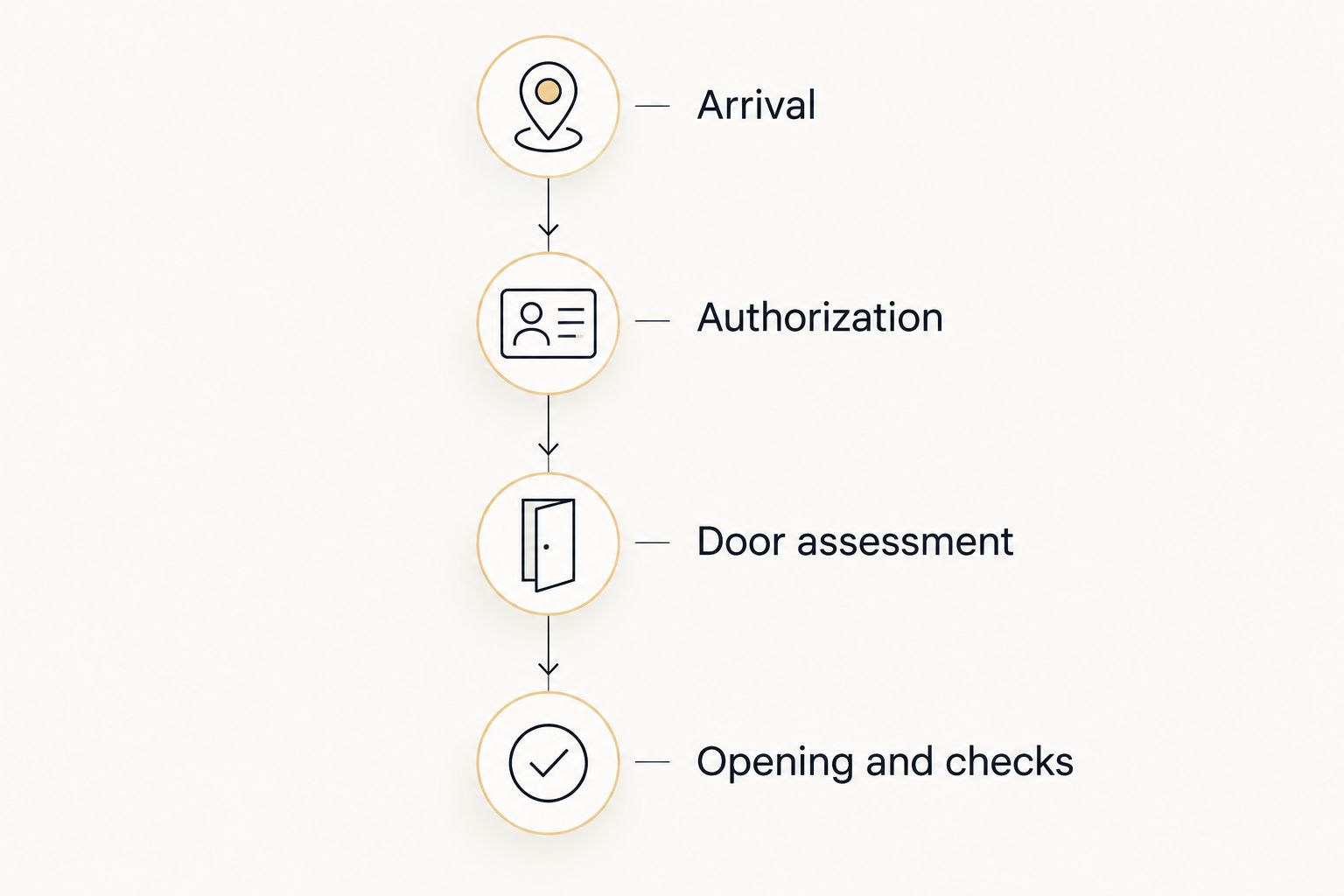
Ask about arrival and on-site work separately when planning your reopening.
What happened to the door matters more than the word “lockout”
Tell the locksmith what you observed without trying to diagnose the mechanism. A description such as “the key turns, but the door stays shut” gives more useful information than “the lock is broken.”
The following situations call for different assessments. None supports a reliable opening-time promise without examining the door.
| Situation | What to report | Immediate goal | What entry alone does not resolve |
|---|---|---|---|
| Keys are inside or missing | Whether the door worked normally before the lockout | Restore authorized entry | Missing-key security concerns |
| A key broke in the lock | Whether a fragment remains and whether the door is locked | Assess the fragment and lock condition | Possible damage or wear that caused the break |
| The key turns but the door stays shut | What moves, what does not, and any earlier sticking | Identify why the door will not release | A latch, lock, or door-operation fault |
| The lock shows visible damage | What damage is visible and when you noticed it | Assess entry and security needs | The need to secure damaged hardware afterward |
| The entrance uses a push bar | Whether the problem concerns outside entry or inside exit | Identify the affected hardware | Any separate exit-operation problem |
A missing-key lockout does not, by itself, establish that replacement is necessary. Conversely, getting a damaged door open does not establish that its lock is fit to remain in service.
Ask what needs to happen after entry before approving the work. That keeps an opening-only request separate from repair, replacement, or rekeying and helps you understand what the estimate actually covers.
Why storefront unlocking time varies
The useful factors are specific to the entrance and the service request. You do not need to know the lock’s technical name to explain them.
- Lock and hardware type. Describe a keyed cylinder, handle, deadbolt, or push bar if you recognize it. Different assemblies require different assessments; appearance alone does not establish how they can be opened.
- Cause of the lockout. Keys left inside, a broken key, and a lock that stopped operating are distinct problems. Tell the locksmith which event happened first.
- Door condition. Report sticking, scraping, or a need to pull on the door before the incident. These observations help distinguish a simple access problem from a broader operating problem.
- Visible damage. A bent key, damaged cylinder, or signs of forced entry change what needs inspection. Do not keep testing damaged components to obtain a more detailed description.
- Authorization arrangements. An employee waiting outside is not necessarily the person authorized to approve work. Having the appropriate decision-maker reachable avoids uncertainty about permission and scope.
- Work needed after entry. Opening, extracting a broken key, repairing hardware, and rekeying are different tasks. Ask which are included and which require a separate decision.
Travel belongs in your overall reopening plan, but it is not part of the hands-on unlocking duration. Give the full location when checking availability rather than assuming a general service-area statement establishes an arrival time.
What should you have ready before calling?
Prepare a short description that someone unfamiliar with your business can understand. Start with the location and the problem, then explain any deadline affecting the business.
Identify the correct entrance
Provide the street address, suite number, business name, and the door where assistance is needed. Mention whether that entrance faces the street, parking area, or an interior corridor.
A shopping center address alone can leave the actual entrance unclear. If someone will meet the technician, make sure that person knows which door has the problem and can contact the person approving the work.
Describe the last normal operation
Explain whether the door locked normally at closing or had already been difficult to operate. Mention a key that became hard to turn, a handle that stopped moving normally, or a door that began rubbing before the lockout.
Report observations, not conclusions. “The key would not turn this morning” is clearer than asserting that a particular internal part has failed when it has not been inspected.
Arrange permission and approval
Ask what evidence of authorization is required for the visit. Have relevant identification and a way to reach the owner, manager, or property representative, as appropriate to your arrangement.
If you lease the storefront, check who can authorize changes to the lock or door hardware. Permission to reopen the business and permission to replace hardware are separate questions; do not assume your lease treats them identically.
State what you need completed
Explain whether you need entry only, suspect a broken key, or also need the entrance secured after damage. If a key is missing, say so rather than describing it as merely locked inside.
Ask for a job-specific estimate and clarification of what it includes. Read the guidance on recognizing a legitimate locksmith quote if you need help distinguishing an initial estimate from the work ultimately authorized.
What can you do while waiting?
Keep the entrance clear and avoid turning an access problem into a damage problem. Do not force the key, pry against the frame, or put improvised tools into the lock.
If a key has broken, keep the piece you still have and report that a fragment remains inside. Do not push another key or object into the opening to try to move it.
Contact an authorized keyholder or property representative if a legitimate spare key is available. That is a sensible access option, but a spare does not solve a jammed or damaged mechanism; stop if it meets unusual resistance.
Keep customers and deliveries away from the affected entrance while it is being assessed. Give staff a clear update based on the current estimate rather than announcing an opening time that has not been confirmed.
A storefront lockout is an entry problem. If someone cannot leave the premises safely, or there is an immediate threat to life, contact emergency services rather than waiting for routine locksmith assistance.
Does getting inside mean the storefront is ready to reopen?
Entry and normal door operation are separate outcomes. Before treating the job as complete, ask whether the entrance now opens, closes, latches, and locks as intended.
For a missing-key lockout with otherwise functioning hardware, access can be the immediate objective. Its limitation is key control: opening the door does not prevent a missing key from working later.
Rekeying addresses which keys operate a compatible lock, but it does not repair every mechanical fault. Repair addresses a diagnosed problem, while replacement involves changing hardware; neither should be treated as automatically necessary because a lockout occurred.
If the entrance uses a push bar or door closer, report any operating problem separately. Do not alter exit hardware or prop an entrance open as a substitute for resolving a fault.
Ask the technician to explain any proposed additional work before you approve it. A clear explanation should connect the recommendation to the condition found, not just to the fact that you were locked out.
Can you get a useful estimate before anyone sees the door?
You can ask for an arrival estimate and explain the symptoms before the visit. A firm hands-on completion time is a different matter: the lock and door condition must be assessed to establish the work involved.
Ask what the initial estimate assumes. For example, an estimate based on a functioning lock with keys inside does not describe the same scope as a damaged cylinder requiring further work.
Tell the locksmith about your business deadline, but keep your reopening announcement separate from the estimate. Customer appointments, deliveries, and employee access are easier to manage when you distinguish an expected arrival from confirmed completion.
Who should you call for a Southwest Florida storefront lockout?
GO Locksmith provides mobile commercial locksmith service for businesses needing authorized entry or confirmed mechanical lock and door-hardware work. Its confirmed commercial services include business and interior door lockouts, lock repair, replacement and rekeying, fresh installation, push bars, door closers, and broken key extraction.
GO Locksmith serves Fort Myers, Cape Coral, Lehigh Acres, Estero, Bonita Springs, and Naples. Give your actual location when checking availability.
The service boundary matters: GO Locksmith does not install or repair electronic access-control systems. If the entrance problem involves that equipment, describe it when you call rather than assuming it falls within a mechanical lockout visit.
Hours are Sunday–Thursday, 7:00 AM–11:00 PM, and Friday, 7:00 AM–5:00 PM; Saturday is closed. Call (239) 412-1101 during those hours to check current availability and request a job-specific estimate. No arrival or opening duration is guaranteed.
FAQ
How long will a locksmith take to open my storefront once they arrive?
The on-site duration depends on the lock, door condition, and cause of the lockout. Ask for an assessment that separates opening the door from any repair or rekeying needed afterward.
Does the arrival estimate include the time needed to unlock the door?
Do not assume the arrival estimate includes unlocking time. Ask separately when the technician is expected and what can be estimated about the work after the entrance is assessed.
Can a commercial storefront be opened without replacing the lock?
Replacement is not automatically required for every storefront lockout. The lock’s condition and the cause of the problem determine whether opening alone, repair, or replacement is appropriate.
What should I tell the locksmith if my key turns but the door will not open?
Say that the key turns but the door stays shut, and describe any sticking or unusual handle movement you noticed. Avoid repeatedly forcing the key or door while waiting for an assessment.
What proof do I need to have a business door unlocked?
Ask the locksmith what identification and evidence of authorization are required. Have an owner, manager, or property representative reachable when permission to enter or approve work needs clarification.
Can GO Locksmith help with an electronic access-control failure?
GO Locksmith does not install or repair electronic access-control systems. Describe the equipment and symptoms when calling so the request is not mistaken for a confirmed mechanical locksmith service.
Should I rekey the storefront after losing the key?
A lost key creates a separate key-control question after entry is restored. Discuss rekeying with the authorized decision-maker; unlocking alone does not stop the missing key from operating the lock.
One last thing: plan for the next closing, not just opening
Before reopening, establish how the entrance will be secured when the business closes. Getting everyone inside solves the immediate interruption, but it does not answer whether a missing key remains usable or damaged hardware needs further work.
When calling, ask: “Can you assess entry and confirm what is needed to leave this door working and secure?” That question gives the service request a clearer endpoint than simply asking how quickly someone can get you inside.