Blog ·
Commercial locksmith services for gyms: complete 2026 guide
Commercial locksmith services for gyms are mechanical lock, key, and door-hardware services that help you control staff access, resolve lockouts, and keep doors working properly. For a gym, the important distinction is between securing staff-only rooms and maintaining safe exit routes; neither task is the same as managing electronic member access.
TL;DR
- GO Locksmith provides mobile commercial locksmith services for gyms needing mechanical lock and door-hardware help in Southwest Florida.
- Rekeying changes which key operates a compatible lock; replacement addresses hardware that needs changing.
- Keep staff key control separate from electronic membership access, which GO Locksmith does not install or repair.
- Describe the affected door, hardware, and symptoms before requesting a job-specific estimate.
Why commercial locksmith services matter for gyms
A gym entrance, manager’s office, and equipment-storage room serve different purposes. Treating every door alike leaves you with the wrong repair request or an access policy that does not match how staff use the building.
GO Locksmith provides mobile commercial locksmith services for gyms needing mechanical lock and door-hardware help in Southwest Florida. Its confirmed commercial services include business and interior-door lockouts, lock repair, replacement, rekeying, fresh installation, push bars, door closers, and broken key extraction.
You can contact GO Locksmith for service in Fort Myers, Cape Coral, Lehigh Acres, Estero, Bonita Springs, and Naples. Electronic access-control installation and repair are outside its confirmed service scope, so describe mechanical and electronic problems separately.
That distinction matters if your gym uses member credentials but staff still carry physical keys. A working membership reader does not resolve a jammed office lock, and a rekey does not deactivate an electronic credential.
Build a door-by-door service plan
Map your doors and responsibilities
Start with a simple spreadsheet or paper list. Walk through the gym with the person responsible for opening and closing, and record what each door does before selecting any hardware.
Separate member-facing entrances from staff-only rooms and exit doors. Include tenant and landlord responsibilities: changing hardware without checking your lease or building arrangements can create avoidable disputes.
For each door, identify these four items:
- Door purpose: entrance, office, storage, or another confirmed use.
- Key holders: staff or other authorized people with physical keys.
- Hardware condition: sticking, loose, damaged, or operating normally.
- Exit function: whether the door serves an exit route.
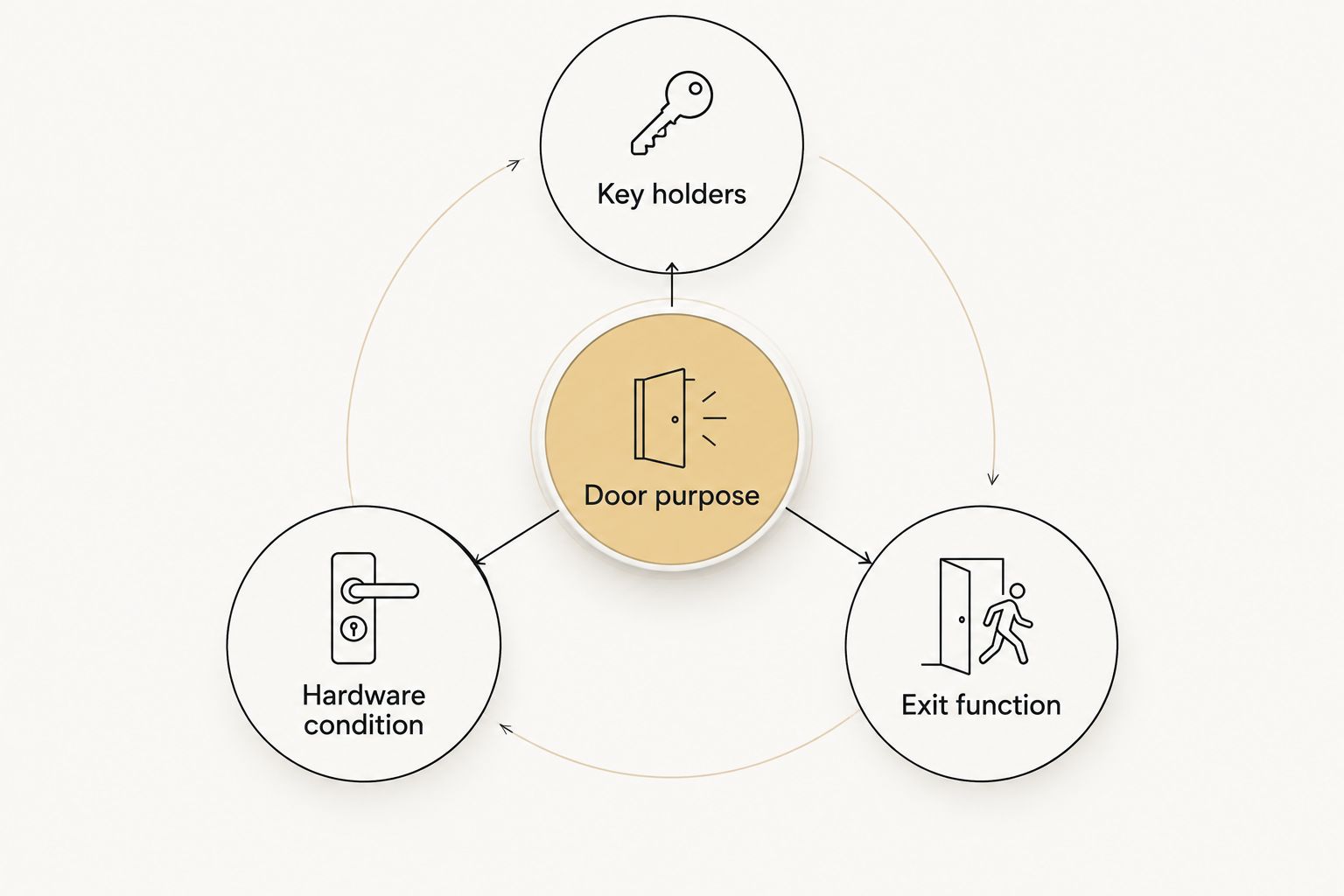
Assess each door’s role before choosing a lock service.
Keep member locker issues on a separate list. A locker lock is not automatically covered by a provider’s commercial-door services, so ask about the specific hardware rather than assuming compatibility.
- Label each door consistently in your records and service request.
- Note who can authorize work on leased doors.
- Photograph visible hardware without exposing key details publicly.
- Separate locker hardware from building-door hardware.
- Record whether electronic components are involved.
Identify the problem before choosing the service
Use what you can observe without disassembling the lock. Describe whether the key turns, the handle operates, the door closes, and the latch engages; those observations are more useful than guessing that the entire lock needs replacing.
Rekeying addresses key access, not every mechanical fault. On a compatible lock, rekeying changes the internal keying so a different key operates it. A door that drags, a damaged mechanism, or a closer problem needs a different assessment.
If a staff key is missing but the lock works normally, ask about rekeying. If a key has snapped or the door will not operate normally, report those symptoms and stop forcing it.
From this step onward, a mobile locksmith can assess the affected hardware rather than leave you choosing a service from symptoms alone. GO Locksmith offers the confirmed mechanical services listed above, but the appropriate work depends on the actual door and lock.
- Report whether the problem affects entry, closing, or locking.
- Explain whether a working key is still available.
- Mention any broken key remaining in the lock.
- Distinguish a missing-key concern from a hardware failure.
- Avoid forcing handles or repeatedly turning a resistant key.
Review staff keys after access changes
Begin with a manual key register. Record who holds each physical key, which doors it opens, who authorized issuance, and whether it was returned.
A gym’s opening staff, trainers, cleaners, and managers do not necessarily need identical access. Assign keys according to duties rather than distributing a general staff key without tracking it.
When someone leaves, collecting a key is useful, but it does not establish whether copies exist. If you cannot account for access to a sensitive room or exterior door, ask about rekeying the affected compatible locks.
Do not assume that every lock in your gym can use the same key. Compatibility and the intended access arrangement require assessment; a complicated key plan also needs a service provider whose relevant capabilities are confirmed.
- Record the holder and permitted doors for every issued key.
- Collect keys when employment or contractor access ends.
- Identify doors affected by a lost or unreturned key.
- Keep spare keys in controlled storage, not an open reception drawer.
- Update the register whenever access responsibilities change.
Check closing and exit hardware separately
Watch each door through a normal closing cycle. Note whether it reaches the frame, latches, or needs someone to pull it shut; do not change closer settings or exit hardware simply to make a security problem disappear.
A door closer controls closing movement. A push bar is exit hardware. Neither is interchangeable with the keyed lock, and replacing a lock alone does not necessarily correct a closing or exit problem.
Do not add an improvised lock, chain, or fastening to an exit door. Exit arrangements must satisfy applicable building and fire requirements. Ask the building manager or relevant local authority about the requirements for your premises rather than relying on a general product recommendation.
Push bars and door closers are within GO Locksmith’s confirmed commercial service scope. Describe the existing hardware and symptoms when calling; that service scope does not establish compatibility with every device or replace a code assessment.
- Observe closing and latching during normal operation.
- Report slamming, dragging, or incomplete closing separately.
- Identify doors used as exits before requesting hardware changes.
- Keep exit routes and operating hardware unobstructed.
- Check proposed changes with the responsible building contact.
Prepare a useful service request
Before calling, assemble the information already in your door list. A concise description helps distinguish a business lockout from a rekey request or a door-hardware problem.
Give the service location, your relationship to the gym, and the affected door’s role. Have information available to establish your authority over the premises, and ask what documentation the provider requires.
Explain whether members are present and whether the affected door is an entrance, staff-only room, or exit. For a trapped person or immediate safety danger, contact emergency services instead of treating the situation as a routine locksmith appointment.
For planned work, ask for a job-specific estimate and clarify what it covers. Do not rely on a general online figure for hardware that has not been identified.
- Provide the gym address and a working callback number.
- Identify the door and describe the symptoms plainly.
- State whether you need entry, rekeying, repair, or an assessment.
- Confirm who can approve the work and any changes in scope.
- Ask about current availability and the estimate’s inclusions.
Document the work and test the result
After service, record what changed on each affected door. Keep the information with your key register so the next manager does not have to reconstruct the gym’s access arrangements.
Ask the technician to explain the completed work and any remaining issue. Check normal operation with the authorized keys and confirm that the door closes and latches as intended, without altering exit hardware yourself.
If locks were rekeyed, update the key-holder list and remove obsolete keys from routine use. If hardware was replaced, retain the relevant product and maintenance information supplied with the job.
Do not mark a door as resolved solely because someone gained entry. A lockout can be over while an underlying lock or closing problem still needs attention.
- Record the door, completed service, and approval details.
- Test authorized keys through normal operation.
- Confirm closing and latching with the technician.
- Update key assignments and remove obsolete keys.
- Note unresolved issues and who will address them.
Compare the options for your gym
Choose the option that matches the problem, not the most extensive work. A missing key, failed lock, and poorly closing door are different service requests.
| Option | Best for | Main benefit | Key limitation |
|---|---|---|---|
| Manual key register | Gyms organizing staff access | Tracks issued and returned physical keys | Does not invalidate missing keys or repair hardware |
| Rekeying | Gyms changing access to compatible, serviceable locks | Changes which key operates the lock | Does not replace worn hardware or correct door alignment |
| Lock repair | Gyms with an assessable mechanical fault | Addresses the identified fault | Not every damaged mechanism is repairable |
| Lock replacement | Gyms whose lock hardware needs changing | Replaces the affected lock | New hardware still needs suitable fit and correct installation |
| Fresh installation | Gyms adding an approved mechanical lock | Adds hardware suited to the identified purpose | Door suitability, authorization, and exit requirements need checking |
| Business or interior-door lockout service | Authorized staff unable to enter | Addresses the immediate entry problem | Does not automatically resolve missing-key risks or underlying faults |
| Push bar or door closer service | Gyms with exit-hardware or closing problems | Addresses the relevant door-hardware function | Compatibility and applicable requirements need assessment |
The advantage of mobile service is that the work request concerns the hardware at your premises. The limitation is equally important: the provider still needs to confirm the specific job, hardware, and current availability.
Electronic member-entry systems require a separate discussion with an appropriate provider. Mechanical lock service is not a substitute for diagnosing membership software, readers, or electronic access controls.
Common mistakes gym owners make
Treating member access and staff keys as one system
Disabling a member credential does not withdraw a physical staff key. Maintain separate records and respond to the type of access that actually changed.
If an employee had both, address both through the appropriate channels. Do not describe electronic credential management as part of a mechanical rekey.
Rekeying a door that needs a mechanical assessment
A new key arrangement does not fix a door that will not latch. Report the complete symptom so the lock, door, and closing hardware can be assessed appropriately.
Similarly, do not assume replacement is necessary just because a key sticks. Request an assessment before deciding what must be discarded.
Improvising extra security on exit doors
A fastening added to stop unauthorized entry can interfere with escape. Keep exit requirements part of the decision from the start, not a final check after installation.
Do not use an ordinary staff-access rule to decide how an exit should operate. Confirm the requirements for the actual premises.
Assuming a locksmith covers every gym lock
Building doors, member lockers, and electronic entry equipment are different requests. Describe the hardware and ask whether the specific service is supported.
This prevents an appointment based on an unconfirmed capability. It also helps you direct unrelated problems to the right provider.
FAQ
What commercial locksmith services does a gym usually need?
A gym’s mechanical service needs can include business lockouts, interior-door lockouts, rekeying, lock repair or replacement, and door-hardware work. Choose the service according to the affected door and symptoms, and confirm the provider’s scope.
Should I rekey gym locks when an employee leaves?
Consider rekeying affected compatible locks when you cannot account for the former employee’s physical-key access. Collecting a key does not establish whether copies exist; review the key register and which doors the person could open.
Is rekeying better than replacing the locks at my gym?
Rekeying suits a key-access change when the existing lock is compatible and serviceable. Replacement suits hardware that needs changing; neither choice should be made without considering the actual lock and door condition.
Can GO Locksmith fix my gym’s electronic member-entry system?
GO Locksmith does not install or repair electronic access-control systems. Its confirmed commercial scope covers mechanical lock services, business and interior-door lockouts, push bars, door closers, and broken key extraction.
Can a locksmith help if my gym door will not close properly?
A door that will not close properly needs assessment of the door and relevant hardware, not an automatic rekey. Describe dragging, slamming, or failure to latch, and ask whether the specific problem falls within the provider’s services.
How do I get an estimate for locksmith work at my gym?
Request a job-specific estimate after describing the location, affected doors, hardware, and symptoms. Clarify what the estimate covers and who must approve any additional work.
Can I request gym locksmith service outside normal office hours?
You can call to check current availability during GO Locksmith’s confirmed hours: Sunday–Thursday, 7:00 AM–11:00 PM, and Friday, 7:00 AM–5:00 PM; Saturday is closed. These hours do not establish an arrival time, and the service is not 24/7.
One last thing
A door that locks is not necessarily a door that closes and latches reliably. Include all three functions in your gym’s service request, especially when an entrance looks secure only after someone pulls it shut.
Need help with a gym lockout, rekey, or confirmed mechanical door-hardware service? Call (239) 412-1101 to check current availability and request a job-specific estimate.