Blog ·
Lock rekey service for schools and daycares: complete 2026 guide
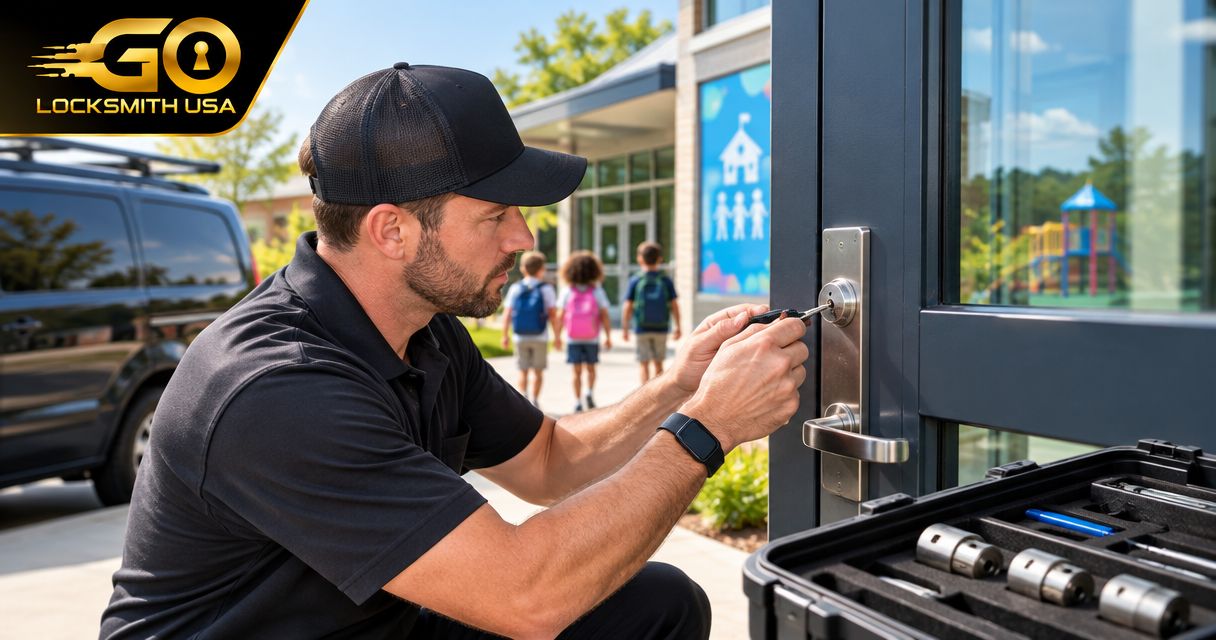
School and daycare lock rekeying is changing a compatible lock’s internal keying so a new key works and the previous key no longer operates that cylinder, with the aim of controlling physical access. A lock rekey service for schools must account for staff access, child supervision, authorized entry, and safe exit—not just replacing keys.
TL;DR
- Lock rekey service for schools changes key access; it does not repair damaged doors or manage electronic credentials.
- GO Locksmith provides mobile commercial lock rekey services; confirm your school’s hardware and job scope before scheduling.
- Inventory affected doors, identify authorized keyholders, and separate rekey work from lock repairs.
- Preserve required exit operation and test new keys before returning doors to normal use.
Why rekeying matters for schools and daycares
A returned key does not establish that every copy has been returned. Rekeying a compatible cylinder changes which key operates it, giving your school or daycare a defined point at which previous keys stop working on that cylinder.
Schools and daycares also need to separate adult access from children’s movement through the building. An exterior entrance, staff office, supply room, and classroom do not necessarily need the same key access. Decide who needs each door before deciding which locks to rekey.
GO Locksmith commercial lock rekey services are for schools and daycares seeking mobile service for mechanical locks in confirmed service areas. GO Locksmith serves Fort Myers, Cape Coral, Lehigh Acres, Estero, Bonita Springs, and Naples, and also operates in Jacksonville. Confirm the location, hardware, and requested work when you call.
Rekeying has a clear limitation: it changes key access, not the condition of the entire doorway. A sticking latch, damaged lock, unreliable closer, or electronic credential problem requires a separate assessment.
Plan a school rekey without losing control of access
Identify the doors affected by the key problem
Start with a walkthrough and a simple written inventory. Record each door’s location, the key that operates it, and any operating problem. You do not need specialized software to establish the scope.
Focus on the actual exposure. If a missing key operates several doors, listing only the door where it was last used leaves the remaining affected cylinders out of the plan. If its access is unknown, document that uncertainty rather than assuming it opened only one room.
Keep the inventory internal. Detailed key-to-door records should not be posted in visitor areas or distributed with general school communications.
- Entry doors: Record exterior entrances operated by the affected key.
- Staff access: Identify offices and staff-only spaces within its access.
- Storage rooms: Include keyed rooms containing supplies or sensitive materials.
- Shared premises: Note doors controlled by a landlord or another organization.
- Hardware condition: Record sticking, damage, or incomplete latching separately.
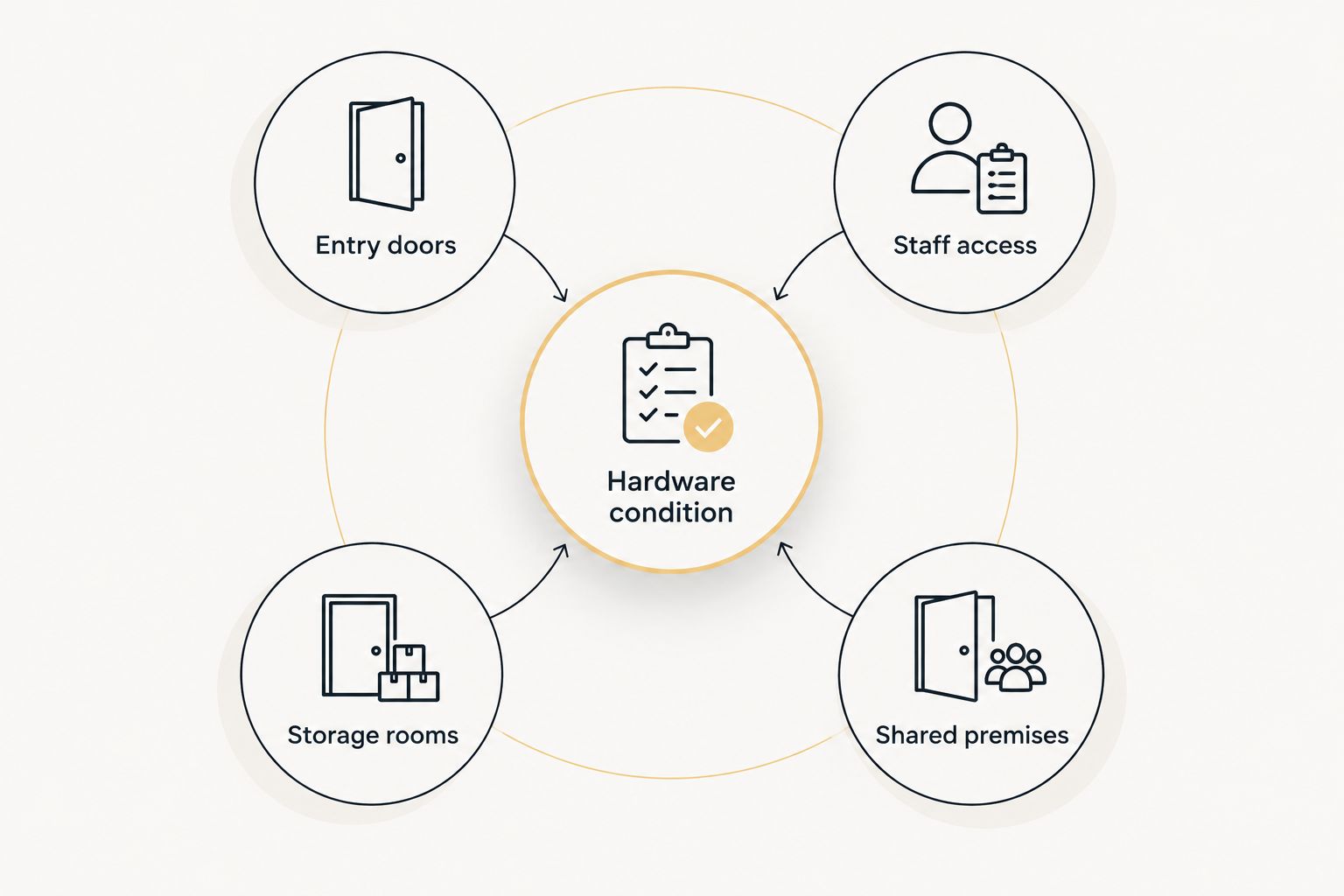
Define the affected doors before requesting rekey work.
Confirm authorization and assign a responsible contact
Before scheduling, establish who can approve changes to the locks. A daycare leasing space and a school operating its own building can have different approval arrangements. Check your lease, facilities policy, or ownership records instead of assuming the person holding a key can authorize the work.
Assign a site contact who understands the door list and can coordinate access. That person should distinguish the approved work from additional issues discovered during the visit.
Ask the locksmith what authorization or identification is required. Do not assume that a staff badge alone will satisfy the provider’s requirements.
- Identify the person authorized to approve lock changes.
- Obtain landlord or facilities approval where required.
- Name the contact responsible for meeting the locksmith.
- Make existing keys and the affected-door inventory available.
- Establish how additional work will be approved.
Separate rekeying from repair and replacement
Rekeying is appropriate when a compatible, serviceable lock needs a different operating key. Replacement addresses hardware that needs to be changed. Repair addresses a fault; changing the key alone does not correct a damaged mechanism or misaligned door.
Start by documenting what you observe without disassembling the lock. Describe whether the key turns, the latch engages, or the door fails to close. Those details help separate an access problem from a hardware problem.
GO Locksmith offers confirmed commercial lock repair, replacement, rekeying, fresh installation, push bar, and door closer services. Its guide to rekeying without replacing a lock explains the basic distinction. Compatibility and the appropriate work still depend on the actual hardware.
Do not prescribe a rekey for every door simply because the school is changing keys. Identify serviceable cylinders and faulty hardware separately.
- Request rekey assessment for compatible, functioning cylinders.
- Flag locks that bind, stick, or show visible damage.
- Report doors that do not close or latch reliably.
- Identify any existing master-key arrangement before changes begin.
- Keep electronic access-control work outside the mechanical rekey scope.
Set staff access before issuing replacement keys
Create a role-based access list using a spreadsheet or paper register. Start with the rooms each role actually needs, rather than copying the old distribution list unchanged.
A classroom employee, administrator, cleaner, and maintenance contact do not automatically need identical access. Decide the access boundaries with the responsible school or daycare manager. Then ask what the existing hardware can support.
Do not assume all cylinders can use one key, or that a new master-key arrangement is included in a routine rekey. Hardware compatibility and existing keying arrangements need assessment. GO Locksmith does not install or repair electronic access-control systems.
- Match each staff role to approved doors.
- Remove departed staff from the new key register.
- Identify temporary or contractor access separately.
- Decide who will hold and issue spare keys.
- Ask whether the proposed key arrangement fits the existing locks.
Coordinate work around supervision and building use
Map the affected doors against your daily activities before choosing a work window. Account for arrival, dismissal, classroom use, deliveries, and staff access. The goal is to avoid leaving people dependent on a door that is temporarily being serviced.
Ask for a job-specific schedule after providing the door inventory. The number and type of locks, their condition, existing keying, and site access affect the work. Do not build your staffing plan around an assumed completion time.
GO Locksmith is a mobile service, not a confirmed walk-in storefront. Its hours are Sunday–Thursday, 7:00 AM–11:00 PM; Friday, 7:00 AM–5:00 PM; Saturday closed. Call to check current availability rather than assuming an after-hours appointment is available.
- Choose a window that accounts for children’s supervision.
- Tell staff which doors are included in the work.
- Identify authorized alternate routes during servicing.
- Confirm who will remain available for decisions.
- Ask how key handover and completion checks will be coordinated.
Protect exit operation and test completed work
Key control and safe exit are separate requirements. A lock that rejects an old key is not enough if the door no longer closes, latches, or operates as required from the exit side.
Have the responsible facilities representative and locksmith review affected exit hardware. School and childcare requirements depend on the building, occupancy, hardware, and applicable rules. Refer compliance questions to the appropriate building or fire authority rather than treating a general rekey guide as approval.
Check completed work with the authorized site contact present. Report any uncertainty before treating the doorway as ready for normal use.
- Test each new key on its assigned cylinder.
- Confirm the previous key no longer operates the rekeyed cylinder.
- Check that the door closes and latches properly.
- Verify required exit-side operation with the responsible personnel.
- Record unresolved faults and arrange appropriate follow-up.
Record the handover and manage later key changes
A rekey establishes a new access boundary, but your key register preserves it. Record who received each key and which doors it operates. Keep that record separate from public-facing staff information.
Set a return process for departures, role changes, and temporary assignments. When a key goes missing, use the register to identify affected doors instead of relying on memory.
Retain the approved scope and completed-work record with your facilities documents. Future decisions are easier when you can distinguish a lost-key event from a recurring hardware fault.
- Record the recipient, issue date, and approved door access.
- Store spare keys in a controlled location.
- Document key returns during staff departures.
- Report missing keys to the designated decision-maker.
- Update the register whenever responsibilities change.
Compare the options for your school or daycare
Choose the work that solves the actual problem. Rekeying controls which mechanical key works; repair or replacement addresses hardware needs. An administrative key return helps with accountability but does not change a cylinder’s keying.
| Option | Best for | Main advantage | Key limitation |
|---|---|---|---|
| Collect keys and update the register | Staff departures when all issued keys are accounted for | Restores a documented record of possession | Does not invalidate unreturned or copied keys |
| Rekey compatible mechanical locks | Missing keys or changes in authorized access | Changes the operating key while retaining serviceable hardware | Does not repair door faults or disable electronic credentials |
| Repair faulty locks or door hardware | Sticking locks, latch problems, or unreliable closing | Addresses an operating problem | Does not necessarily change who has key access |
| Replace unsuitable or damaged locks | Hardware that cannot support the required work | Allows the faulty or unsuitable hardware to be changed | Requires assessment of fit, function, and applicable requirements |
Request a job-specific estimate that distinguishes rekeying, repair, replacement, and other approved work. Describe the doors and key arrangements rather than asking for one figure for an unspecified “school rekey.”
For electronic credential issues, contact the provider responsible for that system. Mechanical rekeying is not a substitute for deleting a card, changing a code, or updating an electronic access permission.
Common rekeying mistakes schools and daycares make
Treating key return as proof that access has ended
Collecting a departing employee’s key is useful, but it does not establish whether other copies exist. Decide whether rekeying is needed based on the affected access and your organization’s policy, not solely on receiving one key back.
Changing one cylinder without checking the key’s other doors
A missing key creates a scope question before it creates a scheduling question. Check every known door it operates. If it belongs to a broader keying arrangement, disclose that arrangement before approving changes.
Giving every adult the same access
A broadly distributed key creates more doors to review when that key is lost. Set access according to actual responsibilities. Convenience at issuance should not replace a deliberate decision about offices, storage, or staff-only areas.
Ignoring a door fault during the rekey
A new key does not fix a door that fails to latch. List mechanical problems separately and ask what work addresses them. Avoid signing off on the project merely because the replacement key turns.
Announcing a firm reopening time before confirming the scope
Different hardware and site conditions require different work. Confirm the proposed schedule and handover process first, then communicate the operational plan to staff. Keep supervision and authorized access arrangements clear throughout the visit.
FAQ
What does a lock rekey service for schools actually change?
A lock rekey service changes a compatible mechanical cylinder so a new key operates it and its previous key no longer does. It does not automatically replace the lock, repair the door, or change electronic access permissions.
Should a daycare rekey after an employee leaves?
A daycare should assess rekeying when a departing employee’s key is unreturned or continued access is a concern. Review every door the key operates and follow the organization’s authorization and key-control policies.
Can a school keep its existing locks when rekeying?
A school can retain compatible, serviceable locks during a rekey. Damaged, unsuitable, or incompatible hardware needs a separate assessment for repair or replacement.
Can every classroom and office use the same new key?
A shared key arrangement depends on hardware compatibility and the school’s access requirements. Decide which roles need each door before asking whether the existing cylinders support that arrangement.
Does rekeying school locks change keycards or keypad codes?
Rekeying a mechanical cylinder does not change electronic credentials or keypad permissions. GO Locksmith does not install or repair electronic access-control systems; contact the provider responsible for that system.
How much does school or daycare rekeying cost?
School or daycare rekeying requires a job-specific estimate based on the locks, keying arrangement, and requested work. Call GO Locksmith at (239) 412-1101 with your location and affected-door list to request an estimate.
Can rekeying be scheduled outside classroom hours?
You can request a work window outside classroom hours, but the appointment depends on current availability. GO Locksmith operates Sunday–Thursday from 7:00 AM–11:00 PM and Friday from 7:00 AM–5:00 PM; Saturday is closed.
One last thing
The useful final check is not just that the new key works—it is that the previous key no longer works on each rekeyed cylinder. Pair that check with door operation and a completed key register. That closes the gap between changing hardware access and managing it.
For school or daycare mechanical lock work in a confirmed service area, call (239) 412-1101 with your location, door list, and reason for rekeying. Ask about current availability and a job-specific estimate.