
Blog ·
Can a locksmith remove a broken key from a car ignition?
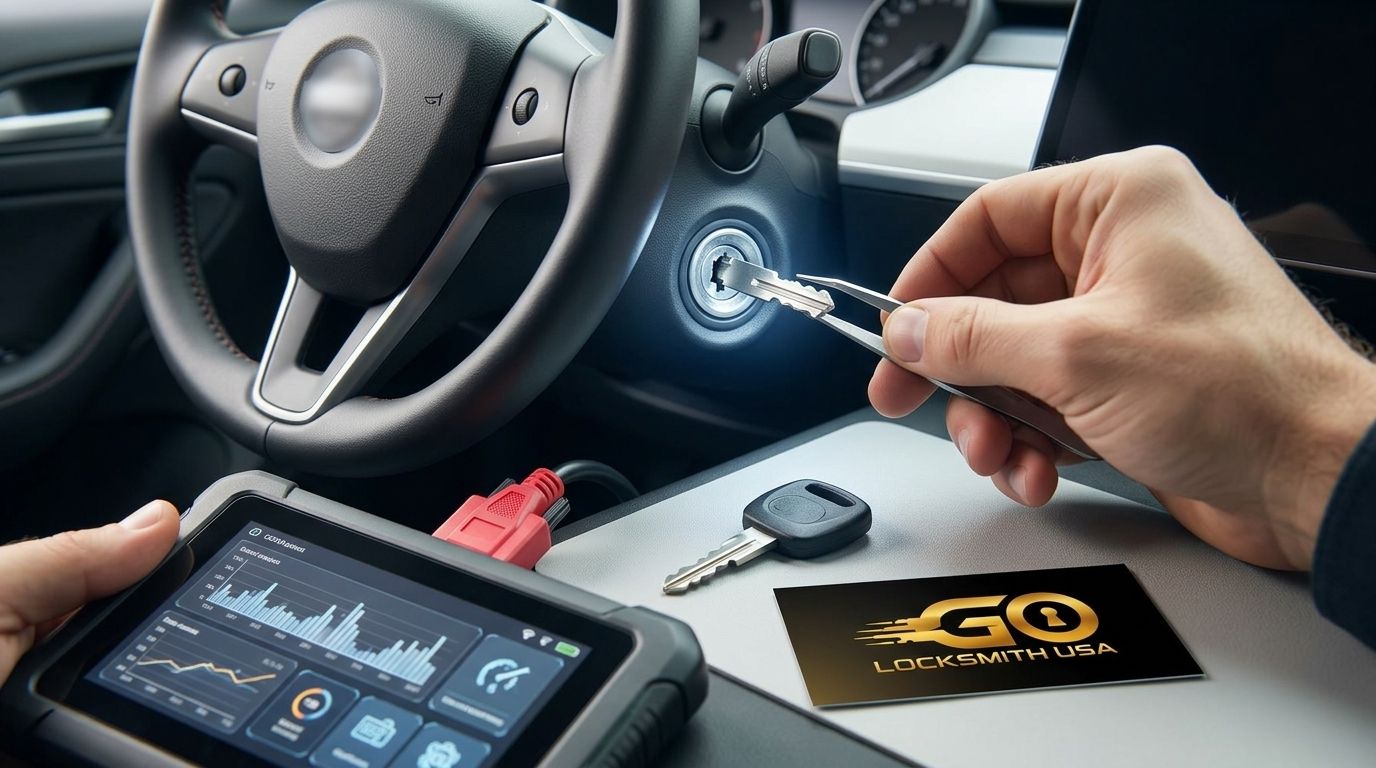
Yes—a locksmith can remove a broken key from a car ignition, but the result depends on the fragment’s position and the ignition cylinder’s condition. Removing the fragment does not fix an already damaged cylinder or replace the broken key. Have the ignition assessed before authorizing replacement; a snapped key alone does not establish that the ignition needs replacing.
TL;DR
- A locksmith can remove a broken key from a car ignition; cylinder condition determines what happens next.
- Stop turning the broken key, and do not push tools or glue into the ignition.
- Broken key extraction, ignition repair, and replacement key cutting address different problems.
- GO Locksmith offers mobile broken key extraction and ignition repair/replacement; call to confirm service for your vehicle.
Can a locksmith remove a broken key from a car ignition?
Yes. Automotive locksmiths use extraction tools and vehicle-appropriate methods to remove broken key fragments. The first task is to assess where the metal broke, whether the cylinder is damaged, and whether the ignition had problems before the break.
For local help, GO Locksmith provides mobile automotive broken key extraction, ignition repair/replacement, car key cutting, and car key programming. Explain your vehicle’s year, make, model, and symptoms when calling; the service list does not establish compatibility with every vehicle.
Extraction, repair, and replacement are separate decisions. Here is what each addresses:
| Option | Best for | What it addresses | Limitation |
|---|---|---|---|
| Broken key extraction | A trapped fragment in an otherwise usable cylinder | Removing the broken metal from the keyway | Does not repair internal wear or provide a working replacement key |
| Ignition repair | A repairable mechanical ignition fault | The identified problem preventing normal operation | Suitability depends on the cylinder, damage, and vehicle |
| Ignition replacement | A cylinder assessed as needing replacement | Replacing the affected ignition component | Does not automatically resolve every key, immobilizer, or starting problem |
| Replacement key cutting and, where required, programming | A broken key that cannot be reused | Providing an appropriate replacement key | Requirements depend on the vehicle and key system |
Choose the work based on the diagnosis, not simply on the fact that the key snapped. You might need extraction and a replacement key without needing a replacement ignition. If the cylinder was already binding, extraction alone does not address that underlying problem.
Why this matters: getting the fragment out is only part of the job
Your immediate problem is the metal stuck inside the ignition. Your practical goal is a working key and an ignition that operates correctly. Those are not always the same repair.
A key can break after repeated bending or wear. A binding cylinder can also place stress on a key when someone forces it. The broken blade alone does not prove which part caused the failure.
Tell the locksmith whether the key previously needed extra pressure, worked only in a particular position, or resisted removal. These observations help distinguish a sudden key failure from a problem that existed before the break. Describe what happened rather than trying to diagnose the internal parts yourself.
What should you do while the broken key is still inside?
Keep the situation unchanged as much as possible. Repeated attempts to turn or pull the fragment can move it, deform it, or damage the opening the locksmith needs to inspect.
- Stop turning. Do not use the remaining key head, pliers, or another object to force the ignition. If the engine is running or the ignition is stuck on, tell the locksmith immediately and follow vehicle-specific guidance.
- Secure the vehicle. If you are safely parked, leave the vehicle secured and follow the owner’s manual for parking precautions. If the vehicle presents a road hazard, address your immediate safety first.
- Keep the pieces. Save the broken key head and any loose fragments. Keep a spare key available, but do not insert it while a fragment remains inside.
- Gather vehicle details. Have the year, make, model, location, and a description of the key ready. Mention whether the blade broke inside a keyed ignition or somewhere else.
- Request an assessment. Explain what you tried, including any tools or substances used. Ask what the initial assessment covers and whether additional work requires your authorization.
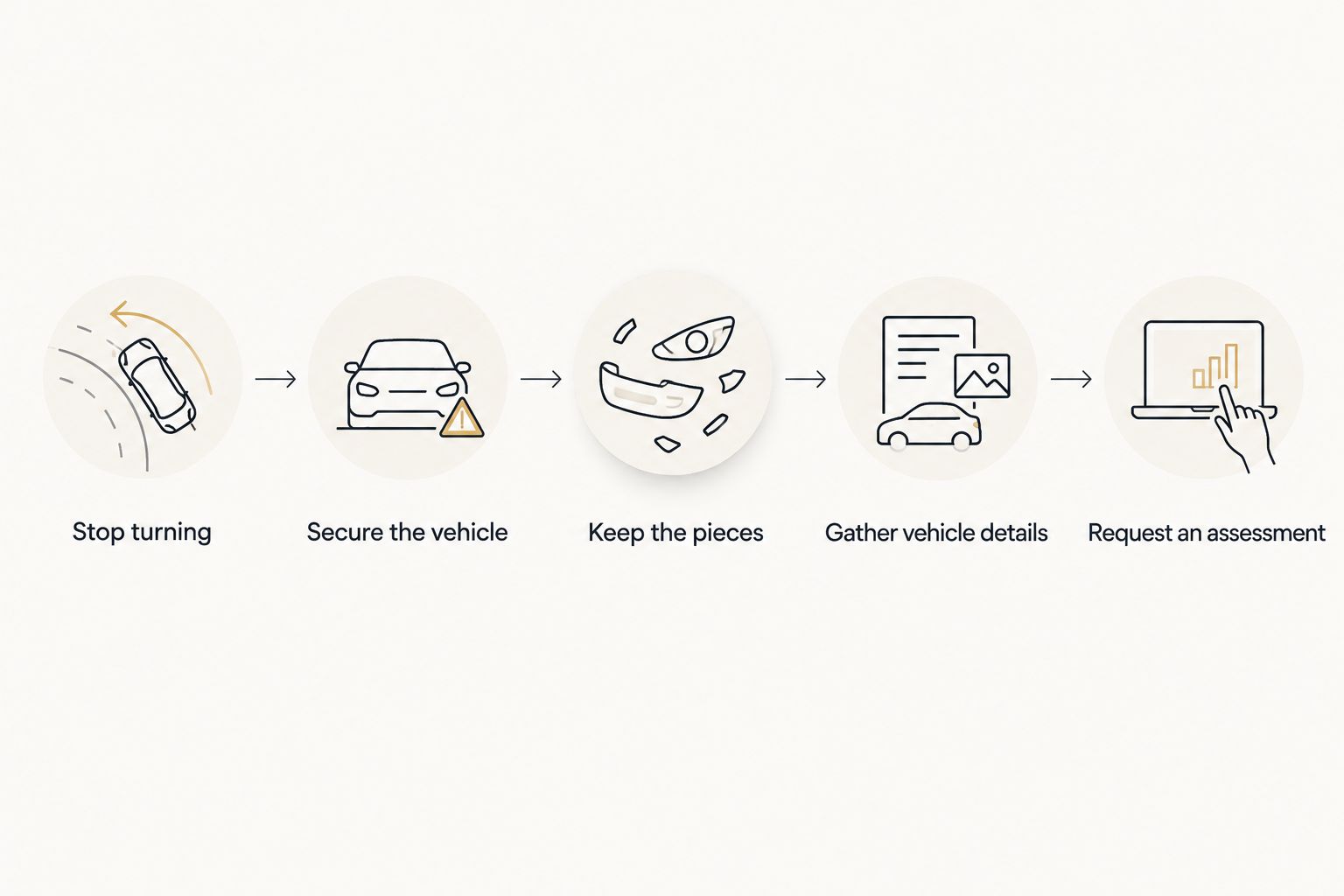
Preserve the broken pieces and describe the symptoms before attempting another repair.
Avoid putting glue into the keyway. It can bond the fragment to internal components and complicate removal. Do not add lubricant unless the vehicle manufacturer’s instructions or the locksmith assessing the ignition recommends an appropriate product.
A visible fragment is not necessarily easy to remove. How much metal you can see does not reveal whether the piece is caught internally or whether the cylinder is in a suitable position for removal.
What determines whether extraction is enough?
The useful distinction is not simply “visible key” versus “hidden key.” A locksmith needs to consider the fragment and the mechanism holding it.
- Fragment position: A piece near the opening presents a different access problem from one lodged deeper inside. Describe what you can see without pushing anything into the keyway.
- Cylinder condition: Existing binding, damaged internal parts, or damage from forced turning changes the repair decision. Extraction cannot restore worn or broken components.
- Ignition position: Tell the locksmith whether the key broke while inserting, turning, or removing it. Also report whether the ignition is currently off, on, or between normal positions.
- Vehicle design: Ignition assemblies and access requirements differ by year, make, and model. Advice for another vehicle is not a reliable procedure for yours.
- Earlier removal attempts: Glue, broken tools, or a fragment pushed farther inside adds a separate issue to assess. Be clear about what happened.
- Replacement key requirements: A usable spare changes what you need after extraction. Without one, key cutting and any required programming become separate parts of the job.
These factors also affect the scope of an estimate. Ask the locksmith to distinguish the extraction from any proposed cylinder work and replacement key service. That makes the recommendation easier to understand before you approve it.
Does a broken key mean you need a new ignition?
No—a broken key does not automatically mean you need a new ignition. If the cylinder remains serviceable after extraction, replacing it solely because the key broke is not the same as repairing an identified fault.
The opposite matters too: removing the fragment does not prove the ignition is healthy. If the original key repeatedly stuck or required force, explain that history before anyone tests a replacement key.
Ask what finding supports the recommendation. Is the problem limited to the broken blade, or is there damage inside the ignition cylinder? A useful explanation connects the proposed work to an observed fault rather than treating every snapped key as the same job.
For that separate repair decision, see the guide to whether a locksmith can repair a car ignition without replacing it. Repair suitability still depends on your vehicle and the condition found during assessment.
Can you start the car after the broken piece is removed?
Removing the broken piece does not itself give you a working key. You need an intact, appropriate key and a functioning ignition. If the vehicle uses an immobilizer, its key-recognition requirements also remain relevant.
A spare is useful information, not a reason to force another attempt. Tell the locksmith whether the spare previously started the vehicle and whether the broken key had a plastic head, remote buttons, or a separate fob.
If no usable spare exists, ask about replacement key cutting and whether programming is required for your specific vehicle. Mechanical cutting and electronic programming serve different purposes; neither should be assumed from the appearance of the broken blade alone.
Keep all recovered pieces until the locksmith tells you they are no longer needed. They help show what broke, but a saved fragment is not a guarantee that a replacement can be made from it.
What should you ask before authorizing the work?
Describe the job as “a key broken inside the ignition,” rather than just “a car that will not start.” The first description identifies the known obstruction. The second also describes many unrelated vehicle problems.
Use these questions to clarify the proposed service:
- Can you assess this vehicle’s year, make, model, and ignition type?
- Does the estimate cover extraction only, or also a replacement key?
- What finding would make ignition repair or replacement necessary?
- Will you explain additional work before proceeding?
- Does the replacement key require programming for this vehicle?
- What ownership or authorization documents should I have ready?
Do not assume the extraction includes every later task. Ask for a job-specific estimate and an explanation of what remains uncertain until inspection. The useful comparison is the scope of work, not an unsupported headline price.
GO Locksmith is a mobile locksmith option for drivers who need broken key extraction assessed at their vehicle. Its confirmed automotive services include ignition repair/replacement and key making, cutting, and programming; vehicle-specific service still needs confirmation when you call.
FAQ
Can a locksmith remove a key that broke flush with the ignition?
Yes, a fragment that breaks flush with the ignition can still be assessed for extraction. The cylinder’s condition, fragment position, and vehicle design determine the appropriate method; a visible end is not required for every professional extraction method.
Should I use tweezers or pliers to pull out a broken ignition key?
Do not force tweezers or pliers into the ignition. Tools can push the fragment deeper or damage the keyway, so stop if the piece does not come away without manipulating the lock.
Can I put the broken key head back against the fragment and turn it?
Do not use the broken key head to force the ignition. Turning against a trapped fragment can move it or add damage, and it does not restore the key’s strength.
Will I need a new programmed key after extraction?
Programming depends on your vehicle and the replacement key you need. A usable spare changes the situation, while a replacement for an immobilizer-equipped vehicle requires confirmation of its electronic requirements.
How much does broken ignition key removal cost?
Request a job-specific estimate for broken ignition key removal. Describe the vehicle, fragment, prior symptoms, and any removal attempts, and ask whether the estimate includes a replacement key or ignition work.
Can GO Locksmith help with a broken ignition key in Southwest Florida?
GO Locksmith offers mobile automotive broken key extraction and ignition repair/replacement in its confirmed service areas, including Fort Myers, Cape Coral, Lehigh Acres, Estero, Bonita Springs, and Naples. Call (239) 412-1101 to confirm service for your vehicle and check current availability.
One last thing: mention what happened before the snap
The most useful detail might be that the key had been difficult to turn for weeks—not how much of it remains visible now. That history helps the locksmith assess whether extraction solves the immediate obstruction while leaving another problem unresolved.
Need help with a broken ignition key? Call (239) 412-1101 with your vehicle details to request an estimate and check availability. Hours are Sunday–Thursday, 7:00 AM–11:00 PM, and Friday, 7:00 AM–5:00 PM; Saturday is closed.