Blog ·
Best ignition repair and replacement options for older vehicles 2026

Best for a repairable lock: ignition-cylinder repair. Best for a damaged lock: cylinder replacement. Best for a worn or broken key: key service before replacing the ignition. The best ignition repair and replacement options for older vehicles depend on whether the fault is in the key, mechanical lock, or electrical starting system—not simply the vehicle’s age.
TL;DR
- The best ignition repair and replacement options for older vehicles start with identifying the failed component.
- GO Locksmith offers mobile ignition repair and replacement; call to confirm service for your specific vehicle.
- A worn key or broken key fragment does not automatically mean the ignition needs replacement.
- A turning key with a no-start condition needs diagnosis beyond the mechanical ignition cylinder.
Why the right diagnosis matters
An ignition problem describes a symptom, not a single failed part. The ignition lock cylinder accepts the key; the electrical ignition switch controls electrical circuits. Depending on the vehicle, other components also participate in starting and theft prevention.
Replacing the wrong component leaves the original problem unresolved. Ask for a diagnosis before authorizing a replacement, especially when the key turns normally but the engine does not start.
GO Locksmith provides mobile ignition repair and replacement for drivers in Fort Myers and Southwest Florida. Give the vehicle’s year, make, model, location, and symptoms when calling so the specific service requirements can be discussed.
What makes a suitable ignition repair option?
Use these criteria to judge the proposed work before choosing a provider or part:
- Fault match: The recommendation should address the key, cylinder, switch, or other component actually causing the problem.
- Vehicle fit: Parts and procedures must match the vehicle’s specific ignition and key system. Age alone does not establish compatibility.
- Repairability: Keep serviceable components when the diagnosed fault can be corrected without replacing them.
- Key requirements: Clarify whether the work changes the mechanical key or requires transponder programming.
- Complete scope: Ask what diagnosis, parts, key work, and follow-up checks the proposed job includes.
- Service setting: Confirm whether the specific work can be performed where the vehicle is parked or requires a workshop.
A useful explanation connects the symptom to the proposed repair. If the explanation stops at “it’s an old car,” ask which component failed and how that conclusion was reached.
Ignition repair options at a glance
The order below is a decision path, not a ranking of businesses. Each option serves a different diagnosed problem.
| Option | Best for | Main advantage | Key limitation |
|---|---|---|---|
| Ignition-cylinder repair | A repairable mechanical lock fault | Addresses the cylinder without automatically replacing it | Unsuitable when damage makes the cylinder unserviceable |
| Ignition-cylinder replacement | A damaged or unserviceable cylinder | Replaces the failed mechanical lock component | Key matching and programming requirements need confirmation |
| Key correction or broken key extraction | A worn, damaged, or snapped key | Addresses a key-related fault first | Does not correct unrelated cylinder or electrical damage |
| Electrical starting-system diagnosis | A key that turns but the vehicle does not start | Separates lock operation from electrical starting faults | Requires appropriate automotive diagnostic capability |
| Model-specific workshop or dealership assessment | An unresolved fitment or security-system requirement | Helps establish the correct vehicle-specific repair path | Requires confirmation of service capability and arrangements |
The distinction between mechanical and electrical symptoms matters more than the vehicle’s age. A key that will not turn and a key that turns without starting the engine are different problems, even when both are described as an “ignition failure.”
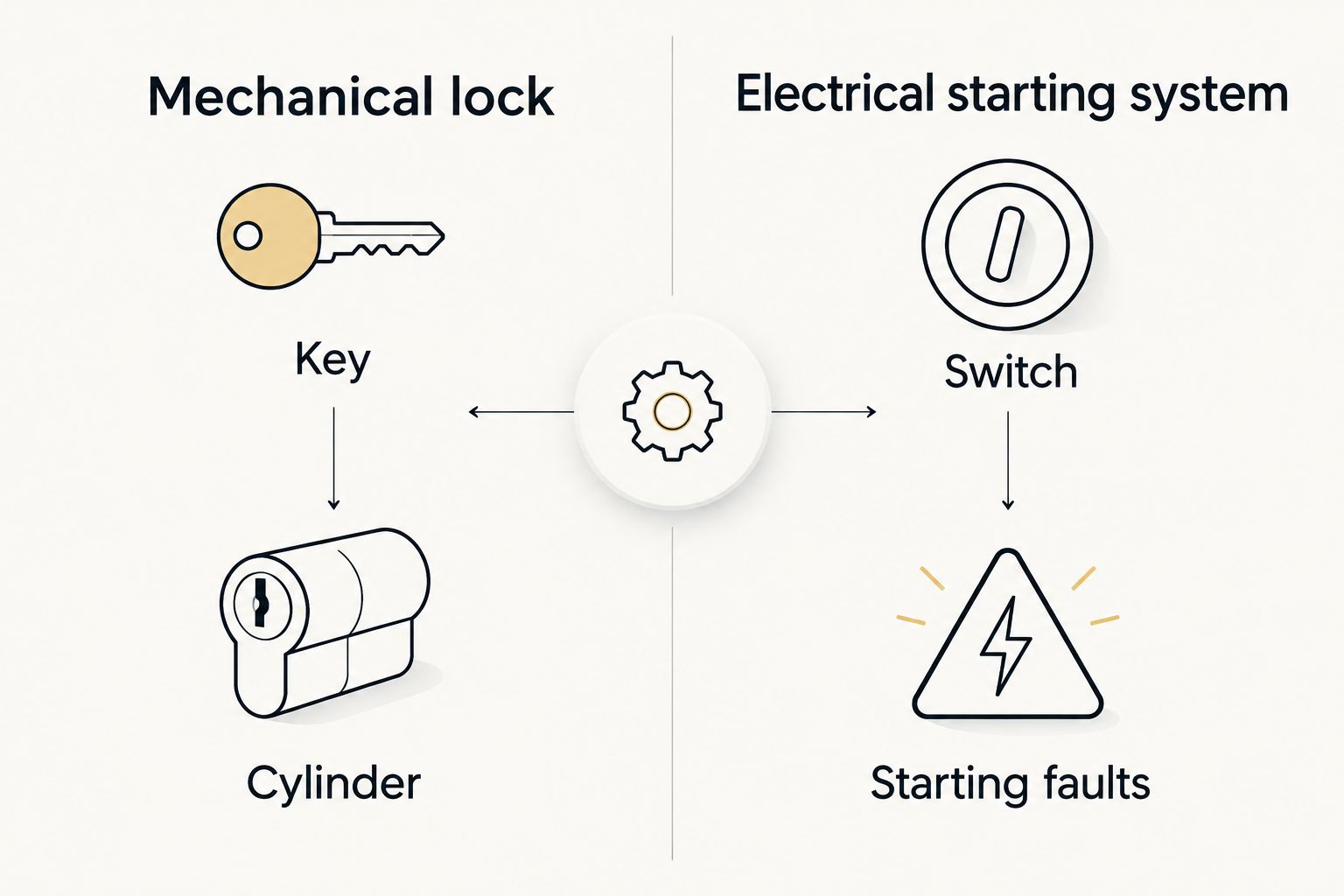
Describe whether the key turns before choosing an ignition repair path.
1. Ignition-cylinder repair: best for a repairable lock fault
Ignition-cylinder repair addresses a mechanical problem in the lock that accepts your key. It belongs on the shortlist when an assessment establishes that the cylinder is repairable, rather than damaged beyond service.
Difficulty inserting or turning a key is a reason to investigate the mechanical lock and key together. It is not proof that the cylinder needs replacing.
Ignition-cylinder repair pros:
- Keeps the existing cylinder when its condition permits repair.
- Targets the diagnosed mechanical fault.
- Avoids treating every sticking key as a replacement job.
Ignition-cylinder repair cons:
- Does not fix an electrical ignition-switch fault.
- Is unsuitable when the cylinder cannot be restored to proper operation.
- Still requires checking whether the key contributes to the problem.
Best for: A confirmed, repairable mechanical cylinder fault.
Ask what is wrong with the cylinder and what would make replacement necessary. Also ask whether the existing key remains suitable after the repair; retaining a cylinder does not establish that a worn key should stay in use.
Verdict: Buy repair only after the cylinder’s condition supports it.
2. Ignition-cylinder replacement: best for an unserviceable cylinder
Ignition-cylinder replacement changes the mechanical lock component when repair is not appropriate. The replacement must suit the vehicle, and its relationship to the existing keys needs clarification before work begins.
Do not assume a replacement cylinder automatically includes electrical-switch replacement. These are different components, even when their location or assembly connects them.
Ignition-cylinder replacement pros:
- Addresses a confirmed failure of the mechanical cylinder.
- Provides a repair path when the existing cylinder is unserviceable.
- Creates an opportunity to clarify the vehicle’s future key arrangement.
Ignition-cylinder replacement cons:
- Does not resolve unrelated no-start faults.
- Can introduce separate key-matching or programming requirements.
- Depends on correct parts and the vehicle’s construction.
Best for: A damaged or otherwise unserviceable ignition cylinder.
Ask whether the ignition and door locks will use the same key afterward. Do not assume the answer: the available parts, lock design, and proposed work determine the arrangement.
Verdict: Buy replacement when diagnosis establishes that repair is unsuitable.
3. Key service: best for a worn, damaged, or broken key
A key problem can resemble a cylinder problem. Key assessment, cutting, or broken key extraction addresses the key-related issue before an otherwise serviceable ignition is replaced.
GO Locksmith offers car key making, cutting, programming, and broken key extraction. Specific vehicle support still needs confirmation; a listed service is not a compatibility promise for every older vehicle.
Key service pros:
- Addresses an identified key fault directly.
- Separates a damaged key from a damaged cylinder.
- Allows mechanical key needs and programming needs to be discussed separately.
Key service cons:
- Does not repair an independently damaged ignition cylinder.
- Extraction does not establish that the remaining lock is undamaged.
- A mechanically fitting key still needs the correct electronic authorization when the vehicle requires it.
Best for: A damaged key or broken key fragment, with the cylinder’s condition still to be assessed.
If you have an intact spare, tell the provider whether it previously worked normally. A spare that behaves differently is useful diagnostic information, but it is not a complete diagnosis.
Verdict: Buy the confirmed key service; hold cylinder replacement until assessment supports it.
4. Electrical diagnosis: best when the key turns but the car will not start
When the key turns normally, the mechanical cylinder is not the only component to investigate. The electrical switch, battery, starter circuit, theft-prevention system, and other vehicle systems can affect starting.
Describe whether the engine cranks, whether dashboard lights appear, and whether a security warning is visible. These observations help an automotive repair provider choose a diagnostic path without treating every no-start condition as a lock failure.
Electrical diagnosis pros:
- Distinguishes a mechanical lock issue from a starting-system fault.
- Tests the reason for failure before parts are selected.
- Directs the repair toward the affected system.
Electrical diagnosis cons:
- Does not substitute for cylinder assessment when the key physically binds.
- Requires the appropriate diagnostic equipment and vehicle information.
- Can identify work outside a locksmith’s confirmed service scope.
Best for: A key that turns normally but does not produce normal starting behavior.
Ask an automotive repair shop whether it handles the suspected electrical diagnosis. Do not assume ignition repair means a provider repairs batteries, starters, wiring, or every theft-prevention fault.
Verdict: Buy diagnosis; skip an unexplained cylinder replacement.
5. Model-specific assessment: best for unresolved parts or security requirements
A workshop or dealership assessment is appropriate when the correct part, key system, or repair procedure remains uncertain. The useful distinction is vehicle-specific capability—not the provider’s label alone.
Ask whether the provider supports the exact year, make, model, and ignition configuration. Older vehicles still differ in cylinder design, electrical layout, and key authorization requirements.
Model-specific assessment pros:
- Clarifies fitment before a part is ordered or installed.
- Establishes whether programming is part of the repair.
- Helps resolve uncertainty about the required service setting.
Model-specific assessment cons:
- Capability must still be confirmed for the particular vehicle.
- Does not automatically make full assembly replacement necessary.
- Does not remove the need for a clear diagnosis and work scope.
Best for: A vehicle whose parts, programming, or repair requirements have not been established.
Ask for the reason behind any recommendation to replace a larger assembly. A model-specific requirement is a useful explanation; a general statement that all older ignitions need complete replacement is not.
Verdict: Buy specialist assessment when fitment or security requirements remain unresolved.
Before you authorize the work
You do not need to diagnose the vehicle yourself. You need to describe the problem accurately and understand what the proposed repair includes.
Have the following information ready:
- The vehicle’s year, make, and model.
- Whether the key inserts, turns, sticks, or has broken.
- Whether the engine cranks when the key turns.
- Whether an intact spare key is available.
- Any visible security warning or recent change in behavior.
- The vehicle’s current location and access arrangements.
Then ask which component is being repaired or replaced, what key work is included, and how normal operation will be checked afterward. Request a job-specific estimate rather than relying on a general ignition-repair figure.
Do not force a binding key. Avoid adding household oil or other products unless the vehicle manufacturer or qualified service provider recommends them for that specific lock. If the vehicle stalls or behaves unpredictably while running, stop driving when safe and seek automotive assessment.
How these options are ranked
The ranking follows fault match, repairability, vehicle fit, key requirements, and service setting. It does not claim that one repair method or business is universally better.
Choose the smallest appropriate repair that resolves the diagnosed fault. That means repair for a serviceable cylinder, replacement for an unserviceable cylinder, key service for a key fault, and automotive diagnosis for an electrical starting problem.
Which ignition repair option should you choose?
Start with the symptom. If the key binds, ask for key and cylinder assessment; if it turns normally but the engine does not start, ask about starting-system diagnosis.
GO Locksmith provides mobile ignition repair and replacement, with Fort Myers as its primary market. Confirmed Southwest Florida service areas also include Cape Coral, Lehigh Acres, Estero, Bonita Springs, and Naples. Call to confirm service for the specific vehicle and location rather than assuming every ignition job can be completed where it is parked.
For an ignition or car-key problem, call GO Locksmith at (239) 412-1101 to check availability and request a job-specific estimate. Hours are Sunday–Thursday 7:00 AM–11:00 PM and Friday 7:00 AM–5:00 PM; Saturday is closed.
FAQ
What's the best ignition repair option for an older car?
The appropriate option is the one that addresses the diagnosed fault. Repair suits a repairable cylinder, replacement suits an unserviceable cylinder, and a key or electrical problem needs its own assessment.
Can a locksmith repair an ignition instead of replacing it?
A repairable ignition cylinder can be a candidate for repair rather than replacement. GO Locksmith offers ignition repair and replacement; call with the vehicle's year, make, model, and symptoms to confirm the specific service.
Does a key that won't turn mean I need a new ignition?
No, a key that will not turn does not by itself establish that the ignition needs replacement. The key, cylinder, and vehicle-specific steering-lock or interlock conditions need assessment.
Why does my key turn but my older car won't start?
A turning key does not rule out an electrical or other starting-system fault. Tell an automotive repair provider whether the engine cranks, dashboard lights appear, or a security warning is visible.
Will an ignition replacement require a new car key?
The key requirements depend on the replacement cylinder and the vehicle's key system. Confirm whether the existing key can remain in use, whether a different mechanical key is needed, and whether programming is required.
Can an older vehicle still need transponder key programming?
Yes, some older vehicles use transponder-based key authorization. The vehicle's age alone does not establish whether programming is required; confirm the year, make, model, and key system.
How much does ignition repair or replacement cost?
The estimate depends on the vehicle, diagnosed fault, parts, and required key work. Call GO Locksmith at (239) 412-1101 for a job-specific estimate and current availability during confirmed business hours.
One last thing
After ignition work, ask how the ignition key and door key will function together. A vehicle that starts but leaves you uncertain about its door-key arrangement is not a clear handover. Clarify both mechanical operation and any required key programming before considering the job complete.