
Blog ·
Can a locksmith repair a car ignition without replacing it?
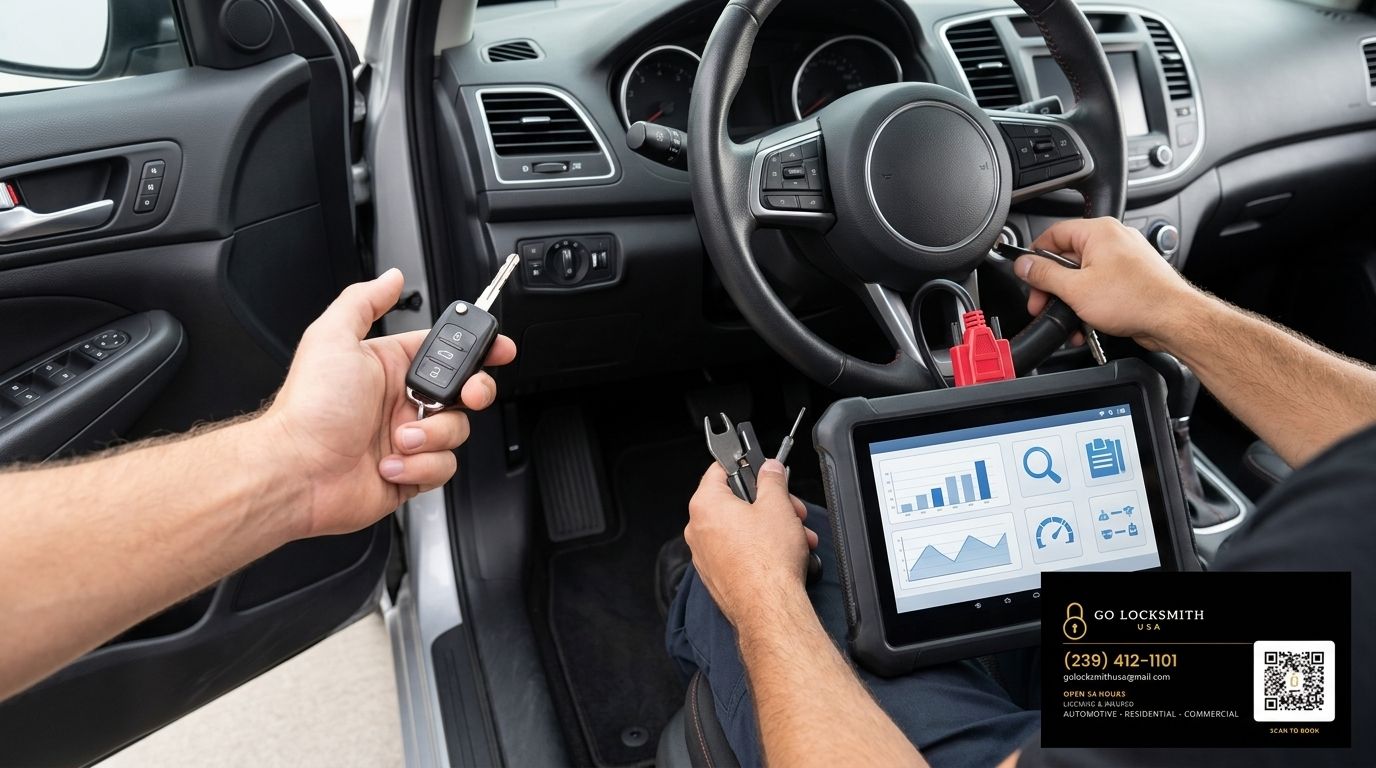
Yes, a locksmith can repair a car ignition without replacing it when the fault involves a serviceable mechanical component, an obstruction, or a key problem rather than an irreparably damaged assembly. Repair is not always possible, and a key that will not turn needs a different assessment from an engine that will not start after the key turns normally.
TL;DR
- Can a locksmith repair a car ignition without replacing it? Yes, when the affected components are serviceable.
- A stuck key does not prove the entire ignition needs replacement; the key and lock need assessment.
- GO Locksmith offers mobile ignition repair and replacement; confirm suitability for your vehicle before requesting service.
- Do not force a stuck key or authorize replacement before understanding which component has failed.
Why this matters
A starting problem is not automatically an ignition-lock problem. Replacing the lock cylinder will not resolve an unrelated battery, starter, or engine fault. Likewise, replacing a worn key will not repair a damaged cylinder.
The useful question is which part has failed—not whether every ignition can be repaired. For an aging vehicle, the guide to ignition repair and replacement options for older vehicles provides related context. Vehicle age alone does not establish the right repair.
Can a locksmith repair a car ignition without replacing it?
Yes. A repair is possible when the affected part can be restored to proper operation without replacing it. However, removing a broken key, correcting a key problem, repairing a cylinder, and replacing a cylinder are different jobs.
Before authorizing work, ask the locksmith to distinguish the mechanical lock from the electrical starting system. On a conventional keyed ignition, the cylinder accepts the key; the ignition switch performs an electrical function. The components work together, but they are not interchangeable terms.
| Possible approach | Best for | Main benefit | Limitation |
|---|---|---|---|
| Key assessment or replacement | A damaged or worn key with an otherwise serviceable lock | Addresses the key rather than replacing an unaffected cylinder | Does not repair damage inside the ignition |
| Broken key extraction | A key fragment obstructing the cylinder | Removes the obstruction so the remaining condition can be assessed | Extraction alone does not establish that the cylinder is undamaged |
| Mechanical ignition repair | A fault in a serviceable lock component | Retains components that remain usable | Depends on the cylinder design and extent of damage |
| Ignition component replacement | A component that cannot be restored to reliable operation | Replaces the failed component | Key matching or programming requirements depend on the vehicle |
| Automotive electrical diagnosis | A key that operates normally but a vehicle that does not start | Investigates faults beyond the mechanical lock | Is not the same service as ignition-cylinder repair |
Authorize a solution for the identified fault, not an entire assembly based only on a symptom. A sound explanation should identify what is damaged, what work is proposed, and what that work will—and will not—resolve.
When a key problem does not require ignition replacement
A worn, bent, or damaged key can have trouble operating a lock. If the cylinder remains serviceable, addressing the key is a separate option from replacing the ignition. Do not straighten a damaged key or keep twisting it to see whether it eventually works.
If you already have an undamaged spare, tell the locksmith whether it previously worked normally. A spare that works while the usual key does not is useful information, but it is not a complete diagnosis. Avoid repeated attempts with either key if the lock binds.
A replacement key also needs to suit the vehicle's mechanical and electronic requirements. A blade that fits the cylinder does not, by itself, establish that the vehicle will recognize the key and permit starting.
When ignition repair is an option
Mechanical repair is an option when inspection identifies a fault that the cylinder's construction allows a locksmith to correct. That decision depends on the actual damage, not simply on whether the key feels stiff.
A broken key fragment is a good example of why assessment matters. The fragment needs attention, but its presence does not prove that the entire ignition assembly has failed. After extraction, the condition of the cylinder and the remaining key still matters.
Ask what the proposed repair retains and what it changes. The word repair can describe different work, so the estimate should make the scope clear rather than leaving you to assume that every ignition-related issue is included.
When replacement is the appropriate option
Replacement is appropriate when the affected component cannot be returned to reliable operation through a suitable repair. Damage following an attempted theft, a broken component, or a cylinder that is not serviceable can change the decision.
Repair is not automatically preferable to replacement. Retaining a failed component is not useful if it leaves the ignition binding or unable to operate correctly. Conversely, a replacement recommendation should identify the failed component rather than treating every no-start condition as a cylinder failure.
Ask whether the proposal replaces the cylinder, the electrical switch, or another component. Also ask how the existing keys will be affected. Those answers depend on the vehicle and the replacement arrangement; keeping the same key is not a universal outcome.
Why the repair-or-replace decision varies
These factors determine whether retaining the ignition is practical:
- Vehicle and ignition design. The year, make, model, and type of ignition determine which components are present and how they are serviced.
- Key condition. A damaged blade or an electronic key-recognition problem needs a different response from internal cylinder damage.
- Extent of mechanical damage. A removable obstruction and a broken internal component are not equivalent faults.
- Component serviceability. Some faults permit repair; others require replacement of the affected component.
- Electronic requirements. Key recognition and programming requirements can affect the work needed after mechanical service.
- Fault location. A problem in the electrical starting system requires a different assessment from a key that physically cannot turn.
These are reasons to request a vehicle-specific assessment, not reasons to accept an unexplained replacement recommendation. Describe the symptoms accurately and ask which finding supports the proposed work.
What should you do before calling about a stuck ignition?
Start with safety and useful observations, not dismantling the steering column. You do not need to identify the failed part yourself.
- Safe location. If the vehicle is exposed to traffic or another hazard, prioritize your safety. Do not attempt roadside work in an unsafe position.
- Note symptoms. Record whether the key inserts, turns, gets stuck, or has broken. If the key turns normally, explain what happens when you attempt to start the vehicle.
- Check the manual. Follow the vehicle manufacturer's instructions for normal starting, steering-lock operation, and key removal. Do not force controls that resist normal operation.
- Gather details. Have the vehicle's year, make, model, location, and available-key information ready. Mention visible damage and any recent change in how the ignition behaves.
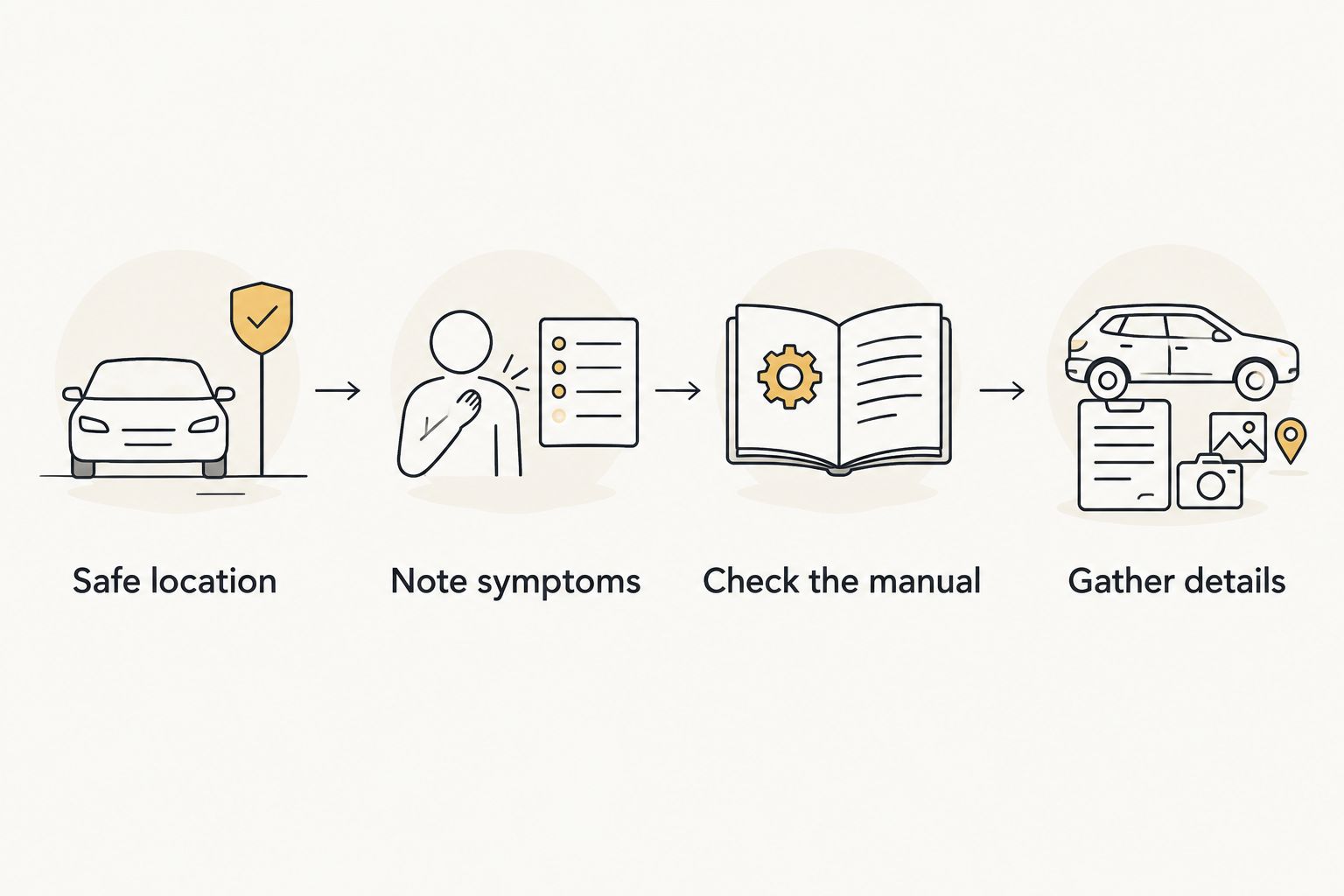
Useful observations help distinguish a stuck mechanical lock from a vehicle that will not start.
Avoid pliers, improvised extraction tools, and repeated force on the key. Do not add lubricant or cleaning products unless the vehicle manufacturer or the professional assessing the ignition recommends the specific product for that application.
A useful service request sounds like this: describe what the key does, what the vehicle does, and whether an undamaged spare is available. That is more informative than reporting only that the ignition is broken.
Will I need a new car key after ignition repair?
Not necessarily. Whether you need a new key depends on the key's condition, the work performed, and the vehicle's key system. Repairing a mechanical fault does not automatically require replacing every key.
Before approving work, ask whether your existing key will still operate the ignition and whether it will continue to operate the doors. If programming is required, ask which keys are included in the proposed work. Do not assume that mechanical key cutting and electronic programming are the same task.
Does a key that turns but will not start the car mean the ignition needs replacement?
No. A key that turns normally does not establish that the ignition cylinder needs replacement. Battery, starter, electrical-switch, key-recognition, and other vehicle faults can produce starting problems.
Describe whether the engine cranks, whether you hear clicking, and whether a warning message appears. These observations help direct the assessment, but they do not identify the failed part on their own. An automotive repair provider is appropriate when the fault falls outside the locksmith's confirmed service scope.
Can a mobile locksmith help with ignition trouble?
Yes, mobile ignition service is an option, subject to the vehicle and the work required. GO Locksmith is a mobile locksmith option for drivers seeking car ignition repair or replacement in its confirmed service areas. Vehicle-specific service needs confirmation before work is arranged.
GO Locksmith's primary market is Fort Myers, with Southwest Florida service areas including Cape Coral, Lehigh Acres, Estero, Bonita Springs, and Naples. The business also operates in Jacksonville. Mobile service does not mean every ignition fault can be resolved at the vehicle's location.
When you call, ask whether the described fault and vehicle are suitable for service, what the estimate includes, and what happens if inspection identifies a different problem. Request an explanation before approving additional work.
FAQ
Can a locksmith fix an ignition if the key will not turn?
Yes, a locksmith can address some mechanical ignition faults, but a key that will not turn does not establish the cause. The key, cylinder, and vehicle-specific operating requirements need assessment before repair or replacement is chosen.
Does a broken key in the ignition mean I need a new ignition?
No, a broken key in the ignition does not automatically require ignition replacement. The fragment needs removal, followed by an assessment of the cylinder and the key's condition.
Will repairing my ignition fix a key-fob problem?
Not necessarily; mechanical ignition repair and key-fob faults are different issues. Explain whether the problem affects remote buttons, key recognition, physical key operation, or starting so the appropriate service can be considered.
Is repairing an ignition always cheaper than replacing it?
There is no universal repair-versus-replacement price rule. Ask for a job-specific estimate that identifies the failed component, the proposed work, and any key or programming requirements.
Can I keep driving if my ignition sometimes sticks?
Arrange an assessment rather than treating intermittent sticking as normal. If the key or ignition does not operate normally, stop forcing it and follow the vehicle manufacturer's instructions.
Does GO Locksmith repair car ignitions in Cape Coral?
GO Locksmith offers ignition repair and replacement, and Cape Coral is a confirmed service area. Call with the vehicle's year, make, model, and symptoms to confirm whether the specific job can be handled.
Is GO Locksmith available all night for ignition repairs?
GO Locksmith is not a 24-hour service. Its hours are Sunday–Thursday 7:00 AM–11:00 PM and Friday 7:00 AM–5:00 PM; Saturday is closed. Call during those hours to check availability.
One last thing
A key that still works in the door does not prove the ignition is healthy. The door lock and ignition are separate mechanisms, even when they accept the same key. Tell the locksmith which locks the key operates normally instead of using that observation to rule out ignition damage.
For help with a sticking key, broken key, or ignition problem, call GO Locksmith at (239) 412-1101 during business hours. Have your vehicle details ready, ask whether repair is suitable, and request a job-specific estimate before authorizing work.