
Blog ·
Can a locksmith open an office door without damaging the frame?
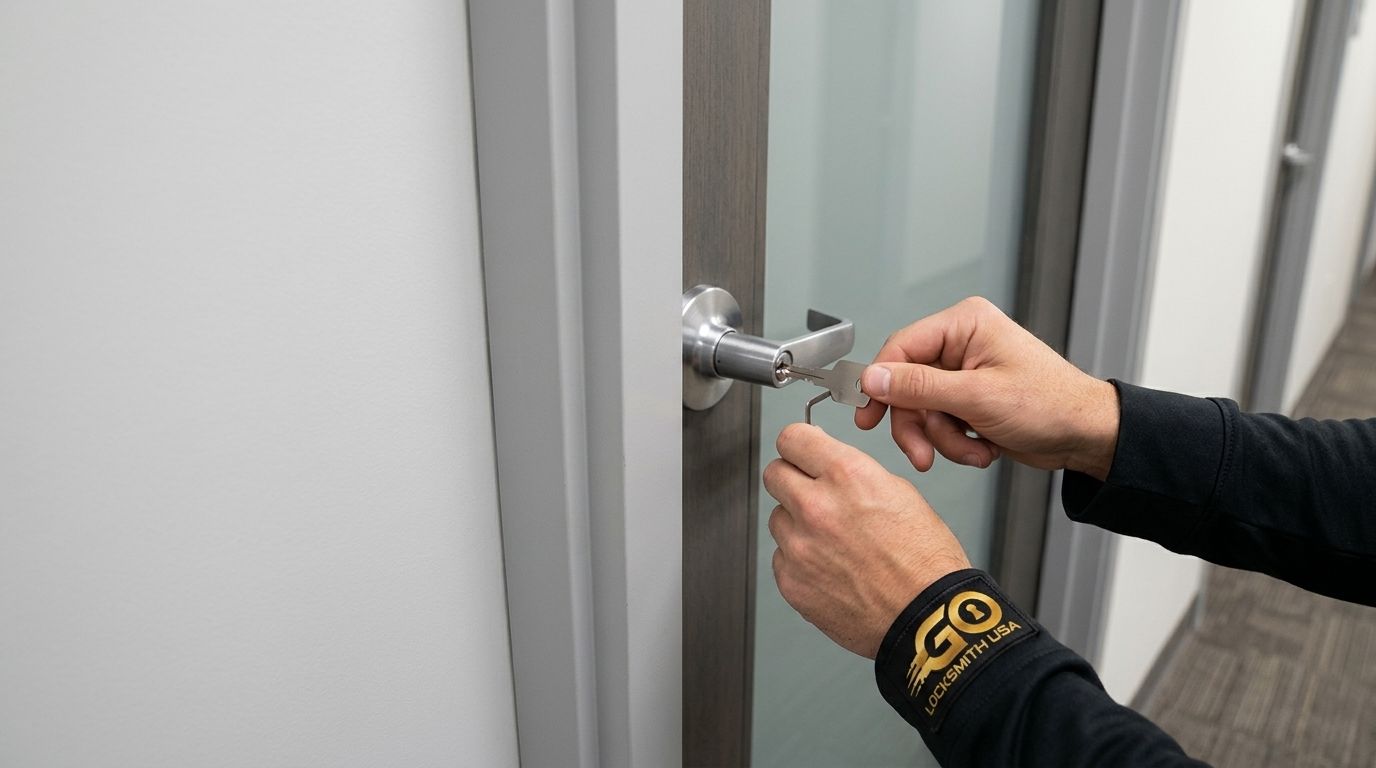
Yes—a locksmith can open an office door without damaging the frame, but the result depends on the lock, the door’s condition, and what caused the lockout. A failed lock can require work on the cylinder or other hardware even when the frame stays intact. Ask the locksmith to assess the door and explain any proposed damage before you authorize the work.
TL;DR
- Can a locksmith open an office door without damaging the frame? Yes, but the lock and door condition determine the approach.
- An undamaged frame does not necessarily mean the lock can be saved.
- Ask which parts will remain intact before approving drilling, replacement, or other destructive work.
- GO Locksmith provides mobile commercial lockout service; call to discuss the door and check availability.
Why protecting the frame matters
An office lockout involves more than getting the door open. You also need a door that closes, latches, and locks properly afterward, without creating another repair problem.
The frame supports the opening and holds the strike—the part that receives the latch or bolt. Prying against it can bend metal, split wood, or loosen hardware. Avoid forcing the door while you wait for an assessment.
GO Locksmith’s confirmed locksmith services include business lockouts, interior door lockouts, and commercial lock repair, replacement, and rekeying. Those are relevant services when your office door is locked or its mechanical lock has stopped working.
Can a locksmith open an office door without damaging the frame?
Yes. A locked door does not automatically require frame damage, and replacing the whole door is not the default answer to a lockout. The important distinction is whether the door is simply locked or whether a component has failed.
These situations call for different assessments:
| What you notice | What it helps the locksmith assess | What it means for the frame |
|---|---|---|
| The key is missing, but the door worked normally before | A lockout without a reported mechanical fault | Frame damage is not inherently necessary to open a functioning lock |
| The key turns, but the latch does not release | A possible problem with the lock or latch mechanism | Hardware work can be necessary without requiring frame replacement |
| The door rubbed or needed lifting before the lockout | Possible alignment or hinge-related trouble | Opening the lock alone might not resolve the underlying problem |
| A key has broken inside the lock | The broken key and the condition of the cylinder | The broken key does not, by itself, establish a need to damage the frame |
| The frame is bent, split, or visibly damaged | Existing damage affecting the opening | Preserving the frame and repairing existing damage are separate questions |
Tell the locksmith what happened immediately before the door stopped opening. A missing key, a stiff handle, and a door that stopped closing squarely are different clues—not interchangeable descriptions of the same problem.
Frame-safe opening is not the same as damage-free opening
A locksmith can preserve the frame while still needing to replace part of the lock. That distinction matters when you hear the phrase non-destructive entry.
Ask what the description covers. Does it mean no damage to the frame, no damage to the door, or no damage to any lock component? Those are different outcomes, and an assessment should distinguish them.
Opening without replacing hardware
Best fit: a functioning lock with a lost or inaccessible key. Preserving usable hardware avoids replacing parts solely because you are locked out.
The limitation is that the lock’s design and condition determine which approaches are suitable. A locksmith cannot responsibly promise that every office lock will open without damage before inspecting it.
Opening followed by lock repair or replacement
Best fit: a lock with a confirmed mechanical fault or damage. Repairing or replacing the affected component addresses the reason the door would not open, rather than treating access as the entire job.
The trade-off is additional work beyond unlocking. Ask whether the proposed replacement concerns the cylinder, the complete lock, or another component; each has a different scope.
| Approach | Main benefit | Main limitation |
|---|---|---|
| Preserve existing hardware | Keeps functioning parts in use | Not suitable for every lock or failure |
| Repair affected hardware | Addresses a repairable mechanical problem | Depends on the fault and condition of the parts |
| Replace affected hardware | Removes an unusable or unsuitable component | Requires agreement on replacement scope and compatibility |
If the discussion centers on the cylinder, this guide explains replacing just the lock cylinder. A cylinder replacement and a full lock replacement are not necessarily the same job.
What should you do before the locksmith opens the door?
Your role is to provide useful information and approve a clear scope—not to diagnose or force the lock. Follow this sequence before work begins.
- Confirm authorization. Identify who can authorize entry and changes to the hardware. For leased premises, check whether the property manager needs to approve lock replacement.
- Describe the problem. Explain whether the key is lost, broken, stuck, or turning without opening the door. Mention earlier rubbing, sticking, or handle problems.
- Document existing damage. Take clear photos of visible scratches, gaps, cracks, or bent hardware. Photograph only what you can safely see; do not remove parts.
- Agree on scope. Ask which components the locksmith expects to preserve and what would trigger a change in approach. Request an explanation before destructive work or replacement.
- Check operation. After access is restored, have the door’s closing, latching, and locking checked before treating the job as complete.
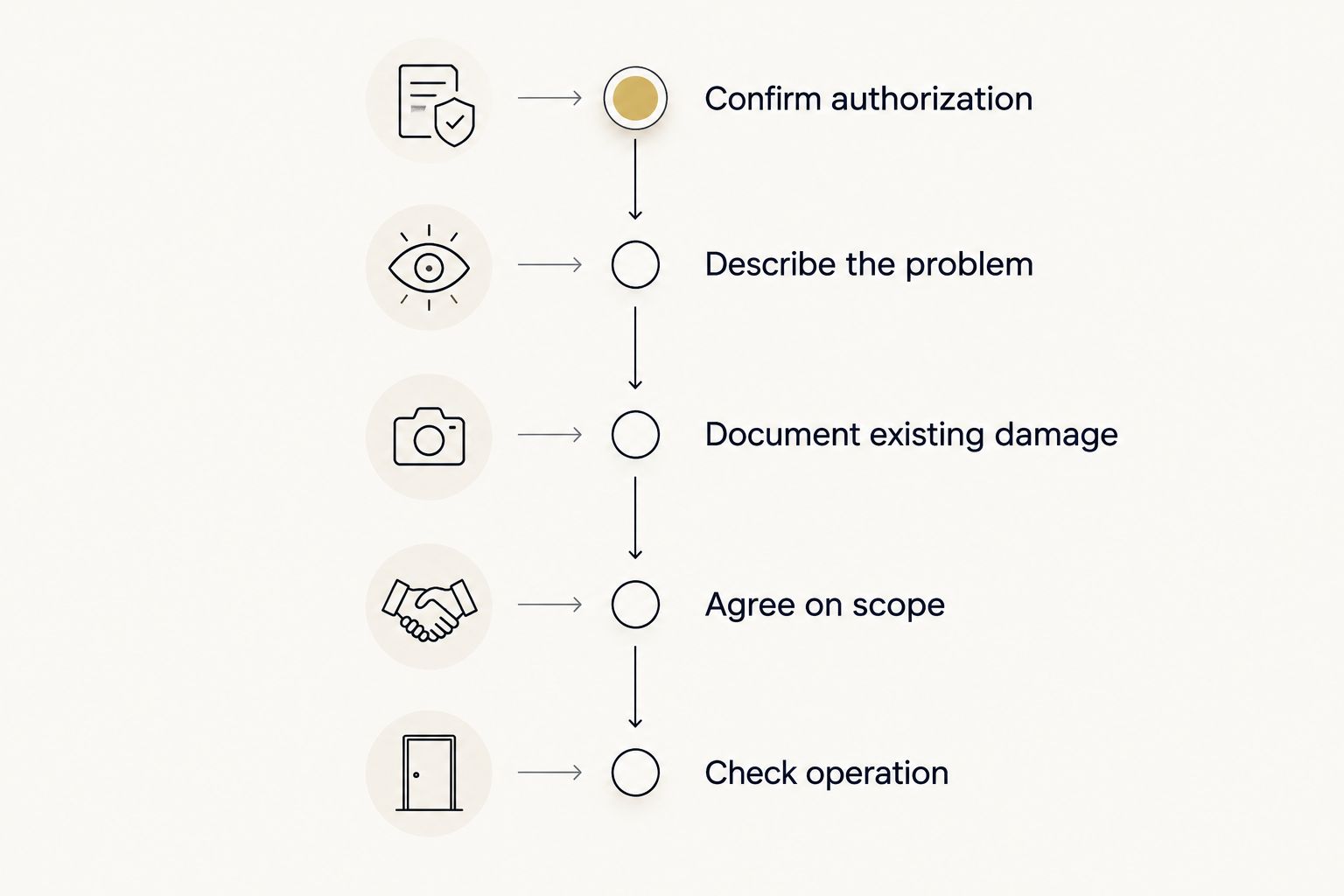
Agree on the work before opening, then check that the door operates properly afterward.
If your identification or lease documents are inside the locked office, explain that when arranging service. Ask what evidence of authorization is needed rather than assuming a particular document will be accepted.
Why the risk of frame damage varies
There is no single answer for every office door. These factors affect whether preserving the frame is straightforward or whether the opening needs further assessment:
- Lock condition. A working lock with a missing key presents a different problem from a seized cylinder or broken latch.
- Door alignment. A door that drags, rubs, or sits unevenly can place pressure on the latch or bolt. Unlocking does not necessarily correct that condition.
- Frame material and condition. Wood, metal, and existing damage affect how the opening responds to force. Report cracks, loose hardware, or deformation before work begins.
- Installed hardware. An interior office lever, a mortise lock, and a door with exit hardware are different assemblies. Identify visible hardware without taking it apart.
- Previous attempts. Prying, repeated force, or improvised tools can damage parts and complicate the original lockout.
- Door function. A fire-rated door or an exit door requires attention to its intended operation. Do not approve alterations simply because they make entry easier.
The useful question is not just whether the door can open—it is whether it will remain secure and operate correctly afterward. Keep both outcomes in the conversation.
Does drilling a lock mean the frame will be damaged?
No. Drilling a lock component is not the same as drilling, cutting, or prying the frame. Work confined to a cylinder can leave the frame intact, although the affected lock component can require replacement.
That does not make drilling appropriate for every lockout. Ask why it is proposed, which part it affects, and what replacement is needed afterward. Do not approve work based on the vague explanation that the entire door needs to be “broken open.”
A clear explanation should distinguish the lock, door, strike, and frame. If the scope changes during the job, ask for the reason before additional destructive work proceeds.
Will you need a new office door after a lockout?
No—not solely because the office door was locked. An otherwise sound door and frame do not automatically need replacement when the problem is confined to the lock.
Existing damage changes the assessment. A split frame, bent door, loose hinges, or damage from a previous forced-entry attempt needs separate attention. Ask the locksmith to identify what prevented entry and what still needs repair after the door opens.
For a leased office, keep the property manager informed before agreeing to changes affecting the door or frame. Building approval requirements are separate from permission to enter your own office.
What happens after the office door is open?
Restoring access is only part of resolving the problem. Before the door is secured again, ask for the original fault and the condition of the hardware to be explained.
Check these points with the person completing the work:
- Does the door close without scraping or needing to be lifted?
- Does the latch engage rather than leaving the door resting against the frame?
- Does the authorized key operate the lock normally?
- Does the inside handle or exit hardware work as intended?
- Is any temporary condition or unfinished repair clearly explained?
If the key was lost, discuss whether rekeying is appropriate. Opening a door restores access; it does not stop a missing key from working. Rekeying also does not repair a bent frame or failed latch, so keep those decisions separate.
Arranging mobile commercial lockout service
GO Locksmith provides mobile commercial locksmith service for office managers who need business lockout assistance or mechanical lock work. Confirmed commercial services also include interior door lockouts, fresh lock installation, push bars, door closers, and broken key extraction.
Service areas include Fort Myers, Cape Coral, Lehigh Acres, Estero, Bonita Springs, and Naples. When calling about an office door, give the address, explain whether it is an entrance or an interior door, and describe the hardware and symptoms.
GO Locksmith does not install or repair electronic access-control systems. If the problem involves a badge reader or another electronic access-control component, identify that clearly rather than assuming a mechanical lockout service covers it.
Call to check current availability and request a job-specific estimate. The actual work depends on the door, lock, and fault; there is no frame-preservation guarantee before assessment.
FAQ
Can a locksmith guarantee no damage to my office door frame?
No—a frame-preservation guarantee is not responsible before the lock and door are assessed. Ask which components the proposed work affects and require an explanation before destructive work begins.
Can a locksmith open an office door if the key turns but nothing happens?
A locksmith can assess a door whose key turns without releasing the latch, but the symptom does not identify the exact fault. Explain whether the handle also moves normally and whether the door had been sticking.
Should I keep pushing the door if it seems stuck?
Stop forcing a stuck office door. Repeated force can damage the door, frame, or hardware, so report the symptoms and arrange an assessment instead.
Does opening an office door mean I need to replace the lock?
No—opening an office door does not automatically require lock replacement. Replacement depends on the lock’s condition, the opening method, and any separate security concern such as a lost key.
Can a locksmith help with a locked interior office rather than the main entrance?
Yes—GO Locksmith’s confirmed commercial services include interior door lockouts as well as business lockouts. Describe which door is locked and who can authorize access when requesting service.
How much does it cost to open an office door without damaging the frame?
The estimate depends on the specific door, lock, and work required. Call with the symptoms and ask whether the proposed work includes unlocking only or also repair or replacement.
Can I call for office lockout service at night?
You can call during GO Locksmith’s confirmed hours: Sunday–Thursday, 7:00 AM–11:00 PM, and Friday, 7:00 AM–5:00 PM; Saturday is closed. Call to check current availability rather than assuming immediate dispatch.
One last thing: test the door before locking it again
A door that opens successfully can still have the problem that caused the lockout. Ask for closing, latching, and locking to be checked before the door is secured again. That is especially important if you had to lift the door or pull hard on it before the failure.
Need help with a locked office door? Call GO Locksmith at (239) 412-1101 during business hours to describe the problem, check availability, and request an estimate.