
Blog ·
Best locks for Florida pool enclosure doors 2026
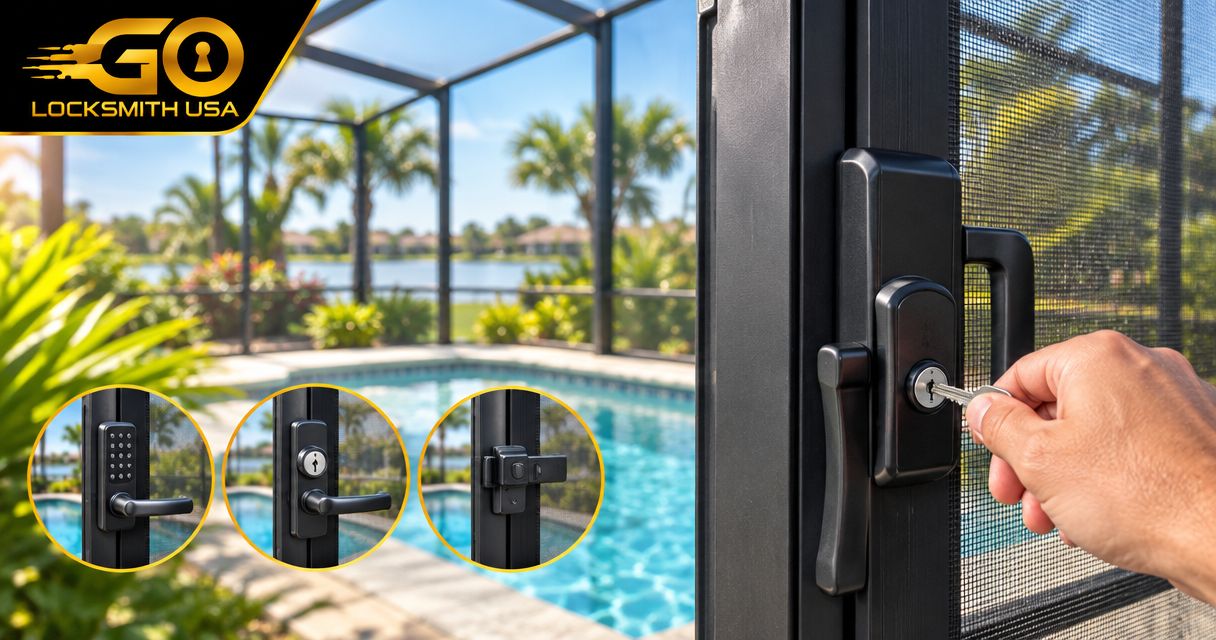
Best overall: a purpose-built, self-latching pool-barrier latch matched to your enclosure door. Best for keyed access: a compatible keyed enclosure latch. Best for an existing door with sound hardware: an exact-specification replacement latch. The best choice depends on whether the door forms part of the required pool barrier—not simply whether a lock fits.
TL;DR
- The best locks for Florida pool enclosure doors preserve self-closing and self-latching operation.
- Choose a purpose-built pool-barrier latch when the enclosure door serves as a pool barrier.
- A keyed enclosure latch adds access control but does not replace required barrier protection.
- GO Locksmith offers residential lock services; confirm pool-enclosure hardware scope before requesting service.
Why the door’s role matters more than the lock brand
A screened enclosure door and a house door opening toward a pool are different installations. Before choosing hardware, establish which door you have and whether it forms part of the property’s required pool barrier.
Florida Statutes §515.29 addresses residential swimming-pool barriers, including access gates. The requirements that apply to your property depend on its barrier arrangement and applicable rules; a product described as a “pool lock” does not establish compliance by itself.
GO Locksmith’s services include residential lock repair, replacement, and rekeying. Pool-enclosure hardware needs a separate scope check: do not assume every screen-door latch or closer falls within those services.
What makes the best locks for Florida pool enclosure doors?
Use these criteria before comparing options:
- Barrier function: The hardware must support the door’s required safety function, not just restrict entry with a key.
- Automatic latching: A self-latching mechanism must engage when the properly functioning door closes, without someone operating a separate bolt.
- Door compatibility: Match the frame profile, mounting arrangement, door thickness, handing, and latch-to-strike alignment.
- Outdoor suitability: Check the manufacturer’s stated exposure limits and maintenance instructions for the complete assembly, including fasteners.
- Safe release: Confirm release placement and operation against the applicable barrier and exit requirements.
- Repairability: Prefer identifiable hardware with installation instructions and compatible replacement components.
A strong lock on a door that does not close and latch is not a complete pool-barrier solution. Treat the hinges, closing mechanism, frame, latch, and strike as one working assembly.
Pool enclosure lock options at a glance
These are hardware categories, not tested product endorsements. Each recommendation is conditional on the door’s construction and applicable requirements.
| Option | Best for | Standout feature | Key limitation |
|---|---|---|---|
| Purpose-built pool-barrier latch | A door serving as a pool barrier | Self-latching operation designed for barrier applications | Requires compatible mounting and correct release placement |
| Keyed enclosure latch | Secondary access control | Key-operated locking on compatible enclosure hardware | A key does not establish child safety or compliance |
| Exact-specification replacement latch | Restoring a correctly specified existing assembly | Preserves the intended mounting arrangement | Repeats existing problems if the original setup was unsuitable |
| Supplemental deadbolt | A separately assessed additional locking point | Adds a manually operated bolt | Does not provide automatic latching and can affect exit operation |
1. Purpose-built pool-barrier latch: best for barrier doors
A purpose-built pool-barrier latch is the first category to consider when the enclosure door is part of the required barrier. Select an assembly documented for the intended application, then check its compatibility with the actual door and frame.
The latch cannot pull a sagging door into alignment or substitute for a functioning closing mechanism. The complete installation must close and engage as intended.
Purpose-built pool-barrier latch pros:
- Centers the selection on barrier function rather than ordinary door privacy.
- Provides automatic latching when correctly installed with compatible hardware.
- Gives you manufacturer instructions to check before modifying the frame.
Purpose-built pool-barrier latch cons:
- Mounting and release requirements can rule out otherwise attractive designs.
- Door sag, movement, or a failing closer can still prevent engagement.
Best for: An enclosure door confirmed to serve as a pool-barrier access point.
Verdict: Buy only after confirming the exact assembly, mounting arrangement, and applicable barrier requirements.
2. Keyed enclosure latch: best for secondary access control
A keyed enclosure latch lets you restrict operation with a key, depending on its design. It belongs on the shortlist when you need access control in addition to the door’s required closing and latching functions.
Check what the key actually controls. Do not assume that a locked handle, cylinder, or release behaves the same way across different latch assemblies—or that locking it preserves acceptable exit operation.
Keyed enclosure latch pros:
- Adds key-operated access control to compatible door hardware.
- Separates your access-control needs from simple handle operation.
- Can retain a familiar mechanical interface without electronic components.
Keyed enclosure latch cons:
- Key operation alone does not establish pool-barrier compliance.
- An unsuitable locking arrangement can interfere with required exit operation.
Best for: Homeowners who need keyed access while preserving an independently suitable barrier arrangement.
Verdict: Hold until you verify locking behavior from both sides and confirm that automatic latching remains intact.
3. Exact-specification replacement latch: best for restoring an existing door
An exact-specification replacement is a sensible option when the existing assembly was correctly selected and the latch itself has failed. Identify the manufacturer and model before buying; matching appearance is not enough.
Compare the replacement’s mounting pattern, operating direction, strike, and documented application. If the door drags or the frame moves, replacing the latch alone leaves the underlying problem unresolved.
Exact-specification replacement latch pros:
- Preserves the intended relationship between compatible components.
- Avoids unnecessary changes to mounting locations when specifications match.
- Makes installation instructions easier to compare with the existing assembly.
Exact-specification replacement latch cons:
- An identical replacement does not correct an unsuitable original installation.
- Wear in hinges, the frame, or the strike can remain after replacement.
Best for: A previously suitable assembly with an identifiable, isolated latch failure.
For a broader repair decision, read when to repair or replace an exterior door lock. Pool-barrier requirements still need their own assessment.
Verdict: Buy after confirming both the replacement specification and the condition of the surrounding hardware.
4. Supplemental deadbolt: best considered only for an additional locking point
A manually operated deadbolt adds a separate locking point where the door construction and applicable requirements permit it. It is not a replacement for a self-latching pool-barrier latch.
Do not choose a house-door deadbolt simply because it looks stronger. An enclosure door’s narrow framing, available mounting space, and exit function can make that hardware unsuitable.
Supplemental deadbolt pros:
- Provides a separate, manually operated locking function.
- Keeps supplemental locking distinct from the primary latch.
- Offers mechanical operation without batteries when the application permits it.
Supplemental deadbolt cons:
- Does not automatically engage when the door closes.
- Requires a separate assessment of frame suitability and exit operation.
- Risks becoming an obstacle rather than an improvement on the wrong door.
Best for: Only an additional locking point specifically assessed as suitable—not a default enclosure-door upgrade.
Verdict: Skip as the primary pool-barrier solution; consider supplemental use only after a qualified assessment.
Check the door before ordering hardware
An accurate hardware choice starts with the opening, not the shopping cart. Keep children away from an unreliable barrier while you arrange an appropriate correction; do not treat a temporary workaround as equivalent protection.
Door role
Identify whether you are dealing with a screened enclosure access door, a separate pool gate, or a house door leading into the pool area. Ask the local building department which barrier requirements apply when that role is unclear.
Door condition
Look for dragging, loose hinges, visible frame damage, or a strike that no longer lines up. Observe the problem without bending components, enlarging holes, or defeating the latch.
Closing action
Check whether the door closes and latches without being pushed into its final position. Follow the manufacturer’s inspection instructions; a successful closure after a firm shove does not demonstrate reliable self-closing operation.
Hardware identity
Photograph identifying marks, the latch, the strike, both sides of the door, and the mounting area. Record measurements requested by the manufacturer or service provider rather than guessing from a similar-looking online listing.
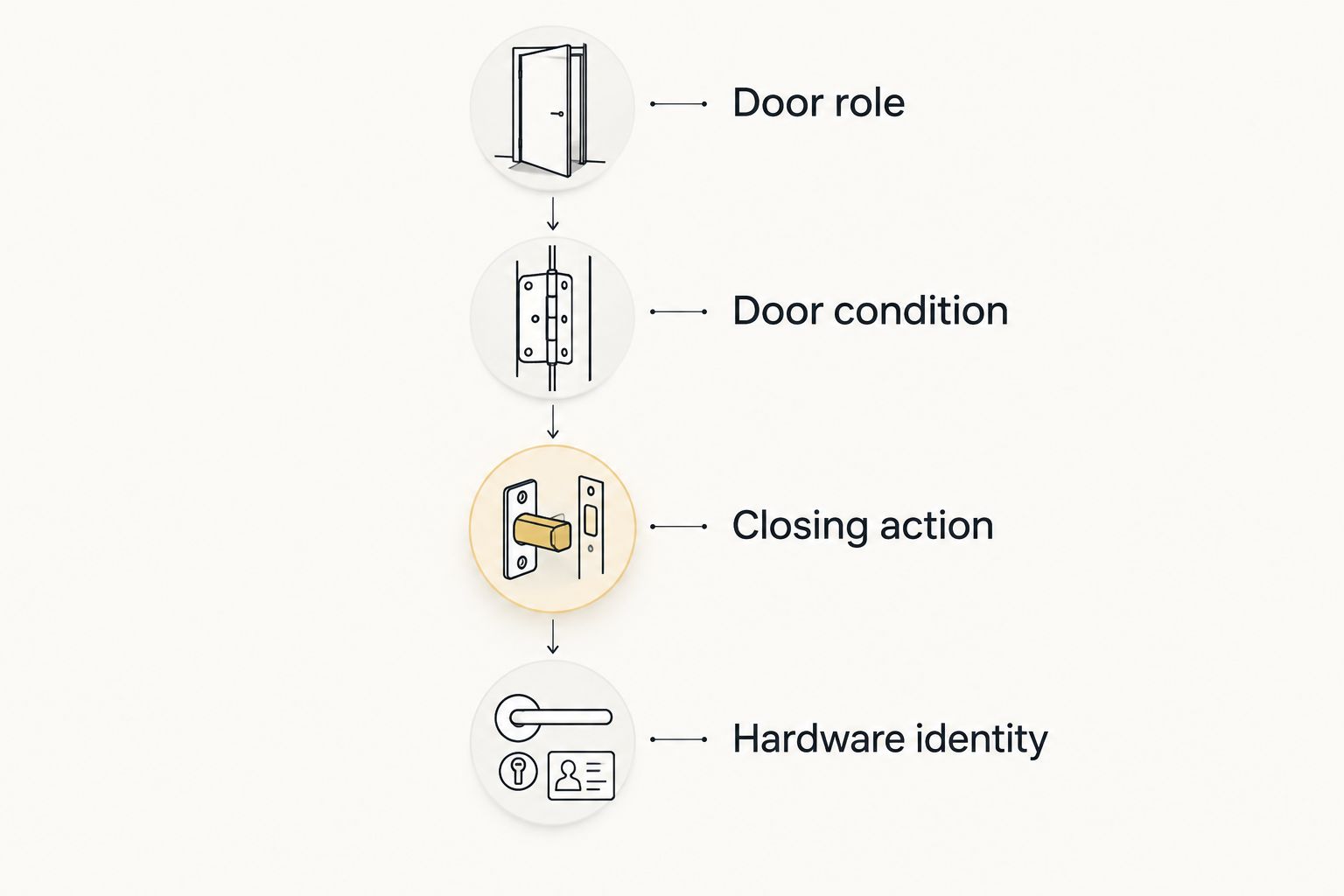
Identify the door and its condition before selecting a replacement latch.
Florida exposure: check the whole assembly
Outdoor suitability applies to more than the visible latch cover. Check the manufacturer’s guidance for the latch mechanism, cylinder if present, strike, fasteners, and contact with the enclosure’s frame material.
Coastal exposure makes material compatibility and maintenance particularly relevant. Do not treat “weatherproof,” “stainless,” or “marine” wording as proof that every component suits your installation.
Follow the specified cleaning and lubrication instructions. Avoid applying a lubricant solely because it works on another household lock; the correct maintenance method depends on the mechanism and materials.
After repairs or noticeable changes in operation, reassess closing and latching. A latch that worked before a door began sagging still needs attention when alignment changes.
How these options are ranked
The ranking puts barrier function first, followed by fit, automatic operation, outdoor suitability, and maintainability. It does not rank manufacturers by unverified durability claims or assume that one latch fits every Florida enclosure.
Purpose-built barrier hardware leads because it addresses the relevant function. Keyed hardware addresses an additional access need; like-for-like replacement addresses a repair need; a supplemental deadbolt is not a substitute for either automatic closing or latching.
Which pool enclosure lock should you choose?
Start with a purpose-built pool-barrier latch if the door is part of the required barrier. If you also need keyed control, look for a compatible assembly that preserves required operation rather than adding an unrelated lock.
Choose an exact-specification replacement only after checking that the original setup was suitable. If the door fails to close, address that fault before treating a new cylinder or latch as the answer.
GO Locksmith provides residential lock repair, replacement, and rekeying for homeowners; pool-enclosure hardware requires a job-specific scope check. For confirmed lock-service needs in Fort Myers, Cape Coral, Lehigh Acres, Estero, Bonita Springs, or Naples, describe the door and hardware before requesting service.
FAQ
What are the best locks for Florida pool enclosure doors?
For a door serving as a pool barrier, start with a purpose-built self-latching latch compatible with the enclosure and applicable requirements. Keyed control is an additional consideration, not a substitute for the required barrier function.
Is a keyed screen-door lock enough for a pool enclosure?
A keyed screen-door lock alone does not establish that a pool enclosure meets barrier requirements. The door’s closing action, latching, release arrangement, and overall barrier configuration also matter.
Can I put a regular deadbolt on my pool screen door?
Do not assume a regular deadbolt suits a pool screen door. Frame construction, mounting space, barrier requirements, and exit operation need assessment, and a manually operated deadbolt does not replace self-latching hardware.
Does a Florida pool enclosure door have to close by itself?
Self-closing and self-latching requirements apply to access gates covered by Florida’s residential pool-barrier provisions. Confirm how your enclosure door is classified and which requirements apply with the local building department.
Should I replace the latch if the enclosure door will not stay shut?
Identify the cause before replacing the latch. Misalignment, loose or worn hinges, a closing problem, and a damaged latch can produce similar symptoms but require different corrections.
What should I ask before buying outdoor pool-door hardware?
Ask whether the exact hardware suits your door profile, exposure, mounting arrangement, and required barrier function. Request the manufacturer’s installation and maintenance instructions before making changes.
Can GO Locksmith replace my pool enclosure lock?
Call GO Locksmith at (239) 412-1101 to confirm whether the specific enclosure hardware is within service scope and request a job-specific estimate. Hours are Sunday–Thursday 7:00 AM–11:00 PM and Friday 7:00 AM–5:00 PM; Saturday is closed.
One last thing
A door can be closed without being latched. After any permitted repair or replacement, verify actual latch engagement rather than relying on the door’s appearance or the sound it makes.
For help identifying a confirmed residential lock-service need, contact GO Locksmith and describe the door, the problem, and any identifying marks. Confirm the hardware scope and current availability before arranging service.