
Blog ·
Can a locksmith service a lock on a storm door?
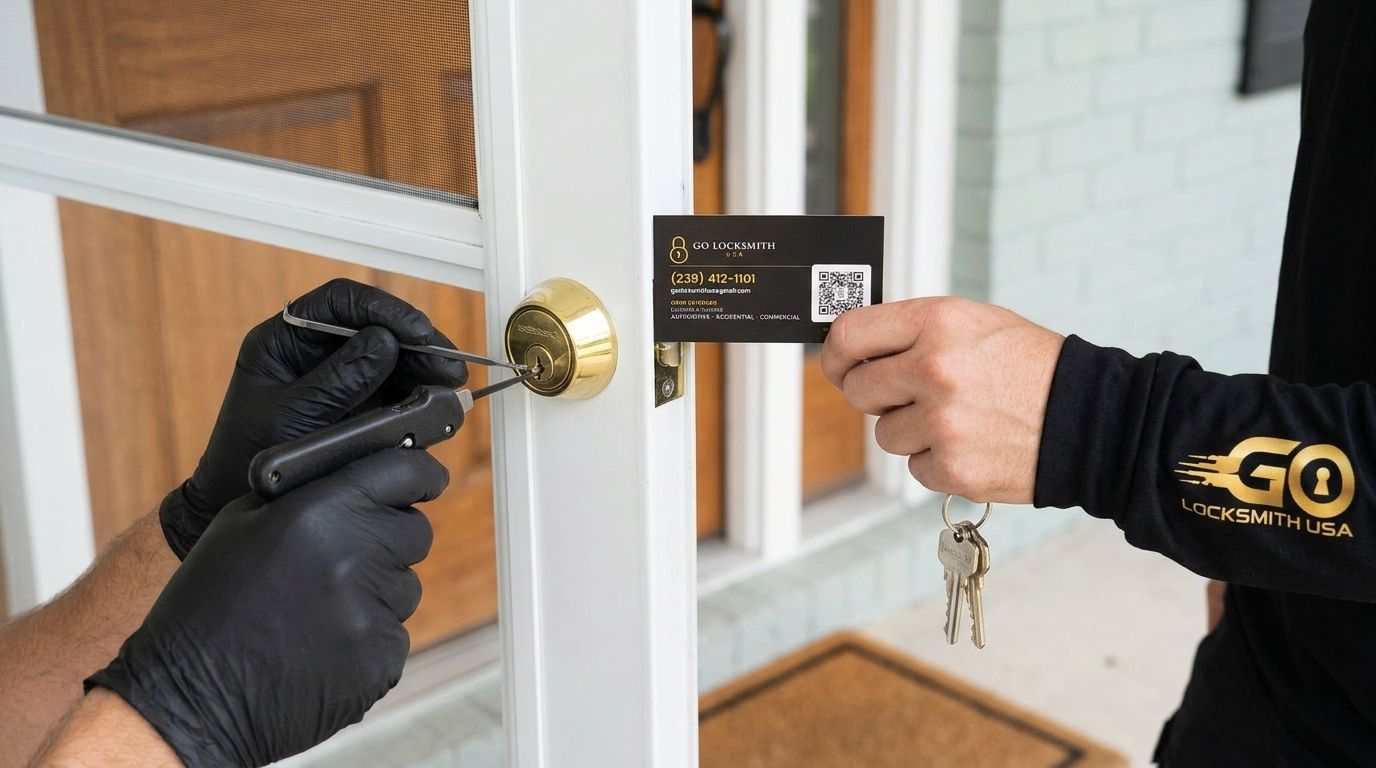
Yes, a locksmith can service a lock on a storm door when its design allows repair, rekeying, or replacement with compatible hardware. The important distinction is whether the problem is inside the lock or in the door’s alignment, handle, or latch. A damaged frame or hinge problem can require door repair rather than lock work alone.
TL;DR
- Can a locksmith service a lock on a storm door? Yes, when compatible hardware permits repair, rekeying, or replacement.
- Rekeying changes which key works; it does not fix a broken latch or a misaligned door.
- A replacement storm door lock must match the door’s hardware preparation, not just its appearance.
- GO Locksmith provides residential lock repair, replacement, and rekeying; confirm your storm door’s hardware before requesting service.
Can a locksmith service a lock on a storm door?
A serviceable storm door lock does not automatically require a new door. A locksmith can assess the locking hardware and determine whether the problem calls for repair, a different key, or a compatible replacement. That assessment depends on the actual lock, not simply the fact that it is mounted on a storm door.
Storm door hardware varies. Some doors have a separate keyed cylinder; others combine the handle, latch, and locking mechanism into an assembly. A repair that works on one design is not necessarily possible on another.
GO Locksmith’s confirmed residential locksmith services include lock repair, replacement, and rekeying. Describe the storm door and its symptoms before booking so the specific job can be assessed without assuming compatibility.
| Service option | Best for | Main benefit | Main limitation |
|---|---|---|---|
| Lock repair | A serviceable lock with a repairable fault | Keeps usable hardware in place | Cannot correct every worn or broken component |
| Rekeying | Changing key access on a compatible, working cylinder | Changes which key operates the lock | Does not repair mechanical damage |
| Lock replacement | Failed hardware with a compatible replacement | Replaces the defective locking assembly or component | Fit depends on the door and existing hardware |
| Door repair assessment | Binding caused by hinges, frame damage, or door position | Addresses problems outside the lock | Is separate from servicing the lock itself |
Why the cause matters more than the symptom
A storm door that will not lock does not necessarily have a defective cylinder. The latch must line up with the opening in the frame, and the handle must move the mechanism correctly. Replacing a cylinder will not solve a latch that cannot reach its receiving opening.
The opposite is also true. A door that closes normally can still have an internal lock problem. Separating those situations helps you describe the job accurately and avoid requesting a repair that does not address the cause.
Treat symptoms as clues, not a final diagnosis. Tell the locksmith what happens when you turn the key, operate the handle, and close the door. Do not force any part to complete those checks.
What to check before calling a locksmith
You do not need to take the lock apart. These observations give a locksmith useful information while keeping the existing hardware intact.
- Check your access. Say whether the storm door is open, locked shut, or blocking access to the main entry door. An inaccessible lock presents a different job from one that can be inspected from both sides.
- Describe key movement. Explain whether the key inserts fully, stops partway, turns stiffly, or turns without releasing the latch. Stop if the key bends or requires force.
- Compare door positions. If you can safely open the door, note whether the lock operates differently when open and closed. Do not extend a bolt and then slam the door against the frame.
- Observe the handle. Report looseness, sticking, or a handle that moves without retracting the latch. Those symptoms help distinguish handle and latch problems from key-cylinder problems.
- Identify the hardware. Look for a manufacturer name, model label, or marking without removing components. Ask whether photos would help identify the assembly before a visit.
If the door is stuck closed, skip observations that require opening it. Do not pry near glass, force the handle, or try to reach the mechanism through the door. Explain the access problem when you call.
When repairing the storm door lock makes sense
Repair fits a lock that has a correctable fault and otherwise usable hardware. A locksmith needs to distinguish a loose or malfunctioning component from an assembly with damage that calls for replacement.
Describe how the problem developed. A handle that gradually became loose presents different information from a key that suddenly stopped turning after it was bent. Neither description proves the cause, but both help direct the inspection.
Repair also has limits. Some assemblies are not designed for practical component-level servicing, and damaged parts need a suitable replacement. Keeping an old assembly is not useful if the underlying fault remains.
If you are weighing those choices, the guide to repairing or replacing an exterior door lock explains the broader decision. For a storm door, hardware fit remains an additional consideration.
When rekeying a storm door lock makes sense
Rekeying is appropriate when you want to change key access and the storm door has a cylinder that supports the work. It changes the cylinder’s keying rather than replacing the entire handle assembly.
Rekeying is an access change, not a mechanical repair. It does not straighten a door, repair a broken handle, or make a damaged latch retract correctly. A lock with both an access concern and a mechanical fault needs both issues assessed.
If you want the storm door and main entry door to use the same key, ask about compatibility before requesting that result. The locks must support compatible keying; similar-looking keys or matching finishes do not establish that.
A lost key also does not automatically mean the entire storm door needs replacement. The available options depend on the cylinder, the condition of the assembly, and whether compatible parts can be fitted.
When replacing the lock makes sense
Replacement fits hardware that is broken beyond practical repair or cannot support the required work. The replacement must suit the door’s existing openings and construction.
Do not choose a handle set by appearance alone. Storm door thickness, mounting-hole spacing, latch dimensions, and clearance from the main door can all affect fit. Depending on the design, the replacement may be a cylinder, a handle-and-latch set, or a larger integrated assembly.
Use the manufacturer’s identification and installation information where possible. Keep removed parts until the replacement has been checked, and do not enlarge openings simply to make an unverified part fit.
Replacing the lock and replacing the door are separate decisions. A failed lock does not establish that the door is unusable. Conversely, a new lock cannot restore a badly damaged door or frame.
Why storm door lock service varies
The work depends on what is installed and what has failed. These factors determine which service is appropriate:
- Cylinder design: A removable, serviceable cylinder offers different options from an integrated locking assembly.
- Hardware condition: Broken, distorted, or heavily corroded components can limit repair choices.
- Door alignment: A latch that misses its receiving opening needs a different assessment from a key that will not turn.
- Replacement fit: Door thickness, openings, mounting points, and handle clearance affect compatibility.
- Access to the assembly: A door locked shut can restrict inspection compared with an open door.
- Purpose of the work: Restoring operation and changing who has key access are different objectives.
Give the locksmith both the symptom and your goal. “The handle sticks, and I also need the old key to stop working” describes the job more clearly than “the lock is bad.”
Can a locksmith rekey a storm door to match my front door?
A locksmith can rekey a storm door to match another lock only when the cylinders and key systems are compatible. Ask for that compatibility check before buying hardware or assuming your existing entry key will work.
If matching is not possible with the installed cylinder, ask what compatible replacement options exist. Do not assume a different cylinder will fit the existing assembly.
Do I need a locksmith or a door repair professional?
A locksmith is the appropriate starting point for a key, cylinder, or locking-mechanism problem. A visibly sagging door, damaged frame, or hinge failure calls for a door repair assessment, either instead of or alongside lock service.
If the lock operates with the door open but binds when closed, report that distinction. It points attention toward fit and alignment without proving which component needs work.
Can I replace a storm door lock myself?
You can consider replacing storm door hardware yourself when you have a confirmed compatible part and clear manufacturer instructions. Stop if the job requires modifying the door, working around damaged glass, or forcing a stuck mechanism.
Take photos before removing anything, retain the original parts, and keep another usable entrance accessible. A replacement that mounts successfully still needs to latch, lock, and release correctly without interference from the main door.
What should I ask before booking service?
Ask whether the locksmith can assess your particular storm door lock, what identifying information is needed, and how the estimate will be confirmed. Mention whether the door is open or locked shut and whether you have a working key.
For GO Locksmith, call (239) 412-1101 to discuss the hardware and request a job-specific estimate. Residential lock repair and rekeying are confirmed services; compatibility with your storm door still needs confirmation.
FAQ
Can a locksmith service any storm door lock?
No, service options depend on the storm door’s hardware, condition, and compatible parts. A locksmith needs to identify the assembly before confirming repair, rekeying, or replacement.
Why does my storm door lock work when open but not when closed?
Different operation when open and closed suggests that door position or latch alignment needs assessment. It does not prove the cylinder is faulty or establish which adjustment is needed.
Will rekeying fix a storm door handle that sticks?
Rekeying does not repair a sticking handle or damaged latch. Rekeying changes key access on a compatible cylinder; the mechanical problem needs a separate assessment.
Do I need to replace the whole storm door if the lock breaks?
A broken lock does not automatically require replacing the whole storm door. Compatible lock or handle hardware can be an option when the door itself remains serviceable.
Can I use a regular front door lock on my storm door?
Do not assume a standard entry-door lock fits a storm door. Door thickness, mounting openings, latch dimensions, and clearance must match the replacement hardware.
What should I do if a key breaks in my storm door lock?
Stop trying to turn the remaining key or push another object into the keyway. Ask a locksmith to assess extraction and check whether the lock has damage beyond the broken key.
Does GO Locksmith provide residential lock service in Southwest Florida?
GO Locksmith provides mobile residential lock repair, replacement, and rekeying in Fort Myers, Cape Coral, Lehigh Acres, Estero, Bonita Springs, and Naples. Call to confirm the specific storm door hardware and current availability.
One last thing
A working lock can still be blamed for a door-fit problem. Before ordering a replacement, note whether the mechanism behaves differently with the door open and closed. That observation gives the person assessing the job something useful to investigate.
Need help with a storm door lock? Call (239) 412-1101 to discuss the symptoms and check availability. Hours are Sunday–Thursday 7:00 AM–11:00 PM and Friday 7:00 AM–5:00 PM; Saturday is closed.