
Blog ·
Best gun safes for Florida homeowners 2026
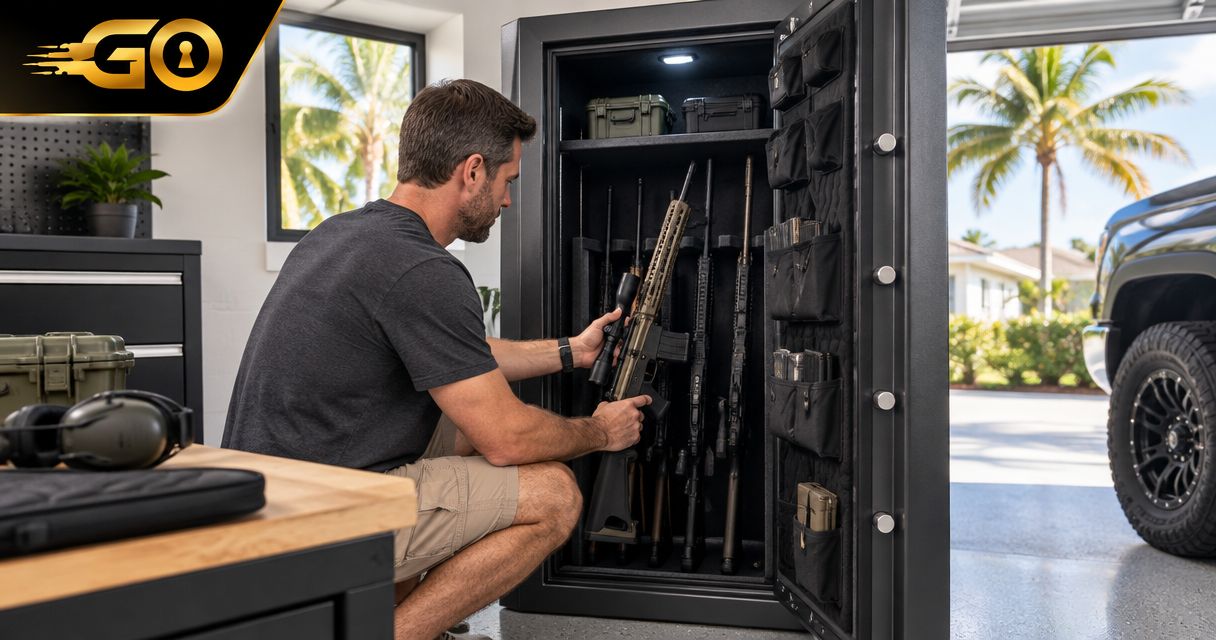
Best overall for a mixed firearm collection: an anchored, independently security-tested full-size gun safe. Best for handgun-only storage: a securely mounted handgun safe. Best for difficult indoor access: a modular gun safe. Best for a collection stored alongside high-value belongings: a safe with a documented burglary rating. The best gun safes for Florida homeowners match the household’s access-control needs, indoor conditions, and installation space—not just an advertised firearm count.
TL;DR
- The best gun safes for Florida homeowners combine secure mounting, documented security testing, and a workable humidity-control plan.
- Choose full-size, handgun, modular, or burglary-rated storage according to your collection and installation constraints.
- Fire resistance, burglary resistance, and water resistance are separate claims; verify each for the exact model.
- GO Locksmith provides safe service; call with your safe’s make, model, and problem to discuss your specific job.
Why Florida homeowners need more than a heavy box
A safe controls access, but it does not automatically control moisture or protect its contents from flooding. For Florida homeowners, placement and indoor conditions belong in the buying decision—not on a checklist you revisit after delivery.
GO Locksmith is a mobile locksmith business, not a gun-safe manufacturer. Its confirmed offerings include safe service; the recommendations below compare safe types rather than claim that particular models have been tested or endorsed.
Start by separating your concerns: unauthorized access, removal of the container, fire exposure, and moisture. A claim about one does not establish protection against the others. A large cabinet can lack documented burglary testing, while a fire-resistant container can still have important security limitations.
What makes the best gun safe for your home?
Use these criteria before comparing finishes, accessories, or advertised capacity:
- Documented security testing: Look for an identifiable testing organization, standard, and classification for the exact model. A lock’s certification is not certification of the whole safe.
- Secure mounting: Check the manufacturer’s anchoring instructions and whether your intended floor or structure supports the required installation.
- Usable interior: Compare actual shelf spacing, door clearance, and interior dimensions against your unloaded firearms and accessories.
- Moisture management: Choose a location where you can monitor humidity and follow the firearm and safe manufacturers’ storage guidance.
- Separate hazard claims: Read fire and water documentation independently from burglary claims. Test conditions matter more than a broad protective label.
- Dependable authorized access: Understand the lock’s operating instructions, maintenance requirements, and authorized recovery process before storing firearms inside.
Gun-safe options at a glance
These are buying categories, not interchangeable security ratings. A modular safe or compact handgun safe still needs its own security documentation.
| Safe type | Best for | Standout feature to verify | Key limitation |
|---|---|---|---|
| Anchored full-size gun safe | A mixed collection of long guns and handguns | Documented whole-container security testing and usable shelving | Requires a suitable location and a planned delivery route |
| Mounted handgun safe | Handgun-only households with limited storage space | Secure mounting and a lock suited to authorized users | Limited capacity; a portable container needs protection against removal |
| Modular gun safe | Homes with difficult interior access | Manufacturer-designed assembly and anchoring | Assembly quality matters; modular construction alone proves no security level |
| Burglary-rated safe | Firearms stored with other high-value belongings | Independently documented burglary classification | Weight, dimensions, and interior configuration can complicate residential placement |
1. Anchored full-size gun safe: best for a mixed collection
A full-size gun safe provides upright storage for long guns and configurable space for handguns and accessories. Choose one with documented security testing rather than treating size or appearance as evidence of protection.
The interior deserves a close inspection. Optics, slings, and other fitted accessories take up room, so an advertised firearm count is not a reliable description of how your particular collection will fit.
Full-size gun safe pros:
- Accommodates long guns without relying on separate small containers.
- Offers shelving arrangements that you can compare against your actual storage needs.
- Provides a fixed storage location when installed and anchored as directed.
Full-size gun safe cons:
- Delivery, floor suitability, and door clearance require advance planning.
- A full-size enclosure is not automatically fire-tested, water-resistant, or independently security-tested.
Best for: Homeowners who need organized storage for both long guns and handguns in a suitable indoor location.
Before choosing, measure the delivery route and the space with the safe door open. Check whether shelves, door organizers, or interior fittings reduce the clearance you need. If electrical humidity-control equipment is part of your plan, confirm that the manufacturer permits the intended setup.
Verdict: Buy this type for a mixed collection when its documented security, interior fit, and mounting requirements match your home.
2. Mounted handgun safe: best for handgun-only storage
A compact handgun safe keeps a smaller collection in a dedicated locked container without requiring a full-size enclosure. Its value depends on access control and secure mounting—not simply on fitting inside a drawer.
Check the exact locking system and the manufacturer’s instructions. If the safe uses electronic or biometric access, understand its power requirements and any authorized backup method before relying on it.
Mounted handgun safe pros:
- Fits storage needs that do not include long guns.
- Requires less dedicated interior space than a full-size safe.
- Allows you to evaluate mounting and authorized access around a specific household location.
Mounted handgun safe cons:
- Interior space can be restrictive once accessories are included.
- An unsecured portable container leaves a removal risk that its lock alone does not address.
Best for: Households storing handguns only, with a suitable mounting location inaccessible to unauthorized users.
Do not equate a fingerprint reader with a whole-container security rating. Authentication describes how a lock recognizes an authorized user; it does not establish resistance to forced entry. Also consider where backup keys or recovery information will be kept, because those need their own access controls.
Verdict: Buy this type for handgun-only storage when you can secure the container and manage every authorized access method.
3. Modular gun safe: best for difficult indoor access
A modular gun safe is designed to be assembled from separate components. That construction can suit a home where a conventional assembled safe will not pass through the intended route.
Compare the manufacturer’s component dimensions, assembly instructions, and completed-safe documentation. The word modular describes construction, not a security classification.
Modular gun safe pros:
- Lets you assess individual components against narrow access points.
- Offers an alternative when a one-piece enclosure does not fit the delivery route.
- Allows installation planning around the manufacturer’s assembly sequence.
Modular gun safe cons:
- Correct assembly is essential to the finished enclosure.
- Security, fire, and water claims still require separate documentation for the completed model.
Best for: Homeowners whose doorways, hallways, or other access constraints rule out a suitable one-piece safe.
Resolve assembly responsibility before committing. Ask who checks the completed enclosure, how anchoring works, and whether the chosen location provides the access needed for installation. Do not assume modular construction solves floor-loading or anchoring concerns; those remain separate questions.
Verdict: Buy this type when access constraints justify it and the completed safe meets your documented security requirements.
4. Burglary-rated safe: best for firearms and high-value belongings
A safe with a documented burglary classification is an option when resistance to forced entry drives the decision. Compare the exact classification and its scope rather than relying on descriptions such as heavy-duty or commercial-grade.
Confirm that the interior is appropriate for firearms. A safe designed around shelves for valuables does not necessarily provide useful long-gun clearance or suitable organization.
Burglary-rated safe pros:
- Gives you a defined security classification to investigate.
- Supports a decision based on documented testing rather than appearance.
- Lets you discuss specific protection requirements with your insurer.
Burglary-rated safe cons:
- Weight and dimensions can restrict suitable residential locations.
- Burglary classification alone establishes neither fire protection nor water resistance.
Best for: Homeowners storing firearms with other high-value belongings who have suitable placement and delivery arrangements.
Ask your insurer about any applicable storage requirements before selecting the model. Then check the safe’s actual documentation against those requirements. A salesperson’s general assurance is not a substitute for confirmation about your policy or the exact container.
Verdict: Buy this type when documented burglary protection is the priority and the safe fits both your collection and your home.
Plan the location before choosing the model
A location that looks convenient on a floor plan can create delivery, moisture, or mounting problems. Work through these decisions in order:
- Choose the location. Consider unauthorized access, indoor conditions, and the property’s flood exposure. Do not assume a garage provides the same environment as conditioned living space.
- Check the route. Measure doorways, turns, thresholds, and the space needed to position the safe without damaging the property.
- Confirm support. Have floor-loading and anchoring questions resolved by an appropriately qualified professional where needed.
- Plan moisture control. Follow the equipment manufacturers’ guidance and arrange a way to check conditions inside the closed safe.
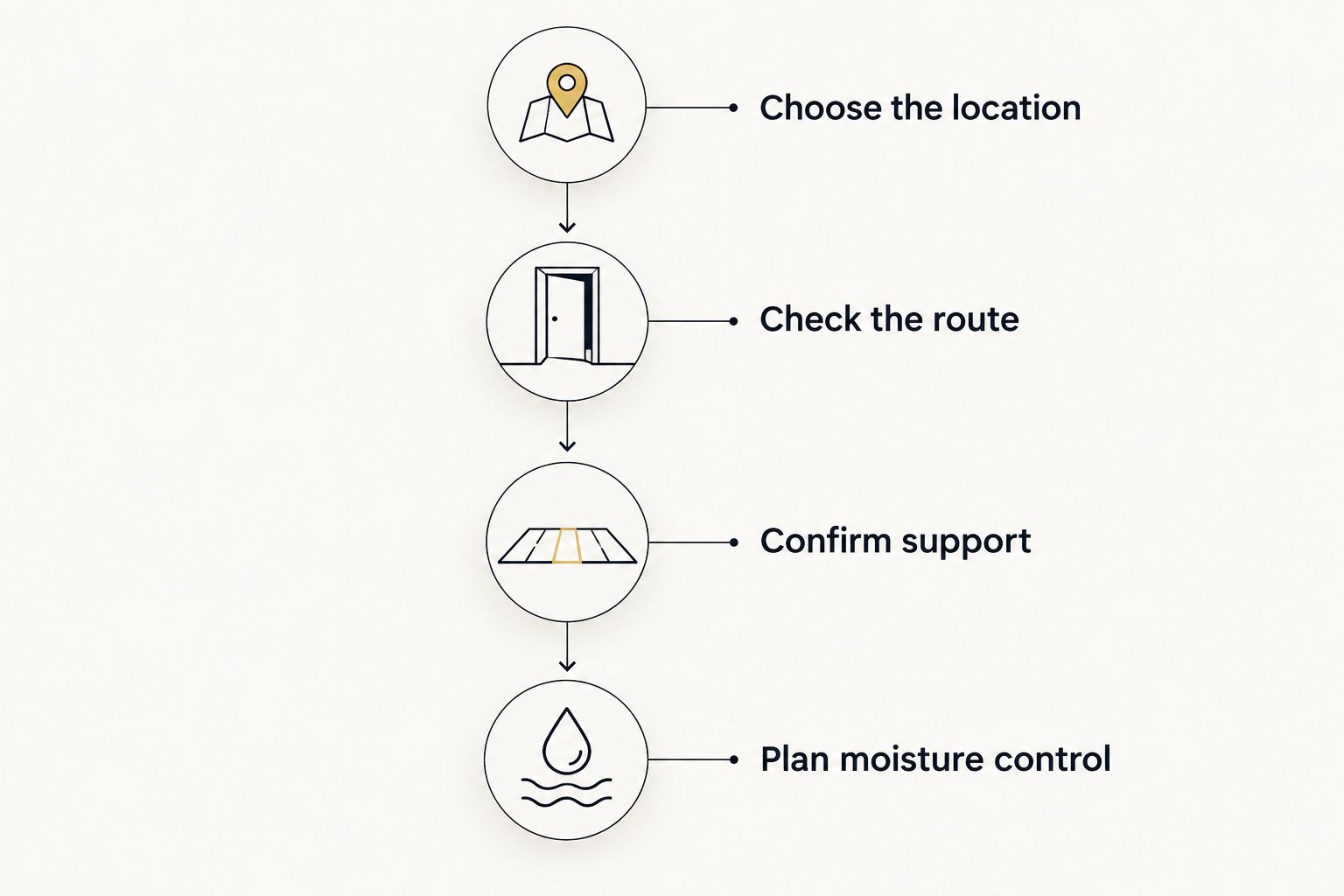
Settle the location and installation requirements before choosing a safe.
Keep installation decisions separate from assumptions about storm protection. A fire test does not establish flood performance, and raising a safe without an approved installation plan can create new stability or anchoring problems.
Avoid drilling into a safe to add accessories unless the manufacturer expressly permits the modification. Use designated provisions and approved equipment instead.
How these recommendations are ranked
The full-size safe is the default for a mixed collection because its layout addresses both long-gun and handgun storage. The other categories answer different needs: limited handgun storage, difficult access, or a stronger emphasis on documented burglary protection.
This is a selection framework, not a claim of hands-on model testing. The exact safe’s documentation takes priority over its category name. Reject any candidate whose security claims, mounting instructions, or usable dimensions you cannot establish.
Which gun safe should you choose?
Choose an anchored, independently security-tested full-size gun safe if you need one location for a mixed collection. Choose a mounted handgun safe if you only need handgun storage; consider modular construction when delivery access is the obstacle.
For an existing safe that is not operating normally, separate the service question from the replacement decision. GO Locksmith provides safe service for homeowners in its confirmed Southwest Florida service areas, including Fort Myers, Cape Coral, Lehigh Acres, Estero, Bonita Springs, and Naples. Call with the make, model, and symptoms to discuss the specific job; do not assume every safe or lock is supported.
FAQ
What are the best gun safes for Florida homeowners?
The best choice depends on your collection, installation space, and required protection. For a mixed collection, start with an anchored full-size gun safe with documented security testing, then verify interior fit and moisture-management requirements.
Is a gun safe automatically waterproof?
No. Security testing or a fire-resistance claim does not establish water resistance. Check the exact model’s water-test documentation and limitations, and assess the proposed location’s flood exposure separately.
Should I put my gun safe in a Florida garage?
Evaluate the garage’s humidity, temperature conditions, flood exposure, and access before choosing it. Follow the safe and firearm manufacturers’ storage guidance rather than assuming any garage is suitable.
Does a heavy gun safe still need anchoring?
Follow the manufacturer’s anchoring instructions regardless of how heavy the safe feels. Weight alone does not establish that the container is properly secured, and the floor must suit the required installation.
Is a biometric handgun safe better than a keypad safe?
A biometric reader is not automatically better than a keypad. Compare the exact container’s security documentation, authorized access methods, power requirements, and recovery instructions—not just the input method.
Does fire-resistant mean a safe protects firearms from every fire?
No. Fire resistance applies to specified test conditions, not every possible fire. Review the test scope and limitations, and do not treat protection for documents as proof that every firearm component or accessory will remain undamaged.
Can GO Locksmith help with an existing gun safe?
GO Locksmith offers safe service. Call (239) 412-1101 with the make, model, and problem to discuss your job and check availability; support for a particular safe or lock is not guaranteed.
One last thing: manage the backup access
A secure container still needs a plan for backup keys, combinations, and recovery information. Keep those away from unauthorized users, and do not store your only recovery instructions inside the locked safe.
Store firearms unloaded, control access to ammunition separately, and follow applicable law and manufacturer guidance. If your existing safe needs attention, call (239) 412-1101 or request service with its identifying details. Hours are Sunday–Thursday, 7:00 AM–11:00 PM; Friday, 7:00 AM–5:00 PM; Saturday closed.