
Blog ·
Best commercial door hardware for hurricane-prone buildings 2026
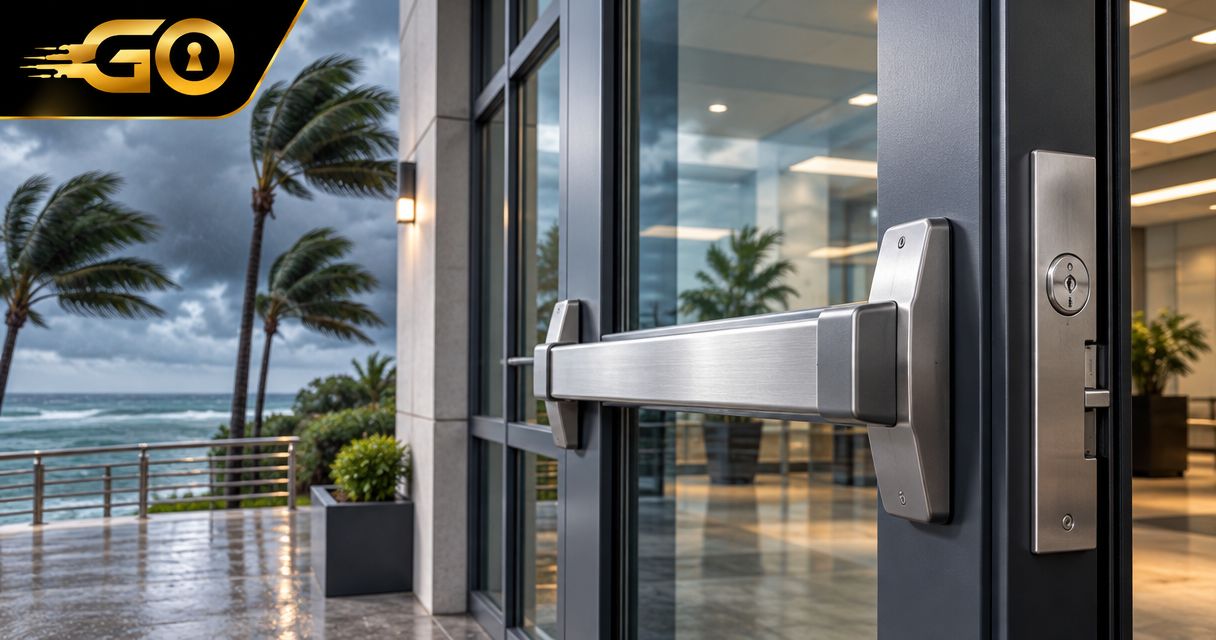
Best starting point: hardware specified for your approved door assembly. Best for single-door exits: a compatible rim exit device. Best for paired exits: the approved paired-door latching arrangement. The best commercial door hardware for hurricane-prone buildings preserves the opening’s wind resistance, required exit operation, and everyday function—not just its security.
TL;DR
- The best commercial door hardware for hurricane-prone buildings matches the approved door assembly, not a standalone strength claim.
- Compare rim exit devices, paired-door latching, mortise locks, closers, and hinges by their distinct jobs.
- A security grade does not establish hurricane performance or approval for your opening.
- GO Locksmith provides mechanical commercial locksmith services; confirm the specific hardware job before scheduling.
Why the whole opening matters
A commercial exterior door works as an assembly: door leaf, frame, anchors, hinges, latch, strike, and other specified components. Replacing one component with something advertised as stronger does not establish that the altered assembly meets its required wind or impact performance.
Start with the opening’s documentation, then select hardware. If you need help with locks, push bars, or door closers, review GO Locksmith’s services and describe the existing hardware when you call. Product-approval interpretation and structural questions belong with the manufacturer, building professional, or local building department.
This guide ranks hardware categories by their job, rather than naming an unsupported universal winner. Some belong on the same door; others serve different opening configurations and are not interchangeable.
What makes the best commercial hurricane-door hardware?
Use these criteria before comparing a replacement with the part already installed:
- Assembly approval: The documentation must support the hardware and its installation on the specific opening.
- Wind requirements: Confirm the required design pressures and any applicable impact protection through the project documents and governing requirements.
- Exit operation: Preserve required egress, accessibility, and any fire-door function. A stronger latch is not an improvement if occupants cannot exit correctly.
- Exterior exposure: Check the manufacturer’s suitability and maintenance instructions for rain, humidity, and coastal exposure.
- Door compatibility: Match the door material, preparation, swing, dimensions, frame, strike, and mounting arrangement.
- Serviceability: Favor clearly identified components with available installation and maintenance documentation.
The Florida Building Code addresses wind-resistant exterior openings. Florida Product Approval records and Miami-Dade Notices of Acceptance are established sources of product documentation, but their conditions and limitations matter as much as the approval identifier.
Do not assume that every Florida opening requires the same approval route or impact protection. Have the applicable requirements checked for your building and location.
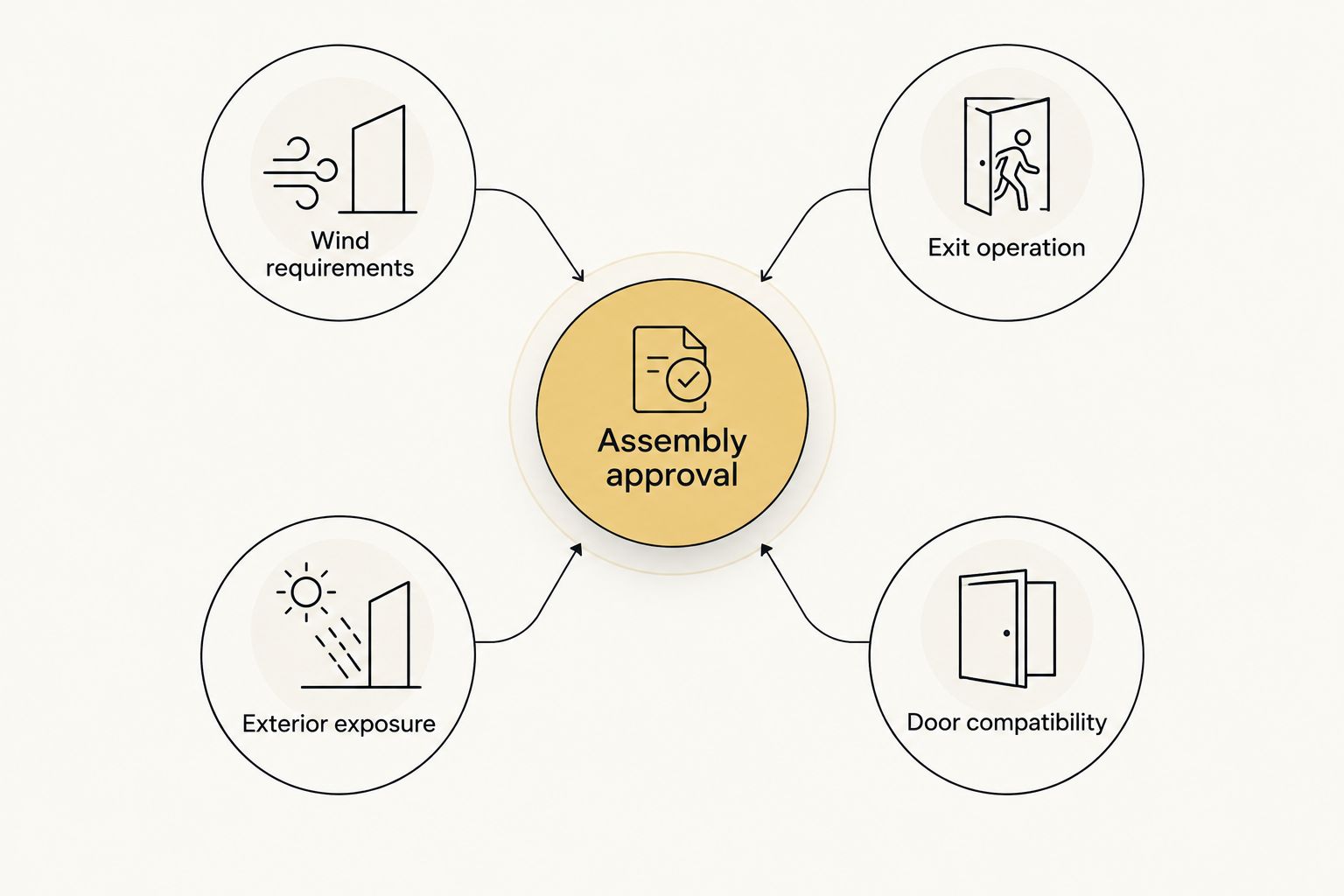
Evaluate the hardware as part of the opening, not as an isolated component.
Commercial door hardware at a glance
| Hardware category | Best for | Standout function | Key limitation |
|---|---|---|---|
| Compatible rim exit device | Single-door exits requiring panic hardware | Push-operated release with latching at the frame | Must match the approved door, strike, and attachment details |
| Approved paired-door latching | Double-door exits | Secures the opening using its documented paired-door arrangement | Rods, strikes, mullions, and meeting edges are configuration-specific |
| Compatible commercial mortise lock | Staff entrances where permitted | Combines lock and latch functions within a mortise case | Not a substitute for required panic hardware |
| Compatible commercial door closer | Doors needing controlled closing | Controls the closing cycle and helps the door reach its latch | Does not establish wind resistance or act as a storm brace |
| Specified hinges and reinforcement | Supporting the door leaf and hardware attachment | Maintains the documented support and mounting arrangement | Changing hinge type or fasteners requires compatibility verification |
1. Rim exit devices: best for single-door panic exits
A rim exit device releases the latch when someone operates the interior push bar. It is a practical category to evaluate for a single exterior exit where panic hardware is required and the opening’s documentation permits that configuration.
The important purchase is not simply “a heavy-duty push bar.” It is the correct device, strike, exterior trim, and mounting arrangement for that particular door.
Rim exit device pros:
- Provides push-operated exit release.
- Uses a frame-mounted strike in a compatible single-door arrangement.
- Offers an identifiable hardware configuration to compare against the opening documents.
Rim exit device cons:
- A different strike or attachment method can fall outside the documented assembly.
- Exterior trim and locking functions need separate checking against operating requirements.
Do not assume an existing bar proves the opening is compliant. Confirm the device identification and whether a fire-exit-hardware listing is necessary for a labeled fire door.
Best for: Single-door commercial exits requiring panic hardware, where the assembly permits a rim device.
Verdict: Buy only after the device, strike, trim, and mounting details match the opening.
2. Paired-door latching: best for double-door exits
A pair of doors needs a coordinated latching arrangement. Depending on the approved design, that arrangement can involve vertical-rod exit devices or rim devices used with a specified mullion.
Treat those as documented configurations, not interchangeable shopping choices. Removing a mullion or changing how the inactive leaf secures can change how the opening performs.
Paired-door latching pros:
- Addresses the interaction between both door leaves.
- Provides a defined arrangement for securing a wider opening.
- Allows the documented hardware schedule to guide component selection.
Paired-door latching cons:
- Alignment and operation depend on more interacting components than a simple single-door opening.
- Floor strikes, rods, meeting edges, and mullions introduce configuration-specific maintenance needs.
Inspect both leaves together. A functioning push bar on one leaf does not establish that the other leaf latches correctly or that the pair closes in the required sequence.
Best for: Commercial double-door exits whose documentation specifies a paired-door latching system.
Verdict: Hold the purchase until the complete paired-door configuration is identified.
3. Commercial mortise locks: best for permitted staff entrances
A mortise lock fits into a pocket prepared in the door edge. It combines latch and locking functions within a case and is a category to consider for staff entrances where the required exit function allows it.
An existing mortise preparation does not make every replacement compatible. Case dimensions, trim, strike, handing, and operating function still need verification.
Commercial mortise lock pros:
- Combines several mechanical functions in one lock case.
- Supports different operating functions when properly specified.
- Provides a replacement path for an opening already documented for that lock arrangement.
Commercial mortise lock cons:
- Door preparation and component dimensions limit replacement choices.
- A keyed locking function must not conflict with required exit operation.
Do not add a separate deadbolt as a generic hurricane upgrade. Additional locking can interfere with egress, and new preparation can conflict with the approved assembly.
Best for: Staff or service entrances where a mortise lock is permitted and documented.
Verdict: Buy the compatible operating function, not merely a matching exterior appearance.
4. Commercial door closers: best for controlled closing
A door closer controls the door’s closing movement. Correct selection and adjustment help the leaf return toward the frame and engage its latch during ordinary operation.
A closer is not a hurricane restraint. Increasing closing force does not turn an unsuitable opening into a wind-rated assembly, and excessive force can make the door difficult to use.
Commercial door closer pros:
- Controls the closing cycle.
- Helps a correctly aligned door reach the latched position.
- Provides adjustment options within the manufacturer’s permitted settings.
Commercial door closer cons:
- Cannot correct a damaged frame or fundamentally misaligned opening.
- Incorrect selection or adjustment can impair accessibility and normal operation.
Check the closer body, arm, mounting points, and signs of leakage or damage. A door that slams or stops short needs diagnosis rather than repeated force adjustments.
Best for: Compatible exterior doors needing controlled closing and reliable everyday latching.
Verdict: Buy when the existing closer needs replacement and the mounting arrangement is verified.
5. Specified hinges and reinforcement: best for preserving support
Hinges support the door leaf, while reinforcement and fasteners provide the specified attachment for hinges and other hardware. These less-visible parts deserve attention before you replace the lock.
A sagging leaf can keep a sound latch from engaging. A larger screw or different hinge is not automatically an acceptable correction on an approved opening.
Specified hinges and reinforcement pros:
- Preserve the documented support arrangement.
- Help maintain the alignment needed for latching.
- Address attachment details that a lock-only replacement overlooks.
Specified hinges and reinforcement cons:
- Corrosion or hidden substrate damage can require broader assessment.
- A different hinge style or fastener pattern needs verification before installation.
Do not assume continuous hinges or additional fasteners are universal upgrades. Use the opening’s documents and manufacturer instructions to establish the permitted repair.
Best for: Openings with hinge wear, loose attachments, or alignment problems requiring a documented repair.
Verdict: Hold substitutions until the hinge, reinforcement, and attachment requirements are confirmed.
How these recommendations are ranked
The ranking follows the decision you need to make: identify the exit configuration, select the permitted locking arrangement, then check closing and support components. It is not a claim that one category outperforms all others in hurricane testing.
No manufacturer or model receives a storm-performance recommendation without opening-specific documentation. Security, durability, fire protection, and wind resistance answer different questions; a claim in one category does not prove another.
What to collect before requesting replacement hardware
Give the person assessing your opening enough information to distinguish a worn component from a compatibility problem:
- Opening identification: Note which entrance is affected and whether it has a single leaf or paired leaves.
- Visible labels: Photograph readable door, frame, and hardware identification without removing components.
- Current symptoms: Describe sticking, incomplete latching, slamming, loose hardware, corrosion, or visible damage.
- Existing documents: Locate the hardware schedule, installation instructions, and product-approval paperwork if available.
- Operating needs: Explain how occupants enter and exit, including any known fire-door or panic-hardware requirements.
Avoid drilling new holes, adding bolts, or removing labeled components while you investigate. If the frame, anchors, or surrounding wall appear damaged, request assessment beyond a lock-only replacement.
GO Locksmith provides commercial lock repair, replacement and rekeying, push bar service, and door closer service. GO Locksmith does not install or repair electronic access-control systems; confirm the proposed mechanical hardware work when requesting service.
Which hardware should you choose?
Choose the documented replacement for the opening, not the product with the strongest advertising. For a single panic exit, evaluate the compatible rim device. For paired exits, preserve the approved paired-door arrangement; for a permitted staff entrance, evaluate the specified lock function.
Then check the closer, hinges, strike, and attachments. Buying a new latch before diagnosing a sagging door leaves the underlying problem unresolved.
FAQ
What's the best commercial door hardware for hurricane-prone buildings?
The best choice is hardware permitted for the specific door assembly and its required wind, impact, and exit performance. Select the exit device or lock configuration first, then verify the strike, hinges, closer, and attachments against the documentation.
Does a heavy-duty security grade mean a lock is hurricane-rated?
No. A security or durability grade does not establish the wind or impact performance of a complete door assembly. Check the applicable opening documentation rather than treating a grade as hurricane approval.
Can I add a deadbolt to make my business exit safer during a hurricane?
Do not add a deadbolt without checking egress requirements and the approved assembly. Additional locking or new door preparation can conflict with those requirements.
Is a rim exit device better than vertical rods?
Neither configuration is universally better. The correct choice depends on the approved single-door or paired-door arrangement, required exit function, and installation details.
Will a stronger door closer keep a commercial door shut in a hurricane?
A door closer is not a storm brace and does not establish hurricane resistance. Its job is controlled closing; the complete opening needs the appropriate documented performance.
Does stainless hardware make a door hurricane-resistant?
No. Material and finish selection address exposure and corrosion considerations, not approval of the complete opening. Verify both exterior suitability and assembly compatibility.
Can GO Locksmith help with commercial locks and push bars?
GO Locksmith provides commercial lock repair, replacement and rekeying, push bar service, and door closer service. Describe the opening and existing hardware when you call to confirm the specific job and current availability.
One last thing: photograph the labels before they disappear
A readable identification label is more useful than a guess based on the handle’s appearance. Keep photographs with your building’s hardware documents, and avoid painting over or removing identification during maintenance.
For a commercial lock, push bar, or closer problem in Fort Myers, Cape Coral, Lehigh Acres, Estero, Bonita Springs, or Naples, call GO Locksmith at (239) 412-1101 to discuss the job and check availability. Ask for a job-specific estimate rather than assuming a standard hardware replacement covers every opening.