Blog ·
Emergency locksmith for veterinary clinics: complete 2026 guide
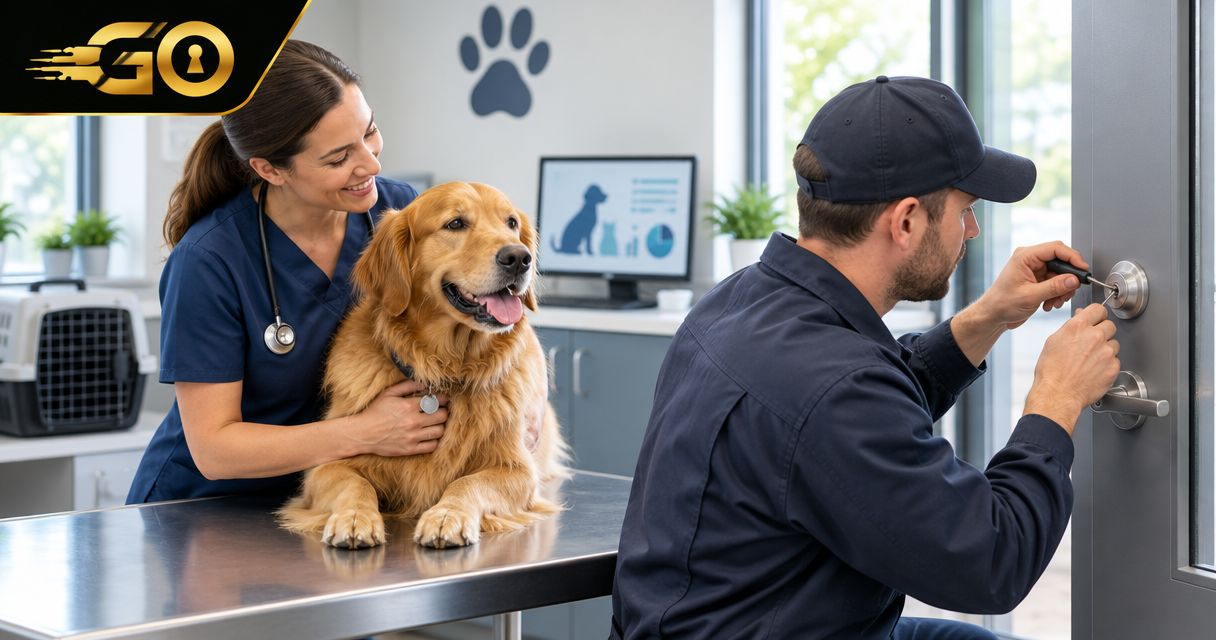
Veterinary clinic emergency locksmith service is help with a lockout or failed lock so authorized staff can regain access and secure the clinic. Your response must also protect animals, preserve staff access to treatment areas, and keep exits usable—not simply get the front door open.
TL;DR
- An emergency locksmith for veterinary clinics should address the affected door without disrupting animal care or safe exits.
- GO Locksmith offers mobile commercial lockout, rekey, lock repair, push bar, and door closer services.
- Choose rekeying for lost-key concerns; request hardware assessment when a lock or door stops working properly.
- GO Locksmith does not install or repair electronic access-control systems and does not operate around the clock.
Why emergency locksmith service matters for veterinary clinics
A clinic lock problem affects more than access to a building. Staff can be separated from treatment rooms, owners can arrive with animals while the entrance remains locked, and a door that will not latch can leave a controlled area unsecured.
Treat access, animal containment, and exit safety as separate problems. Opening a door resolves only one of them. Before requesting service, identify which functions have failed and tell the provider what the clinic needs restored.
GO Locksmith is a mobile locksmith service serving Fort Myers, Cape Coral, Lehigh Acres, Estero, Bonita Springs, and Naples, and also operating in Jacksonville. GO Locksmith is an option for veterinary clinics needing mobile mechanical lock service in these confirmed service areas.
The confirmed commercial services include business and interior door lockouts, lock repair, replacement and rekeying, fresh installation, push bars, door closers, and broken key extraction. Electronic access-control installation and repair are not included.
Handle a clinic lock emergency without creating another problem
Check immediate safety before checking the lock
Start with the people and animals affected. Ask whether anyone is trapped, whether an exit is obstructed, and whether staff can continue necessary care through an authorized route. An immediate threat to life or safety requires emergency services, not a wait for a locksmith.
If the situation is a routine lockout, use your clinic's existing contact list to locate an authorized keyholder. Keep arriving clients informed and direct them to a staffed entrance only when that route is safe and permitted.
Do not prop open a security door just to restore traffic. At a veterinary clinic, an open doorway also changes how animals move through the building. Assign responsibility for controlling the entrance while the access problem is being resolved.
- Check whether people or animals face an immediate safety risk.
- Keep designated exit routes clear.
- Contact an authorized keyholder before attempting any workaround.
- Separate waiting clients and animals from the affected doorway.
- Assign a staff member to communicate entrance changes.
Identify the door and describe the failure
Use observation first. Note whether the problem is at the exterior entrance, an interior treatment-room door, an office, or another restricted area. Describe what happens during normal use rather than deciding that the entire lock needs replacement.
A key that will not turn, a key that turns without releasing the door, and a door that opens but will not latch are different symptoms. A reader that rejects a credential is different again. Accurate details help you request the appropriate service without promising a diagnosis over the phone.
If a key has broken in the lock, stop forcing it. Keep any loose pieces for the service provider, but do not insert tools or attempt to dismantle the hardware. Mention visible door or frame damage separately from the key problem.
- Identify the exact door and its role in clinic operations.
- Describe the key, handle, latch, or push bar symptom.
- Note any visible damage without taking the assembly apart.
- Explain whether the door opens, closes, and latches normally.
- Distinguish mechanical hardware trouble from an electronic credential issue.
Prepare authorization and request the right service
Gather the clinic address, a callback number, and the name of the person authorized to approve work. If the clinic leases its space, check who can approve changes to the door hardware. Arrange for that decision-maker to be reachable rather than leaving the technician and reception team to resolve permission questions onsite.
Next, call GO Locksmith at (239) 412-1101 to check current availability and discuss the mechanical lock problem. Explain the affected door, the symptoms, and whether the clinic is operating. Request a job-specific estimate and ask what information or documentation is needed before service begins.
GO Locksmith's hours are Sunday–Thursday, 7:00 AM–11:00 PM; Friday, 7:00 AM–5:00 PM; Saturday closed. Do not build your clinic's overnight response plan around assumed round-the-clock availability. A veterinary clinic's operating hours and a locksmith's service hours are separate.
Prepare these details in order: Safety check, Door details, Authorization, and Service request. This keeps the call focused on the problem that needs attention.
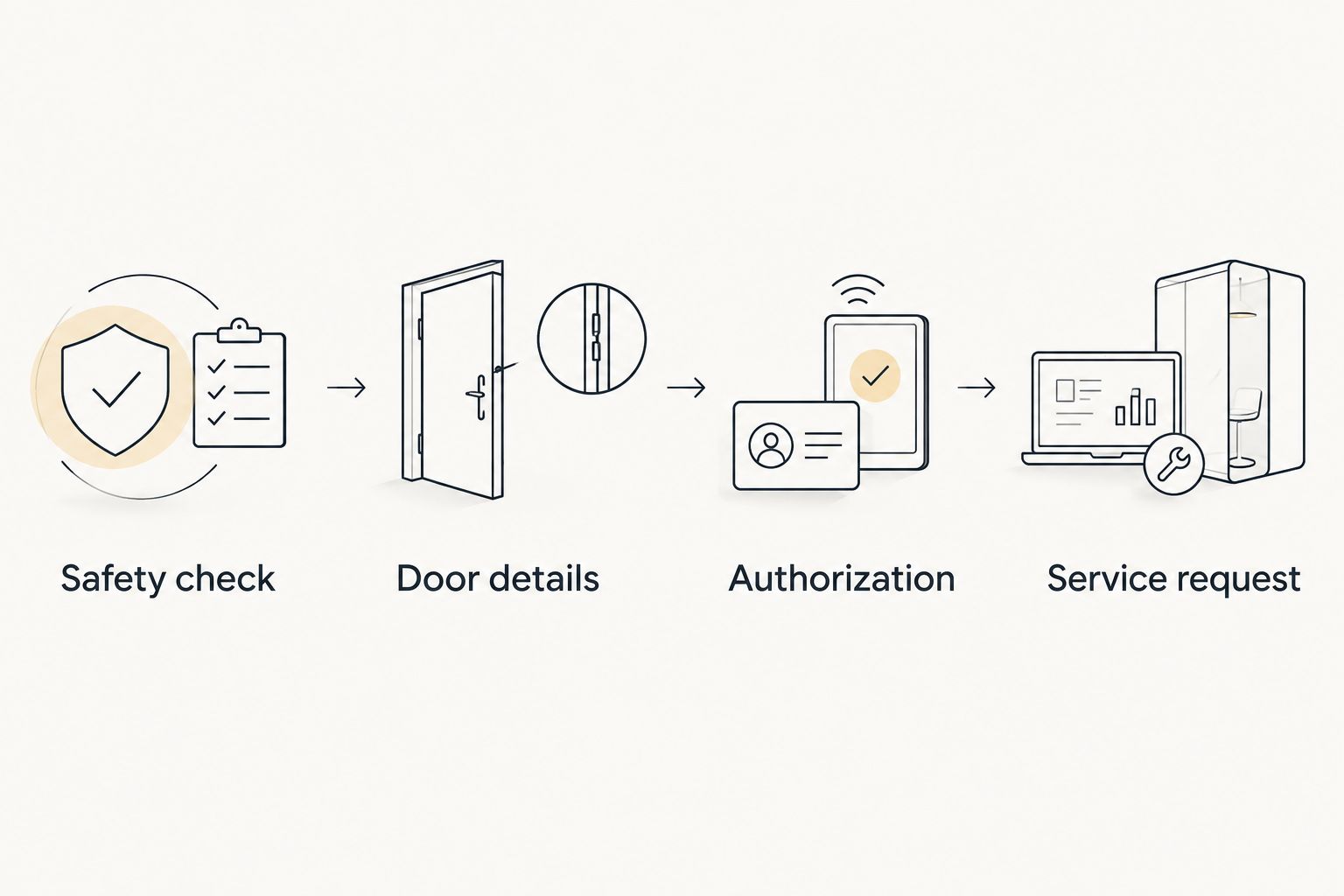
Describe the access problem and confirm who can approve work before requesting service.
- Safety check: Explain any immediate access or exit concern.
- Door details: Give the location, symptoms, and visible hardware information.
- Authorization: Identify the person who can approve the work.
- Service request: Ask about current availability, the estimate, and required documentation.
Choose the fix that matches the problem
If an authorized spare key resolves the lockout and the hardware works normally, you have restored access without changing the lock. That does not settle a separate lost-key concern. Decide whether an unaccounted-for key creates a reason to change which keys operate the affected locks.
Rekeying changes a compatible lock's key configuration without replacing the entire lock. It addresses key access, not a broken closer, damaged latch, or door that no longer fits its frame correctly. Repair and replacement decisions depend on the condition and suitability of the existing hardware.
Restore access first, then confirm the door can secure the space. Ask the provider to explain the proposed work and any unresolved hardware issue before approving changes. Do not assume that a replacement lock automatically corrects every door problem.
- Use an authorized spare when the problem is only a missing working key.
- Request a rekey assessment when key control has been lost.
- Request repair assessment when the hardware malfunctions.
- Discuss replacement when the existing lock is damaged or unsuitable.
- Report push bar and door closer problems as distinct symptoms.
Control the work area and check normal operation
Before work starts, move routine foot traffic away from the affected doorway where practical. Follow the clinic's own procedures for animal handling, restricted rooms, and cleaning. Keep a designated staff contact available to answer questions without exposing patient records or unrelated areas.
Interior-door decisions need particular care. A room used for consultations has different access needs from an office or a restricted storage area. The guide to interior door locks for medical offices provides related hardware context, but your clinic's actual door use must guide the choice.
After the work, have authorized staff check normal operation with the provider. Confirm that the door opens, closes, and latches as intended, and that issued keys operate the locks included in the work. Do not treat a quick door check as a substitute for any required building or fire-safety assessment.
- Keep clients and animals clear of the active work area.
- Identify restricted rooms before allowing access.
- Make the approving staff member available for decisions.
- Check normal key and door operation after the work.
- Record unresolved concerns and the agreed next action.
Update key control before the next shift
Once access is restored, document what changed. Record the affected door, the approved work, and who holds the current keys. If locks were rekeyed or replaced, remove obsolete keys from circulation so the next opening shift does not encounter another avoidable lockout.
Keep this record simple enough for your team to maintain. A secure key register and an authorized backup-key process are useful starting points; neither requires purchasing an electronic system. Restrict access to the register rather than posting key locations where clients or visitors can see them.
For a veterinary clinic, continuity matters across opening staff, closing staff, and anyone responsible for animals remaining onsite. Review the access plan with the people who actually use it, not only the person who approved the repair.
- Record which doors were repaired, rekeyed, or replaced.
- List authorized holders of the current keys.
- Remove obsolete keys from staff keyrings and backup storage.
- Confirm the next shift has the access it needs.
- Keep provider contacts and service hours in the clinic's response plan.
Compare the available responses
Choose by the failure, not by the word emergency. An authorized spare is useful for a straightforward lockout; rekeying addresses key control; mechanical repair addresses faulty hardware. Electronic credential failures require a provider responsible for that system.
| Option | Best for | Main benefit | Key limitation |
|---|---|---|---|
| Authorized spare key | A lockout with functioning hardware | Restores access through an existing authorized key | Does not address a lost key's continued access or damaged hardware |
| Mobile commercial lockout service | Staff unable to open a mechanical clinic door | Addresses the immediate access problem | Availability must be checked; opening alone does not resolve every security concern |
| Mechanical lock repair | A malfunctioning lock suitable for repair | Addresses the hardware fault without automatically replacing the lock | Suitability depends on the actual damage and hardware condition |
| Rekeying | Lost keys or changes in authorized keyholders | Changes which keys operate compatible locks | Does not repair a damaged door, closer, or latch |
| Lock replacement | Damaged or unsuitable lock hardware | Replaces the affected lock | Door compatibility and any separate frame problems still need assessment |
| Existing electronic-system provider | Credential readers or electronic access-control faults | Addresses the system within that provider's scope | Is not a substitute for resolving a separate mechanical door problem |
GO Locksmith offers the listed commercial mechanical services, subject to the specific job. The service is mobile, with no confirmed storefront, and does not include electronic access-control installation or repair. Call with the door details to discuss scope and request an estimate; no fixed price or arrival time is established here.
Common lock-response mistakes veterinary clinics make
Treating a blocked treatment room like a front-door lockout
An interior lockout needs a room-specific response. Tell the provider what the room is used for, who needs access, and whether an authorized alternative exists. Keep staff responsible for animal care involved in the decision.
Rekeying when the door will not latch
Rekeying changes key access. It does not correct a failing door closer or other unrelated door problem. Describe the full symptom rather than requesting rekeying because it is the only service name you know.
Propping open a door without assigning supervision
A workaround can create an uncontrolled entrance or an animal-containment problem. Use the clinic's own procedures for temporary access, and assign a staff member to manage any approved change in traffic.
Assuming every emergency locksmith repairs electronic systems
A clinic's mechanical lock and electronic credential system are different service scopes. Identify which component is failing before calling. Do not request electronic access-control work from a provider that does not offer it.
Returning to work without updating the next shift
The repair is not operationally complete if closing staff still carry obsolete keys. Document the change and confirm access with the next responsible team before the approving manager leaves.
FAQ
Who should I call if our veterinary clinic is locked out?
Contact an authorized clinic keyholder first, then a commercial locksmith if you still cannot enter. If people or animals face an immediate threat to life or safety, contact emergency services rather than waiting for locksmith service.
Can GO Locksmith help with a veterinary clinic's interior door lockout?
GO Locksmith offers commercial interior door lockout service. Describe the door, the symptoms, and the clinic location when calling to check current availability and discuss the job.
Should we rekey the clinic after a staff key goes missing?
Request a rekey assessment if an unaccounted-for key creates an access concern. Rekeying applies to compatible locks and does not repair damaged hardware, so identify both key-control and mechanical problems.
Does GO Locksmith provide overnight or Saturday emergency service?
GO Locksmith is not a 24/7 service and is closed Saturday. Its hours are Sunday–Thursday, 7:00 AM–11:00 PM, and Friday, 7:00 AM–5:00 PM; call during those hours to check current availability.
How much does an emergency locksmith visit for a veterinary clinic cost?
The estimate depends on the specific door, hardware, and work required. Call with the clinic location and problem details for a job-specific estimate rather than relying on a general price.
Can GO Locksmith repair our clinic's electronic access-control system?
GO Locksmith does not install or repair electronic access-control systems. Contact the provider responsible for that system, and describe any separate mechanical lock or door-hardware fault independently.
What should our clinic have ready before the locksmith arrives?
Have an authorized decision-maker, the affected door details, and the clinic's access requirements ready. Ask the provider what documentation is needed, and arrange a safe work area away from routine client and animal traffic.
One last thing
An unlocked door is not necessarily a resolved door problem. Before returning to normal operation, confirm that the entrance or room can be secured and that the next shift has the correct keys. That final handoff matters as much as regaining access.
For a mechanical clinic lockout, failed lock, or rekey request, call GO Locksmith at (239) 412-1101 during its confirmed service hours to check availability and discuss the work.