
Blog ·
Can a locksmith unlock a locked gate or fence door?
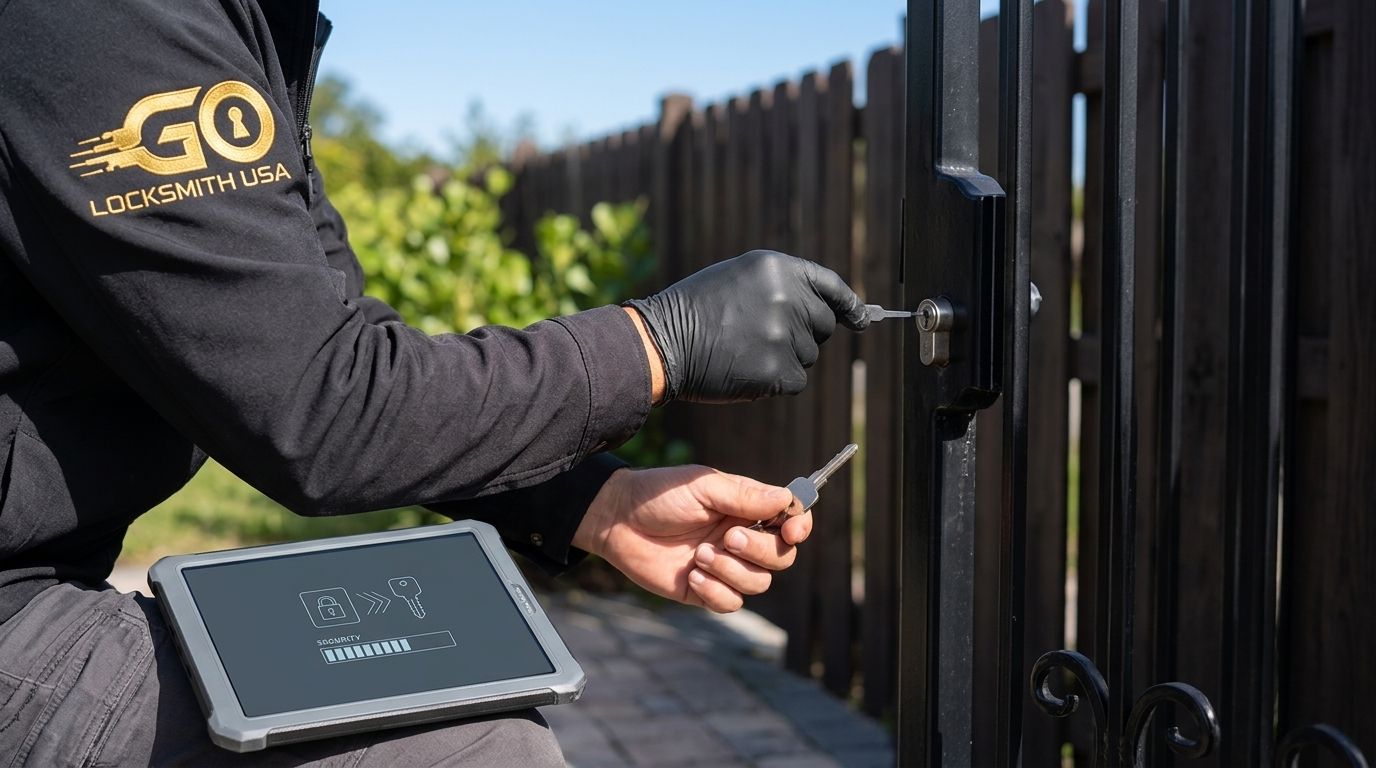
Yes, a locksmith can open many locked gates and fence doors fitted with mechanical locks, provided you have authorization and the hardware is serviceable. The right solution depends on whether the problem is the lock, the gate’s alignment, or a powered opening system. Opening the lock does not fix a sagging gate or a failed gate operator.
TL;DR
- Can a locksmith unlock a locked gate or fence door? Yes, many mechanical gate locks are serviceable.
- GO Locksmith offers mechanical lock services; call to confirm whether your particular gate hardware is covered.
- A turning key with a stuck gate can indicate alignment trouble rather than a locked cylinder.
- Powered gate faults and electronic access-control problems require a different service assessment.
Can a locksmith unlock a locked gate or fence door?
A locksmith is an appropriate first call when a mechanical lock is preventing authorized entry. Examples include a missing padlock key, a broken key in a gate cylinder, or a keyed latch that no longer operates normally. The locksmith needs to identify the hardware before confirming a method or outcome.
GO Locksmith provides mobile residential and commercial lock repair, replacement, rekeying, and broken key extraction. Its locksmith services do not establish compatibility with every gate lock; describe yours before requesting a visit.
Use the symptoms to explain what is happening, not to diagnose the fault yourself:
| What you observe | What needs assessment | Important limitation |
|---|---|---|
| A padlock is locked and the key is missing | Padlock type, condition, and access to it | Opening without sacrificing the padlock is not guaranteed |
| A key will not turn in a gate lock | Key condition and internal lock operation | Forcing the key can break it |
| The key turns but the gate stays shut | Latch movement and gate alignment | Unlocking alone does not correct structural binding |
| A key has broken inside the cylinder | Broken fragment and cylinder condition | Extraction does not establish that the lock is undamaged |
| A powered gate will not respond | Operator, power supply, and access-control equipment | A mechanical locksmith visit is not automatically the right service |
Why identifying the fault matters
A gate is both a moving structure and a security barrier. Its hinges, latch, strike, lock, and any powered equipment have different jobs. A problem in one part can look like a lockout even when the key and cylinder still work.
That distinction affects whom you call and what work you authorize. Paying to open a lock will not solve a gate that drags against the ground, and replacing a cylinder will not repair an electric motor.
Before arranging service, separate the complaint into three plain descriptions: the key does not work, the latch does not release, or the gate does not move. You do not need technical vocabulary to give a useful description.
A padlocked gate: identify the lock before discussing removal
A padlock on a chain or gate hasp presents a different job from a lock built into the gate. Tell the locksmith whether the padlock is exposed, enclosed by a protective cover, or difficult to reach. A clear photograph helps show the arrangement without requiring you to manipulate it.
Do not assume that every padlock can be opened intact. Its construction, condition, and accessibility affect the available approach. Ask whether the proposed work preserves the lock and what happens if removal becomes necessary.
Also distinguish ownership of the gate from ownership of the padlock. A tenant, contractor, or employee should obtain permission from the person responsible for the lock before authorizing its removal.
A keyed gate latch: describe what the key does
For a lock built into the gate, explain whether the key enters fully, stops partway, turns normally, or refuses to move. Mention whether you are using the usual key or a spare that has not been tried before. These observations help separate a key problem from a latch or cylinder problem.
Stop if the key requires force. Repeatedly twisting a reluctant key can turn an access problem into a broken-key problem. Do not insert improvised tools into the keyway or apply a product without checking that it is suitable for that lock.
If part of a key has already broken off, keep the remaining piece and tell the locksmith. Do not push another key into the opening; it can move the fragment farther inside.
A gate that stays shut after unlocking: check the symptom, not the force
A gate can remain stuck even when its lock is unlocked. A latch under pressure, a shifted strike, or a sagging gate can prevent normal movement. These are different from losing the key.
From a safe position, look for visible rubbing, a gate edge resting against the ground, or a latch that no longer lines up with its receiving hardware. Observe only; do not climb the gate, put your fingers between moving parts, or force a heavy panel.
Describe the problem using these categories:
- Mechanical lock: The key or locking mechanism does not operate normally.
- Gate alignment: The gate rubs, sags, or places pressure on the latch.
- Powered operator: A motorized gate does not respond or move as expected.
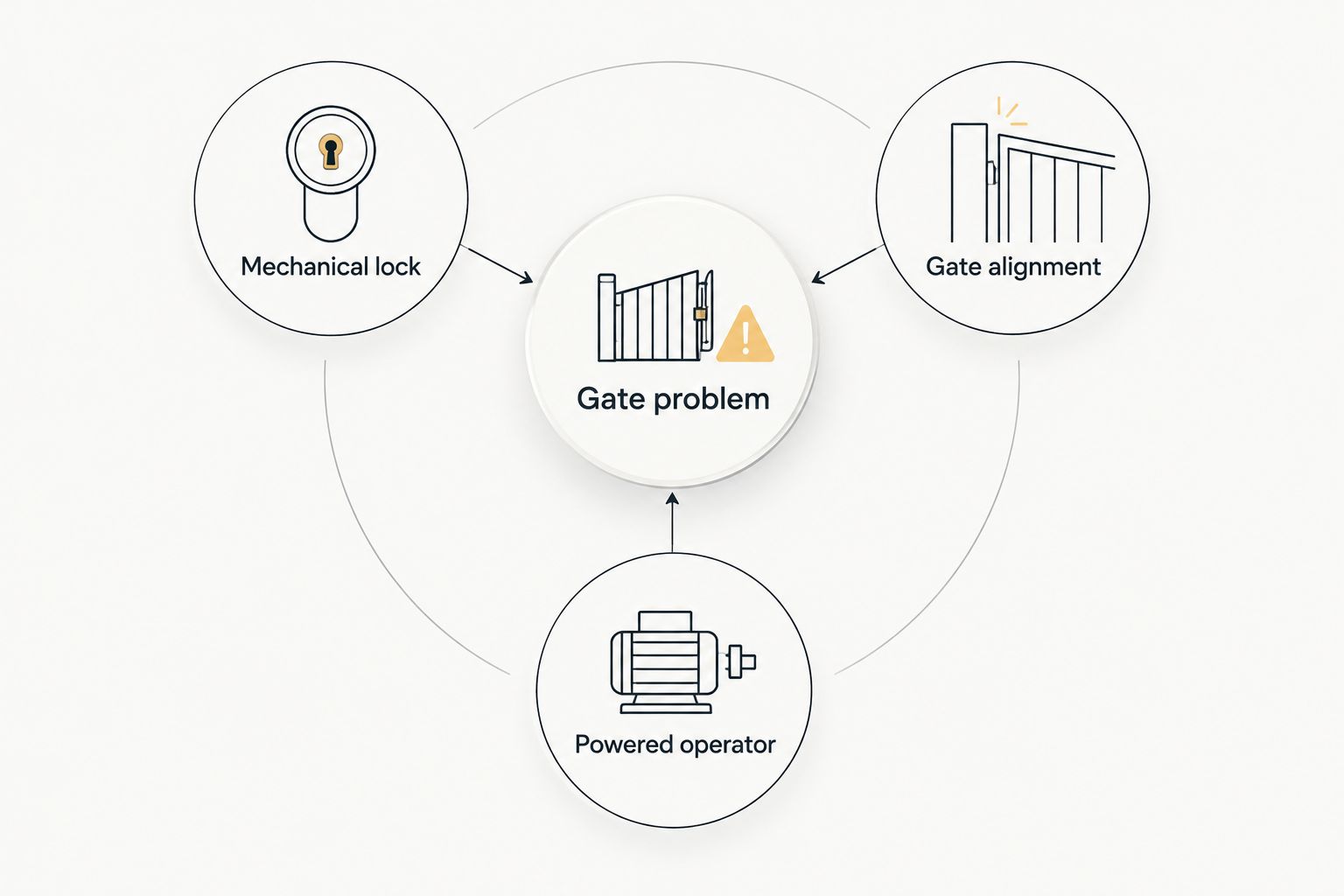
Describe the failing part before arranging a service visit.
A locksmith can assess the lock-related portion of the problem, but fence, hinge, post, or operator repairs require confirmation from the appropriate provider. Do not assume one appointment includes all of those trades.
Why the opening method and scope vary
There is no universal gate-opening procedure. The assessment depends on the actual hardware and the cause of the lockout.
- Lock construction: A padlock, keyed latch, and mortise-style gate lock have different mechanisms and access points.
- Hardware condition: Corrosion, wear, or previous damage affects whether existing parts remain usable.
- Gate alignment: Pressure against a bolt or latch changes the problem from a straightforward missing-key situation.
- Physical access: A protective enclosure or restricted working position limits access to the lock.
- Electrical equipment: An operator, electric lock, or access-control device introduces components beyond an ordinary mechanical lock.
- Authorization: Shared, rented, or managed property requires permission from the responsible person before changes are approved.
Agree on the scope before work starts. Ask whether the job covers opening only, diagnosis, repair, or replacement. If the proposed approach changes after inspection, request an explanation before authorizing additional work.
What should you tell the locksmith before a visit?
Give the provider enough information to decide whether the job fits its services. A precise description is more useful than saying only that the gate is “jammed.”
- Describe the gate. Say whether it is a pedestrian gate, a driveway gate, or a fence door, and whether it is manually operated or powered.
- Describe the lock. Identify a padlock, a built-in keyed latch, or visible electronic equipment. Do not guess the model if you cannot read it.
- Explain the failure. State whether the key is missing, broken, stuck, or turning without releasing the latch.
- Explain your authority. Tell the provider whether you own the property or are acting for the owner or manager. Ask what documentation to prepare.
- Explain access constraints. Mention a shared entrance, a pet in the yard, restricted parking, or another issue that affects safe access.
Ask how to send photographs if the provider needs them. Useful views show the whole gate and the lock area from a position you can reach safely. Avoid including access codes or unrelated personal information.
What if the gate has a keypad, remote, or exit button?
A keypad or remote does not, by itself, tell you which component has failed. The credential reader, release device, lock, controller, and gate operator can perform separate functions. Report which action fails rather than asking for a mechanical lockout service by default.
For example, understanding how push-to-exit buttons work helps distinguish an exit-release input from the mechanical latch it ultimately releases. A release button that does not produce the expected result does not prove that the key cylinder is faulty.
Do not open control cabinets, disconnect wiring, or attempt to bypass safety devices. Contact the property manager or the provider responsible for the powered gate and its access-control equipment.
GO Locksmith does not install or repair electronic access-control systems. If the entrance combines mechanical and electronic hardware, explain both parts when calling so the service scope is clear.
Can a locksmith open the gate without damaging it?
A locksmith can assess whether a nondestructive opening is practical, but damage-free entry is not guaranteed. The answer depends on the lock’s design, condition, and accessibility, as well as whether the gate is binding.
Ask what the proposed method risks damaging: the lock, the hasp, the latch, or the gate itself. Do not approve a vague promise to “get it open” without understanding whether you will still be able to secure it afterward.
Do I need to replace the gate lock after it is opened?
Opening a gate does not automatically require replacing its lock. A usable lock with a lost key presents a different decision from hardware that is worn, broken, or damaged during entry.
Ask whether repair, rekeying, or replacement fits the actual hardware. Rekeying changes which key operates a compatible lock; it does not repair a sagging gate or restore damaged components.
Who can authorize work on a shared fence gate?
The property owner, manager, or another authorized representative should approve work on a shared gate. Having permission to pass through an entrance does not automatically give you authority to remove or replace its lock.
For a rental property, condominium, business, or shared access route, contact the responsible manager first. Confirm who will authorize the work and who needs access after the lock is secured again.
Before you close the gate again
Restoring entry is only part of the job. Before relying on the gate, ask the service provider to explain what caused the problem and what remains unresolved.
Check normal operation from a safe position while you still have another way out. Confirm that the key operates, the latch releases, and the gate closes as intended. If the gate protects a pool area or forms part of an exit route, do not improvise changes to its latching or release arrangement.
GO Locksmith serves Fort Myers, Cape Coral, Lehigh Acres, Estero, Bonita Springs, and Naples. Call (239) 412-1101 to describe your gate hardware, confirm whether the job is covered, and request a job-specific estimate. Hours are Sunday–Thursday, 7:00 AM–11:00 PM, and Friday, 7:00 AM–5:00 PM; Saturday is closed.
FAQ
Can a locksmith unlock my fence gate if I lost the key?
A locksmith can assess many mechanically locked fence gates when the key is missing. Identify the lock type and confirm that you have authority to request entry before arranging service.
Can a locksmith open a rusty gate padlock without cutting it?
Opening a rusty padlock without cutting it depends on its construction and condition. Ask whether preserving the padlock is practical and what removal would involve if it is not.
Why does my gate stay locked when the key turns?
A turning key with a gate that stays shut can indicate a latch problem or pressure caused by misalignment. Stop forcing the key and describe whether the latch moves or the gate visibly rubs.
Should I call a locksmith or a fence repair company?
Call a locksmith about the mechanical lock and a fence repair provider about a sagging panel, damaged post, or structural alignment problem. Describe both symptoms if you cannot tell which part is preventing entry.
Can a locksmith fix an automatic gate that will not open?
An automatic gate needs an assessment of the component that failed; a mechanical locksmith is not automatically the right provider. Operator, power, or electronic access-control faults belong with a provider that confirms those services.
What should I have ready when I call about a locked gate?
Have the property location, a description of the lock, the exact symptom, and information about your authority to request service. Ask whether photographs or ownership documentation are needed.
One last thing
Do not relock a gate that still binds just because it opened once. If the underlying fault remains, you have restored access without resolving the next lockout. Ask what must be corrected before you rely on the entrance again.