
Blog ·
Can a locksmith service a safe that won't lock properly?
Yes—a locksmith who services safes can assess a safe that won't lock properly and determine whether the problem involves the lock, the door, or the locking mechanism. The repair depends on the safe's make, model, condition, and parts support; not every locksmith handles every safe. If the door is already open, avoid closing it to test a suspected fault, because you could turn a locking problem into a lockout.
TL;DR
- Can a locksmith service a safe that won't lock properly? Yes, but model-specific assessment comes first.
- GO Locksmith lists safe service; call to confirm whether your particular safe and fault can be handled.
- A keypad response or turning handle does not, by itself, prove that a safe is securely locked.
- Avoid forcing the handle, removing covers, or closing an open safe with a suspected locking fault.
Can a locksmith service a safe that won't lock properly?
Yes, but the right service starts with identifying exactly what fails—not assuming the safe needs a new lock. A door that will not close presents a different problem from a door that closes but will not stay locked. An electronic lock that does not respond needs a different assessment from a handle that feels unusually stiff.
GO Locksmith is a mobile locksmith service with safe service among its confirmed offerings. Before requesting a visit, describe the fault and ask whether your safe's make, model, and locking system are within the service scope.
Use this comparison to describe what you are seeing. These are observations to report, not diagnoses or instructions to dismantle the safe.
| What you observe | What needs assessment | What to do now |
|---|---|---|
| The door will not sit fully closed | Contents, visible obstructions, door fit, and locking-bolt position | Stop pushing; check only for obvious loose items in the way |
| The door closes but does not secure | Lock engagement and the mechanism that holds the door shut | Do not treat the safe as secure |
| The handle feels stiff or stops unexpectedly | Resistance in the door or locking mechanism | Stop rather than applying more force |
| The keypad does not respond normally | The model's power requirements and electronic lock operation | Consult the manufacturer's instructions before changing anything |
| The lock works intermittently | The conditions under which the fault occurs | Record the symptoms and arrange assessment before relying on it |
A symptom can have more than one cause. For example, resistance at the handle does not identify which internal component is responsible, and a working keypad does not establish that the door is locking correctly.
Why this matters: a closed safe is not necessarily a locked safe
A safe door can look closed without being properly secured. If you cannot confirm normal locking operation using the manufacturer's instructions, do not rely on the safe to protect its contents.
The opposite risk matters too: closing a faulty safe can leave you unable to reopen it. If the safe is open, preserve access rather than repeatedly testing whether the fault has disappeared. Keep children and unauthorized people away from an open safe, and do not leave sensitive contents exposed.
Avoid improvised substitutes such as wedging the door shut or treating a stiff handle as evidence of security. The goal is normal, verified operation—not simply making the door stay in place.
If the safe is open, keep the problem from becoming a lockout
An open safe gives you access to its contents and identifying information. Do not sacrifice that access just to demonstrate the problem over the phone.
Follow this preparation sequence before requesting help:
- Preserve access. Avoid closing the door while the locking fault remains unresolved. Keep your hands away from hinges and moving locking parts.
- Record symptoms. Note what happened during the last normal attempt: whether the door closed, whether the handle moved, and whether the lock gave an unusual response. Do not repeat a failing action just to gather more detail.
- Identify the safe. Look for accessible manufacturer and model information without removing panels or moving a heavy safe. Keep serial-number photographs private.
- Check instructions. Read the manufacturer's guidance for your exact model. Only carry out owner-level checks that the instructions expressly describe.
- Request assessment. Explain that the door is open and ask what to leave untouched before the appointment.
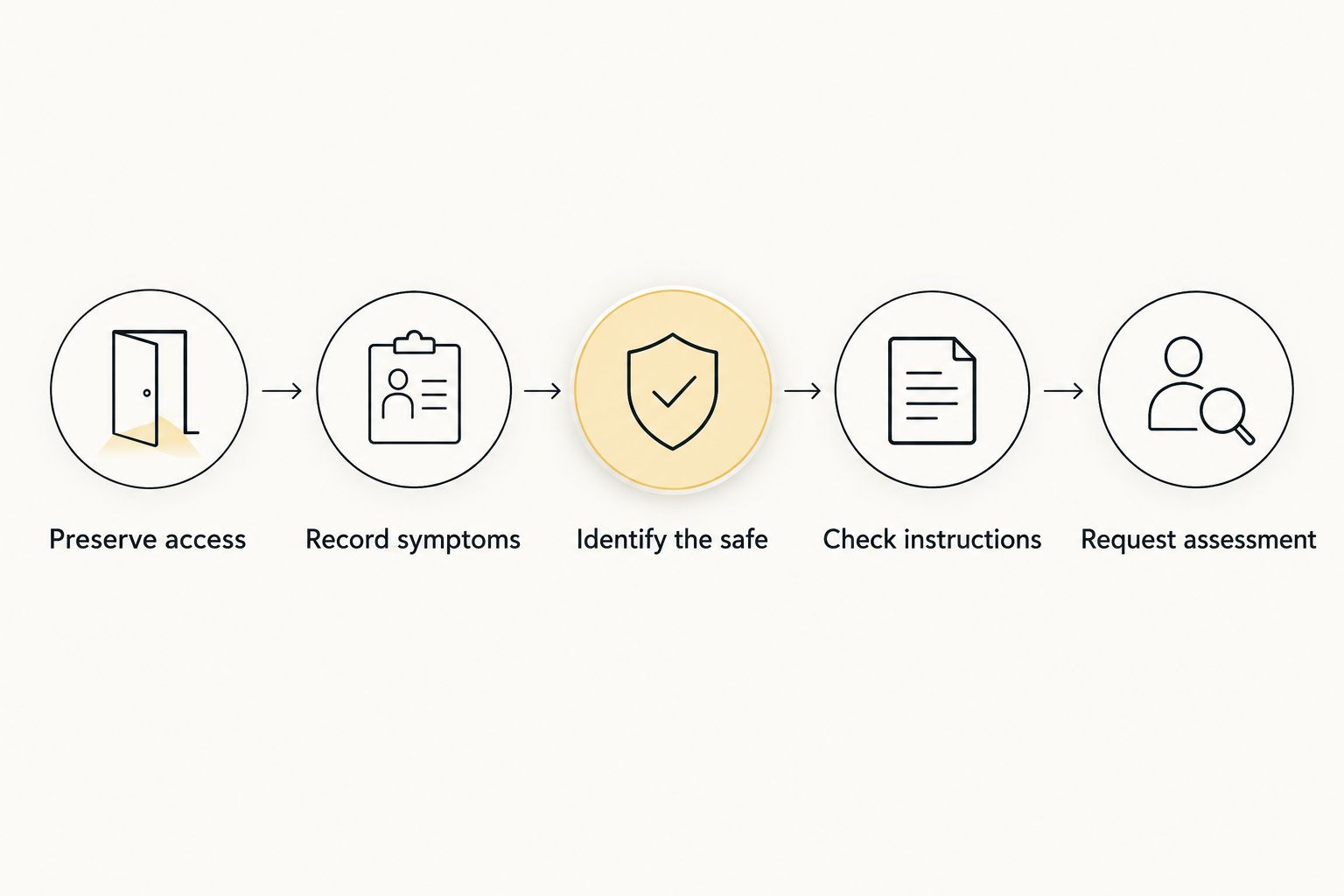
Preserve access and record the fault before attempting further operation.
If you remove valuables, use another secure storage arrangement appropriate to those items. An open safe with a known fault is not secure storage, even when it is inside a locked room.
If the safe is closed, describe the fault without forcing it
A closed safe that will not lock and a locked safe that will not open are different service requests. Tell the locksmith which situation you have, including whether you can currently access the contents.
Do not pull hard on the handle, pry at the door, or repeatedly cycle the lock to see what happens. Stop when normal operation produces unusual resistance or an unfamiliar response.
Record any message or indicator exactly as it appears. Avoid interpreting a beep, light, or clicking sound as proof that the safe is locked; its meaning depends on the particular lock and the manufacturer's instructions.
If access is already lost, explain that when you call. Opening the safe and correcting the original locking fault are separate outcomes, so ask what the proposed work is intended to accomplish.
Why a safe's locking problem varies
The same description—“it won't lock”—can refer to several different faults. These details determine what information a service provider needs before advising you:
- Make and model. Safe construction and service instructions differ. A repair approach for one model is not automatically suitable for another.
- Lock type. A key-operated lock, mechanical combination lock, and electronic lock do not use the same operating instructions. Identify yours without taking it apart.
- Door position. Whether the door is open, closed, or partly closed affects access to the fault and the risk of a lockout.
- Visible interference. Papers, containers, or other contents can obstruct the closing path. Check for obvious interference without reaching into mechanisms.
- Fault history. A sudden failure, intermittent operation, or a problem that followed moving the safe gives the service provider different information.
- Parts and manufacturer support. Repair suitability depends on the actual safe and the components it needs. Do not assume a generic replacement will fit.
These factors explain why a phone description can start the assessment but cannot establish the repair by itself. Ask for a model-specific assessment before authorizing replacement parts or other work.
What can you safely check yourself?
Start with what you can observe without tools. Look for an item visibly blocking the doorway, note whether the door appears out of position, and read any accessible identifying label.
For a battery-powered lock, follow the manufacturer's instructions for the specified battery type and replacement procedure. Do not assume that every keypad uses the same battery arrangement or that replacing a battery will resolve a mechanical locking fault.
Leave internal covers, hinges, wiring, and locking components alone. Do not spray a general-purpose lubricant into the lock or mechanism unless the manufacturer specifically directs you to use that product there.
Also avoid resetting the combination as a general troubleshooting step. A change to the access code does not establish that the door and locking mechanism are working correctly, and an incorrect procedure can complicate access.
What should you tell the locksmith before a visit?
A useful call describes the safe's present condition rather than naming a repair you think it needs. “The door closes, but it opens again after the normal locking sequence” is more informative than “the lock is broken.”
Have these details ready where accessible:
- Manufacturer and model information.
- Whether the door is open or closed.
- Whether you know the current combination or have the operating key.
- The exact symptom and when it first appeared.
- Any recent move, impact, battery change, or attempted repair.
- Your location and any access restrictions around the safe.
Ask what ownership or authorization documentation the provider requires. If the safe belongs to a business, confirm who can approve the work before arranging service.
Do not share a combination in a public message, review, or photograph. Ask the provider how to share any access information needed for the appointment.
Should you repair the safe or replace it?
Choose only after the fault and repair scope are understood. Neither a keypad symptom nor a stiff handle, by itself, establishes that the entire safe needs replacement.
| Option | Best for | Benefit | Limitation |
|---|---|---|---|
| Repair assessment | Owners who need the cause identified before deciding | Establishes whether the existing safe has a suitable repair path | Does not guarantee that repair or compatible parts are possible |
| Manufacturer guidance | Owners with model information or an existing warranty question | Provides instructions specific to the safe | Does not replace hands-on assessment of a physical fault |
| Replacement assessment | Owners facing an unsuitable repair path or significant damage | Allows consideration of a different safe | Requires a separate decision about storage needs, placement, and installation |
If warranty coverage could apply, check its terms before approving alterations. Do not assume that replacing a lock or modifying a safe preserves any existing warranty or certification.
After service, ask the provider to explain the fault found, the work completed, and the correct way to verify normal operation. Do not put valuables back solely because the door now closes.
How much does servicing a safe that won't lock cost?
Safe-service pricing depends on the particular job. The safe's identity, access condition, fault, and any required parts must be understood before you can compare proposed work meaningfully.
Ask whether the estimate covers assessment, the proposed repair, parts, and confirmation of normal operation. Also ask how additional work will be approved if the initial assessment identifies a different problem.
GO Locksmith lists safe service for customers seeking mobile locksmith assistance; confirm your model and job scope before booking. Call (239) 412-1101 for a job-specific estimate rather than relying on a general safe-repair figure.
FAQ
Can a locksmith fix a safe that closes but won't stay locked?
A locksmith who services safes can assess why the door is not securing. Whether repair is suitable depends on the safe, the fault, and compatible parts; do not rely on the safe until normal locking operation is confirmed.
Should I close my safe before the locksmith arrives?
Avoid closing an already-open safe with a suspected locking fault. Tell the service provider that it is open and ask what to leave untouched before the appointment.
Does a working keypad mean my safe is locked?
A working keypad does not, by itself, prove that the safe is locked. Follow the manufacturer's instructions for confirming the complete locking sequence on your model.
Will changing the batteries fix a safe that won't lock?
Changing batteries is not a general fix for a safe that won't lock. Follow the manufacturer's battery instructions where applicable, but do not assume a power-related check rules out a door or mechanical fault.
Can every locksmith repair every kind of safe?
No—not every locksmith services every safe or locking system. Give the provider the manufacturer, model, door position, and symptoms before arranging a visit.
Can I spray lubricant into a stiff safe lock?
Do not apply lubricant unless the safe or lock manufacturer's instructions specify the product and application. Stop forcing a stiff handle or key and arrange assessment instead.
Does GO Locksmith provide safe service in Southwest Florida?
GO Locksmith lists safe service and serves Fort Myers, Cape Coral, Lehigh Acres, Estero, Bonita Springs, and Naples. Call (239) 412-1101 to confirm whether your particular safe and locking problem can be handled.
One last thing: report the sequence, not just the sound
The most useful detail is often the order of events: the door closes, the handle moves, the lock responds, but the door does not secure. Describe what you observed during normal use without recreating a failing sequence.
To discuss your safe, contact the service team or call (239) 412-1101 with its make, model, and current door position. Hours are Sunday–Thursday, 7:00 AM–11:00 PM; Friday, 7:00 AM–5:00 PM; Saturday closed.