
Blog ·
Best renter-friendly door locks for Florida apartments 2026
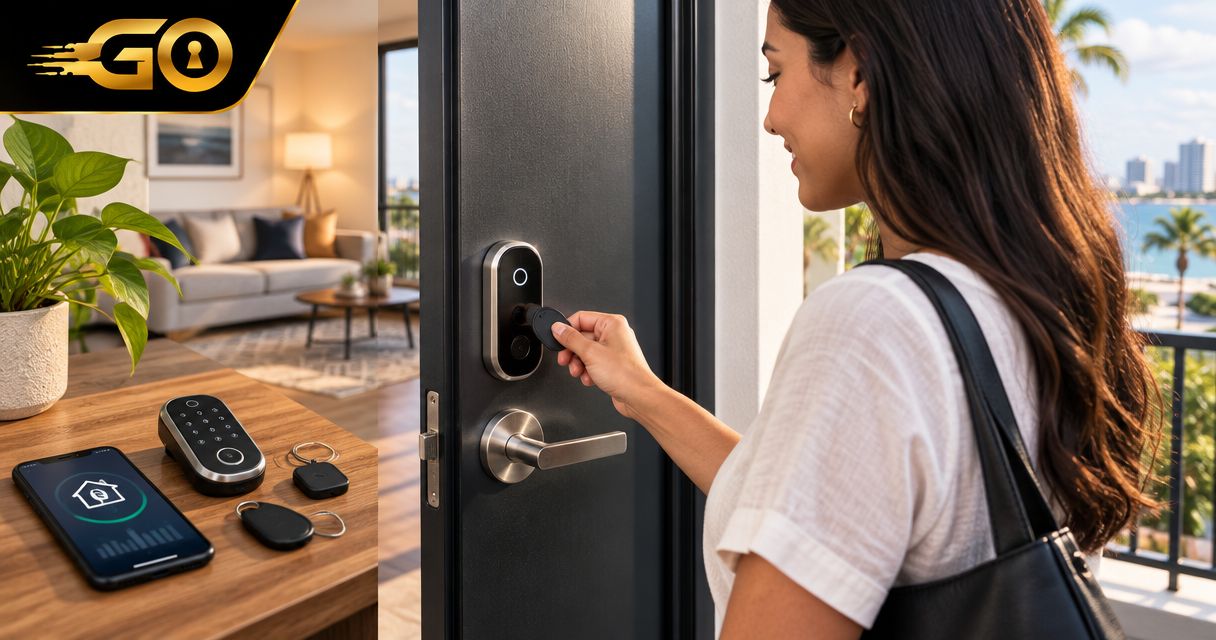
Best for changing who has a key: rekeying your existing lock with landlord approval. Best for damaged hardware: an approved, like-for-like deadbolt replacement. Portable door locks are a conditional option, not a default recommendation for Florida apartment entry doors. The best renter-friendly door locks for Florida apartments preserve safe exit, fit the existing door, and meet your property's written requirements.
TL;DR
- The best renter-friendly door locks for Florida apartments depend on landlord permission, door compatibility, and safe exit.
- Rekeying changes key access while retaining compatible existing hardware; it does not repair a damaged lock.
- Choose an approved replacement deadbolt when existing hardware needs replacement, not simply because a key is missing.
- GO Locksmith provides residential rekey, lock repair, and replacement services; call to discuss your apartment's specific hardware.
Why this matters in a Florida apartment
A renter-friendly lock is not simply one that avoids drilling. Your apartment entrance belongs to a larger door assembly, and a removable device can still interfere with closing, emergency access, or your exit.
Start with the problem you need to solve: an unaccounted-for key, unreliable hardware, or additional privacy while you are inside. Those problems require different answers. GO Locksmith is a mobile service offering residential lock repair, replacement, and rekeying in Fort Myers and the confirmed surrounding Southwest Florida service areas.
This guide ranks approaches rather than specific retail models. A model recommendation is only useful after you know your door's hardware, your lease requirements, and whether management permits the change.
What makes a door lock renter-friendly?
Use these criteria before choosing hardware or booking work:
- Written permission: Get management's approval for the exact change, including any requirement to provide a working key.
- Hardware fit: Match the existing door preparation, lock arrangement, and manufacturer requirements. No-drill advertising does not establish compatibility.
- Clear exit: Check that the proposed arrangement preserves required exit operation and that every occupant can use it.
- Door integrity: Do not alter a labeled fire door, closer, frame, or hurricane-rated assembly without the appropriate approval.
- Exposure suitability: For doors exposed to weather, check the manufacturer's stated environmental suitability rather than choosing by finish alone.
- Move-out plan: Agree on whether the hardware stays, who keeps removed parts, and what restoration management expects.
Permission, fit, and exit operation are separate checks. Passing one does not settle the others: a lock can fit the holes but still conflict with the building's requirements.
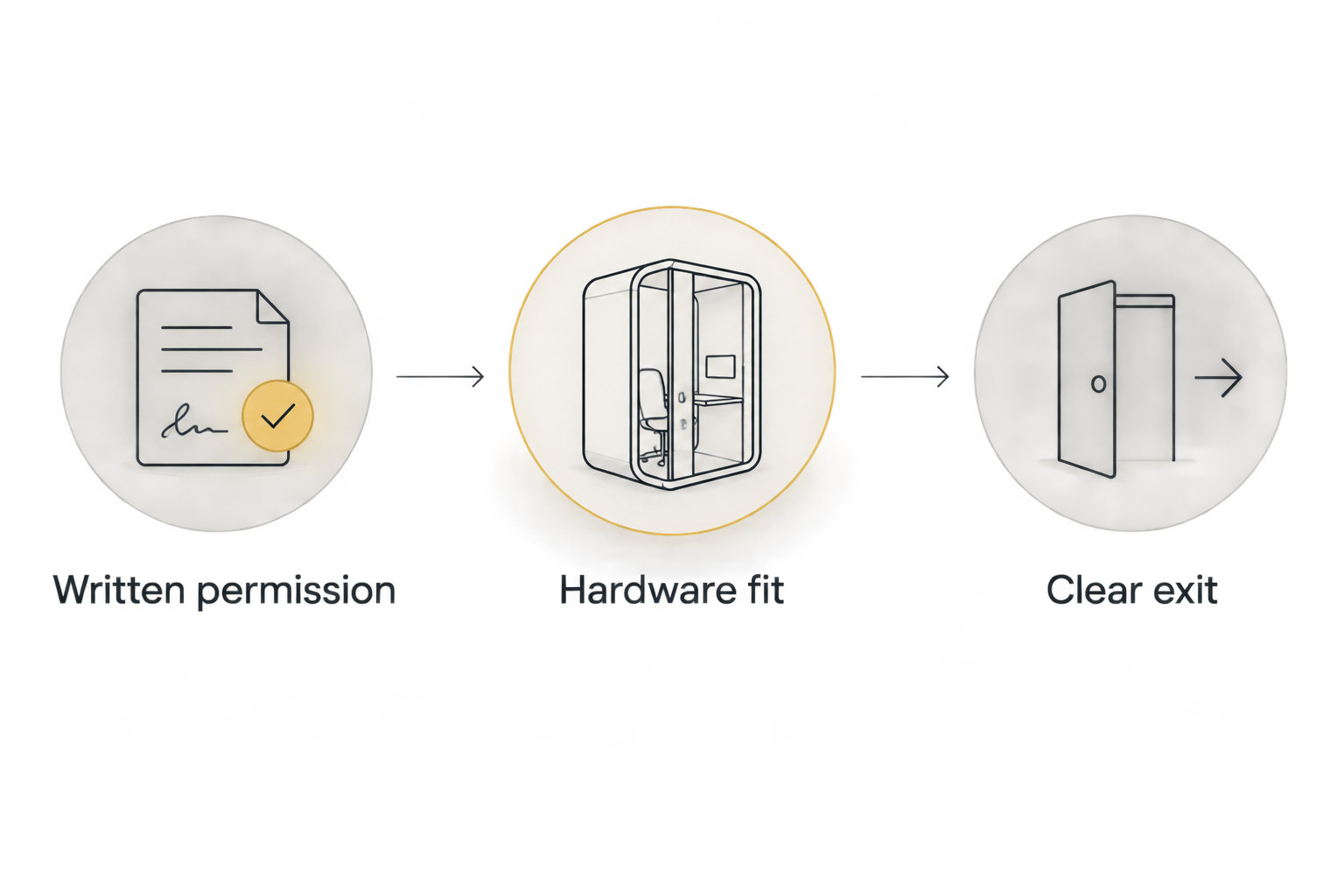
A lock that fits still needs management approval and a safe exit arrangement.
Renter-friendly lock options at a glance
| Rank and option | Best for | Standout feature | Key limitation |
|---|---|---|---|
| 1. Rekey the existing lock | Changing key access without replacing sound hardware | Retains the existing lock body | Does not correct mechanical damage or poor door alignment |
| 2. Approved replacement deadbolt | Replacing a worn or damaged deadbolt | Replaces the faulty locking hardware | Requires compatibility checks and management approval |
| 3. Removable portable door lock | Considering an occupied-room privacy supplement | Some designs require no permanent fastening | Door fit, exit operation, and emergency access can rule it out |
The default choice is to retain sound, approved hardware and address the actual fault. A new lock is not automatically the right answer to a missing key, and a portable device is not a repair for a failing deadbolt.
1. Rekeying: best for changing who has a working key
Rekeying changes a compatible lock's internal keying so a different key operates it. It is a service rather than a new lock purchase, but it belongs first because renters often need different key access, not different hardware.
Consider rekeying when a key is missing or you want management to address uncertainty about existing copies. Management approval still matters, especially if the apartment uses restricted keys or a building-managed key system.
Rekeying pros:
- Retains a serviceable lock and its existing appearance.
- Addresses which key operates the lock without replacing the entire assembly.
- Avoids unnecessary hardware changes when key access is the only concern.
Rekeying cons:
- Does not repair a sticking bolt, damaged cylinder, or misaligned door.
- Depends on the lock's design and condition.
- Requires coordination with any management-controlled key system.
Ask management who is authorized to arrange the work and receive keys. Do not assume that handing over a new key afterward satisfies the lease or building policy.
Best for: Renters whose existing lock works correctly but who need an approved change in key access.
Verdict: Hold off on buying a replacement; request an approved rekey assessment first.
2. Replacement deadbolt: best for worn or damaged hardware
An approved replacement deadbolt is the stronger candidate when the existing deadbolt itself needs replacement. Look for compatibility with the existing preparation and door assembly, not an unsupported promise of universal fit.
Before replacing anything, establish whether the fault is in the lock or the door. If you have to lift, push, or pull the door to operate the bolt, describe that symptom to management rather than assuming a new cylinder will solve it.
Replacement deadbolt pros:
- Replaces damaged or worn locking components when repair is unsuitable.
- Can retain the existing door preparation when the approved hardware matches.
- Provides an opportunity to select hardware suited to the door's exposure and requirements.
Replacement deadbolt cons:
- Does not automatically resolve frame, hinge, or alignment problems.
- Is not interchangeable across every apartment door or multipoint system.
- Can create move-out obligations if management requires restoration.
For an exterior-facing Florida apartment door, check the manufacturer's environmental guidance. For a labeled door assembly, ask management to confirm acceptable hardware before ordering. A replacement lock alone does not establish hurricane performance for the whole entrance.
The guide to repairing versus replacing an exterior door lock explains the decision in more detail.
Best for: Renters with a confirmed hardware problem and written approval for a compatible replacement.
Verdict: Buy only after management approves the exact hardware and the cause of the fault is established.
3. Portable door lock: conditional option for occupied-room privacy
A removable portable door lock adds an interior device while you are inside. Designs differ, and some depend on the door's swing direction, strike arrangement, and available clearance.
Portability does not establish apartment suitability. A device that prevents a management key from opening the door also changes how authorized access works while it is engaged.
Portable door lock pros:
- Some designs require no permanent fastening.
- Can be removed when you leave or move out.
- Does not necessarily require changing the existing cylinder.
Portable door lock cons:
- Can interfere with exit or authorized emergency access.
- Does not secure the apartment while you are away.
- Can be incompatible with the door, strike, or required operation.
Do not force a device into a tight gap, modify the strike to accommodate it, or use it to compensate for a broken primary lock. A device that scrapes, jams, or changes how the door closes is not a suitable fit.
Best for: Considering temporary privacy only after management confirms the device is permitted and appropriate for that door's exit requirements.
Verdict: Hold until permission, compatibility, and exit safety are confirmed; skip it if any remain unresolved.
Check your apartment door before choosing
You do not need to dismantle the lock to give management useful information. Record the symptoms and visible arrangement without removing labels, loosening hardware, or changing adjustments.
Identify the existing arrangement
Note whether you have a separate deadbolt and handle, an integrated lock body, or hardware that operates locking points elsewhere on the door. Tell management if there is a door closer or a visible fire label.
Do not assume every apartment entrance accepts a standard replacement deadbolt. An unfamiliar lock arrangement is a reason to identify the hardware, not to drill new holes.
Describe when the problem occurs
Does the key resist turning, does the bolt scrape, or does the door fail to latch? If the lock behaves differently with the door open and closed, report that observation without forcing the mechanism.
A clear symptom description helps distinguish key-access concerns from a mechanical fault. Stop using force if the key bends or the hardware feels loose.
Check exposure and shared access
Tell management whether the entrance faces an interior corridor or an exposed walkway. Also identify anyone who needs authorized access, including roommates and property staff under the property's access procedures.
For Florida apartments, weather exposure and building requirements are more useful selection criteria than a product described merely as a “Florida lock.” Match the actual entrance.
What to ask management before work starts
Send a written request that names the problem and proposed solution. “A key is missing; can the existing lock be rekeyed?” is clearer than “Can I upgrade security?”
Ask these questions:
- Who arranges and authorizes the locksmith visit?
- Does the property require a particular lock, cylinder, or key system?
- Must management receive a working key?
- Are there fire-door or other assembly restrictions?
- Who keeps removed hardware, and what happens at move-out?
Keep the response with your lease records. If permission is unclear, resolve it before purchasing or changing hardware.
GO Locksmith is a practical service option for renters seeking an approved residential rekey, lock repair, or replacement. Explain that you rent, describe the hardware, and have management's authorization ready when discussing the job.
How these options are ranked
The ranking prioritizes permission, hardware fit, clear exit, door integrity, exposure suitability, and restoration. It is a decision guide, not a product durability test or a claim that one device fits every apartment.
Rekeying comes first for key-control problems because it retains sound hardware. Replacement follows for confirmed hardware faults. Portable devices remain conditional because removability alone does not settle exit safety or building access requirements.
Which option should you choose?
Choose an approved rekey when the lock works but key access needs to change. Choose an approved replacement when the hardware itself needs replacing. Ask management to address a door that does not close or latch correctly before adding another locking device.
If your main goal is feeling more private while at home, explain that concern to management before choosing a portable lock. Start with an approved solution rather than a device whose compatibility is uncertain.
FAQ
What's the best renter-friendly door lock for a Florida apartment?
The right option depends on the problem: rekey sound existing hardware for a key-access change, or use an approved replacement for faulty hardware. Confirm landlord permission, compatibility, and safe exit before either change.
Can I change my apartment lock without asking my landlord?
Get written management approval before changing your apartment lock. Your lease, property rules, and building key arrangements determine what changes are permitted and who must receive a working key.
Is rekeying better than replacing an apartment deadbolt?
Rekeying is the appropriate starting point when the existing compatible lock works and only key access needs to change. Replacement is a separate decision for damaged hardware or an approved hardware change.
Are portable door locks safe for apartment entrances?
Portable door locks are not automatically suitable for apartment entrances. The exact device and door must be checked for fit, required exit operation, and authorized emergency access before use.
Do Florida apartment locks need to be hurricane-rated?
Check the requirements for your specific door assembly with property management. A replacement deadbolt by itself does not establish hurricane performance for the door, frame, and hardware together.
Can a locksmith help with a rental apartment lock?
GO Locksmith offers residential lock repair, replacement, and rekeying. Call with your location, hardware details, and management authorization to discuss the job and check current availability.
How much does an apartment rekey or lock replacement cost?
Pricing depends on the specific lock, its condition, and the work required. Call GO Locksmith at (239) 412-1101 for a job-specific estimate rather than relying on a generic figure.
One last thing
Removable does not mean consequence-free. Before choosing any added device, make sure every occupant can operate the entrance as required; an accessory should not turn a familiar exit into a puzzle.
For an approved apartment rekey, repair, or replacement in Fort Myers, Cape Coral, Lehigh Acres, Estero, Bonita Springs, or Naples, call (239) 412-1101 or contact the service team. Hours are Sunday–Thursday 7:00 AM–11:00 PM and Friday 7:00 AM–5:00 PM; Saturday is closed. Call to check current availability.