Blog ·
Car key programming for auto repair shops: complete 2026 guide
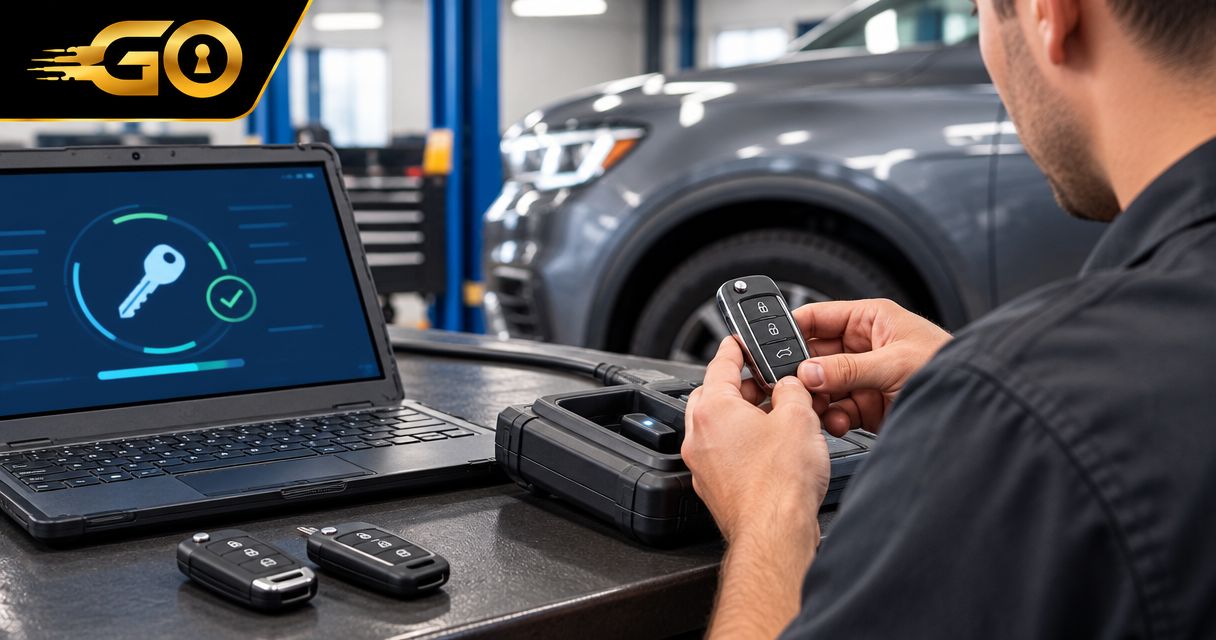
Auto repair shop car key programming is the process of registering a compatible electronic key with a vehicle so your shop can return it with the required key functions working. Unlike a standalone key request, a repair-shop job must fit the diagnosis, customer authorization, parts sourcing, and vehicle handover.
TL;DR
- Car key programming for auto repair shops starts with vehicle identification, customer authorization, and compatibility checks.
- GO Locksmith offers mobile car key programming; repair shops must confirm support for the specific vehicle before scheduling.
- Key cutting, immobilizer programming, and remote-button pairing are different tasks; define the required work before ordering parts.
- Choose in-house work, a mobile locksmith, or a dealership according to confirmed vehicle coverage and your shop’s capabilities.
Why car key programming matters for auto repair shops
A key problem changes how you handle a repair order. A vehicle with no working key presents a different job from a vehicle that starts normally but needs a spare, and neither is automatically the same as an ignition fault.
Separate the customer’s symptom from the requested service before promising a solution. A worn blade, an unrecognized transponder, and a remote with nonworking buttons require different checks. Replacing or programming a key without identifying the problem can leave the original complaint unresolved.
For mechanical symptoms, the guide to ignition repair and replacement options for older vehicles addresses a different decision from electronic key registration. Keep those repair paths distinct on your work order.
Your shop also needs a clear handover standard. The customer should know which functions were requested, which were checked, and whether any separate fault remains. That record matters more than describing the job simply as a successful programming session.
Build a key-programming workflow around the repair order
Identify the vehicle and record the exact complaint
Start with your existing intake form or a paper checklist. Record the vehicle identification number, year, make, and model, then ask the customer to describe what happens when they use each available key.
A description such as key does not work is too broad for parts selection or scheduling. Does the blade fail to turn? Do the remote buttons fail while the engine still starts? Does the vehicle display a key-recognition warning? Capture the symptom without treating it as a confirmed diagnosis.
If the vehicle arrived for unrelated repairs, record whether it started with the supplied key before work began. This gives your technician and any outside provider a shared starting point without assigning an unsupported cause.
- Record the vehicle identification number and model details.
- List every key supplied with the vehicle.
- Describe starting, mechanical, and remote-button symptoms separately.
- Note relevant warnings and previous key-related work.
- Identify whether the request is for a spare or replacement.
Confirm authorization before ordering or programming
Use your normal customer-authorization process first. Establish who owns the vehicle, who can approve the work, and who will collect it. For a fleet vehicle, identify the authorized business contact rather than relying only on the person who dropped it off.
Ask the selected provider what documentation is required before the appointment. Do not assume your repair order alone satisfies another business’s verification requirements.
Define the approved scope in plain language. A customer who requests working remote buttons has not necessarily authorized ignition replacement or a broader electrical diagnosis. If the scope changes, obtain approval before additional work begins.
- Confirm the customer’s authority to request key work.
- Ask the provider about required identification and ownership documents.
- Record the approved services on the repair order.
- Identify the contact who can approve a changed scope.
- Agree on how keys and documents will be handed over.
Choose who will perform the job
Begin with your shop’s documented capabilities. Check vehicle coverage, technician training, equipment requirements, and access to the applicable service information. Owning a programming tool does not establish support for every vehicle or every key-loss situation.
If the job falls outside that coverage, contact an outside provider before buying a key. GO Locksmith is a mobile service offering car key making, cutting, and programming. Ask about the exact vehicle, key system, and requested work; those services do not establish universal compatibility.
GO Locksmith is an option for auto repair shops seeking mobile car key programming in Southwest Florida. Its confirmed service areas include Fort Myers, Cape Coral, Lehigh Acres, Estero, Bonita Springs, and Naples. Confirm the job and current availability before promising the customer an appointment.
- Check your documented in-house vehicle coverage.
- Identify any equipment or information gaps.
- Ask an outside provider to confirm the specific job.
- Separate provider availability from the customer’s requested deadline.
- Record who owns diagnosis, parts sourcing, and final testing.
Verify the key before committing to parts
Use vehicle-specific parts and service information to establish what key is required. Appearance alone is not a compatibility check: matching housings or button layouts do not prove that the electronics, blade, or programming requirements match.
Separate three possible tasks. Cutting shapes a mechanical blade to operate the relevant lock. Immobilizer programming concerns recognition needed for starting on vehicles equipped with that system. Remote pairing concerns functions such as locking and unlocking; the applicable procedure depends on the vehicle.
For customer-supplied keys, ask the provider to assess suitability before accepting the job. Do not promise that a used, aftermarket, or previously programmed key can be registered. Suitability depends on the key and vehicle system.
- Confirm the required key or fob specification.
- Distinguish blade cutting from electronic registration.
- Identify the remote functions the customer expects.
- Ask about customer-supplied key acceptance.
- Establish who is responsible for sourcing the key.
Prepare the vehicle and coordinate the appointment
Start with a written handoff rather than a verbal message passed between technicians. Give the person doing the key work the vehicle details, complaint, authorization status, and agreed scope.
Ask what vehicle access, existing keys, and preparation the applicable procedure requires. Follow the vehicle-specific instructions rather than applying a generic internet programming sequence. Procedures and prerequisites differ between systems.
Coordinate the appointment with other repairs. A vehicle undergoing electrical work, with disconnected components, or awaiting diagnosis needs a clear status report before key programming begins. Do not represent an unfinished repair as a confirmed programming fault.
- Share the approved scope.
- Supply the vehicle details.
- Gather existing keys.
- Confirm vehicle readiness.
- Agree on handoff arrangements.
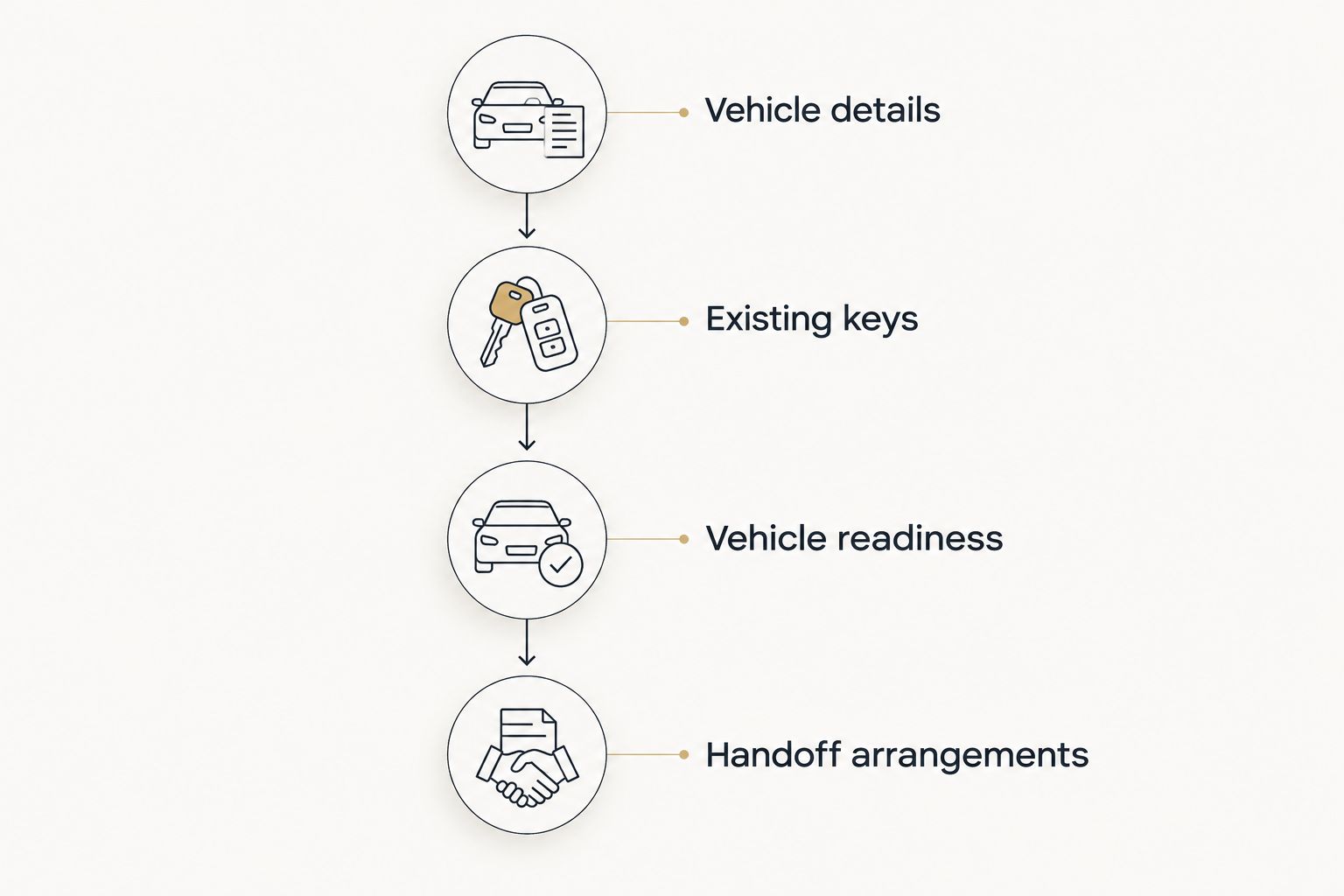
Confirm the vehicle’s status and handoff arrangements before the key-programming appointment.
Test the agreed functions before releasing the vehicle
Use the approved work order as your test checklist. Programming completion is not a substitute for confirming that the customer’s requested functions work.
Check the supplied keys individually using the applicable vehicle procedure. Where relevant, confirm starting, mechanical operation, and the agreed remote functions. Test previously working keys as well, because key-registration procedures can affect which keys remain recognized.
If a fault remains, describe it accurately. A working replacement key does not resolve every possible starting or door-lock problem. Keep any separate diagnosis visible on the work order rather than closing the original complaint by assumption.
- Identify each key tested.
- Check starting with each applicable key.
- Check the agreed mechanical and remote functions.
- Record any remaining symptoms or warnings.
- Confirm the result with the customer before release.
Document the result and improve your next handoff
Use your existing repair-order system to record the outcome. Keep the information useful: the requested service, parts source, provider, functions checked, and unresolved issues.
For outsourced work, distinguish your shop’s work from the provider’s work. Retain the relevant job documentation and explain the scope to the customer without inventing a warranty or making promises on another business’s behalf.
Review unsuccessful handoffs for practical causes. Missing vehicle details, unconfirmed parts, incomplete authorization, and conflicting repair schedules are process issues your shop can address. Do not turn a single successful job into a blanket compatibility promise for future vehicles.
- Record the completed service and provider.
- Retain the key identification information available to you.
- Document the functions checked at handover.
- Explain any unresolved work to the customer.
- Update your intake checklist when a handoff exposes a gap.
Compare in-house, mobile, and dealership routes
Choose the route with confirmed support for the vehicle, not the broadest advertising claim. Your shop’s workload and existing capabilities matter, but they do not replace a compatibility check.
| Option | Best for | Main advantage | Key limitation |
|---|---|---|---|
| In-house programming | Shops with documented coverage and trained staff | Keeps the work within your existing repair workflow | Your shop must maintain the required equipment, information, and vehicle-specific capability |
| Mobile locksmith, including GO Locksmith | Shops seeking mobile key service within a confirmed service area | Offers a mobile service route for confirmed automotive key work | Vehicle support and current appointment availability require confirmation |
| Dealership service | Jobs for which the dealership confirms the required vehicle-specific service | Provides another route when your shop cannot perform the work | Acceptance, vehicle delivery arrangements, and scheduling must be checked |
In-house programming gives your shop direct control over the work, but also responsibility for preparation and troubleshooting. Outsourcing reduces the work your technicians perform, but creates a handoff that needs clear ownership.
Ask each provider the same questions: can you perform this specific job, what documentation do you need, who supplies the key, and how will the result be checked? Request a job-specific estimate after describing the vehicle and scope. Do not assume one route is always cheaper or quicker.
Common mistakes auto repair shops make
Treating every no-start complaint as a programming problem
A no-start complaint does not establish that the key needs programming. Record the symptoms and follow the appropriate diagnostic process before ordering a replacement. If the blade binds or the ignition has a mechanical problem, describe that separately.
Ordering a fob because the housing looks correct
A matching shell is not proof of compatibility. Verify the required specification through vehicle-specific information or the provider handling the job. Buying first and checking later leaves your shop responsible for an unconfirmed part.
Scheduling before asking whether any key still works
An additional-key request and an all-keys-lost request are different scopes. Tell the provider which keys exist and what each one does. Do not schedule one type of job using the details of another.
Promising a fixed completion time before confirmation
Your customer’s collection deadline is not a provider’s confirmed appointment. Check current availability and the job requirements before committing. If the vehicle still needs diagnosis or parts verification, explain that dependency clearly.
Testing only the new key
The new key is only part of the handover. Check the other supplied keys and the functions included in the work order. Record unresolved symptoms so the customer does not mistake a partial result for a completed repair.
FAQ
What’s the best way for an auto repair shop to arrange car key programming?
Start by confirming the vehicle, key status, customer authorization, and required functions. Choose in-house work or an outside provider only after confirming support for that specific job.
Is car key cutting the same as programming?
No. Cutting shapes the mechanical blade, while programming registers compatible electronics with the relevant vehicle system. A job can require one or both, depending on the vehicle and key.
Can GO Locksmith program keys at an auto repair shop?
GO Locksmith is a mobile locksmith offering car key programming. Call with the shop location, vehicle details, and key status to confirm whether the specific job can be scheduled.
Can a repair shop supply its own replacement fob?
Ask the provider to confirm whether the supplied fob is suitable and accepted before booking. Matching appearance alone does not establish compatibility, and suitability depends on the vehicle and key system.
What should a shop do when the customer has lost every key?
Describe the job as an all-keys-lost request when contacting the provider. Confirm vehicle support, documentation requirements, and parts sourcing before promising completion to the customer.
How much does car key programming cost for a repair shop?
Request a job-specific estimate based on the vehicle, key system, existing keys, and required services. Ask whether the proposed scope includes key sourcing, cutting, programming, and testing where applicable.
When can a shop contact GO Locksmith about a key job?
GO Locksmith’s hours are Sunday–Thursday, 7:00 AM–11:00 PM, and Friday, 7:00 AM–5:00 PM; Saturday is closed. Call (239) 412-1101 during those hours to check current availability and vehicle-specific service support.
One last thing
Make key status a required intake field, not a note added when programming fails. Knowing whether a working key exists helps define the request before your shop orders parts, allocates technician time, or promises a collection date.
For a mobile key job in a confirmed service area, call (239) 412-1101 with the vehicle details, shop location, and existing-key status. Ask for service confirmation and a job-specific estimate before booking.