Blog ·
Best lock brands for marina and boat storage 2026
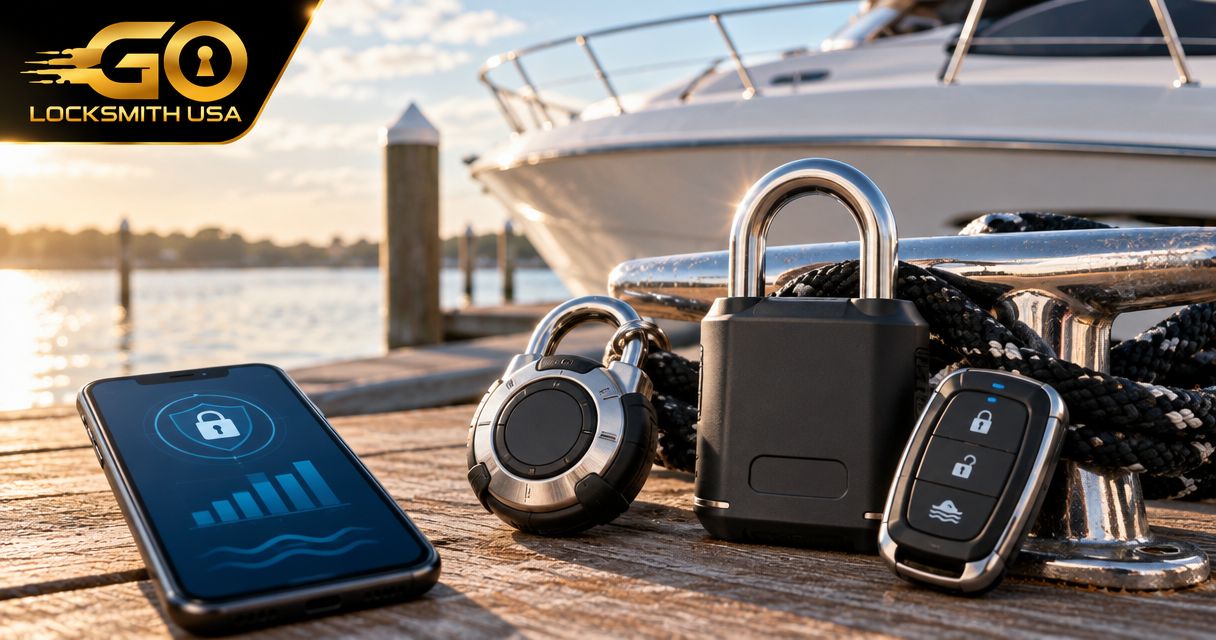
For marina and boat storage, start with ABUS marine padlocks for exposed outdoor hardware, Master Lock marine padlocks for boat lockers, Squire Stronghold for security-focused storage gates, Mul-T-Lock for controlled key duplication, and Schlage for commercial personnel doors. These are different buying paths, not interchangeable locks; the right choice depends on salt exposure, hardware fit, and who needs access.
TL;DR
- The best lock brands for marina and boat storage depend on salt exposure, hardware fit, and key control.
- ABUS marine padlocks are a starting point for exposed hardware; check the exact model’s materials.
- Master Lock marine padlocks suit a boat-locker shortlist; Squire Stronghold belongs in a security-focused gate comparison.
- Mul-T-Lock addresses controlled key duplication; Schlage addresses commercial personnel-door hardware.
- GO Locksmith provides confirmed mechanical commercial lock services; call to discuss the specific door or lock.
Why marina lock selection needs a different approach
A marina lock must resist unauthorized entry and keep working in its environment. Salt exposure, wet hardware, a poorly aligned gate, and uncontrolled key copies create different problems. Buying for only one leaves the others unresolved.
Corrosion resistance and forced-entry resistance are separate requirements. A corrosion-resistant padlock does not strengthen a weak hasp, and a security-focused lock is not automatically suitable for salt spray.
For building doors, GO Locksmith offers confirmed commercial lock repair, replacement, rekeying, and fresh installation services. Ask about the specific hardware before assuming a boat compartment, marine hatch, or specialized marine lock falls within those services.
What makes the best marina and boat-storage lock
Use these criteria before choosing a brand:
- Exposure suitability: Look for manufacturer documentation addressing outdoor or marine use. Inspect the specified body, shackle, cylinder, and protective features rather than relying on a weather-resistant label alone.
- Hardware fit: Confirm that the shackle fits the hasp or gate fitting and allows the lock to close correctly. Excess clearance leaves more hardware exposed.
- Attack resistance: Consider the complete assembly: lock, hasp, chain, fasteners, gate, and mounting surface. The strongest component cannot compensate for the weakest.
- Key control: Decide whether ordinary replacement keys are sufficient or whether you need a documented restricted-key system.
- Door function: A storage padlock and a commercial exit-door lock perform different jobs. Preserve required escape functions and use hardware appropriate to the opening.
- Maintenance access: Choose a lock you can inspect and maintain according to its manufacturer’s instructions. A seized cylinder creates an access problem even when the lock remains closed.
Marina lock brands at a glance
The comparison below separates each brand by buying need. Check the current manufacturer documentation for the exact model before ordering; a brand name does not establish corrosion resistance, compatibility, or a security rating.
| Brand or product family | Best for | Standout consideration | Key limitation |
|---|---|---|---|
| ABUS marine padlocks, including 24IB Diskus | Exposed outdoor hasps | Marine-oriented options and a disc-shaped option with limited exposed shackle | Must fit the hasp; marine suitability does not establish an attack rating |
| Master Lock marine padlocks | Boat lockers needing a conventional padlock | Marine-designated options in familiar padlock formats | Materials and protective features vary by model |
| Squire Stronghold | Security-focused storage gates | Padlock options intended for demanding security applications | Security specifications alone do not establish salt-exposure suitability |
| Mul-T-Lock mechanical systems | Storage buildings needing controlled key duplication | Restricted-key options and mechanical locking systems | Key-control arrangements depend on the selected system |
| Schlage commercial mechanical hardware | Marina offices and personnel doors | Commercial door-lock and mechanical hardware options | Door preparation, function, and exposure must match the selected hardware |
1. ABUS: best shortlist for exposed outdoor hasps
ABUS offers marine-oriented padlocks, including the 24IB Diskus. Its disc-shaped format limits exposed shackle compared with a conventional open-shackle layout, but the surrounding hasp still needs to protect the opening properly.
Start here when outdoor exposure is the main selection problem. Check the exact model’s material specifications and dimensions rather than treating every ABUS padlock as a marine product.
ABUS pros:
- Marine-oriented models provide a more relevant starting point than indoor padlocks.
- The Diskus format limits accessible shackle when paired with suitable hardware.
- Manufacturer model documentation lets you compare construction and fit before buying.
ABUS cons:
- A disc-shaped padlock does not fit every locker hasp or gate arrangement.
- A marine designation does not replace evidence of the security performance you require.
Best for: An exposed storage hasp where a marine-oriented padlock fits without forcing the hardware.
Verdict: Buy only after confirming the exact ABUS model’s exposure suitability and hasp fit.
2. Master Lock: best shortlist for conventional boat-locker padlocks
Master Lock offers marine-designated padlocks alongside its broader padlock range. That makes the marine category a useful starting point for a locker whose existing hasp requires a conventional padlock shape.
Match the lock to the fitting first. A longer shackle offers reach, but unnecessary exposed shackle creates additional accessible metal; select the shortest clearance that still allows correct operation.
Master Lock pros:
- Marine-designated options help separate relevant products from general-purpose locks.
- Conventional padlock formats suit many ordinary hasp arrangements.
- Model-specific dimensions let you check clearance before purchasing.
Master Lock cons:
- The brand’s general-purpose padlocks are not automatically appropriate for marine exposure.
- A lock that fits loosely cannot correct an oversized or damaged hasp.
Best for: A boat locker that accepts a conventional padlock and does not require a building-door lock.
Verdict: Buy a documented marine model that fits; skip a general-purpose substitute selected only by appearance.
3. Squire Stronghold: best shortlist for security-focused storage gates
Squire’s Stronghold range includes padlocks intended for demanding security applications. Consider this family when the main task is securing a storage-yard gate or a substantial chain-and-lock assembly.
Treat environmental suitability as a separate check. A security-focused specification is useful, but exposed waterfront hardware also needs documented suitability for its operating conditions.
Squire Stronghold pros:
- The range provides a security-focused starting point for gate-lock selection.
- Model-specific specifications support comparison of shackle protection and construction.
- A suitable padlock can form part of a stronger chain-and-gate assembly.
Squire Stronghold cons:
- A heavy padlock does not strengthen weak chain links, hinges, or anchors.
- Salt-exposure suitability must be confirmed for the selected model.
Best for: A boat-storage gate where forced-entry resistance drives the specification.
Verdict: Hold the purchase until the padlock, chain, mounting hardware, and environmental requirements match.
4. Mul-T-Lock: best shortlist for controlled key duplication
Mul-T-Lock offers mechanical locking systems with restricted-key options. This is a different problem from choosing a padlock for a wet locker: the priority is controlling how replacement keys are obtained and which people retain access.
For a storage building with changing staff or tenants, ask about the selected system’s duplication process, authorization requirements, and rekeying options. Restrictions depend on the actual key system, not simply the name stamped on the key.
Mul-T-Lock pros:
- Restricted-key options address unauthorized duplication more directly than an ordinary key label.
- Mechanical system options support a building-level key-control discussion.
- Documented authorization procedures help clarify responsibility for replacement keys.
Mul-T-Lock cons:
- Replacement-key arrangements require planning and an authorized supply route.
- Restricted duplication does not prevent entry with an authorized key that has been lost or retained.
Best for: A storage building where key issuance and duplication need formal control.
Verdict: Buy only after documenting who authorizes keys and how access changes are handled.
5. Schlage: best shortlist for commercial personnel doors
Schlage offers commercial mechanical door locks and related hardware. Consider these products for an office, workshop, or storage-building personnel door rather than trying to adapt a padlock to that opening.
The door’s function matters as much as the lock brand. Confirm the preparation, latch arrangement, closing behavior, and required exit function before choosing hardware.
Schlage pros:
- Commercial hardware options address personnel-door functions rather than padlock applications.
- Published product documentation identifies door preparation and available functions.
- Mechanical hardware provides a route that does not depend on electronic access control.
Schlage cons:
- Existing door preparation can limit replacement choices.
- An ordinary commercial lock specification does not establish suitability for direct salt spray.
Best for: A marina office or storage-building personnel door requiring commercial mechanical hardware.
Verdict: Buy the correct function and compatible hardware; skip any arrangement that compromises required exit operation.
How these recommendations are ranked
This shortlist ranks brands by distinct use case, not by an unsupported claim that one manufacturer wins every marina application. The order begins with exposed padlocks, moves to gate security and key control, and ends with commercial personnel doors.
The criteria are exposure suitability, fit, attack resistance, key control, door function, and maintenance. Manufacturer product documentation supports selection, but it does not establish how an unspecified model will perform at your property. Compare the exact products, not brand reputations alone.
Check the opening before ordering
A useful buying decision starts at the opening, not the product shelf. Record the condition of the existing hardware and work through these checks in order.
- Identify exposure: Describe whether the lock sits under cover, receives rain, or faces salt spray. Give the supplier the actual conditions.
- Check fit: Record the hasp opening, required shackle clearance, and any obstruction. For a door lock, identify the existing hardware and door preparation.
- Plan keys: List who needs access, who holds spare keys, and what happens when a key is lost or a tenancy ends.
- Confirm operation: Check that the gate or door closes correctly and that the proposed lock preserves the opening’s required function.
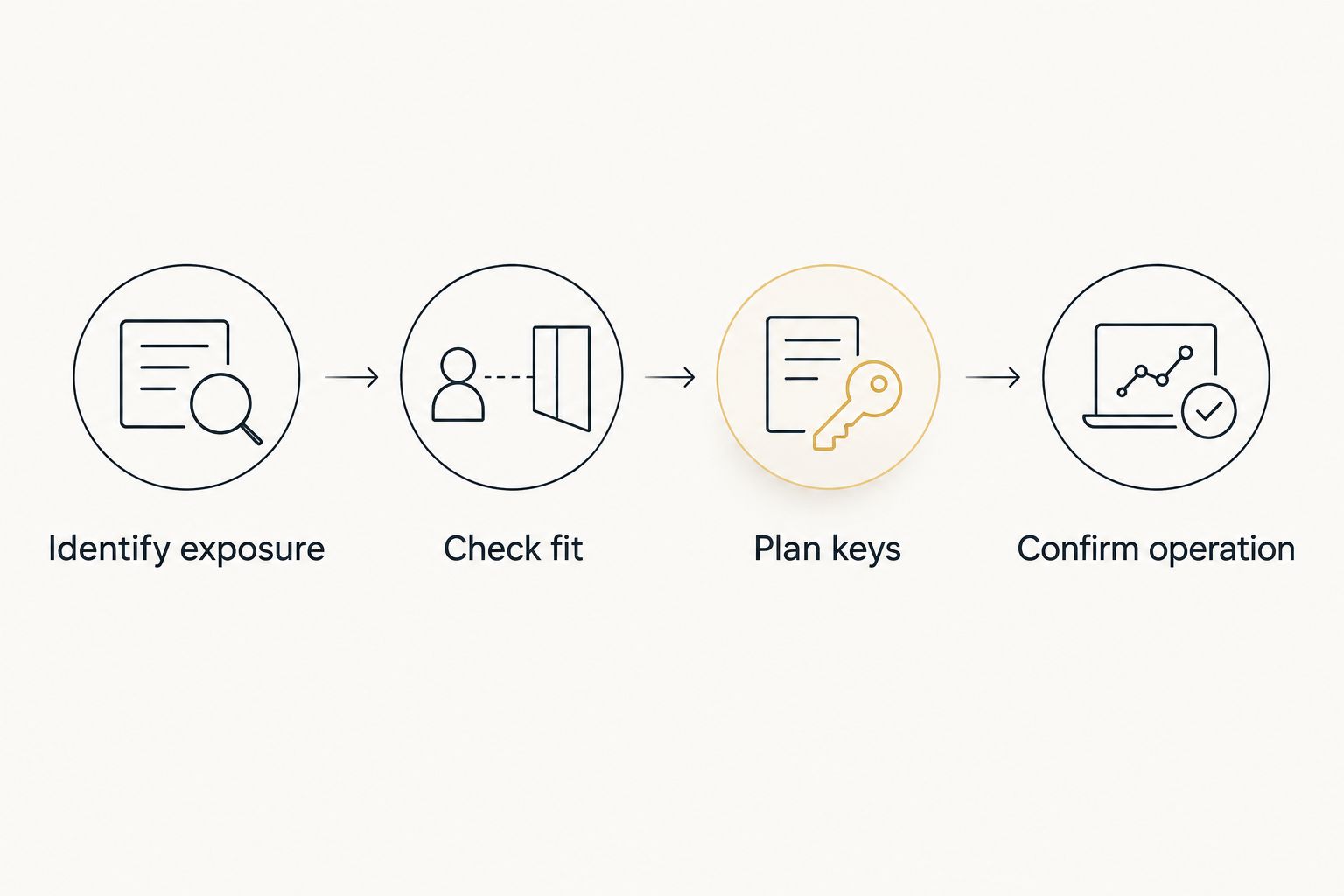
Choose the lock after checking the opening and deciding how access will be managed.
Do not force a stiff key or compensate for a sagging gate by buying a longer-shackle lock. Identify the cause first. Follow the lock manufacturer’s cleaning and lubrication instructions; different mechanisms do not necessarily call for the same maintenance product.
For enclosed boat-storage units, the commercial locks guide for self-storage facilities covers a related buying context. Keep waterfront exposure as an additional requirement rather than assuming a storage-facility recommendation is automatically marine-suitable.
Which lock should you choose?
For an exposed hasp, begin with an appropriately specified ABUS marine padlock. Choose a Master Lock marine model when its conventional format better matches a boat locker. For a storage-yard gate, compare Squire Stronghold options against both the assembly’s security needs and its environmental conditions.
Choose Mul-T-Lock when controlled key duplication is the main requirement. Choose Schlage commercial mechanical hardware when the opening is a personnel door. Neither choice removes the need to confirm exposure and compatibility.
GO Locksmith is a mobile service option for customers who need confirmed commercial mechanical lock work rather than another lock-brand comparison. Service areas include Fort Myers, Cape Coral, Lehigh Acres, Estero, Bonita Springs, and Naples. Call to discuss the specific job; specialized marine-lock work and brand compatibility require confirmation.
FAQ
What are the best lock brands for marina and boat storage?
ABUS, Master Lock, Squire, Mul-T-Lock, and Schlage belong on different use-case shortlists. Compare marine padlocks for exposed hasps, security-focused padlocks for gates, restricted-key systems for key control, and commercial hardware for personnel doors.
Is a stainless-steel padlock enough for saltwater exposure?
Stainless steel alone does not establish that a complete padlock is suitable for saltwater exposure. Check the manufacturer’s specifications for the whole lock, including its cylinder and internal components, and follow the stated maintenance instructions.
Is ABUS better than Master Lock for a boat locker?
The exact model and locker fitting matter more than the brand name. Compare documented marine suitability, shackle clearance, and protection of the surrounding hasp before choosing either brand.
Should I use the same lock on a boat locker and a storage gate?
Choose each lock for its own opening rather than assuming the same model fits both. A locker hasp and a gate-and-chain assembly can require different clearances, protection, and security specifications.
Can a restricted key stop former tenants from entering?
A restricted key system does not disable an existing key that a former tenant still holds. Discuss rekeying or another appropriate access change when you cannot account for all issued keys.
How much does a marina lock replacement cost?
The estimate depends on the specific lock, hardware condition, compatibility, and work required. Call GO Locksmith at (239) 412-1101 to discuss confirmed mechanical services and request a job-specific estimate.
Does GO Locksmith install electronic access-control systems?
GO Locksmith does not install or repair electronic access-control systems. Its confirmed commercial services include mechanical lock repair, replacement, rekeying, fresh installation, push bars, and door closers.
When can I call GO Locksmith about a commercial lock?
GO Locksmith’s hours are Sunday–Thursday, 7:00 AM–11:00 PM, and Friday, 7:00 AM–5:00 PM; Saturday is closed. Call (239) 412-1101 during those hours to check current availability and discuss the job.
One last thing
A lock purchase does not resolve an unaccounted-for key. Before replacing working hardware, check whether the problem is corrosion, poor alignment, physical damage, or lost control of issued keys. Each points to a different next step.
For a commercial building door in a confirmed service area, call GO Locksmith at (239) 412-1101 to discuss the lock and request an estimate. Describe the opening, symptoms, and exposure so the conversation starts with the actual job.