Blog ·
Best commercial locks for self-storage facilities 2026
For self-storage unit doors with a compatible exposed hasp, a disc padlock is the default choice; for a recessed lock receiver, choose the cylinder lock specified for that receiver. This guide compares the best commercial locks for self storage facilities by door fit, exposed hardware, key control, and the separate requirements of offices and exit doors.
TL;DR
- The best commercial locks for self storage facilities depend on the door, not one universal lock model.
- Disc padlocks suit compatible exposed hasps; cylinder locks require matching recessed receivers.
- Mortise locks serve compatible office doors, while exit-device trim belongs on designated exit doors.
- GO Locksmith provides mechanical commercial lock services; electronic access-control installation and repair are not offered.
Why the door matters more than the lock label
A self-storage property has several different locking jobs. A tenant’s roll-up unit door, a management office, a maintenance room, and a corridor exit should not automatically receive the same hardware. Start with the opening and its purpose.
GO Locksmith is a mobile service providing confirmed commercial lock repair, replacement, rekeying, fresh installation, business lockout assistance, push bar, and door closer services. Ask about your specific hardware before arranging work; a general service listing does not establish compatibility with every storage-door lock.
GO Locksmith provides mechanical commercial lock services for self-storage operators in its confirmed Florida service areas. Electronic access-control installation and repair are outside its confirmed services.
What makes the best commercial lock for self-storage?
Use these criteria before comparing lock shapes or choosing a replacement:
- Door compatibility: The lock must fit the existing hasp, receiver, door preparation, or exit device. Similar-looking hardware is not proof of compatibility.
- Shackle exposure: For padlocked unit doors, consider how much shackle remains accessible when the lock is secured.
- Hardware condition: Inspect the hasp, fasteners, receiver, frame, and door alignment. A replacement lock does not repair damaged supporting hardware.
- Outdoor suitability: Check the specific manufacturer’s stated environmental suitability and maintenance instructions for exposed locations.
- Key control: Decide who holds each key and how you will handle lost keys, staff changes, and tenant turnover.
- Exit function: Keep required exit operation separate from tenant-unit security. Replacement hardware must preserve the approved door function.
These criteria favor a matched door-and-lock combination over a blanket recommendation. A protected lock that cannot seat correctly is the wrong purchase.
Commercial lock types at a glance
| Lock type | Best for | Standout feature | Key limitation |
|---|---|---|---|
| Disc padlock | Unit doors with compatible exposed hasps | Circular body limits exposed shackle | Body and shackle must clear the hasp |
| Recessed cylinder lock | Unit doors with matching lock receivers | Lock sits within purpose-built receiving hardware | Cylinder formats are not universally interchangeable |
| Shrouded-shackle padlock | Compatible hasps needing additional shackle coverage | Protective shoulders surround part of the shackle | Larger body can interfere with the latch |
| Commercial mortise lock | Offices with compatible mortise-prepared doors | Lock case fits within a door-edge pocket | Requires matching door preparation and function |
| Mechanical exit-device trim | Staff entrances on compatible exit doors | Coordinates exterior entry with an exit device | Must match the device and required exit operation |
The first three options address padlocked or receiver-equipped storage units. The final two address building doors, not interchangeable upgrades for roll-up units.
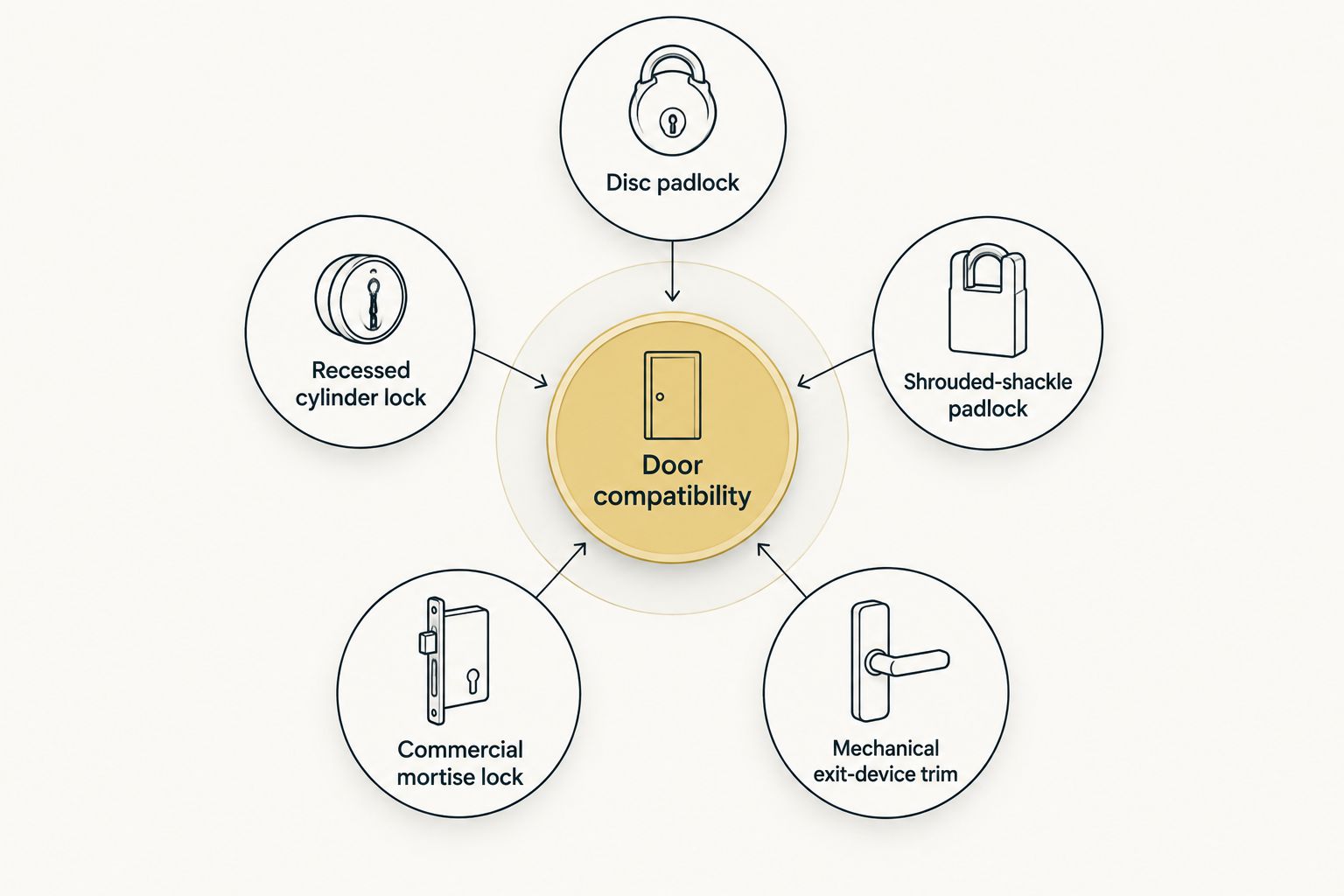
Choose the lock category from the opening before comparing individual models.
1. Disc padlock: best for compatible exposed unit-door hasps
A disc padlock uses a circular body that encloses much of its shackle. It is a practical starting point when a storage-unit latch accepts this shape without interference. The remaining exposed shackle depends on the lock and hasp combination.
Check the complete fit, not just whether the shackle passes through the hole. You need room to position the body, operate the key, and remove the lock without forcing the latch.
Disc padlock pros:
- Limits exposed shackle compared with an otherwise comparable open-shackle layout.
- Works as a removable lock on compatible existing hasps.
- Separates the tenant’s locking hardware from the door’s permanent latch hardware.
Disc padlock cons:
- A circular body can foul a narrow or recessed latch.
- Shackle protection does not address a damaged hasp or insecure mounting.
Best for: Tenant-unit doors whose manufacturer-approved latch arrangement accepts a disc padlock.
Verdict: Buy only after confirming body clearance and shackle fit; skip it for an incompatible receiver.
2. Recessed cylinder lock: best for matching storage-door receivers
A storage-door cylinder lock fits a receiver designed for that lock format. This arrangement differs from a conventional padlock hung through a hasp. The door hardware determines which cylinder can be used.
Do not substitute an office-door cylinder because the name sounds similar. Compare the receiver identification, cylinder format, and operating arrangement before ordering replacements.
Recessed cylinder lock pros:
- Uses the door’s purpose-built receiving hardware.
- Avoids a hanging padlock body where the system is designed for a recessed cylinder.
- Provides a defined replacement format when the receiver documentation identifies it.
Recessed cylinder lock cons:
- Cannot replace a padlock without the necessary receiving hardware.
- Similar appearance does not establish interchangeable dimensions or operation.
Best for: Storage units already equipped with a documented, compatible cylinder-lock receiver.
Verdict: Buy the specified compatible cylinder; hold the purchase if the receiver cannot be identified.
3. Shrouded-shackle padlock: best for compatible protective hasps
A shrouded-shackle padlock has raised protective shoulders that cover part of the shackle. It is an alternative when an existing hasp accepts that body shape and the shroud can sit close to the locking point.
The coverage only helps where the hardware fits together correctly. A large gap or awkward latch position leaves exposed areas that the lock’s appearance alone does not reveal.
Shrouded-shackle padlock pros:
- Covers part of the shackle with protective body shoulders.
- Offers another fit option where a circular disc body conflicts with surrounding hardware.
- Remains removable on a compatible hasp without changing the door’s locking category.
Shrouded-shackle padlock cons:
- Protective shoulders can prevent engagement with recessed or narrow hasps.
- Additional body size does not establish a verified security rating.
Best for: Unit or maintenance-door hasps with sufficient clearance for the protective shoulders.
Verdict: Buy for a confirmed close-fitting arrangement; skip it if the shroud obstructs the latch.
4. Commercial mortise lock: best for compatible management-office doors
A mortise lock places its lock case inside a pocket in the door edge. It belongs on a compatible swinging door, such as an office opening already prepared for that hardware. It is not a substitute for a storage-unit padlock.
Select the required operating function as carefully as the physical fit. Staff entry, interior operation, existing trim, and any applicable fire-door requirements all affect the replacement choice.
Commercial mortise lock pros:
- Combines locking and latching functions within a fitted lock case.
- Suits existing doors prepared for the matching mortise hardware.
- Offers defined operating functions for different building-door uses.
Commercial mortise lock cons:
- Requires compatible door preparation, dimensions, and trim.
- The wrong operating function can create an access or exit problem.
Best for: Management offices and other swinging doors already designed for compatible mortise hardware.
Verdict: Buy a matched replacement with the correct function; skip conversion based solely on appearance.
5. Mechanical exit-device trim: best for compatible staff entrances
Mechanical exit-device trim controls exterior entry on a door fitted with a compatible exit device. The interior push bar serves a different purpose: allowing exit. Treat the trim, device, door, and required operation as a coordinated assembly.
This is not a recommendation to add a separate padlock or deadbolt to an exit. Have the applicable exit and fire-door requirements checked before changing the hardware.
Mechanical exit-device trim pros:
- Provides exterior entry control through compatible keyed trim.
- Coordinates with the existing exit-device arrangement.
- Keeps the hardware selection focused on both entry and exit functions.
Mechanical exit-device trim cons:
- Must match the exit device and its specified operating function.
- Incorrect alterations can interfere with required exit operation.
Best for: Staff entrances that are also exit doors with compatible, approved exit-device hardware.
Verdict: Buy a verified compatible assembly; skip any added lock that compromises required exit operation.
Before ordering, inspect the door around the lock
A lock comparison cannot diagnose a bent latch, loose hasp, damaged receiver, or misaligned door. Inspect those parts before you standardize replacements across a facility. Otherwise, you risk buying locks that fit one opening but bind on another.
Separate the inspection into these checks:
- Latch condition: Look for deformation, looseness, or signs that the hardware no longer engages correctly.
- Mounting condition: Check whether the supporting hardware is secure and whether surrounding material is damaged.
- Door movement: Record binding, scraping, or alignment problems rather than treating every symptom as a lock failure.
- Lock operation: Note whether the key turns normally and whether the lock opens and closes without force.
Do not force a sticking key or assume a larger lock will correct a door problem. Describe the symptoms when requesting service, and ask whether the work concerns the lock, the door hardware, or both.
Storage-unit roll-up doors also differ from vehicle-access openings. When evaluating commercial garage door options, distinguish the door assembly from its locking hardware; replacing one component does not establish compatibility with the other. This distinction also matters when a facility has separate maintenance bays or vehicle-access doors.
Match key control to the lock choice
Before choosing locks, decide who should hold the keys. Tenant-unit access and staff access are separate responsibilities. Do not assume a lock choice authorizes entry to a rented unit or replaces the facility’s access procedures.
For employee-controlled doors, record which keys are issued and identify what happens when a key is lost or a staff member leaves. For tenant units, make your lock requirements clear before a customer brings an incompatible lock.
The key management guide for self-storage facilities addresses the operational side of the decision. Keep this buying decision focused on fit and function: a suitable lock still needs clear responsibility for its keys.
Rekeying changes which key operates a compatible lock; replacement changes the hardware. Neither choice repairs an unrelated door-alignment problem. Ask which option addresses the actual condition rather than requesting replacement automatically.
How the lock types are ranked
This ranking starts with tenant-unit doors, then separates office and exit-door requirements. It compares hardware categories by compatibility, exposed locking parts, key handling, and operating function—not by unverified brand claims or destructive testing.
No category wins every opening. Disc padlocks are the starting point for compatible exposed hasps; specified cylinders take priority where recessed receivers are already installed.
Which commercial lock should you choose?
Choose a disc padlock for a compatible exposed unit-door hasp, and choose the specified cylinder for a recessed receiver. Consider a shrouded-shackle padlock only where its shoulders fit properly. Keep office locks and exit-device trim on their respective building doors.
For commercial lock repair, replacement, or rekeying, call GO Locksmith at (239) 412-1101 with the door type, hardware details, symptoms, and location. Confirmed Southwest Florida service areas include Fort Myers, Cape Coral, Lehigh Acres, Estero, Bonita Springs, and Naples; the business also operates in Jacksonville.
Hours are Sunday–Thursday, 7:00 AM–11:00 PM, and Friday, 7:00 AM–5:00 PM; Saturday is closed. Call to check current availability and request a job-specific estimate. No arrival time is guaranteed here.
FAQ
What's the best lock for a self-storage unit door?
A disc padlock is a practical default for a compatible exposed hasp; a recessed receiver needs its specified cylinder lock. Confirm the facility's lock requirements and the actual door hardware before purchasing.
Is a cylinder lock better than a disc padlock for storage?
The correct choice depends on the receiving hardware, not the category name alone. A cylinder lock fits a compatible receiver, while a disc padlock fits a compatible hasp.
Can I use the same lock on every door at my storage facility?
Only use the same lock where every opening has compatible hardware and the same operating requirements. Tenant-unit doors, offices, and exit doors need separate evaluations.
Does a shrouded padlock make the whole door secure?
A shrouded padlock covers part of its shackle, but it does not correct weak or damaged supporting hardware. Inspect the hasp, mounting, receiver, and door condition as well.
Should I rekey or replace an office lock after losing a key?
Rekeying is an option when the existing lock supports it and remains serviceable. Replacement addresses hardware that is damaged, unsuitable, or incompatible with the required function.
Can GO Locksmith install electronic access control at a storage facility?
GO Locksmith does not install or repair electronic access-control systems. Its confirmed commercial services focus on mechanical locks, lockouts, push bars, and door closers.
How much does commercial lock replacement cost?
The estimate depends on the specific lock, hardware condition, and work required. Call (239) 412-1101 with the job details for a job-specific estimate and to check availability during business hours.
One last thing
Confirm removal clearance, not just locking clearance. A padlock that passes through a hasp still needs enough space for key operation and removal. Check that fit before approving a facility-wide purchase.